What if the standard three to five year wait for United States citizenship wasn’t your only option? For many residents seeking expedited naturalization California offers specific legal avenues that bypass the typical processing queues. Whether you’re a service member or the spouse of a citizen stationed abroad, the path to your American dream might be significantly shorter than the standard timeline suggests.
We understand the deep frustration of watching months turn into years while navigating the confusion of USCIS forms. It’s natural to worry that a minor error on your N-400 could stall your progress for another season. This guide provides the professional clarity you need to move forward with confidence. We’ll outline the specific criteria for Section 319(b) and military exceptions that allow you to accelerate your journey legally and efficiently.
You’ll also find insights into 2026 processing trends at the San Jose field office on Coleman Avenue. We’ve designed this roadmap to help you file correctly and avoid the common pitfalls that lead to unnecessary delays. Let’s explore the specialized pathways and exceptions available to you in the current immigration landscape.
Key Takeaways
- Understand the specific legal waivers that allow for expedited naturalization California residents can use to bypass standard three or five year residency requirements.
- Learn the criteria for Section 319(b), which enables spouses of citizens working abroad for American companies to naturalize without meeting traditional physical presence rules.
- Explore how military service members and their families can leverage honorable service to qualify for immediate citizenship or reduced residency windows.
- Identify how Form N-470 protects the continuous residence status of religious and government workers who must live outside the country for their missions.
- Navigate the 2026 processing trends and jurisdictional nuances for the San Jose and San Francisco USCIS offices to ensure your N-400 is filed correctly.
Understanding Expedited Naturalization: Can You Skip the 5-Year Wait?
Many applicants assume that the path to citizenship requires a fixed five-year period of permanent residency. However, the legal framework for expedited naturalization California residents often utilize allows for significant exceptions. Under the broader scope of United States nationality law, these exceptions aren’t just bureaucratic shortcuts; they’re specific statutory waivers designed for individuals serving the national interest or facing unique family circumstances.
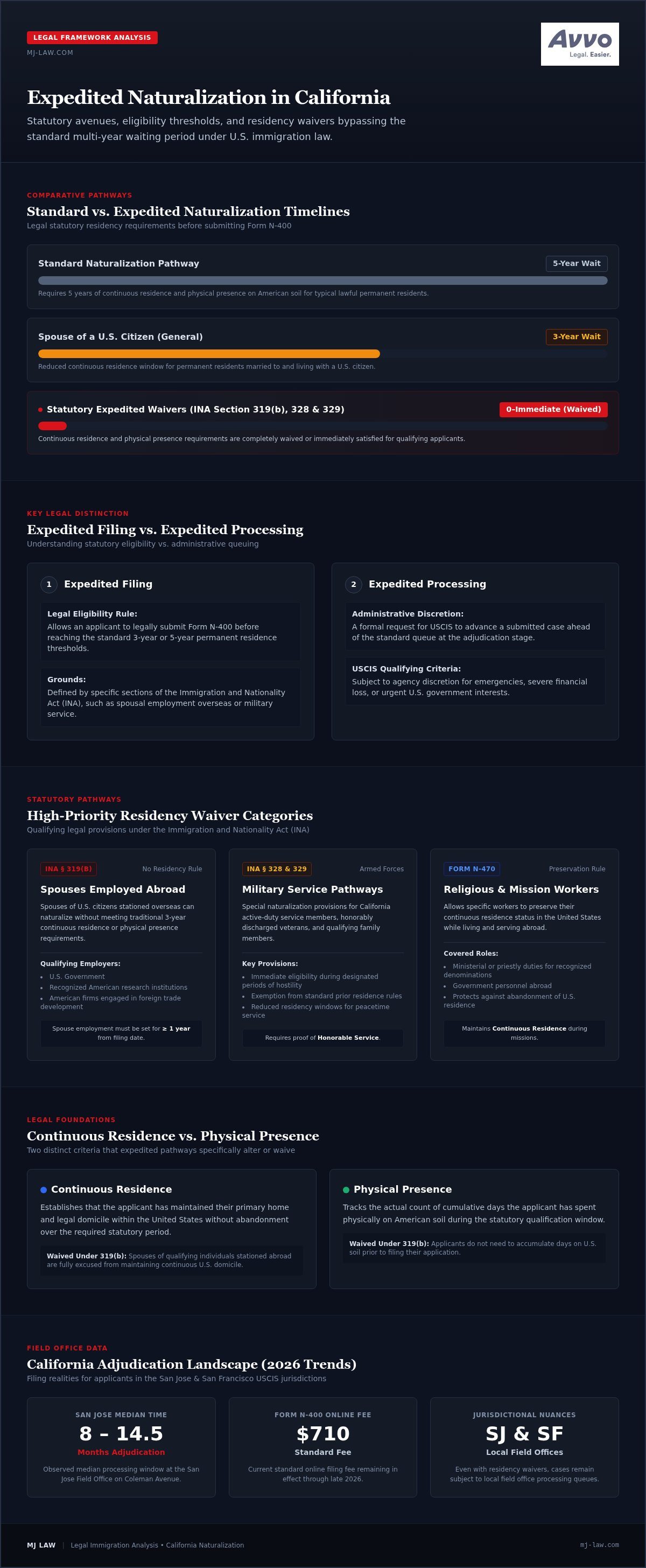
The standard naturalization timeline requires five years of continuous residence. For those married to U.S. citizens, this requirement is typically reduced to three years. True expedited naturalization goes further, potentially waiving residency requirements entirely through specific sections of the Immigration and Nationality Act (INA), such as Section 319(b) for spouses of citizens employed abroad or Sections 328 and 329 for military members. It’s important to understand that “expedited” in this context refers to your legal eligibility period, not the speed of mail delivery or a guaranteed faster interview date.
Expedited Filing vs. Expedited Processing
It’s vital to distinguish between qualifying for an early filing and requesting faster administrative handling. Expedited filing refers to your legal eligibility to submit the N-400 before the standard three or five year marks. In contrast, expedited processing is a discretionary request for USCIS to move your case to the front of the line due to emergencies, severe financial loss, or urgent government interests.
In 2026, processing trends at the San Jose field office show median adjudication times between 8 and 14.5 months. Even if you qualify for expedited naturalization California pathways, you’re still subject to these local office timelines. A strategic filing approach ensures you don’t lose time to avoidable administrative delays or fee-related rejections, especially as the current $710 online filing fee remains the standard through late 2026.
Who Qualifies for a Waiver of Residency?
Eligibility for residency waivers generally falls into three high-priority categories:
- Military Service: Active duty members or veterans who served during designated periods of hostility qualify immediately without meeting prior residence rules.
- Overseas Employment: Spouses of U.S. citizens working for the government, American research institutions, or U.S. firms abroad may bypass the three-year wait.
- Religious Workers: Individuals performing ministerial or priestly duties for recognized denominations can preserve their residence status while serving overseas.
Section 319(b) serves as the primary tool for spouses of U.S. citizens working abroad, allowing them to naturalize without meeting standard continuous residence or physical presence requirements. If you’re unsure which category fits your situation, you can schedule a consultation to review your specific eligibility. Maintaining “Continuous Residence” means you haven’t abandoned your U.S. home, while “Physical Presence” tracks the actual days you’ve spent on American soil.
Section 319(b): Expedited Citizenship for Spouses of U.S. Citizens Employed Abroad
Section 319(b) of the Immigration and Nationality Act is often called the “no residency” rule. It’s a specialized path for Lawful Permanent Residents married to U.S. citizens who are stationed abroad. Unlike standard applications, this pathway allows you to naturalize without meeting the usual three-year physical presence or continuous residence requirements. This is a critical component of expedited naturalization California families use when professional opportunities take them across the globe.
To qualify, the U.S. citizen spouse must be employed by a specific type of entity. According to USCIS guidance on spouses of citizens employed abroad, these include the U.S. government, recognized American research institutions, or American firms engaged in the development of foreign trade. The citizen spouse’s employment must be expected to last for at least one year from the date of the naturalization filing. Additionally, the applicant must declare a genuine intent to reside in the United States immediately after their spouse’s overseas assignment ends.
Silicon Valley Context: Working for U.S. Tech Firms Overseas
In the Bay Area, we frequently see this pathway applied to employees of global tech leaders headquartered in San Francisco or San Jose. If a U.S. citizen spouse is transferred to a regional office in London, Tokyo, or Zurich, their partner may be eligible for citizenship before they even depart. You’ll need an official employment letter from the U.S. company verifying the overseas assignment and its duration. If you are a high-level professional yourself, you might also be exploring options like an EB-1A Extraordinary Ability Lawyer to secure your own long-term status.
The Application Journey for 319(b) Candidates
The process begins by filing Form N-400 with specific annotations indicating you’re applying under Section 319(b). Because you aren’t bound by the standard three-month state residency rule, you can often choose a convenient field office for your interview, such as San Jose or San Francisco. Navigating expedited naturalization California rules requires precise timing to ensure your interview and oath ceremony occur before you leave the country. Your evidence package must be robust, including:
- Proof of the spouse’s U.S. citizenship and a valid marriage certificate.
- Detailed employment contracts or “assignment letters” from the qualifying U.S. employer.
- Travel orders or documentation showing the expected length of the overseas stay.
Preparation is key to avoiding delays. If you’re navigating these requirements while preparing for an international move, you can schedule a time to discuss your case with our team to ensure every detail is addressed.
Naturalization for Military Members and Families in California
Serving in the U.S. Armed Forces provides a distinct and honored pathway toward citizenship. For those seeking expedited naturalization California offers numerous military installations where service members can begin this process. Under Section 329 of the Immigration and Nationality Act, individuals who serve honorably during designated periods of hostility qualify for citizenship without any prior period of residence or physical presence. As of September 2026, the period of hostilities that began on September 11, 2001, remains active. This means current active-duty members can often apply for naturalization immediately upon enlistment.
For those serving during peacetime, Section 328 allows for a residency waiver after just one year of honorable service. This is a significant reduction from the standard five-year requirement for most green card holders. These benefits extend beyond the service member; surviving spouses and children may also be eligible for posthumous citizenship or preserved immigration benefits if a service member passes away due to injury or disease incurred in the line of duty. Navigating these specific naturalization through military service protocols requires careful coordination with both military and civilian authorities.
California-Specific Military Resources
California is home to several key installations, including Travis Air Force Base in Fairfield and Moffett Federal Airfield in Mountain View. Service members at these locations often have access to a Judge Advocate General (JAG) office. While JAG officers provide excellent general guidance, they don’t always handle complex individual naturalization cases that involve prior immigration history or family complications. Many members of the California National Guard also qualify for these expedited paths, provided they meet the active-duty service requirements during the current period of hostilities.
Expedited Steps for Military Spouses
Spouses of service members don’t have to wait for their partners to return from deployment to start their own journey. If a service member is stationed abroad, their spouse may qualify for expedited processing under Section 319(b) or 319(g). USCIS often provides accommodations for military families, such as mobile fingerprinting units or prioritized interview scheduling at the San Jose or San Francisco field offices. It’s a vital benefit to note that military naturalization is often fee-exempt as of 2026, with a $0 filing fee for Form N-400 under Sections 328 or 329. Navigating expedited naturalization California rules for military families requires precision, especially when coordinating with deployment schedules. If you need help aligning your application with a pending deployment, you can request a consultation to ensure your paperwork is processed without delay.
Continuous Residence Exceptions for Religious and Government Workers
Maintaining continuous residence is usually the biggest hurdle for Lawful Permanent Residents who work internationally. For those in specific roles, Form N-470 (Application to Preserve Residence for Naturalization Purposes) serves as a vital legal safeguard. This form allows your time spent outside the United States to count toward your naturalization requirements rather than resetting your residency clock. It’s a specialized component of expedited naturalization California residents use when their careers in public service or faith-based missions take them abroad.
Most government employees and researchers must demonstrate at least one full year of uninterrupted physical presence in the U.S. as a permanent resident before they can file Form N-470. This means you can’t have any trips outside the country, even for a single day, during that 365-day period. Religious workers benefit from a significant exception; they can file either before or after their departure and are generally exempt from the one-year prior physical presence rule. Navigating these nuances is essential for anyone seeking expedited naturalization California pathways while serving in the national or global interest.
Religious Workers in the Bay Area
The San Jose region is home to diverse religious organizations that frequently send ministers, priests, and missionaries on international assignments. If you’re part of a qualifying denomination, you must provide evidence of your religious status and the nature of your work abroad. A common mistake is returning to California only to find that your overseas service wasn’t documented in a way that USCIS accepts. Ensuring your mission is clearly defined as serving the interests of a recognized U.S. religious denomination is essential for a successful N-400 later on.
Preserving Your Green Card Status While Working Abroad
It’s easy to confuse a Re-entry Permit with Form N-470. While a Re-entry Permit helps you avoid abandoning your status during long absences, it doesn’t protect your “continuous residence” for citizenship. Only a properly filed N-470 keeps your naturalization timeline moving forward. You should also consult the Naturalization Tax Requirements to confirm that your overseas income won’t create a conflict during your interview. If you’re preparing for an international departure, schedule an appointment with our team to ensure your residency is protected before you leave.
Navigating the N-400 Process at San Jose and San Francisco USCIS Offices
Success in your citizenship journey depends heavily on understanding the local landscape of Northern California’s USCIS offices. If you reside in Santa Clara, Santa Cruz, Monterey, or San Benito counties, your case will likely be adjudicated at the San Jose Field Office located at 1450 Coleman Avenue in Santa Clara. Residents of San Francisco, Alameda, Contra Costa, and San Mateo counties are typically assigned to the San Francisco Field Office on Sansome Street. Identifying your correct jurisdiction is vital, as processing times vary significantly between these locations. In 2026, the San Jose office continues to show efficient trends, with most cases completed within 8 to 14.5 months.
Working with a local San Jose attorney provides a distinct advantage during this final phase. An experienced representative doesn’t just review your paperwork; they act as a steady hand during the interview itself. They can clarify complex questions from the officer and ensure that your expedited naturalization California eligibility is properly recognized. This professional presence often reduces the stress of the day, allowing you to focus on the civics and English portions of the exam with confidence.
The Local Interview Experience
When you arrive at the Coleman Avenue office in San Jose, you’ll pass through security screening similar to an airport. It’s best to arrive exactly 15 minutes before your scheduled time. San Jose based officers are known for their thorough review of travel history and residency consistency, especially for those who have spent time abroad. They’ll administer the 2008 version of the civics test, where you must answer six out of ten questions correctly. To ensure you’re fully prepared for the specific nuances of this location, review our guide on how to pass your citizenship interview in San Jose.
Finalizing Your Citizenship: The Oath Ceremony
The final step is the Oath of Allegiance. A positive trend in 2026 is the availability of same-day administrative oath ceremonies at both the San Jose and San Francisco offices. If your interview is in the morning and your case is approved on the spot without a name change request, you might be able to take your oath just hours later. If you require a legal name change, you’ll participate in a judicial ceremony at a later date, which is coordinated through the federal courts. This administrative efficiency significantly shortens the time from your interview to becoming a passport-eligible citizen. Ready to start? Schedule a consultation with MJ Law to evaluate your eligibility and begin your path toward expedited naturalization California benefits today.
Secure Your Path to Citizenship with Confidence
Achieving the expedited naturalization California residents deserve requires a blend of legal precision and local expertise. We’ve explored how specific statutory pathways, such as Section 319(b) and military service exceptions, allow you to bypass standard residency requirements legally. You’ve also seen how preserving your continuous residence with Form N-470 protects your citizenship timeline while you work or serve abroad.
With over 30 years of immigration experience, our team at MJ Law provides the steady, authoritative hand needed for these complex cases. As dedicated naturalization experts with a local San Jose office presence, we understand the specific nuances of Northern California USCIS field offices. We act as your compassionate guide, ensuring your application is handled with the care your individual success story deserves.
The journey to U.S. citizenship is a significant milestone, and you don’t have to navigate it alone. Contact MJ Law today to discuss your expedited naturalization options and take the next step toward your future. We look forward to helping you reach your goals with confidence and security.
Frequently Asked Questions
How long does expedited naturalization take in California in 2026?
San Jose processing times for Form N-400 currently range from 8 to 14.5 months, while the San Francisco office typically completes cases within 13.5 to 18 months. While these are the standard windows, pursuing expedited naturalization California pathways can allow you to file much sooner than the traditional five-year mark. It’s important to remember that USCIS does not guarantee specific timelines, and local office workloads can fluctuate based on the volume of complex cases.
Can I get citizenship in less than 3 years if I am married to a U.S. citizen?
Yes, you can qualify in less than three years if you apply under Section 319(b). This specific provision is for spouses of U.S. citizens who are stationed abroad for at least one year with qualifying employers like the U.S. government or American research institutions. By using this legal exception, you can skip the three-year continuous residence requirement entirely. This is a common strategy for Silicon Valley families preparing for international assignments.
Do I need to live in California to file for expedited naturalization here?
Standard applicants must live in their USCIS district for at least three months before filing. However, if you apply under the Section 319(b) exception, you aren’t bound by this requirement. You can choose to have your interview at the San Jose or San Francisco offices even if you currently live abroad. Many applicants select these Northern California locations due to their proximity to major international airports like SFO or SJC for their travel.
What is the “No Residency” rule for spouses of U.S. citizens working abroad?
The “No Residency” rule refers to INA Section 319(b). It allows Lawful Permanent Residents married to U.S. citizens to naturalize without meeting the standard three-year or five-year continuous residence thresholds. To qualify, your spouse must be employed abroad by the U.S. government, a recognized research institution, or an American firm engaged in foreign trade. This is a primary tool for expedited naturalization California residents use when relocating for global tech or government roles.
Can I request an expedited interview if I have a personal emergency?
You can request an administrative expedite, but it’s different from statutory eligibility. USCIS may speed up processing for an existing case if you demonstrate severe financial loss, urgent humanitarian reasons, or a critical U.S. government interest. These requests are discretionary and require significant evidence. For example, an imminent loss of Supplemental Security Income (SSI) benefits might qualify. It’s a procedural step rather than a change in your underlying legal eligibility for citizenship.
Are there extra fees for expedited naturalization filing?
There are no additional government fees for requesting faster processing. As of September 2026, the standard filing fee for Form N-400 is $710 for online submissions and $760 for paper filings. Unlike some employment visas, naturalization doesn’t offer a “Premium Processing” option for an extra fee. However, military service members filing under Sections 328 or 329 are completely exempt from all filing and biometrics fees, resulting in a $0 total cost for the application.
What happens if my spouse’s overseas job ends before my interview?
Eligibility under Section 319(b) requires that the U.S. citizen spouse’s qualifying employment abroad continues through the time of the naturalization interview and oath. If the job ends or the assignment is cancelled before your case is finalized, you may no longer meet the statutory requirements for the residency waiver. In such cases, you might have to wait until you meet the standard three-year or five-year residency rules before you can successfully naturalize.
Can military members naturalize while stationed outside of California?
Yes, military members can naturalize regardless of their station. While you can file from overseas, many service members with ties to Northern California choose to process their applications through the San Jose or San Francisco field offices. These offices have extensive experience handling military cases for those previously stationed at Travis Air Force Base or Moffett Federal Airfield. Active duty members often receive priority adjudication, with a target timeline of under six months for their citizenship.