
What if your most important EB-1A evidence isn’t a trophy, but the measurable impact of technology you helped build? For Silicon Valley professionals, an EB-1A extraordinary ability lawyer can help assess how your achievements fit the criteria, organize the supporting evidence, and prepare a petition that addresses the demanding review, including the possibility of a Request for Evidence.
If you’re on O-1 status, concerned about visa availability in another category, or unsure whether EB-1A is a better fit than EB-1B or NIW, those questions deserve careful analysis. Meeting at least three evidentiary criteria is only part of the process. USCIS also assesses whether the full record shows sustained recognition and places you among the small percentage at the top of your field.
This guide explains the EB-1A standards, the final merits determination, and how to present evidence of critical roles, original work, and broader impact in a well-organized self-petition. You’ll also learn what to consider when comparing options. MJ Law is based in San Jose and offers immigration consultations in English and Spanish for individuals and families in the San Jose and San Francisco area.
Key Takeaways
- Assess whether your record supports the EB-1A standard, then organize evidence around the regulatory criteria that best reflect your achievements.
- Prepare for both stages of USCIS review: meeting the criteria is only the start; the full record must also support the final merits determination.
- Compare EB-1A, EB-1B, and O-1A based on your achievements, employment situation, and long-term immigration goals.
- Show the real-world significance of your software, AI, or startup work with evidence that explains its influence beyond your day-to-day responsibilities.
- An EB-1A extraordinary ability lawyer can help map your career evidence to the criteria and shape it into a clear, persuasive petition narrative.
Understanding the EB-1A Extraordinary Ability Category in 2026
EB-1A is a first-preference employment-based immigrant category for people with extraordinary ability in fields such as science, education, business, the arts, or athletics. It offers a route to permanent residency based on the applicant’s own record, rather than requiring a U.S. employer to sponsor the petition. The broader EB-1 visa category also includes EB-1B and EB-1C, which have different eligibility requirements.
“Extraordinary ability” is a demanding standard. The applicant must show sustained national or international acclaim and demonstrate that their achievements place them among the small percentage at the top of their field. A strong career or respected position alone may not establish that distinction. The evidence must explain both the recognition the applicant has received and the significance of their work.
For Silicon Valley professionals, that means looking beyond job titles and company profiles. The central question is how the individual’s contributions stand out in their field. An EB-1A extraordinary ability lawyer can help assess whether a founder’s, researcher’s, or technology professional’s career evidence supports that case.
The Self-Petition Advantage for Founders and Researchers
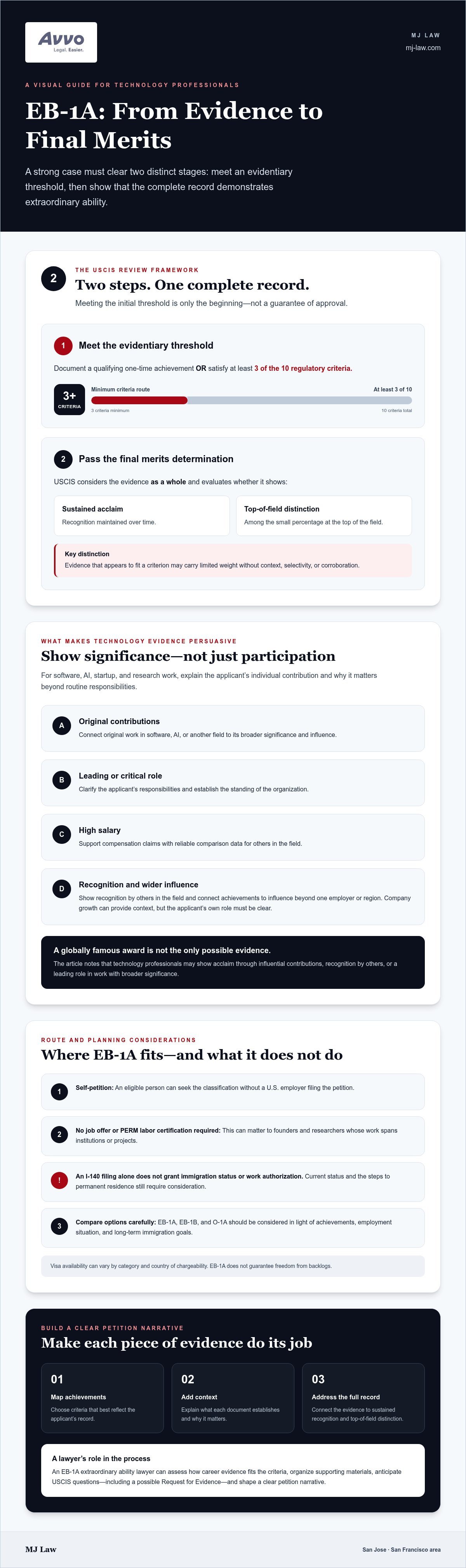
Self-petitioning lets an eligible person seek an employment-based immigrant classification without relying on a U.S. employer to file the petition. That independence can matter to founders whose company may not be positioned to sponsor them, or to researchers whose work spans institutions and projects. Unlike employer-sponsored routes that require labor certification, EB-1A does not require a job offer or PERM labor certification.
This independence can provide more flexibility in career planning, but filing an I-140 by itself does not grant immigration status or work authorization. Applicants still need to consider their current status and the steps required to obtain permanent residence.
Acclaim in the Silicon Valley Context
Extraordinary ability does not require a Nobel Prize or another globally famous award. In technology, relevant evidence may include influential contributions to software or AI, recognition by others in the field, or a leading role in work with broader significance. The record must show more than participation. It should establish the applicant’s individual impact and sustained recognition.
Work based in San Jose or San Francisco can contribute to a wider profile when the evidence connects local achievements to recognition or influence beyond one employer or region. Company growth may provide context, but the petition must make the applicant’s own role clear. Visa availability can vary by category and country of chargeability, so EB-1A may be worth comparing with other routes, but it does not guarantee freedom from backlogs. MJ Law’s San Jose location and immigration services are relevant to individuals considering employment-based options in the San Jose and San Francisco area.
The Two-Step USCIS Review Process: Kazarian and Final Merits
EB-1A adjudication follows a two-step framework associated with Kazarian v. USCIS. First, the petitioner must document a qualifying one-time achievement or satisfy at least three of the ten regulatory criteria. Second, USCIS evaluates the evidence as a whole to decide whether it demonstrates sustained acclaim and recognition as one of the small percentage at the top of the field. Meeting the initial threshold does not, by itself, mean the petition will be approved.
The USCIS EB-1A criteria describe the official evidentiary categories. The distinction between satisfying a criterion and showing why the evidence matters is central: evidence may appear to fit a category but carry limited weight if it lacks context, selectivity, or corroboration. A strong petition anticipates questions an officer may have and explains how the record supports the claim.
Navigating the 10 USCIS Criteria
For business and science professionals, relevant criteria may include a high salary compared with others in the field, a leading or critical role for a distinguished organization, and original contributions of major significance. Connect each document to the criterion it supports and explain what it shows. For example, compensation records need reliable comparison data, while a critical-role claim should clarify the applicant’s responsibilities and the organization’s standing.
Peer review may support the judging criterion when the record shows that the applicant evaluated the work of others in the same or an allied field. Venture-capital due diligence is not automatically equivalent. Evidence should establish that the activity involved judging others’ work and explain what that work entailed. Published-material evidence should focus on coverage about the applicant and their work. Calling an outlet a trade journal or general media outlet does not establish relevance by itself. Explain its audience, the article’s subject, and the connection to the applicant’s field.
Winning the Final Merits Determination
At final merits, USCIS considers the totality of the evidence, weighing how the pieces fit together rather than counting criteria in isolation. Define the applicant’s field or niche carefully, then show a coherent pattern of recognition and impact within it. Direct documentation and independent corroboration can help distinguish personal achievement from routine job duties or a company’s success.
In the final review, quality and probative value matter more than a large volume of loosely connected documents. Under the preponderance of the evidence standard, the applicant must show that each claim is more likely than not to be true. A well-supported explanation matters as much as the underlying records. An EB-1A extraordinary ability lawyer can help organize evidence around that standard. Applicants weighing a complex self-petition may also consider a case-specific immigration discussion.
EB-1A vs. EB-1B vs. O-1A: Choosing Your Best Path
These categories can recognize similar achievements, but they serve different immigration goals. EB-1A is an immigrant category that allows eligible individuals to self-petition without a job offer. EB-1B is also an employment-based green card category, but it requires a qualifying U.S. employer to petition for an outstanding professor or researcher. O-1A, by contrast, is a temporary work status for individuals with extraordinary ability. It is not a green card or an automatic route to one.
Choose based on both your evidence and your career plans. A stable research position and an employer prepared to sponsor may make EB-1B worth considering. A founder or professional seeking independence from one employer may want to assess EB-1A. The Kazarian two-step review provides useful context for why evidence that supported one classification may not be enough for another.
O-1 to EB-1A Transition for Tech Talent
For a San Jose founder, an O-1 approval or a new funding round may be a sensible point to reassess long-term immigration options. Neither guarantees EB-1A eligibility. O-1A evidence can provide a starting record, but the green card petition must independently satisfy EB-1A requirements and make the case for sustained acclaim and top-of-field standing. Don’t assume an O-1 approval or documents submitted previously will carry the same weight in a different adjudication.
Review each item for its relevance, context, and strength under the EB-1A standard. For example, a funding announcement may establish business context, but the petition still needs to explain your personal contributions and their significance. For a closer look at the local transition, see O-1 to EB-1 Transition for San Jose Tech Founders.
EB-1A vs. EB-1B for San Francisco Researchers
EB-1B may suit a researcher with a qualifying U.S. employer, a stable role, and a record that meets that category’s requirements. EB-1A may be a better fit when the applicant can establish extraordinary ability independently and wants greater flexibility to pursue work across organizations or ventures. That flexibility does not remove the need to maintain appropriate immigration status while a green card case is pending. Compare the options in EB-1A vs EB-1B: Which is Best for San Francisco Researchers?.
Processing time and visa availability are separate considerations. Standard EB-1A I-140 processing is reported at about 12 to 20 months, with some estimates extending longer. Premium processing requires USCIS action within 15 business days, but that action could be an approval, denial, Request for Evidence, or Notice of Intent to Deny. It does not bypass visa-number limits. Check the Visa Bulletin and your priority date before planning the next step, since availability can change. An EB-1A extraordinary ability lawyer can help weigh the evidence, sponsorship needs, and timing together.
Strategic Evidence Building for Silicon Valley Professionals
For software and AI professionals, the challenge is often explaining why work that looks technical or company-specific matters beyond the team that created it. Evidence of an original contribution should show what the applicant personally developed, how others have used or recognized it, and why its impact is significant in the field. Depending on the work, useful records may include technical documentation, deployment or licensing evidence, independent evaluations, and corroborating letters from people familiar with its influence.
A critical or leading role also needs context. A startup’s prominence or a “unicorn” valuation does not, by itself, establish the applicant’s contribution. Explain the organization’s reputation, the applicant’s responsibilities, and how their work affected a key product, research program, or business function. Venture funding and valuation can help establish company context or support a broader account of impact, but they are not a stand-alone EB-1A criterion. Connect them to the applicant’s own achievements.
Expert opinion letters are most useful when they offer specific, credible analysis rather than praise alone. Ask knowledgeable industry leaders to explain the contribution, its significance, and the basis for their assessment. Independent perspectives can help clarify why the work matters to people outside the applicant’s immediate organization.
Documenting High Salary and Remuneration
Compensation evidence may include salary records and, where relevant, documents explaining equity awards or stock options. Present each component clearly, including what was granted, its terms, and how it relates to the applicant’s compensation during the relevant period. Compare pay with reliable benchmarks for similar roles, experience, and geography, distinguishing base salary from equity and other compensation.
Make complex compensation easy for a USCIS officer to evaluate by separating each component, explaining its value and timing, and pairing it with relevant comparison data.
Evidence for Founders and Entrepreneurs
Patents, white papers, product records, and technical implementations can document a founder’s work, but the petition should explain their significance and the applicant’s individual role. Media coverage in outlets such as TechCrunch, Wired, or the San Jose Mercury News may help when it discusses the applicant and their work, rather than only reporting on the company. Accelerator participation or membership, including Y Combinator, also needs context. Admission alone may not establish that membership requires outstanding achievements.
An EB-1A extraordinary ability lawyer can help organize technical and business records into a coherent evidentiary presentation. If you’re assembling founder or researcher evidence, discuss your EB-1A evidence strategy with MJ Law.
How an EB-1A Extraordinary Ability Lawyer in San Jose Can Help
A strong EB-1A case needs more than a collection of impressive documents. An EB-1A extraordinary ability lawyer can review your career, identify achievements that may fit the regulatory criteria, and show how each document supports the petition. This mapping can reveal gaps early, such as evidence that describes a successful product but does not establish your personal contribution or its influence in the field.
The petition letter brings the record together. It should explain the significance of your work, connect the evidence to the applicable criteria, and make a clear case for why the full record supports eligibility. If USCIS issues a Request for Evidence (RFE), a strategic response addresses the specific questions raised, adds relevant support where available, and clarifies how the evidence meets the standard. No attorney can guarantee an outcome, but careful preparation can make the claims and supporting documents easier to evaluate.
Local representation can provide useful context for the San Jose and San Francisco technology communities and the achievements of founders and researchers working in the area. A firm’s location does not mean USCIS will adjudicate a petition at a nearby office. USCIS processing and any interview location follow agency procedures, not simply the applicant’s choice of lawyer.
The MJ Law Approach: Immigration Experience in Silicon Valley
MJ Law is an immigration law firm based in San Jose. The firm has been assisting individuals, families, and businesses with visa applications, green cards, and U.S. citizenship for over three decades. Its practice includes employment-based immigration options, and consultations are available in English and Spanish. For a complex self-petition, a collaborative process can help the attorney understand the career behind the evidence and the client understand the strategy being developed.
Start Your EB-1A Journey
A preliminary profile review can help identify potential strengths, evidence gaps, and questions to resolve before building a petition. To prepare for an initial consultation, organize your résumé or career history, current immigration status, major achievements, supporting records, and any prior O-1 or other immigration filings. For each achievement, note who recognized it, how your work was used, and what changed as a result.
If you’re ready to discuss whether your background may support an EB-1A petition, schedule an EB-1A consultation with MJ Law.
Build Your EB-1A Plan with Confidence
An EB-1A case depends on more than meeting individual criteria. Your evidence must tell a coherent story about your achievements, recognition, and impact, while addressing the final merits review. Comparing EB-1A with EB-1B and O-1A can also help you choose a path that fits both your record and your career goals.
An EB-1A extraordinary ability lawyer can help you assess your profile, identify evidence gaps, and organize a persuasive petition. MJ Law brings over three decades of immigration law experience and is based in San Jose, serving individuals, families, and businesses considering immigration options in the San Jose and San Francisco area.
Your next step can be a focused review of your achievements, immigration history, and long-term plans. Book an EB-1A strategy session with MJ Law to discuss your options. A clear plan and carefully presented evidence can help you move forward with greater confidence.
Frequently Asked Questions
Do I need a Nobel Prize or an Oscar to qualify for an EB-1A?
No. A Nobel Prize or Oscar is one possible form of major recognition, not a requirement. Applicants may instead qualify by meeting at least three of the regulatory evidentiary criteria and showing that their record, considered as a whole, demonstrates sustained acclaim and distinction in their field. For a technology professional, evidence might relate to original contributions, a critical role, or other qualifying achievements, provided the petition explains their significance.
Can I apply for an EB-1A while currently on an H-1B or O-1 visa?
Yes. Being in H-1B or O-1 status does not by itself prevent you from filing an EB-1A petition. The I-140 petition and your nonimmigrant status are separate matters, however. Filing an I-140 does not extend or replace your current status, so you’ll need to understand how to maintain lawful status and plan any later adjustment-of-status or consular processing steps. Individual circumstances, including travel and future filings, can affect that strategy.
How long does the EB-1A process take with premium processing in 2026?
Premium processing for an EB-1A I-140 requires USCIS to take action within 15 business days. That action may be an approval, denial, Request for Evidence, or Notice of Intent to Deny, so premium processing does not guarantee approval or completion of the green card process in that period. The time to obtain permanent residence also depends on visa availability and the next application stage. Check current USCIS processing information and the Visa Bulletin.
Is a job offer required for an EB-1A extraordinary ability petition?
No. EB-1A applicants may self-petition and do not need a U.S. job offer or employer sponsor. They also do not need PERM labor certification. The petition must still establish eligibility and show that the applicant intends to continue working in their area of extraordinary ability in the United States. This flexibility can be valuable for founders and professionals whose work spans organizations, but it does not remove the need to maintain appropriate status while pursuing permanent residence.
What happens if my EB-1A petition is denied?
A denial means USCIS did not find the petition sufficient for approval; it does not grant permanent residence. Review the decision carefully to understand the stated reasons and any available options, which may depend on the case and applicable deadlines. In some situations, a person may consider a motion, appeal, or a new petition with stronger or clearer evidence. An I-140 denial does not itself determine whether you can remain in the United States, so assess your separate immigration status promptly.
Can my spouse and children get green cards through my EB-1A?
Eligible dependents may be able to apply for permanent residence as derivatives of the principal EB-1A applicant. This generally includes a spouse and unmarried children under 21, subject to the applicable immigration rules and individual eligibility. Their applications are connected to the principal case and visa availability, but each family member must complete the required process. Timing and filing options depend on whether the family applies through adjustment of status in the United States or consular processing abroad.
How does the “Final Merits Determination” affect my chances of approval?
The final merits determination is USCIS’s second-stage review of whether the evidence, considered together, shows sustained acclaim and places you among the small percentage at the top of your field. Meeting at least three criteria does not automatically satisfy this review. Officers assess the quality, relevance, and context of the record. A well-organized petition should explain how the evidence supports the overall claim, rather than simply listing achievements or submitting documents without analysis.
Is EB-1A better than EB-2 National Interest Waiver (NIW)?
Neither category is universally better. Both can allow self-petitioning without a job offer, but their eligibility standards differ: EB-1A focuses on extraordinary ability and sustained acclaim, while an NIW asks whether waiving the job-offer and labor-certification requirements serves the national interest under its applicable test. Visa availability and priority-date timing can also differ. Compare your evidence, goals, and chargeability before choosing; a qualified immigration lawyer can help assess which route fits your circumstances.