What if the most difficult part of your citizenship interview isn’t the civics test, but the way you’ve documented your travel history? Preparing for your citizenship interview San Jose can feel like a high-stakes balancing act. You’re likely feeling the pressure of memorizing 100 civics questions while simultaneously worrying about how an old tax filing or a long trip abroad might look to a USCIS officer at the Coleman Avenue office. It’s natural to feel anxious when your future in Silicon Valley depends on a single conversation.
This 2026 legal prep guide will provide you with the expert strategies needed to master every step of the naturalization process. You’ll learn how to approach the interview with the confidence of a seasoned applicant who understands the local nuances of the San Jose field office. We’ll break down the specific logistics of the 1450 Coleman Ave location, reveal how to handle complex questions about your background, and provide a definitive checklist of the documents you must bring to ensure success on your first attempt.
Key Takeaways
- Learn the specific arrival and security protocols at the San Jose Field Office on Coleman Avenue to ensure a stress-free start to your day.
- Discover effective strategies for passing both the English proficiency and the 100-question civics test on your first attempt.
- Identify potential legal red flags, such as travel history or tax issues, that could complicate your citizenship interview San Jose and learn how to address them proactively.
- Follow a detailed preparation checklist to organize your original documents and certified translations before you head to your appointment.
- Understand how professional legal representation protects your rights and ensures that USCIS officers adhere to proper protocols during the questioning process.
Navigating the San Jose USCIS Field Office Experience
The final step toward United States citizenship for South Bay residents occurs at 1450 Coleman Ave. This modern facility serves as the primary hub for the citizenship interview San Jose. Walking through those doors represents years of effort and anticipation. Understanding the specific environment of this office helps lower your stress levels so you can focus on the officer’s questions rather than the logistics of the building.
Once you pass through security, you’ll check in at the front desk. The waiting room is often quiet and professional. In 2026, the flow of appointments has become more efficient, but you should still be prepared for a short wait after your scheduled time. Knowing how this specific office operates, from the temperament of the staff to the layout of the interview rooms, provides a sense of control that can significantly boost your confidence. Our firm has spent three decades observing these local nuances to better prepare our clients.
Logistics and Arrival for Silicon Valley Residents
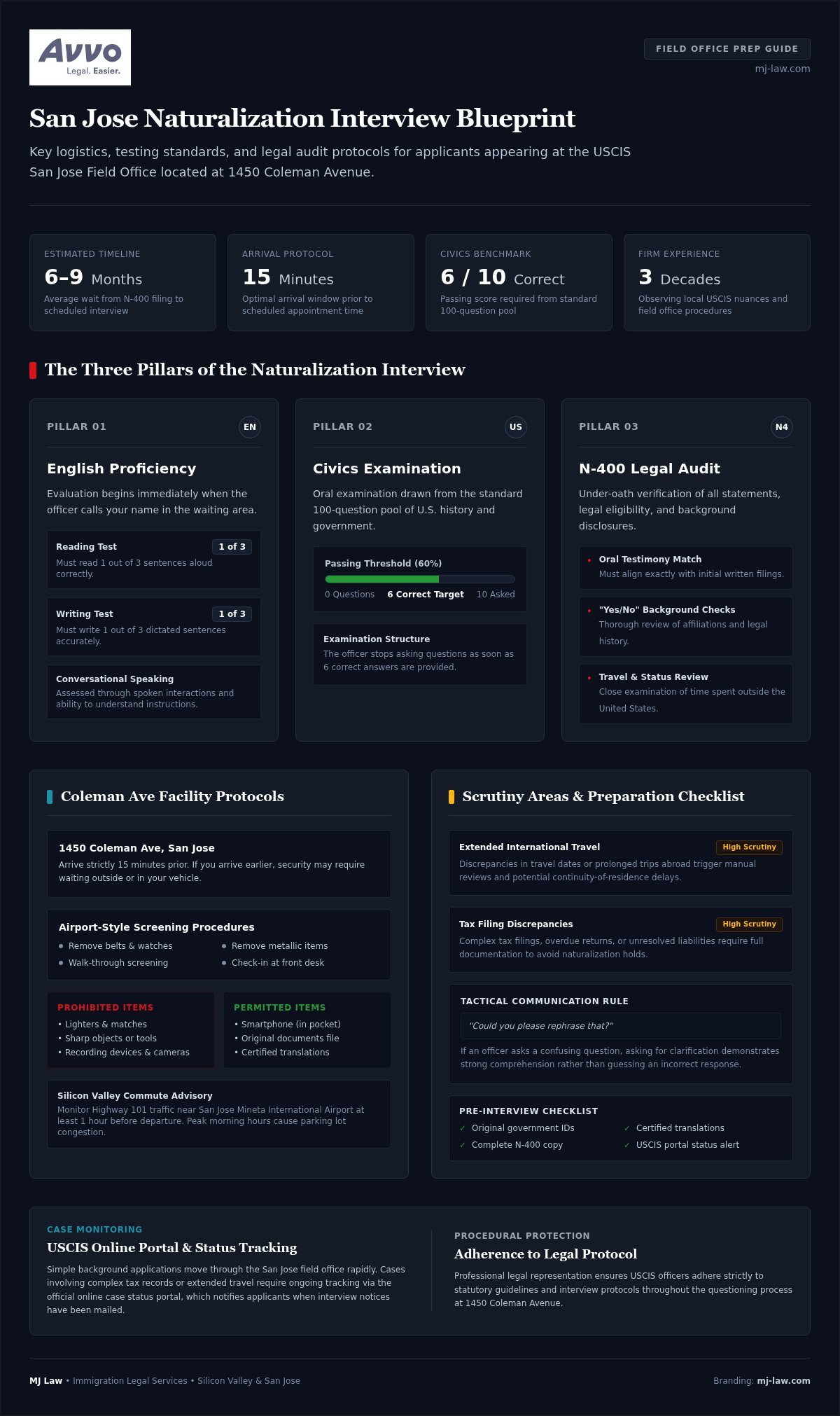
Plan to arrive at the Coleman Ave facility about 15 minutes before your scheduled time. If you arrive earlier, security personnel may ask you to wait outside or in your vehicle. Parking is available on-site, though the lot can become crowded during peak morning hours. The security checkpoint functions similarly to an airport. You’ll need to remove your belt, watch, and any metallic items. Prohibited items include:
- Lighters and matches
- Sharp objects or tools
- Recording devices or cameras (smartphones are generally allowed if kept in your pocket)
For those commuting from San Francisco or the Peninsula, traffic on the 101 can be unpredictable. Check local traffic apps an hour before you leave to account for any delays near the San Jose Mineta International Airport. Being rushed is the last thing you want before your interview begins.
Naturalization Wait Times in San Jose (2026)
As we move through 2026, the San Jose field office has streamlined several internal processes, yet wait times still vary. Most applicants find their citizenship interview San Jose scheduled within six to nine months of filing their N-400, though this window fluctuates based on volume. Several factors influence how quickly your file moves through the system. Simple applications with clear backgrounds often move faster. If your case requires a manual review of complex tax records or extended international travel, you might experience a longer wait. You can monitor your progress through the USCIS online case status tool. This portal provides real-time updates and will notify you when your interview notice has been mailed.
The Three Pillars of the Naturalization Interview
The naturalization process culminates in a formal assessment that many applicants find intimidating. However, viewing the session as three distinct pillars helps simplify your preparation. Each component is designed to confirm you meet the statutory requirements for becoming a citizen. By consulting the USCIS naturalization interview and test guide, you can see the official framework, but local officers at the San Jose office often have specific ways of conducting these evaluations.
Mastering the Civics and English Components
The first two pillars are the English language and civics tests. You’ll need to demonstrate basic proficiency in reading, writing, and speaking English. During the reading portion, you’ll read one of three sentences aloud correctly. For the writing portion, you’ll write one of three sentences as dictated by the officer. The civics test requires you to answer six out of ten questions correctly from the standard 100-question pool.
Success in 2026 often depends on your ability to handle the conversational nature of the speaking test. The officer evaluates your English from the moment they call your name in the waiting room. If you find a question confusing, ask the officer to repeat it. Saying, “Could you please rephrase that?” is better than giving an incorrect answer because you misunderstood a word. This approach demonstrates your listening skills and helps prevent errors that could be misinterpreted as a lack of proficiency.
The N-400 Application Audit
The final and most critical pillar is the review of your N-400 application. The N-400 review is a legal verification of your eligibility. Every answer you give under oath must align perfectly with the information you submitted in your initial filing. Discrepancies here can lead to delays or denials, even if they’re simple mistakes or oversights.
Officers pay close attention to the “Yes/No” questions regarding your background, travel history, and affiliations. They use this oral testimony to assess your “Good Moral Character,” which is a fundamental requirement for naturalization. If your circumstances have changed since you filed, such as a new job or a recent trip, you must disclose these updates clearly. If you’re concerned about how to present specific background details during your citizenship interview San Jose, scheduling a professional application audit can provide the clarity you need before your appointment.
Common Obstacles: Red Flags and How to Address Them
While many applicants focus on memorizing history dates, the most common reasons for a delayed or denied citizenship interview San Jose often involve the “Good Moral Character” assessment. This portion of the interview allows the officer to look beyond your test scores and into your legal and financial history. According to the USCIS Policy Manual on naturalization examinations, officers must conduct a thorough review of your background to ensure you meet all statutory requirements. Discrepancies in your “Have you ever” answers can trigger immediate concerns about your credibility.
International travel is another frequent hurdle. If you’ve spent more than six months outside the U.S. in a single trip, you may have broken your “continuous residence.” Even shorter, frequent trips can lead an officer to question whether you’ve truly maintained your home in the United States. Similarly, any prior arrests or citations must be disclosed, even if they were expunged or occurred decades ago. Failing to mention a past legal encounter is often seen as a greater red flag than the incident itself, as it suggests a lack of candor under oath.
Naturalization Tax Requirements and Compliance
In the South Bay, USCIS officers frequently scrutinize IRS transcripts to verify that you’ve fulfilled your financial obligations to the government. Unpaid taxes or failing to file a return can be interpreted as a lack of good moral character. However, owing money isn’t an automatic disqualification if you can show you’ve taken steps to resolve the debt. If you’re currently on a payment plan, bring official IRS documentation to prove you’re in compliance. For a detailed breakdown of what you need, review our Naturalization Tax Requirements Checklist. This preparation ensures you can explain your financial standing calmly and accurately.
Dealing with “Decision Cannot Be Made” Scenarios
It’s possible to finish your interview and receive a Form N-652 that states a “decision cannot yet be made.” This doesn’t mean you’ve failed. It often means the officer needs more time to review your file or requires additional evidence. Common reasons for this outcome include missing certified translations or the need for a supervisor to sign off on a complex legal issue. By law, USCIS has 120 days to provide a final decision after your interview. If your case is continued, you’ll receive a formal request for evidence (RFE). You must respond to this request within the specified timeframe to keep your application active and avoid a denial based on abandonment.
Step-by-Step Preparation Checklist for San Jose Residents
Success at your citizenship interview San Jose depends on meticulous organization. While the USCIS officer leads the conversation, you control the evidence that supports your eligibility. By following a structured preparation framework, you ensure that no detail is overlooked and that you can respond to requests for documentation instantly. This systematic approach transforms a potentially stressful event into a manageable professional meeting.
The first step involves a final, deep review of your N-400 application. Ensure you’ve noted any changes that occurred after filing, such as a new residential address or a short trip abroad. Next, gather all original documents and their certified English translations. You must also organize these into a physical “Interview Folder.” This folder acts as your tactical guide during the meeting, allowing you to produce tax transcripts or birth certificates without fumbling through loose papers. Finally, perform a logistics check for the 1450 Coleman Ave office, confirming your travel route and parking plan to avoid a rushed arrival.
Organizing Your Essential Document Folder
Your folder should be divided into clear sections for easy access. Bringing more evidence than required is always better than missing a critical piece of proof. At a minimum, include:
- Your Permanent Resident Card (Green Card)
- All current and expired passports
- State-issued identification or driver’s license
- IRS tax transcripts for the last three to five years
- Certified copies of any court dispositions for past citations
If you’re applying based on marriage to a U.S. citizen, include recent joint bank statements, utility bills, and your spouse’s proof of citizenship. This additional layer of documentation confirms the ongoing validity of your relationship. If you want to ensure your folder is complete, book an N-400 audit with our team to review your specific document needs.
Mock Interviews and Local Preparation
Simulating the interview environment is the best way to prepare for the interpersonal dynamics of the Coleman Ave office. Ask a friend or family member to play the role of the officer, using the 100 civics questions and your N-400 as a script. Practice sitting upright, maintaining eye contact, and answering clearly in English. Mock interviews are the #1 way to reduce speech anxiety. For those seeking additional support, several community centers in the South Bay offer citizenship classes that focus on local interview trends. This preparation ensures that when you walk into your citizenship interview San Jose, you feel like a prepared partner in the process rather than a nervous observer.
Why Professional Representation Matters in San Jose
Many applicants assume that legal representation is only necessary for those with complex criminal histories or significant legal hurdles. This is a common misconception. Even for a seemingly straightforward citizenship interview San Jose, having an experienced advocate by your side ensures that your rights are protected throughout the entire process. An attorney acts as a silent guardian, monitoring the officer’s questions to ensure they remain within the scope of the law and don’t stray into unauthorized or inappropriate territory.
If an officer deviates from standard protocol or misinterprets a specific legal requirement, your lawyer can intervene on the spot. This immediate clarification often prevents the case from being delayed or continued for additional evidence. Beyond the interview itself, professional guidance provides a layer of composure. You can walk into the Coleman Avenue office knowing that every part of your N-400 has been reviewed by a professional who understands the specific expectations of the local staff. Once you receive your approval, we’ll guide you through the final steps, including preparing for your Oath Ceremony at the San Jose Convention Center or the local field office.
The MJ Law Advantage: 30+ Years in Silicon Valley
Our firm has been a fixture of the South Bay legal community since 1985. Over three decades of experience have given us deep insights into the evolving landscape of immigration law and the specific nuances of the San Jose and San Francisco USCIS offices. We don’t just process paperwork; we build partnerships with our clients to ensure their individual success stories are realized. As a Family Immigration Lawyer San Jose, our bilingual team is uniquely equipped to assist Spanish-speaking applicants, ensuring that language barriers never stand in the way of your path to citizenship.
Booking Your Pre-Interview Consultation
The most effective way to eliminate anxiety is through a comprehensive naturalization strategy session. During this meeting, we conduct a meticulous audit of your N-400 and all supporting documentation. We’ll identify potential red flags, such as travel discrepancies or tax issues, and develop a plan to address them before your citizenship interview San Jose. This proactive approach ensures there are no surprises on the day of your appointment. If you’re ready to secure your future in the United States, you can Schedule a Consultation with MJ Law today to begin your final review. We’re here to provide the steady hand and expert guidance you need for a successful naturalization journey.
Securing Your Future in Silicon Valley
Becoming a United States citizen is a life-changing milestone that requires more than just memorizing history dates. Success at the Coleman Avenue office depends on your ability to present a clean N-400, manage local logistics, and address potential red flags with total transparency. By organizing your documents and practicing through mock interviews, you can replace anxiety with the confidence needed to succeed on your first attempt.
Preparing for your citizenship interview San Jose is the final hurdle in a long journey. Since 1985, MJ Law has acted as a steady hand for thousands of applicants in Silicon Valley. With over 30 years of immigration expertise, our team provides the professional case audits and bilingual support needed to ensure your application is airtight. Whether you need a final document review or a strategy session in English or Spanish, we’re here to guide you toward the oath ceremony.
Take the next step toward your American dream with a partner who understands the local nuances of the South Bay. Schedule your citizenship interview prep with MJ Law today. You’ve worked hard to get here, and we’re committed to helping you cross the finish line.
Frequently Asked Questions
Where is the citizenship interview held in San Jose?
The citizenship interview San Jose is conducted at the USCIS Field Office located at 1450 Coleman Avenue, San Jose, CA 95110. This facility is situated near the San Jose Mineta International Airport. Applicants should arrive approximately 15 minutes before their scheduled time to navigate the security checkpoint. It’s helpful to account for South Bay traffic, especially during peak morning hours, to ensure you don’t miss your appointment window.
What should I wear to my citizenship interview at the San Jose office?
You should dress in professional or business casual attire for your interview. While there isn’t a strict dress code, wearing professional clothing demonstrates respect for the naturalization process and the USCIS officer. Avoid overly casual items like shorts, flip-flops, or t-shirts with graphics. Dressing as you would for a job interview helps establish a serious and respectful tone from the moment you enter the Coleman Avenue facility.
Can I bring a lawyer to my citizenship interview in San Jose?
Yes, you have a legal right to bring an attorney to your citizenship interview San Jose. Having a representative from MJ Law can provide peace of mind and ensure that the officer follows proper legal protocols. Your lawyer can clarify complex questions and protect your rights if the officer asks for unauthorized information. This professional presence is particularly beneficial if your case involves travel history concerns or past legal citations.
What happens if I fail the civics test in San Jose?
If you don’t pass the civics or English test on your first attempt, USCIS will schedule a second interview within 60 to 90 days. You’ll only be retested on the specific portion you failed. This second opportunity is your final chance before the application is denied. If you’re struggling with the test components, our bilingual team can help you prepare through strategy sessions and mock interviews before your re-examination date.
How long does the citizenship interview usually take?
Most naturalization interviews at the San Jose field office take between 20 and 30 minutes. However, the total time spent at the facility will be longer due to security checks and waiting room periods. If your case involves complex issues like tax payment plans or marriage-based eligibility, the officer may require additional time to review your evidence. It’s best to plan for at least two hours at the office to avoid feeling rushed.
What documents do I need for my naturalization interview?
You must bring your Permanent Resident Card (Green Card), all current and expired passports, and a state-issued photo ID. Depending on your specific case, you may also need IRS tax transcripts for the last five years, marriage certificates, and certified court dispositions for any past legal incidents. Organizing these into a dedicated folder ensures you can present them immediately when the officer asks, preventing unnecessary delays or a “decision cannot be made” result.
Can I reschedule my citizenship interview at the San Jose field office?
You can request to reschedule your interview at the San Jose field office, but you should only do so for a significant reason, such as a medical emergency. Rescheduling often delays your naturalization process by several months. To request a new date, you must follow the instructions on your interview notice and provide a written explanation. If you simply fail to show up without notification, USCIS may administratively close your application.
How soon after the interview is the Oath Ceremony in San Jose?
The timing of the Oath Ceremony varies based on the current volume of the San Jose office. In some instances, same-day ceremonies are available if the officer approves your case immediately. More frequently, you’ll receive a notice for a ceremony scheduled several weeks later. These larger events often take place at the San Jose Convention Center or within the Coleman Avenue facility, marking the final step in your journey to becoming a citizen.