Could a single missing tax transcript from five years ago really be the reason your U.S. citizenship application is denied? For many high achieving professionals in Silicon Valley, the journey toward naturalization feels certain until the N-400 interview begins to focus on complex financial history. It’s natural to feel a sense of anxiety when faced with the strict naturalization tax requirements set by USCIS, particularly when you’re trying to distinguish between standard tax returns and official IRS transcripts. We understand that reporting intricate compensation packages, such as RSUs and stock options, adds another layer of stress to an already significant life milestone.
You deserve to walk into your interview with the confidence that your financial record is beyond reproach. This guide will help you master the tax compliance standards required for your application, ensuring your path to citizenship remains on track despite any past filing errors or existing debt. We’ll provide a comprehensive checklist of required documents, a clear strategy for managing IRS payment plans, and specific insights into how your tax history influences the Good Moral Character standard. By the end of this article, you’ll have a professional roadmap to secure your future as a U.S. citizen.
Key Takeaways
- Understand how tax compliance serves as the essential foundation for meeting the Good Moral Character requirement during the N-400 process.
- Learn why official IRS tax transcripts are the gold standard for satisfying naturalization tax requirements compared to standard photocopied returns.
- Discover how establishing a formal IRS installment agreement can protect your application even if you currently owe back taxes.
- Identify common filing red flags, such as improper “Head of Household” claims, that often trigger additional scrutiny during USCIS interviews.
- Gain a strategic roadmap for handling complex Silicon Valley compensation, including RSUs and stock options, to ensure your financial history is transparent and accurate.
Naturalization and the IRS: Why Tax Compliance is the Foundation of Your N-400
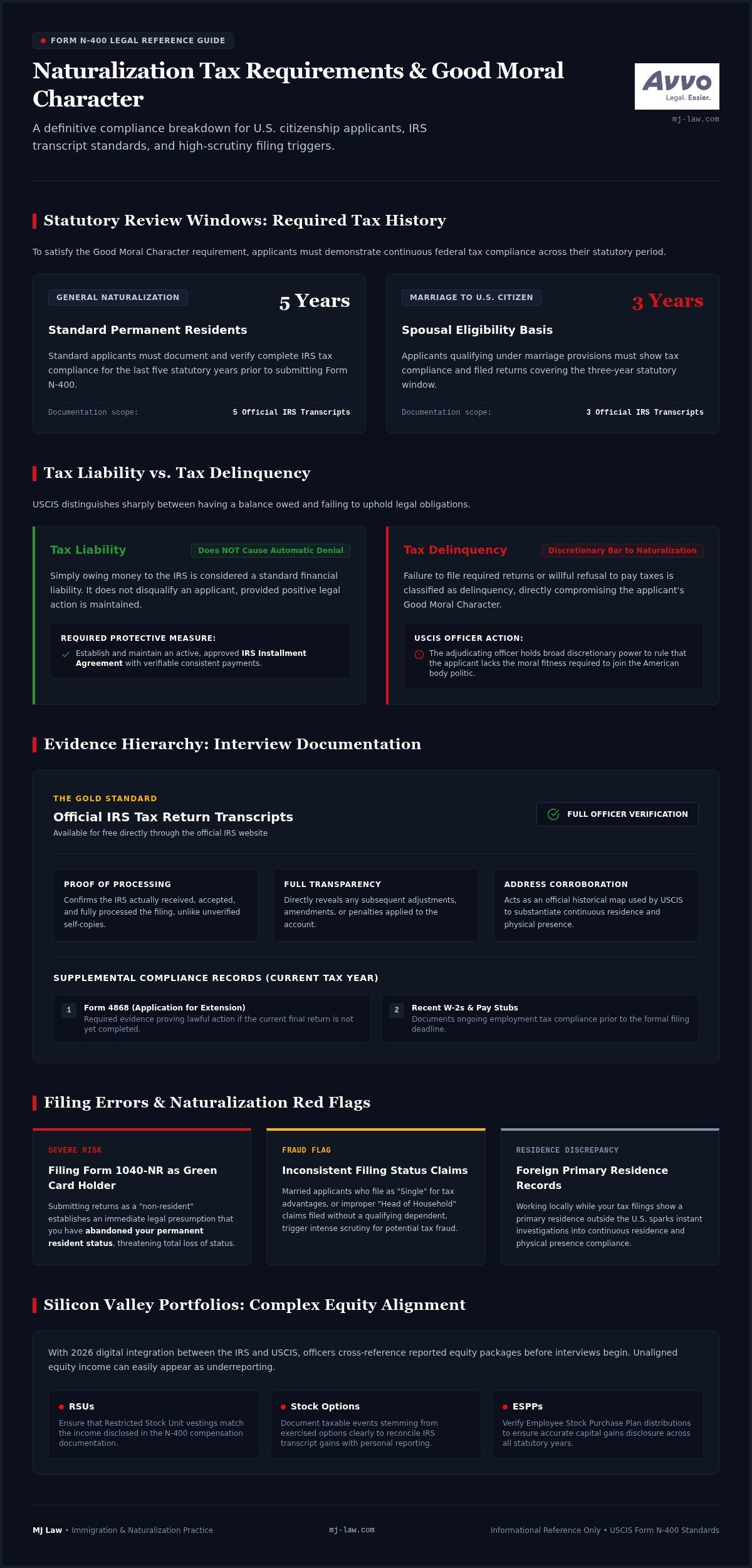
IRS compliance isn’t just about settling a bill; it’s a fundamental test of legal eligibility. USCIS views your tax history as a window into your integrity and your commitment to the laws of the United States. In 2026, digital integration between the IRS and USCIS has reached a level where officers can often spot filing discrepancies before you even sit down for your interview. Failing to meet naturalization tax requirements can halt an application even if every other part of your background is spotless.
It’s vital to distinguish between tax liability and tax delinquency. Simply owing money to the IRS is a liability, and it isn’t an automatic reason for denial. However, tax delinquency-the failure to file or the refusal to pay-is seen as a direct strike against your character. Immigration officers look for a history of responsibility, not necessarily a zero balance.
The Good Moral Character Standard
To become a citizen, you must demonstrate a good moral character requirement during the statutory period. For most applicants, this period covers the last five years. If you’re filing based on marriage to a U.S. citizen, the window is shortened to three years. Failing to file taxes is considered a “discretionary” bar to naturalization. This means the officer has the authority to decide if your tax history suggests you lack the moral fitness to join the American body politic.
Good moral character in the context of federal taxes means the consistent, honest fulfillment of your legal obligation to report and pay all required taxes to the United States government.
Verifying Residency Through Tax Records
Your tax returns do more than report income; they act as a map of your life in the U.S. USCIS uses these records to corroborate the addresses and dates you’ve listed on your N-400. If you’ve spent significant time working for a Silicon Valley tech firm but your tax records show a primary residence in another country, it triggers an immediate investigation into your physical presence and continuous residence.
- Filing Status: If you’re married but file as “Single” to get a higher refund, or if you claim “Head of Household” without a qualifying dependent, USCIS may flag this as potential fraud.
- The Non-Resident Risk: The most dangerous error is filing as a “non-resident” (Form 1040-NR) while holding a Green Card. Doing so creates a legal presumption that you’ve abandoned your permanent residency, which can lead to the loss of your status entirely.
Because the IRS and USCIS share data more frequently now, these inconsistencies are caught earlier in the process. Ensuring your filing status matches your immigration story is the first step in a successful naturalization journey.
Essential Tax Documentation Checklist for Your Citizenship Interview
Preparing for your N-400 interview requires more than just filling out a form; you must prove you’ve met all naturalization tax requirements through official documentation. While many applicants bring photocopies of their signed returns, IRS Tax Return Transcripts are the gold standard. These transcripts prove the IRS actually received and processed your filing. They also show any subsequent amendments or penalties, which provides the transparency USCIS officers look for during their review. If you don’t have these on hand, you can request them for free from the IRS website.
The number of years you need to document depends on your filing category. General applicants must provide transcripts for the last five years. If you’re applying based on three years of marriage to a U.S. citizen, you only need the last three years. If the current tax deadline hasn’t passed, bring your most recent W-2s or pay stubs to show ongoing compliance. If you’ve filed an extension for the current year, bring a copy of Form 4868. This shows you’re acting within the law even if your final return isn’t ready yet.
The Silicon Valley Tech Professional Checklist
San Jose and San Francisco professionals often have complex portfolios that require extra attention. You must ensure that income from Restricted Stock Units (RSUs), stock options, and Employee Stock Purchase Plans (ESPPs) matches what’s on your N-400. Discrepancies here can look like underreporting to an untrained eye. If you work in San Jose but your employer is based in another state, keep records of your multi-state filings to explain any differences in state tax withholdings. Additionally, if you hold foreign accounts exceeding $10,000, ensure you have your FBAR filings ready. If these complexities feel overwhelming, you can schedule a consultation to review your specific portfolio.
Checklist for Marriage-Based Applicants
Proving a “bona fide” marriage is significantly easier when you provide “Married Filing Jointly” tax transcripts. It demonstrates a clear commingling of financial lives. If you filed “Married Filing Separately” while living together, be prepared to explain why. Common reasons include managing student loan payments or protecting one spouse’s credit, but you’ll need to be clear and consistent. The USCIS policy on failure to file or pay taxes makes it clear that tax issues can cast a shadow on your application. Even if your spouse is the one with debt, ensure you have documentation showing that the debt is being addressed through a formal payment plan if you filed jointly.
Handling Tax Debt, Delinquency, and Missed Filings
Lying about financial obligations is a far greater risk to your citizenship than the debt itself. Under the “Disclosure Rule,” any attempt to hide tax liabilities from a USCIS officer is viewed as a lack of candor. This directly impacts the Good Moral Character requirement. If you owe back taxes, you aren’t automatically barred from naturalization. Instead, your eligibility often hinges on how you’ve addressed that debt. Demonstrating a proactive approach is the best way to satisfy naturalization tax requirements while preserving your path to U.S. citizenship.
For Silicon Valley professionals, tax debt often arises from complex scenarios like multi-state income or the delayed vesting of RSUs. These situations can lead to unexpected balances that go unnoticed until you begin the N-400 process. If your tax issues trigger an investigation into your marriage or financial history, it’s wise to consult with a Marriage Green Card RFE Lawyer in San Jose. They can help document the legitimacy of your filings and your relationship to ensure a minor financial error doesn’t derail your case.
Steps to Take if You Owe the IRS
If you discover an outstanding balance, don’t panic. Following a structured plan shows the government that you’re a responsible resident who respects the law. You should follow these specific steps before your interview:
- Step 1: Access the official government portal to request IRS tax transcripts. Specifically, you need the “Account Transcript” to confirm the exact amount, including interest and penalties.
- Step 2: Establish a signed payment agreement or “Installment Agreement” with the IRS. This document is your primary evidence of compliance.
- Step 3: Make at least three consecutive monthly payments. This creates a pattern of good faith that officers can verify.
- Step 4: Bring the original agreement letter and proof of every payment made to your USCIS interview.
What if You Failed to File?
Missing a filing year is a significant red flag, but it’s often fixable. USCIS distinguishes between “willful failure to file” and “honest mistakes,” such as simple oversight or being misinformed about filing thresholds. However, you must resolve these gaps before you submit your N-400. Back-filing missing returns shows that you’ve taken corrective action. If you wait until the interview to address a missing year, the officer may find that you haven’t met the naturalization tax requirements for the statutory period. Completing all missing filings ensures that your record is clean and your commitment to your new country is clear.
Common Tax-Related Red Flags at the San Jose USCIS Office
San Jose USCIS officers oversee one of the most financially complex regions in the country. They’re specifically trained to spot inconsistencies that suggest an applicant isn’t fully meeting their naturalization tax requirements. One major red flag occurs when the income reported on your initial Green Card application doesn’t align with the history presented on your N-400. Substantial discrepancies suggest either past underreporting to the IRS or current misrepresentation to immigration authorities, both of which can stall your application.
As a Lawful Permanent Resident, you’re legally required to report worldwide income to the IRS. If you own property or businesses abroad but fail to disclose those earnings on your tax returns, USCIS views this as a failure of Good Moral Character. Officers also watch for excessive deductions that seem inconsistent with your lifestyle. If you’re a high-earning tech professional claiming poverty-level taxable income through aggressive deductions, expect a deep audit of your financial records during your interview.
The “Non-Resident” Filing Trap
Filing a Form 1040NR (Non-Resident Alien Income Tax Return) is perhaps the most dangerous mistake a Green Card holder can make. Doing so is a formal admission that you consider yourself a non-resident for tax purposes. USCIS interprets this as an “abandonment of residency,” which can lead to a denial of your citizenship and the potential revocation of your permanent resident status. If you’ve claimed tax treaty benefits intended only for non-immigrants, you must correct these errors using Form 1040-X before you apply for naturalization. Fixing these mistakes shows you’re acting in good faith to meet all naturalization tax requirements.
Inconsistencies in Marital Status
Claiming to be “Single” or “Head of Household” on tax returns while being legally married is a common tactic used to lower tax liability, but it’s a disaster for immigration. If your N-400 states you’re married but your taxes suggest you’re single, the officer may suspect your marriage is fraudulent or that you’re providing false testimony. These situations often require the expertise of a marriage green card RFE lawyer San Jose to untangle the legal narrative. Officers will ask pointed questions about why you chose to file as single, and your answers must be consistent with both tax law and immigration regulations. If you’re concerned about how your filing status might impact your case, you can book a strategy session to review your history before your interview date.
How MJ Law Protects Your Path to U.S. Citizenship
The most effective way to approach a USCIS interview is to have already answered every difficult question in your own mind. At MJ Law, we provide a comprehensive N-400 audit that scrutinizes your financial history with the same level of detail as a federal officer. By reviewing your naturalization tax requirements early, we identify potential red flags before they become grounds for a denial. Our firm has spent over three decades helping San Jose residents navigate the specific challenges of Silicon Valley compensation, ensuring that your legal strategy accounts for every nuance of your professional life.
Our team doesn’t work in a vacuum. We take a collaborative approach by working directly with your CPA to ensure your tax records and immigration filings are perfectly aligned. This partnership is vital when explaining stock-based income or multi-state filings to an officer who may not be familiar with tech industry pay structures. During the interview itself, we provide professional representation to manage high-pressure questions about tax compliance. Having a steady, experienced hand by your side ensures your answers remain legally accurate and consistent with your documentation, providing a sense of security during a stressful transition.
Expert Consultation for Complex Cases
Standard application assistance services often fail to account for the financial complexities of high-net-worth individuals. If your case involves intricate portfolios or if you’ve already received a Request for Evidence (RFE) regarding your tax history, you need more than a simple form filler. We draft professional legal briefs that address tax-related concerns with authority and precision, positioning your case for success. You can learn more about our naturalization lawyer San Jose services to see how we handle these intricate scenarios for our clients.
Schedule Your Strategy Session
Don’t let a past tax mistake or a misunderstanding of naturalization tax requirements end your journey to becoming a U.S. citizen. A professional case assessment provides the clarity you need to proceed with confidence. We offer consultations in both English and Spanish, ensuring you can discuss your financial and legal history in the language you’re most comfortable with. Our goal is to act as your reliable anchor throughout this process, focusing on your individual success story. Schedule your naturalization tax review with MJ Law today to secure your future.
Securing Your Future as a U.S. Citizen
Achieving U.S. citizenship is a profound milestone that requires careful preparation of your financial history. Your IRS record is more than just a balance sheet; it’s a testament to your integrity and adherence to the law. By securing official transcripts and resolving any outstanding liabilities through formal agreements, you provide the transparency USCIS officers expect. Meeting the naturalization tax requirements is a manageable process when you approach it with a structured plan and professional oversight.
At MJ Law, we bring over 30 years of San Jose immigration experience to your case. Our bilingual team specializes in the complex financial portfolios common in Silicon Valley, ensuring your N-400 application stands up to scrutiny. Don’t let tax confusion or filing errors delay your success. Book a Naturalization Tax Compliance Consultation with our experts today. We’re here to guide you with the steady hand and compassionate support you deserve on this final step of your journey toward citizenship.
Frequently Asked Questions
Do I need to bring my actual tax returns or just transcripts to the naturalization interview?
You should prioritize official IRS tax transcripts over your personal copies of tax returns. While bringing your own copies is helpful, transcripts are the gold standard because they confirm the IRS actually processed your filing. In the San Jose and San Francisco offices, officers rely on these certified documents to verify your income and residency history. Having these on hand demonstrates a professional level of organization and transparency that supports your naturalization case.
Can I become a U.S. citizen if I currently owe money to the IRS?
You can still become a U.S. citizen even if you have outstanding debt with the IRS. The key is demonstrating that you’ve taken proactive steps to resolve the balance. USCIS officers look for a formal installment agreement and a consistent history of making payments. Showing that you’re meeting your financial obligations through a structured plan proves your Good Moral Character, ensuring that your debt doesn’t become a barrier to your citizenship journey.
How many years of tax transcripts are required for the N-400 application?
The number of years required depends on your specific filing category. Most applicants must provide transcripts for the five years preceding their application to satisfy naturalization tax requirements. However, if you’re applying based on three years of marriage to a U.S. citizen, you only need to provide transcripts for those three years. It’s wise to have these documents ready for the entire statutory period to avoid any delays during your interview in San Jose.
What happens if I filed my taxes late in one of the last five years?
Filing late is generally acceptable as long as you’ve corrected the error before your interview. While a late filing isn’t an automatic reason for denial, you must be prepared to explain the delay to the officer. The most important factor is that you’ve eventually filed and paid any associated penalties. Ensuring your record is complete before you walk into the San Jose USCIS office shows you’re committed to following federal law and maintaining your status.
Does USCIS check if I claimed my children as dependents correctly?
USCIS officers frequently review tax transcripts to ensure that dependents are claimed legally. If you’ve claimed children who don’t reside with you or don’t meet IRS criteria, it could be flagged as tax fraud. This can lead to questions regarding your integrity and Good Moral Character. Accuracy in these details is essential, especially for Silicon Valley families with complex household structures, as any perceived dishonesty can derail your entire N-400 application.
Will filing for a tax extension affect my citizenship eligibility?
Filing for a tax extension is a perfectly legal action and won’t negatively impact your eligibility for citizenship. An extension shows that you’re working within the IRS’s established rules to manage your financial affairs. If your interview occurs while an extension is active, bring a copy of your Form 4868 and your most recent W-2s. This documentation proves you’re staying compliant with naturalization tax requirements while your final return is being prepared for the year.
Can I naturalize if I have an active IRS installment agreement?
You can successfully naturalize while under an active IRS installment agreement. USCIS doesn’t require you to be debt-free; they require you to be in compliance with tax laws. A signed agreement coupled with proof of at least three consecutive payments demonstrates a good faith effort to resolve your liabilities. Bringing these receipts to your San Francisco or San Jose interview provides the evidence needed to satisfy the officer’s questions about your fiscal responsibility and integrity.
What should I do if I accidentally filed as a non-resident on my taxes?
You must amend your tax returns immediately by filing Form 1040-X if you mistakenly filed as a non-resident. Filing as a non-resident while holding a Green Card signals to USCIS that you may have abandoned your permanent residency. This is a critical error that requires professional legal guidance to correct properly. Resolving this discrepancy before your interview is the only way to protect your status and keep your path to U.S. citizenship open and secure.