What if the key to your L-1A executive approval isn’t the number of employees you oversee, but the proprietary depth of your expertise? Many tech leaders in Silicon Valley assume they must fit into the L-1B category because their daily work remains highly technical. However, as USCIS increases scrutiny on L-1B specialized knowledge requirements in 2026, the lines between technical expertise and functional management are blurring. It’s understandable if you feel anxious about the recent spike in Requests for Evidence (RFEs) or if you’re unsure how to document a role that doesn’t follow a traditional organizational hierarchy.
We recognize that navigating these complex legal waters feels like a high-stakes transition for your career and your family. This guide provides the clarity you need to distinguish between L-1A and L-1B eligibility while leveraging your specialized skills to prove functional management. You’ll learn how to navigate the latest 2026 USCIS trends, including new biometric fees and RFE prevention strategies. We’ll also outline a clear path from an L-1A role to an EB-1C green card, ensuring your long-term success in the United States remains secure and predictable.
Key Takeaways
- Learn the critical differences between executive roles and the L-1B specialized knowledge requirements to determine which path best supports your long-term immigration goals.
- Discover why managing a large team is not a strict requirement for L-1A status and how technical leaders can successfully qualify as functional managers.
- Identify the specific 2026 USCIS trends leading to increased scrutiny and the “Standard Industry Practice” trap that often triggers a Request for Evidence.
- Master the strategy for documenting proprietary assets, such as patents or internal code, to prove your essential role within a multinational organization.
- Understand how a well-structured L-1A petition creates a more direct and predictable path toward an EB-1C green card compared to other visa categories.
Understanding the L-1A vs. L-1B Distinction in 2026
The L-1 visa remains a cornerstone for multinational companies expanding into Silicon Valley, yet the choice between the L-1A and L-1B subcategories is more consequential than ever. While both facilitate the transfer of talent from foreign offices to the United States, they serve fundamentally different corporate purposes. The L-1A category is reserved for executives and managers, while the L-1B is designed for employees with specialized knowledge. Selecting the wrong path doesn’t just risk an immediate denial; it can complicate your long-term residency goals, particularly when planning for an EB-1C green card.
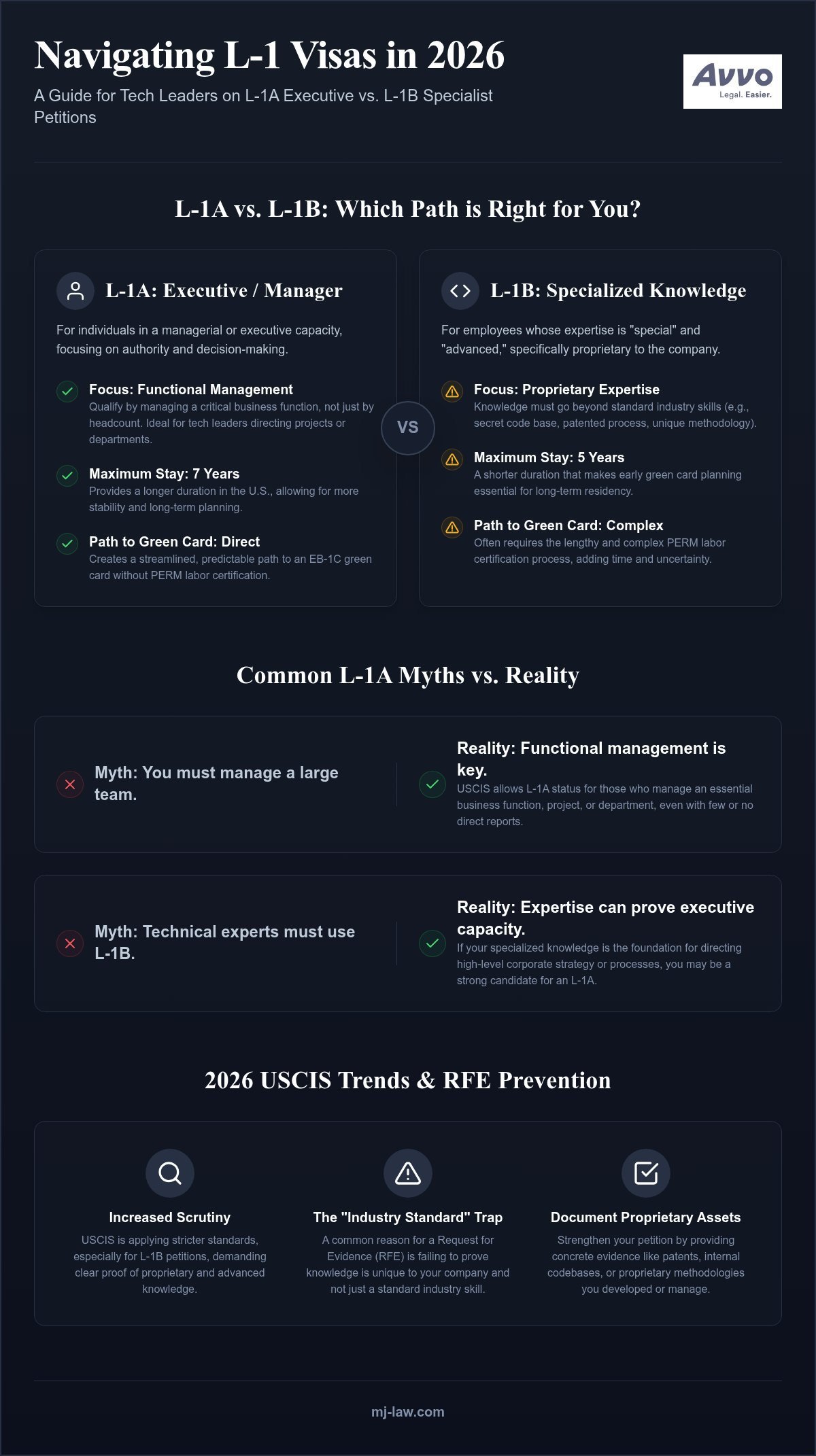
A common but dangerous misconception involves attempting to use “L-1A for specialized knowledge.” While an executive certainly possesses deep expertise, the L-1A petition must focus on authority and decision-making rather than the L-1B specialized knowledge requirements that define technical roles. If your primary value to the U.S. entity is your unique understanding of a proprietary system or process, the L-1B is the standard path. However, if that expertise is used to manage an essential function of the business, an L-1A might be viable and offers a more favorable seven-year stay compared to the five-year limit of the L-1B.
L-1A Managerial Capacity: Beyond Headcounts
In 2026, USCIS officers have moved beyond simply counting heads to determine managerial eligibility. They now focus heavily on “functional management,” which is especially relevant for high-growth tech firms in San Jose. You don’t necessarily need a team of ten subordinates to qualify as a manager if you exercise discretionary authority over a critical department or project. Managerial capacity in the context of high-level tech roles signifies the authority to direct an essential function or department without necessarily overseeing a large team of direct reports. We often see petitions succeed by proving the candidate manages a “function” rather than “people,” provided they have the authority to make high-level decisions and influence company policy.
L-1B Specialized Knowledge: The Technical Specialist
The L-1B specialized knowledge requirements demand proof that an employee’s expertise is both “special” and “advanced.” In the 2026 tech landscape, this means your knowledge must go beyond standard industry skills that a local hire might possess. It must be proprietary to the petitioning company, such as a secret code base, a unique manufacturing process, or a patented methodology. The L-1B is an excellent tool for technical experts, but it carries a strict five-year maximum stay. This shorter duration makes it imperative to begin green card processing early, as the transition from L-1B to permanent residency often requires the more complex PERM labor certification process, unlike the streamlined EB-1C path available to L-1A holders.
If you’re unsure which category fits your specific role in the Bay Area, we invite you to schedule a consultation through our Calendly link to discuss your strategy.
Myth-Busting: Can a Manager Use ‘Specialized Knowledge’ for an L-1A?
Many applicants view the L-1A and L-1B categories as mutually exclusive silos. They believe that if they are technical experts, they must follow the L-1B requirements, while only traditional “bosses” qualify for the L-1A. This binary thinking often leads to missed opportunities. In reality, proprietary expertise frequently serves as the very foundation of an L-1A functional manager role. Meeting the L-1B specialized knowledge requirements is a common goal for subject matter experts, but that same expertise can often prove an executive-level capacity when framed correctly.
There are two primary myths that frequently cause confusion for Silicon Valley professionals:
- Myth #1: You must manage at least 10 people to qualify for an L-1A. USCIS regulations specifically allow for “functional managers” who oversee an essential function of the organization rather than a large headcount.
- Myth #2: Technical experts must always apply for the L-1B category. If your specialized knowledge allows you to direct high-level corporate processes or departments, you may be better suited for the L-1A.
The Rise of the Functional Manager in Silicon Valley
A functional manager qualifies for an L-1A by demonstrating they manage a critical “function” within the company. This is common in tech hubs like San Jose, where a single Lead Architect might oversee a global software release. In this scenario, the manager isn’t necessarily conducting performance reviews for a dozen junior developers; instead, they are exercising discretionary authority over the technical lifecycle, budget, and strategic milestones of a product. Their specialized knowledge is what allows them to manage this process effectively. By proving that you control the “what” and “how” of a major corporate initiative, you can secure an L-1A even without a single direct report.
Strategic Selection: Why L-1A is Often Superior
Choosing the L-1A over the L-1B offers significant long-term advantages. The L-1A allows for a seven-year maximum stay, providing two additional years of flexibility compared to the five-year limit for L-1B holders. More importantly, the L-1A provides a direct, streamlined path to the EB-1C Multinational Manager Green Card. This avoids the lengthy and often unpredictable PERM labor certification process required for most L-1B to green card transitions. If you’re weighing these options against other technical paths, you might also consider how they compare to an H-1B vs E-2 Visa when planning your Silicon Valley career.
Determining whether your technical expertise qualifies you for a functional management role requires a nuanced legal strategy. If you’re ready to explore which category best protects your future, you can schedule a time to speak with our team to review your specific case details.
2026 RFE Trends: Why USCIS is Scrutinizing Executive Roles
In early 2026, we’ve observed a significant surge in Requests for Evidence (RFEs) targeting both managerial and technical petitions. USCIS adjudicators are applying a much higher level of skepticism toward the “special” nature of an employee’s expertise. This trend often manifests as the “Standard Industry Practice” trap. In these cases, officers claim that the skills described in the petition are generic or commonly found among professionals in the Silicon Valley labor market. They frequently argue that the L-1B specialized knowledge requirements aren’t met because the expertise isn’t sufficiently distinguished from standard industry knowledge.
The administrative landscape has also shifted with new regulatory requirements. Effective September 9, 2026, a new “9-11 Biometric Fee” applies to employers with 50 or more employees in the U.S. if more than 50 percent of those workers are in H-1B or L-1 status. This fee adds to the existing $4,500 Public Law 114-113 surcharge for certain firms. These changes reflect a broader push for increased oversight of the foreign entity’s actual operations and its hierarchy, ensuring that the relationship between the overseas office and the San Jose subsidiary is legitimate and active.
Common RFE Triggers for San Jose Tech Firms
For tech companies in the Bay Area, vague job descriptions remain the most frequent cause for a challenge. If a petition for an executive includes too many technical tasks, USCIS will categorize the role as an individual contributor rather than a manager. According to the USCIS definition of specialized knowledge, the evidence must clearly show that the expertise is proprietary and not easily transferable. We also see frequent RFEs when organizational charts are inconsistent between the foreign and U.S. entities, as officers look for a clear, logical structure that supports discretionary authority.
The 2026 Adjudication Climate
The current adjudication climate demands objective, verifiable evidence over simple testimonial letters. Officers now look for patents, internal training certificates, or proprietary code documentation to substantiate claims of expertise. Additionally, the rise of remote work has created new hurdles for proving managerial capacity. Adjudicators often question how an executive effectively directs an essential function or manages a team when the physical office presence is minimal. Successfully navigating these hurdles requires a proactive strategy that anticipates these questions before they are asked. If you’re preparing a high-level transfer, a consultation with an L-1A Visa Lawyer San Jose can provide the specific guidance needed to meet these rigorous 2026 standards.
Avoiding the L-1A RFE: Evidence Strategies for Silicon Valley Firms
Securing an L-1A approval in the high-stakes Silicon Valley environment requires shifting the focus from technical tasks to strategic control. While many applicants struggle to differentiate their daily work from L-1B specialized knowledge requirements, the key to avoiding a 2026 RFE lies in documenting your discretionary authority. For a functional manager, this means moving beyond a list of duties. You must provide concrete evidence of the essential function you oversee, such as specific revenue targets, project milestones, or the management of a high-value proprietary asset. If you can show that the success of a $10 million project hinges on your decision-making, you’ve built a strong case for managerial capacity.
Expert opinion letters from industry veterans or academics remain vital for validating the advanced nature of your expertise. These letters bridge the gap between “standard industry skill” and “advanced proprietary knowledge.” We also recommend a “Day in the Life” breakdown that emphasizes decisions over tasks. Instead of listing “attending meetings” or “writing code,” describe “authorizing resource allocation for global releases” or “making final determinations on architectural scaling.” This framing proves you aren’t just performing the work; you’re directing the technical lifecycle of the company.
The Technical Manager Evidence Checklist
To withstand USCIS scrutiny, your petition should include a robust evidence package. Adjudicators look for clear indicators that a manager operates at a high level within the corporate hierarchy. Key documents include:
- Organizational Charts: These must clearly place the manager above professional-tier employees, such as engineers or developers who hold at least a bachelor’s degree.
- Personnel Authority: Evidence of the power to hire, fire, or recommend significant personnel actions, even if the manager doesn’t have direct reports in a traditional sense.
- Proprietary Documentation: Proof of the unique nature of the products or processes managed, such as patents, internal white papers, or proprietary code repositories.
Leveraging Blanket Petitions for Large Corporations
For established multinational firms with high-volume transfer needs, the L-1 Blanket petition offers a streamlined path. This program allows a company to receive a single approval for its corporate structure, significantly reducing the paperwork for individual transfers. Under a blanket petition, specialized knowledge professionals are handled with a specific focus on their “advanced” expertise. This is often an ideal strategy for San Jose firms looking to move entire teams quickly. You can learn more about these requirements in our L-1 Blanket Petition Requirements: The 2026 Corporate Guide to Global Mobility.
If you’re concerned about how to present your technical role as a management position, we can help you build a compelling evidence strategy. We invite you to schedule a strategic review of your petition materials with our experienced team.
Navigating Complex L-1A Petitions with MJ Law in San Jose
MJ Law has spent over 30 years in the heart of Silicon Valley, serving as a reliable anchor for the tech community. We’ve witnessed the evolution of intracompany transfers from the early days of the dot-com boom to the current 2026 landscape. Our firm acts as the bridge between your technical innovation and legal compliance. We don’t just fill out forms; we build a narrative that showcases your professional value to the U.S. economy. This longevity in the San Jose area allows us to provide a level of seasoned expertise that is both authoritative and deeply personal.
Our collaborative approach is specifically designed for the high-tech sector. We work directly with your engineering and product teams to translate complex “dev-speak” into the precise terminology that USCIS adjudicators require. While many firms find it difficult to navigate the L-1B specialized knowledge requirements, we excel at identifying when technical expertise actually supports a functional management role. By diving deep into your proprietary codebases or patented processes, we ensure your petition reflects the true sophisticated nature of your work. For multinational transfers involving Spanish-speaking entities, our bilingual services in English and Spanish provide a seamless experience for your global talent pool.
Why Local Expertise Matters in San Jose
Our proximity to the San Jose USCIS field office provides a distinct advantage. We monitor local adjudication trends in real time, allowing us to anticipate how officers in the Bay Area might view specific evidence. We understand that Silicon Valley startups often utilize “flat” organizational structures that don’t always align with traditional corporate hierarchies. Our attorneys specialize in documenting these unique roles, proving that a leader manages an essential function even without a large headcount. Every complex specialized knowledge case is attorney-led, ensuring that your strategy is crafted by a seasoned expert who understands the local tech ecosystem.
Start Your L-1A Journey Today
Planning for the 2026 fiscal year requires a methodical and proactive strategy. The transition from an L-1A visa to a permanent Silicon Valley future is a significant life transition, and we’re committed to guiding you through every step. Whether you’re moving a single executive or an entire technical team, early preparation is the best defense against a Request for Evidence. You can begin this process by choosing to schedule a consultation with MJ Law. During this session, Gabriel Jack or Michael Muston will review your specific organizational structure and technical achievements to outline a clear, predictable path forward.
Securing Your Executive Future in Silicon Valley
As the 2026 immigration landscape becomes more rigorous, successfully distinguishing your managerial authority from technical tasks is vital. We’ve explored how functional management provides a viable L-1A path for tech leaders, even when their background initially seems to align with L-1B specialized knowledge requirements. By focusing on discretionary authority and proprietary impact, you can navigate the current spike in USCIS scrutiny while building a bridge toward permanent residency through the EB-1C category.
MJ Law brings over 30 years of Silicon Valley experience to your petition. Our team provides localized support in San Jose and San Francisco, specializing in the complex intersections of technical expertise and executive compliance. We understand the unique pressures of the Bay Area tech sector and are ready to help you translate your professional achievements into a winning legal strategy. It’s a journey that requires precision, but you don’t have to navigate it alone.
Take the next step in your professional journey by choosing to book an L-1A strategy consultation with MJ Law today. We look forward to helping you secure your future in the United States with confidence and clarity.
Frequently Asked Questions
Is an L-1A better than an L-1B for specialized knowledge workers?
Generally, yes, because the L-1A category offers a longer stay and a more direct path to permanent residency. While meeting L-1B specialized knowledge requirements is a common path for experts, the L-1A allows for a seven-year stay compared to five years for L-1B holders. It also bypasses the PERM labor certification process for an EB-1C green card. For tech leaders in San Jose, this provides significantly more long-term stability and a faster route to citizenship.
Can I qualify for an L-1A if I am the only employee in the U.S. office?
You can qualify as a functional manager even if you are the sole employee, provided you manage an essential function of the organization. USCIS recognizes that executives in early-stage Silicon Valley startups often operate without a large staff. You must demonstrate discretionary authority over high-level corporate processes or departments. We’ve helped many San Francisco based founders establish their presence by documenting their role in directing the company’s strategic growth rather than performing daily tasks.
What is the maximum stay for an L-1A manager in 2026?
The maximum total period of stay for an L-1A manager or executive is seven years. This is granted in increments, typically starting with three years for an established company or one year for a new office. On the other hand, those meeting L-1B specialized knowledge requirements are limited to a five-year maximum stay. This two-year difference is critical for multinational companies in San Jose that need extra time to complete green card processing for their key personnel.
How does USCIS define specialized knowledge for L-1B purposes?
USCIS defines specialized knowledge as an advanced understanding of the petitioning employer’s products, services, or proprietary techniques. This knowledge shouldn’t be commonly found in the general industry labor market. For a San Jose tech firm, this often includes proprietary codebases, unique manufacturing processes, or patented methodologies developed within the foreign entity. It requires objective evidence, such as internal training records or patents, to prove the expertise is truly advanced rather than standard industry skill.
Can I transition from an L-1B to an L-1A if I get promoted?
You can transition from L-1B to L-1A status if you are promoted to a managerial or executive position. This change of status must be approved by USCIS before you reach your fifth year in L-1B status. Successfully moving to the L-1A category extends your maximum stay to seven years and opens the door to the EB-1C green card path. Our attorneys in San Jose frequently manage these transitions to ensure the new managerial duties are documented correctly.
Do I need a specific degree to qualify for an L-1A visa?
There is no strict educational requirement for an L-1A visa, though a relevant degree can strengthen your case. USCIS focuses primarily on your professional experience and the nature of your role. You must have worked for a qualifying foreign entity for at least one continuous year within the three years prior to filing. While a degree is helpful, proving your authority to make discretionary decisions and manage essential business functions is the most critical factor for Silicon Valley executives.
How long does it take to process an L-1A petition with premium processing in 2026?
USCIS guarantees a response within 15 business days when you utilize premium processing for an L-1A petition. As of 2026, the premium processing fee is $2,965. This service ensures that the agency will issue an approval, a denial, or a Request for Evidence (RFE) within that timeframe. For San Jose companies on tight hiring schedules, this optional fee is a common investment to avoid standard processing times which can range from three to eight months.
What happens if my L-1A RFE is denied?
If your L-1A petition is denied after an RFE, you generally have the option to appeal the decision or file a motion to reopen or reconsider. You might also choose to refile a new petition with stronger evidence or explore different visa categories like the O-1 or H-1B. Denials are complex and require a methodical review of the USCIS decision letter. Our San Jose based team analyzes these denials to determine the most effective legal path forward for your career.