
Did you know that under the new wage-weighted system, an entry-level professional has only a 15.29% chance of selection in the 2026 lottery? For those weighing the H-1B vs E-2 visa, this data point highlights a growing reality: the traditional corporate path is becoming increasingly volatile. If you’re a tech professional in San Jose, you’ve likely felt the weight of this uncertainty. The dream of a Silicon Valley career shouldn’t feel like a gamble, yet the constant threat of layoffs and the rigid nature of employer sponsorship keep many talented individuals in a state of perpetual anxiety.
Deciding on your immigration strategy is no longer just a choice between jobs; it’s a choice between being an employee or a business owner. This guide provides a comprehensive comparison to help you determine if corporate employment or entrepreneurial investment offers the stability you need. We’ll explore how each option impacts your career mobility, family benefits, and long-term prospects for permanent residency so you can move forward with confidence.
Key Takeaways
- Understand the fundamental shift from being an employer-sponsored worker to an independent investor when comparing the H-1B vs E-2 visa.
- Explore how the 2026 wage-weighted lottery affects your selection probability and why an investment path might offer more legal certainty.
- Identify the specific family benefits of each route, including the automatic work authorization available for E-2 spouses.
- Compare the long-term green card pipelines to determine which strategy aligns best with your permanent residency goals in the United States.
- Learn how to structure a “substantial” investment that meets the rigorous standards of Silicon Valley immigration officers.
Comparing H-1B and E-2: Core Purpose and Eligibility
The decision between an H-1B vs E-2 visa often comes down to who holds the steering wheel: an employer or you. For decades, the H-1B has been the default for Silicon Valley talent, but the 2026 regulatory environment has significantly shifted the odds. While one path relies on a corporate job offer, the other depends on your country of citizenship and your capacity to invest capital into a new or existing enterprise.
The H-1B Specialty Occupation Standard
To qualify for an H-1B, your role must require highly specialized knowledge and a minimum of a bachelor’s degree in a specific field. In the San Jose tech corridor, this standard typically covers software engineers, AI researchers, and systems architects. This H-1B visa overview explains that the burden of proof lies with the sponsoring employer to demonstrate the role’s complexity.
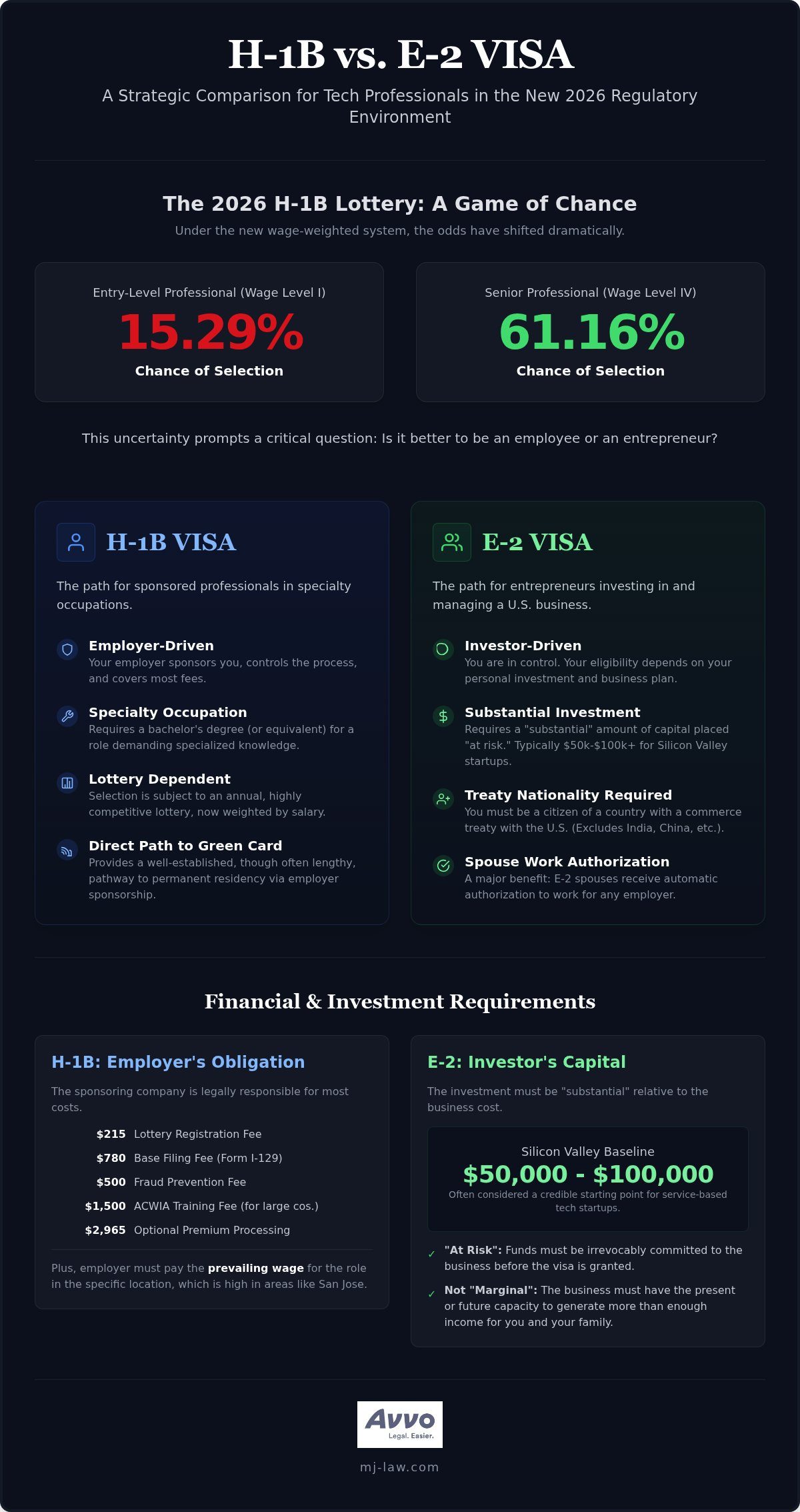
In 2026, eligibility is only the first hurdle. The new wage-weighted lottery system means your salary level directly dictates your probability of selection. Level I professionals currently face a 15.29% selection rate, while Level IV professionals see a much higher 61.16% chance. For the 2026 season, an H-1B applicant must possess a U.S. bachelor’s degree or its foreign equivalent and have a firm offer from a U.S. employer for a role that strictly requires that academic background.
The E-2 Treaty Investor Framework
The E-2 visa bypasses the lottery entirely but introduces a strict requirement: your nationality. You must be a citizen of a country that maintains a qualifying treaty of commerce with the United States. This excludes nationals from countries like India or China unless they hold dual citizenship with a treaty country. Unlike the H-1B, the E-2 is designed for those who intend to “direct and develop” a business they’ve invested in.
Passive investments, like purchasing real estate or stocks, won’t satisfy the requirements. You’re expected to actively manage the operations. New 2026 screening protocols have increased scrutiny on commercial roles to ensure E-2 holders are truly essential to the daily management of the business. If you’re looking to transition from a corporate role to entrepreneurship, you can book a session via our scheduling page to review the current treaty list and your specific investment goals.
Investment vs. Sponsorship: The Financial Requirements
The financial architecture of the H-1B vs E-2 visa differs fundamentally in who carries the burden and when the capital must be deployed. While the H-1B relies on corporate sponsorship where the employer covers most costs, the E-2 requires the individual to put their own capital at risk. Understanding these fiscal nuances is essential for any professional planning their 2026 immigration strategy in the Bay Area.
H-1B Filing Fees and Employer Obligations
For the H-1B, the employer is legally responsible for the majority of the costs. This includes the $215 registration fee for the lottery and the base filing fee of $780 for Form I-129. Additional expenses like the $500 Fraud Prevention and Detection fee and the $1,500 ACWIA training fee (for larger companies) quickly add up. If a company chooses to expedite the process, the premium processing fee is currently $2,965 as of March 2026.
Beyond the fees, the employer must submit a Labor Condition Application (LCA) to the Department of Labor. In San Jose and San Francisco, prevailing wage requirements are among the highest in the country. This ensures that foreign workers don’t undercut local salary standards. If you’re currently on an H-1B and considering a move to a new startup, consulting an h-1b transfer attorney San Jose can help you navigate these wage levels and employer obligations during a job change.
Defining ‘Substantial’ for E-2 Startups
The E-2 Treaty Investor visa doesn’t have a fixed minimum dollar amount. Instead, USCIS uses a “proportionality test” to decide if an investment is substantial. This compares the amount invested against the total cost of creating or purchasing the business. In the tech-heavy landscape of Silicon Valley, an investment of $50,000 to $100,000 is often viewed as a credible baseline for service-based startups or consulting firms.
A critical requirement is that the funds must be “at risk.” This means the capital must be committed to the business before the visa is granted; you can’t simply leave the money in a personal savings account. Officers in 2026 are also focusing heavily on “marginality.” Your business plan must demonstrate that the enterprise will generate more than enough income to provide a minimal living for you and your family. It should ideally create jobs for U.S. workers within five years. If you’re unsure if your capital meets these standards, you can schedule a consultation to review your specific source of funds and business model.
Flexibility and Control: Employee vs. Owner
Choosing between an H-1B vs E-2 visa isn’t just a legal decision. It’s a lifestyle choice that determines how much control you have over your career and your family’s future in the United States. In the fast-paced San Jose tech market, the ability to pivot or change employers can be the difference between professional growth and stagnant “golden handcuffs.” When comparing the H-1B vs E-2 visa, many tech founders find the latter offers a psychological relief that corporate sponsorship cannot match.
Career Mobility in Silicon Valley
H-1B holders often feel tethered to their sponsors. While you can transfer your visa to a new company, the process involves a new USCIS petition and the risk of the lottery if you’re not already cap-exempt. This creates a barrier for those wanting to join early-stage startups that might not have the legal infrastructure to support a transfer. On the other hand, the E-2 visa gives you the freedom to steer your own ship. If your startup needs to pivot its product or service model to stay competitive in 2026, you have the authority to make those changes without filing a new visa petition, provided the core business remains within the same scope.
Spouses of E-2 visa holders are considered employment authorized incident to status, meaning they don’t need to apply for a separate Work Authorization Document to begin working in the U.S. This is a massive advantage over the H-1B route. H-4 spouses often wait months for work permits, and they only qualify if the primary H-1B holder has reached a specific stage in the green card process. For many families in Silicon Valley, this single difference makes the E-2 a much more attractive option for dual-income households.
Renewals and Long-Term Stability
Stability is another area where these paths diverge. The H-1B is generally limited to six years. To stay longer, you must have an approved I-140 petition, which ties you even more closely to the green card sponsorship process. The E-2 visa can be renewed indefinitely in two or five-year increments. As long as you follow the Official E-2 Treaty Investor Guidelines and prove your business is viable and hiring U.S. workers, there’s no set expiration on your stay.
Managing the 2026 USCIS processing times for renewals requires proactive planning. Standard processing can take several months, though premium processing remains an option for those who need a decision in 15 business days. Travel remains a factor to watch, as consular appointments for visa stamps can still face seasonal delays. If you’re weighing the autonomy of ownership against the structure of corporate life, you can explore your options through our scheduling page to see which path fits your five-year plan.
Strategic Planning: The Path to a Green Card
While the immediate goal is securing legal status to work in San Jose, most professionals eventually look toward permanent residency. The fundamental difference between the H-1B vs E-2 visa in this regard is “dual intent.” An H-1B is a dual-intent visa, meaning you can apply for a green card without jeopardizing your current status. The E-2 is strictly a non-immigrant visa. While you can renew it indefinitely, there’s no direct, built-in bridge to a green card. You must find an independent immigrant category to secure your future.
The H-1B to Green Card Pipeline
The transition from H-1B to permanent residency usually follows the PERM Labor Certification process. Your employer must prove there are no qualified U.S. workers for your position before filing an EB-2 or EB-3 petition. In 2026, backlogs remain a significant factor for many applicants, particularly those from high-demand regions. One advantage of this path is the ability to retain your priority date. If you change employers after your I-140 is approved, you don’t lose your place in line. For those with exceptional backgrounds, working with an EB-2 NIW lawyer San Jose can help expedite this journey by bypassing the PERM process entirely.
Creative Green Card Strategies for E-2 Holders
E-2 investors often feel restricted by the visa’s non-immigrant nature, but successful tech founders have several strategic exits. The EB-1A “Extraordinary Ability” category is a popular choice for those who’ve achieved significant business success or received industry recognition. This allows you to self-petition without an employer. Alternatively, the National Interest Waiver (NIW) is an excellent fit for entrepreneurs whose work in fields like AI or clean energy benefits the U.S. economy.
If your business scales significantly, you might consider the EB-5 program. By increasing your investment to meet the 2026 thresholds of $800,000 in a Targeted Employment Area or $1,050,000 elsewhere, and creating ten full-time jobs, you can convert your investment into a green card. This requires careful financial planning from day one. To map out your specific transition strategy, you can book a strategy session with our team to ensure your business plan aligns with your long-term residency goals.
Navigating the Decision: Why San Jose Tech Talent Chooses MJ Law
Deciding between an H-1B vs E-2 visa in 2026 requires more than just a surface-level understanding of immigration law. It demands a partner who understands the unique pressures of the Silicon Valley tech ecosystem. At MJ Law, we provide a personalized assessment that considers your nationality, available capital, and long-term career aspirations. Our firm has spent over three decades serving the San Jose and San Francisco communities, positioning us as a reliable anchor for professionals facing these complex transitions.
We’ve built our reputation on a deep understanding of both corporate H-1B petitions and the intricate business plans required for E-2 success. This dual expertise allows us to guide you through the pros and cons of each path with a level of precision that generalist firms often lack. Our local presence in San Jose means we’re intimately familiar with the preferences and scrutiny levels of local USCIS offices, which is invaluable during interview preparation and petition filing.
The Silicon Valley Advantage
Our firm specializes in the specific needs of tech startups and multinational managers who are often moving at light speed. We frequently handle complex cases that involve transitioning from other visa categories to more stable long-term solutions. For example, we often assist executives with “New Office” L-1A to E-2 transitions when their business goals shift toward ownership. Global companies establishing a Silicon Valley presence should also be aware that a L-1B visa lawyer San Jose can help navigate the heightened USCIS scrutiny that new office petitions face in Northern California. Multinational corporations looking to streamline the transfer of multiple employees should also explore how understanding the L-1 blanket petition requirements can create a more predictable, high-velocity pipeline for moving executive and specialized knowledge talent into the U.S. If you’re currently in a leadership role and considering your options, speaking with an L-1A visa lawyer San Jose can help you determine the most effective way to secure your status while maintaining your business momentum.
Your Next Steps in 2026
The 2026 immigration season is already shaping up to be one of the most competitive on record. With the H-1B lottery registration window usually opening in early March, waiting until the last minute can lead to missed opportunities and unnecessary stress. Early consultation is critical to ensure your documents are in order and your strategy is sound. If the E-2 path is your choice, your business plan will need to withstand the increased scrutiny that officers are applying to commercial roles this year.
We invite you to take a proactive step toward your future in Silicon Valley. Whether you’re aiming for the stability of a corporate role or the autonomy of business ownership, we’re here to act as your compassionate guide. You can Schedule a consultation with MJ Law today to begin reviewing your specific case and mapping out a path that ensures your professional and personal success in the United States.
Securing Your Professional Future in Silicon Valley
The choice between an H-1B vs E-2 visa in 2026 ultimately depends on whether you seek the structure of corporate sponsorship or the autonomy of business ownership. While the H-1B remains a staple for many tech firms, the rising lottery complexity and wage-weighted selection process have made the E-2 a compelling alternative for eligible treaty nationals. Success in either path requires a proactive strategy that accounts for both immediate work authorization and long-term residency goals.
At MJ Law, we’ve spent more than 30 years helping the San Jose community navigate these pivotal transitions. Our team provides bilingual legal support and deep expertise in both tech-focused petitions and complex investor business plans. We act as a steady hand to ensure your application meets the high standards of 2026 immigration protocols. Don’t leave your status to chance in an uncertain lottery season. Book a Consultation with our San Jose Immigration Experts today to begin building a stable legal foundation for your career. Your journey in the United States is unique, and we’re here to help you navigate it with confidence.
Frequently Asked Questions
Can I switch from an H-1B to an E-2 visa if I am laid off?
Yes, you can transition if you meet the treaty country requirements and have capital to invest. You must file a change of status before your 60-day H-1B grace period ends. This is a common strategy for tech professionals in San Jose who want to launch their own startups rather than finding a new corporate sponsor. It’s essential to have your investment funds ready to be committed quickly.
Does the E-2 visa lead directly to a green card?
No, the E-2 is a non-immigrant visa and doesn’t have a direct path to permanent residency. However, many investors use their business success to qualify for other categories like EB-1A or EB-5. When comparing the H-1B vs E-2 visa, the lack of a direct green card path is a major factor. You must proactively plan an exit strategy into an immigrant visa category if you intend to stay permanently.
What is the minimum investment for an E-2 visa in San Jose?
There’s no legally defined minimum dollar amount for an E-2 visa. The investment must be substantial relative to the business type. In the San Jose tech sector, investments between $50,000 and $100,000 are often successful for service-oriented startups. The key is proving the investment is sufficient to ensure the business’s successful operation. It’s not just about the total cash; it’s about the proportionality of the capital.
Can my spouse work in the U.S. if I have an E-2 visa?
Yes, E-2 spouses are automatically authorized to work in the United States once they enter the country. They don’t need to file for a separate Employment Authorization Document (EAD) to begin employment. This provides a significant advantage over the H-1B, where spouses often face long wait times for work permits. This benefit allows families in the San Francisco Bay Area to maintain dual incomes while building a new business.
Is there a lottery for the E-2 visa like there is for the H-1B?
No, the E-2 visa doesn’t have an annual cap or a lottery system. Applications are processed as they’re received by USCIS or U.S. consulates abroad. This makes the E-2 a much more predictable option for those who qualify, especially given the low selection rates for the H-1B lottery in 2026. If you have the capital and the right nationality, you don’t have to worry about random selection.
How long does it take to process an E-2 visa in 2026?
Processing times vary depending on whether you apply through a consulate or via a change of status within the U.S. Consular processing usually takes two to four months. For those already in San Jose, a change of status can take a similar amount of time, though premium processing can reduce the wait to 15 business days. You should plan for additional time to prepare a comprehensive business plan and gather financial documentation.
Can I be the sole owner of my E-2 business?
Yes, you can be the 100% owner of your E-2 enterprise. The requirement is that you must own at least 50% of the business or possess operational control through a management position. Many tech founders in Silicon Valley choose sole ownership to maintain full control over their vision. This flexibility is a key differentiator in the H-1B vs E-2 visa debate, as H-1B workers are always employees of a separate entity.
What happens to my E-2 visa if my business fails?
If the business ceases operations, your E-2 status typically ends. You would need to either change to a different visa category, find an employer to sponsor you for an H-1B, or depart the United States. Maintaining the viability of the enterprise is a core requirement for renewals. Our firm has 30 years of experience helping San Jose entrepreneurs structure their businesses to minimize risk and plan for long-term operational success.