
For a multinational executive, the L-1A visa isn’t just a travel document; it’s the most powerful strategic bridge available for scaling Silicon Valley operations and securing a permanent future in the United States. Partnering with a dedicated L-1A visa lawyer San Jose allows you to navigate the complexities of U.S. immigration with the same precision you apply to your business. We understand that the pressure to transfer key leadership is often met with the stress of complex documentation and the fear of unpredictable processing delays. It’s a high-stakes transition where the difference between a successful transfer and a costly denial often hinges on the quality of your initial filing.
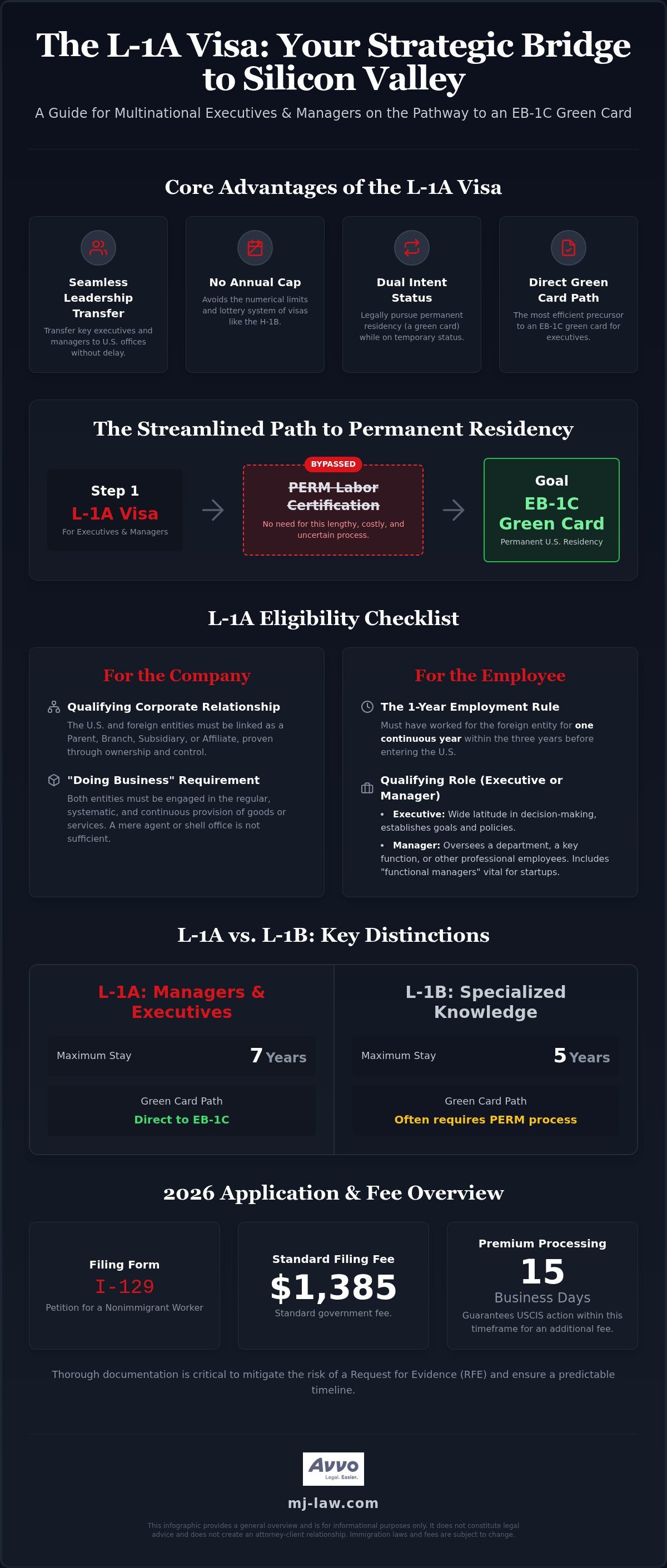
This guide provides a comprehensive roadmap to master intracompany transfers and transition seamlessly into an EB-1C green card without the need for a PERM labor certification. You’ll gain a clear understanding of the 2026 fee structures, such as the $1,385 standard filing fee and the premium processing options that guarantee action within 15 business days. We’ll walk through qualifying corporate relationships, documentation best practices, and the strategic advantages of dual intent status. By establishing a solid legal foundation, you can ensure a predictable timeline for your leadership team and a secure path for your company’s long-term growth in the Bay Area.
Key Takeaways
- Learn how the L-1A visa serves as a critical strategic tool for Silicon Valley companies to scale by seamlessly transferring high-level leadership from global offices.
- Partner with an L-1A visa lawyer San Jose to ensure your corporate structure meets the strict 2026 “qualifying relationship” and “doing business” standards required by USCIS.
- Discover why the L-1A is the most efficient precursor to an EB-1C green card, allowing executives to bypass the lengthy PERM labor certification process.
- Identify the essential documentation needed for Form I-129 to mitigate the risk of a Request for Evidence (RFE) and maintain a predictable expansion timeline.
- Understand the logistical advantages of working with a firm that has decades of experience navigating the specific requirements of the San Jose and San Francisco tech corridors.
Understanding the L-1A Visa for San Jose Business Expansion
The L-1A non-immigrant classification serves as a vital tool for multinational companies to transfer high-level personnel to their U.S. offices. Specifically designed for executives and managers, this visa category facilitates the seamless movement of leadership talent across borders. For tech companies in Northern California, working with an experienced L-1A visa lawyer San Jose is often the first step in a successful global expansion strategy. This visa offers distinct advantages over the H-1B, as it lacks an annual numerical cap and allows for “dual intent.” This means an executive can work toward permanent residency while maintaining their temporary status. For a broader perspective on these classifications, you can review this L-1 visa overview.
Distinguishing between L-1A and L-1B categories is essential for long-term planning. While the L-1A focuses on management, the L-1B is reserved for employees with specialized knowledge. The distinction is critical because L-1A holders can stay for up to seven years and have a more direct path to an EB-1C green card. This specific green card path is highly sought after because it bypasses the PERM labor certification process entirely, saving significant time and resources for the employer.
Executive vs. Managerial Roles: Which Do You Fit?
USCIS applies specific criteria to determine if a role qualifies. An executive must demonstrate wide latitude in decision-making and the authority to establish goals and policies. A manager, conversely, typically oversees a department, a specific function, or other professional employees. For many Silicon Valley startups, the “functional manager” category is indispensable. It allows for the transfer of leaders who manage essential business components even if they don’t oversee a large staff. A skilled L-1A visa lawyer San Jose will document these roles by highlighting the complexity of the function and the level of authority the individual holds within the organizational hierarchy.
The 1-Year Foreign Employment Rule
A cornerstone of eligibility is the requirement that the employee worked for the foreign entity for one continuous year within the three years preceding their U.S. admission. While brief trips to the U.S. for business or pleasure don’t break this continuity, that time doesn’t count toward the one-year requirement. Proving this role was truly executive or managerial requires substantial evidence, such as detailed organizational charts, payroll records, and performance reviews. If you’re unsure if your specific timeline meets these standards, you can schedule a consultation to review your employment history and documentation.
L-1A Eligibility Criteria: Meeting USCIS Standards in 2026
Success in an L-1A petition begins with a precise legal alignment of your corporate structure. It isn’t enough for two companies to simply work together; they must share a specific qualifying relationship as defined by federal regulations. An L-1A visa lawyer San Jose can help you document these ties through stock certificates, tax filings, and articles of incorporation. This documentation proves that the U.S. company is a parent, branch, subsidiary, or affiliate of the foreign employer. Without this foundational proof, the petition cannot move forward, regardless of the candidate’s qualifications.
Beyond the relationship, both the U.S. and foreign entities must be doing business. USCIS defines this as the regular, systematic, and continuous provision of goods or services. It doesn’t include the mere presence of an agent or a shell office. For the executive or manager, you’ll need to demonstrate they’ve held a qualifying leadership role abroad for at least one continuous year within the last three. Reviewing the official USCIS L-1A requirements provides a baseline, but applying these rules to modern tech structures requires a nuanced approach that accounts for the speed of the Silicon Valley market.
Qualifying Corporate Relationships (Parent, Subsidiary, Affiliate)
USCIS focuses on control and ownership to establish a qualifying relationship. In traditional structures, this is proven via majority ownership. However, many San Jose startups face challenges due to complex venture capital funding or diverse ownership groups. In these cases, we look for de facto control, where one entity has the power to direct the management and policies of the other. Proving this often requires a detailed analysis of voting trusts or shareholder agreements to ensure the petition meets the strict 2026 standards. We work to ensure these complex financial arrangements are presented clearly to avoid unnecessary delays.
Establishing a “New Office” in Silicon Valley
If your U.S. company has been in operation for less than 12 months, you’ll likely file a New Office petition. This is a common scenario for international firms expanding into the Bay Area. Unlike established companies, you must provide evidence that you’ve secured a physical business location in San Jose or nearby. USCIS expects to see a lease for a space sufficient to house the intended operations; virtual offices or residential addresses are typically insufficient. Additionally, you must provide a comprehensive business plan. This plan must demonstrate that the new U.S. office will grow large enough to support an executive or managerial position within the first year of the visa. For a detailed breakdown of what USCIS scrutinizes in these filings, our L-1 New Office Petition Guide for San Jose Businesses covers the specific documentation and compliance requirements you’ll need to meet. If you’re currently planning an expansion, you can schedule a review of your business plan to ensure it meets these specific criteria and demonstrates the required financial viability.
The Strategic Path from L-1A to EB-1C Green Card
Transitioning from a temporary work assignment to permanent U.S. residency is a primary objective for many international executives. The L-1A visa provides a unique advantage because it’s a “dual intent” classification. Unlike many other visa types, the L-1A allows you to legally work in San Jose while you’re simultaneously pursuing a green card. This eliminates the risk of being denied entry due to “immigrant intent.” For leaders looking to settle in the Bay Area, an L-1A visa lawyer San Jose helps structure the initial petition to align perfectly with future residency requirements. We look beyond the immediate transfer to ensure your long-term goals are protected.
The bridge between the L-1A and permanent status is typically the EB-1C category. Since the USCIS L-1A visa eligibility criteria share many fundamental similarities with the EB-1C standards, the transition is often smoother than other employment-based paths. Standard processing for an I-140 petition in this category can take between 18 and 20.5 months. However, premium processing is available with a 45-business-day adjudication commitment. This predictability is invaluable for corporate planning and family stability. For professionals evaluating all available options, understanding the differences between the H-1B vs E-2 visa pathways can also inform a more comprehensive long-term immigration strategy. International investors who are also considering treaty-based options may benefit from consulting an E-2 visa attorney San Jose professionals rely on to evaluate whether an investment-based classification better aligns with their business goals.
EB-1C: The Multinational Manager Green Card
The EB-1C green card is designed specifically for managers and executives who have been employed abroad for at least one of the three years preceding their petition. One of its greatest benefits is that it bypasses the PERM labor certification process. This saves employers months of recruitment efforts and government filings. Because the requirements for the L-1A and EB-1C are so closely mirrored, the evidence gathered for your initial work visa serves as a strong foundation for your green card application.
Managerial Capacity Requirements for Permanent Residency
To succeed in an EB-1C petition, you must prove the U.S. position is permanent and requires a high level of authority. USCIS places heavy emphasis on the organizational chart. You must demonstrate that you manage professional-level staff or a critical function within the company. This is where a detailed EB-1C Green Card for Multinational Managers in San Jose strategy becomes essential. We help you document these relationships to show that your role is truly managerial in nature.
Planning for the EB-1C should begin the moment the L-1A is filed. The filing fee for Form I-140 is $715, and the fee for Form I-485 to adjust status is $1,440. By coordinating these filings with a veteran L-1A visa lawyer San Jose, you can manage these costs and timelines effectively. We ensure your documentation clearly reflects your executive duties, providing a secure path to permanent residency for you and your family.
Navigating the Application Process and Avoiding RFEs
Securing an L-1A visa requires a meticulous approach to documentation and timing. The process officially begins with the gathering of corporate records, such as audited financial statements and detailed organizational charts, alongside individual evidence of your managerial tenure abroad. Once the file is complete, your L-1A visa lawyer San Jose will submit Form I-129 to the appropriate USCIS service center. As of late 2026, the standard filing fee for this form is $1,385, though small employers with 25 or fewer employees qualify for a reduced fee of $695. Precision is mandatory; a policy update in August 2026 granted officers greater discretion to deny petitions that lack initial evidence without first issuing a Request for Evidence (RFE).
After USCIS approves the petition, you’ll need to complete consular processing at a U.S. embassy abroad or a Change of Status if you’re already in the United States on a different valid visa. This stage also includes the L-2 visa process for spouses and unmarried children under 21. While the executive focuses on the business transition, we ensure the family’s documentation is handled with equal care to prevent unnecessary separation. Managing these parallel tracks effectively is a hallmark of a structured professional process that prioritizes individual success stories.
Premium Processing and 2026 Timelines
Wait times can fluctuate significantly depending on the service center’s workload. Standard processing currently takes approximately 7 months. For businesses with urgent start dates, the optional premium processing service is often a strategic necessity. For a fee of $2,965, USCIS guarantees an initial action on your L-1A petition within 15 business days. We typically recommend this for San Jose tech firms where leadership must be on-site to oversee critical product launches or funding rounds. It replaces months of uncertainty with a predictable 15-day adjudication commitment.
Common L-1A Pitfalls for San Jose Tech Companies
The “Small Office” RFE is a frequent hurdle for startups and smaller enterprises. USCIS may question how a manager can perform high-level duties without a large staff to handle the day-to-day administrative tasks. We address this by highlighting the complexity of the business function and the manager’s wide discretionary authority. Another common trap is the “Specialized Knowledge” confusion, where USCIS mischaracterizes a managerial role as a technical one. MJ Law leverages decades of experience to pre-emptively structure your petition, ensuring the role is clearly defined as executive or managerial from the start. If you’re concerned about how your organizational structure will be perceived by an adjudicator, book a strategy session to review your case before you file.
Why Silicon Valley Corporations Trust MJ Law for L-1A Petitions
Navigating the complexities of intracompany transfers requires more than just legal knowledge; it demands a deep understanding of the local economic ecosystem. For decades, MJ Law has served as a trusted partner for Silicon Valley corporations, acting as a seamless extension of their internal HR teams. Choosing an experienced L-1A visa lawyer San Jose ensures that your leadership transfers are handled with the precision and speed necessary in the tech sector. Our approach is built on a foundation of collaborative support, moving beyond transactional services to foster long-term success for both the organization and the individual.
We recognize that transferring an executive is a high-stakes transition. Our firm balances a corporate level of precision with a personal touch, ensuring that every petition is grounded in matter-of-fact evidence rather than hyperbole. This steady, composed style is designed to instill a sense of security in our clients, positioning MJ Law as a reliable anchor in a specialized and often intimidating field. We don’t just file forms; we provide the strategic foresight needed to navigate 2026’s rigorous adjudication standards.
Decades of Local Expertise in San Jose
Since 1985, our firm has provided stability in an ever-changing immigration landscape. This longevity allows us to offer a perspective that few others can match. We maintain a deep familiarity with the San Jose USCIS Field Office and the specific regional trends that influence adjudication outcomes. This local presence provides a logistical advantage, especially when dealing with time-sensitive filings or complex corporate restructures. While we specialize in business mobility, our expertise also extends to supporting the relatives of transferees. If you need assistance with broader household needs, our Family Immigration Lawyer San Jose resources provide comprehensive guidance for U.S. family reunification.
Tailored Legal Strategies for Global Mobility
Our petitions are never generic. We develop customized legal strategies that reflect the unique culture and rapid growth trajectories of Silicon Valley startups. Whether you’re filing a complex “New Office” petition or transitioning an executive to permanent residency through an EB-1C case, our high success rates stem from a methodical, detail-oriented process. Clients receive direct access to Gabriel Jack and Michael Muston, ensuring that every case benefits from high-level expertise and decades of combined experience.
To better serve our diverse community, we offer bilingual consultations in both English and Spanish. This commitment to accessible communication has helped us earn over 250 five-star Google reviews from clients who value our composed and reassuring guidance. We provide a clear roadmap for your company’s global mobility goals. When you work with an L-1A visa lawyer San Jose from MJ Law, you’re gaining a partner dedicated to your long-term growth. To take the first step in your professional journey, schedule your L-1A consultation today.
Securing Your Silicon Valley Future
Success in the competitive Bay Area market requires a leadership team that is both agile and permanent. By mastering the L-1A visa requirements and leveraging the strategic dual intent path to an EB-1C green card, your company can secure its most valuable assets. Managing these procedures requires a methodical approach that accounts for the latest 2026 USCIS policy shifts and fee updates. Partnering with a dedicated L-1A visa lawyer San Jose ensures that your initial filing is comprehensive, minimizing the risk of delays or denials that can stall global expansion.
MJ Law has been a steady hand for the Silicon Valley community since 1985. With over 30 years of experience and 250+ five-star Google reviews, we provide the reassuring expertise needed to handle complex corporate restructures and individual residency goals. Whether you’re seeking consultations in English or Spanish, our firm acts as a proactive partner in your professional journey. Take the next step toward a predictable and successful transfer by choosing a firm that understands the speed of tech-sector growth. Schedule Your L-1A Strategy Session with MJ Law today. We look forward to helping your leadership thrive in the United States.
Frequently Asked Questions
How long is the L-1A visa valid for in 2026?
The maximum period of stay for an L-1A visa holder is seven years. Typically, USCIS grants an initial approval for three years, which you can extend in two-year increments. However, if you’re coming to the U.S. to establish a new office in San Jose, the initial visa is valid for only one year. You’ll then need to prove the office is active and supporting an executive role to secure an extension.
Can my spouse work in the U.S. on an L-2 visa?
Yes, your spouse can work in the United States while on an L-2 visa. Current regulations allow L-2 spouses to be authorized for employment incident to their status. This means they don’t necessarily need to wait for a separate Employment Authorization Document (EAD) to begin working. This flexibility is a significant benefit for families relocating to the San Francisco Bay Area, allowing for a much smoother household transition.
What is the minimum salary requirement for an L-1A executive in San Jose?
USCIS doesn’t mandate a specific prevailing wage for L-1A visas like it does for the H-1B category. However, the compensation must be appropriate for an executive or managerial position within the high-cost San Jose market. Adjudicators often look at whether the salary is sufficient to support the transferee without the need for additional employment. An L-1A visa lawyer San Jose can help ensure your compensation package meets these discretionary standards.
Can a tech startup founder qualify for an L-1A visa?
A tech startup founder can certainly qualify for an L-1A visa if the corporate structure is handled correctly. The key requirement is demonstrating an employer-employee relationship where the company has the right to control the founder’s work. This is usually proven by showing a board of directors or a separate ownership group that maintains oversight. We’ve successfully navigated these “New Office” petitions for many international founders expanding into Silicon Valley. For founders navigating the specialized knowledge requirements that often arise in these cases, working with an experienced L-1B visa lawyer San Jose can help ensure all aspects of your petition are properly documented.
Is there an annual cap for L-1A visas like there is for H-1B?
Unlike the H-1B visa, there’s no annual numerical cap for L-1A visas. This makes it a highly reliable option for companies that need to transfer leadership to San Jose at any time during the year. You don’t have to wait for a lottery or a specific filing window. This predictability allows for strategic business planning and ensures that your global mobility goals aren’t delayed by arbitrary government quotas. For professionals who are also weighing employer-sponsored options, our detailed guide on the H-1B vs E-2 visa comparison offers additional context on how these categories differ in terms of caps, flexibility, and long-term planning. Entrepreneurs who are also exploring investment-based immigration as an alternative should consider speaking with an E-2 visa attorney San Jose businesses trust to understand how treaty investor status compares to employment-based visa categories.
What happens if my L-1A petition receives an RFE?
If your petition receives a Request for Evidence (RFE), you’ll have a specific timeframe to provide the missing documentation. However, a 2026 policy update allows USCIS officers to deny petitions that lack required initial evidence without issuing an RFE first. This is why working with an L-1A visa lawyer San Jose is critical for a complete initial filing. If an RFE is issued, we respond with a methodical, evidence-based package.
Can I change employers while on an L-1A visa?
No, the L-1A visa is employer-specific and tied to the qualifying relationship between the U.S. and foreign entities. If you wish to change to an unrelated U.S. employer, you’d generally need to qualify for a different visa category, such as an H-1B or O-1. If you’re transferred to a different subsidiary within the same corporate group, an amended petition may be required to maintain your legal status in San Francisco.
How long do I need to have worked for the foreign company before applying?
You must have been employed by the foreign company for at least one continuous year within the three years immediately preceding your application. This work must have been performed in an executive or managerial capacity. Brief trips to the United States for business or pleasure don’t interrupt the continuity of your year abroad, but that time spent in the U.S. doesn’t count toward the one-year requirement. Accurate payroll records are essential.