For a multinational corporation scaling in 2026, waiting months for individual USCIS approvals isn’t just an inconvenience; it’s a strategic bottleneck that can stall critical product launches or market expansions. You’ve likely felt the weight of the administrative burden that comes with repetitive filings, especially when the definition of a specialized knowledge professional seems to shift with every new petition. It’s frustrating to watch your global mobility strategy get slowed down by bureaucratic hurdles that feel entirely avoidable when you’re trying to move talent at the pace of business.
We understand that your primary goal is to create a seamless pipeline for your executive and managerial talent. By mastering the L-1 blanket petition requirements, you can bypass the cycle of individual USCIS filings and move toward a more predictable, high-velocity transfer model. This guide provides a clear roadmap to help you navigate the 2026 eligibility criteria, from corporate sales thresholds to the latest visa integrity fees. We’ll examine how to streamline your internal processes, reduce your long-term legal expenditures, and ensure your organization remains a steady anchor for its international workforce during complex transitions.
Key Takeaways
- Learn how to bypass repetitive I-129 filings at USCIS service centers by utilizing the “consular-only” advantage of a Blanket L petition.
- Master the specific L-1 blanket petition requirements for corporate eligibility, including the mandatory one-year operational rule and qualifying relationship structures.
- Identify which employees qualify under the blanket, focusing on the one-year continuous employment rule and the eligibility of managers and specialized knowledge professionals.
- Prepare for the 2026 fee landscape, including mandatory costs like the 9-11 Biometric Fee and the updated Visa Integrity Fee.
- Discover how a pre-filing audit of your corporate structure can secure your global mobility strategy and reduce long-term administrative costs.
What is an L-1 Blanket Petition? Streamlining Multinational Transfers
An L-1 Blanket petition is a powerful regulatory tool that allows a multinational corporation to receive a single, broad approval for its entire corporate structure. Instead of justifying the relationship between a parent company and its subsidiaries for every single transfer, the organization proves these connections once. This pre-approval simplifies the process of moving executives, managers, and specialized knowledge professionals into the United States. While a general L-1 visa overview outlines the basic requirements for individual transfers, the Blanket program is a distinct, high-velocity lane for companies that meet specific size and volume thresholds.
The most significant advantage of this program is the “consular-only” processing route. Once the Blanket structure is established, individual employees bypass the traditional Form I-129 filing at a USCIS service center. They take their documentation directly to a U.S. Consulate abroad. This shift removes a major layer of domestic bureaucracy, which is particularly beneficial for San Jose tech firms that need to onboard critical talent without the unpredictability of USCIS service center backlogs. Meeting the L-1 blanket petition requirements allows your firm to treat global mobility as a standard operational process rather than a series of legal emergencies.
Blanket L vs. Individual L Petitions
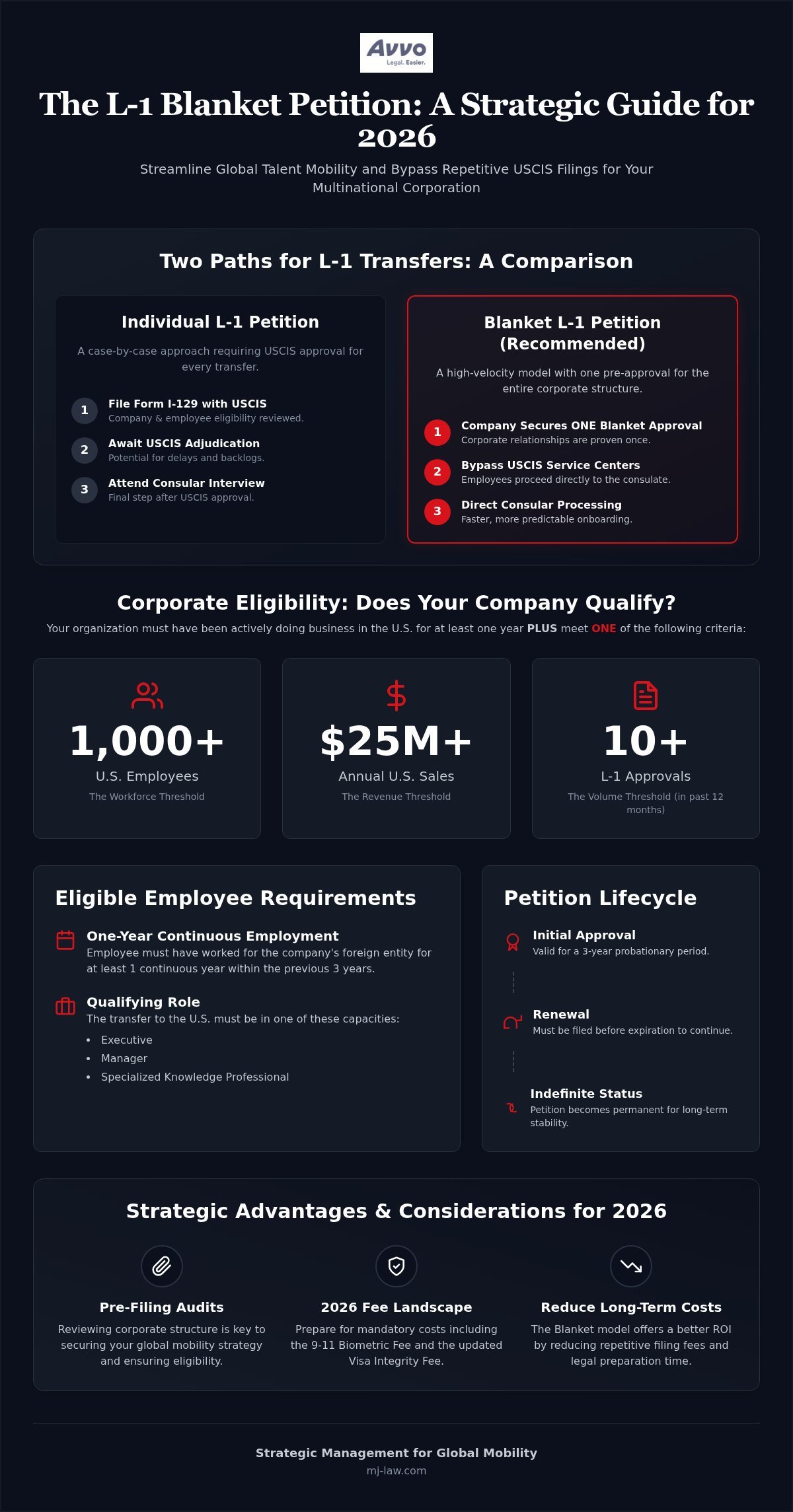
The primary difference between these two paths is the point of adjudication. In an individual petition, USCIS must approve the company’s eligibility and the employee’s qualifications before a visa interview can even be scheduled. Under a Blanket petition, the corporate eligibility is already settled; the consular officer only needs to verify the individual’s role and their one-year prior employment with the foreign entity. High-growth firms in Silicon Valley often prefer this model because it scales efficiently. If your organization transfers ten or more employees annually, or has U.S. sales of at least $25 million, the Blanket model typically offers a better return on investment by reducing both filing fees and legal preparation time.
The Indefinite Blanket Renewal
When USCIS first approves a Blanket petition, it’s granted for an initial three-year probationary period. This allows the government to verify that the company is using the program correctly and maintaining its qualifying relationships. To ensure the program remains a permanent fixture of your mobility strategy, you must file for a renewal before this initial period expires. If the renewal is approved, the Blanket petition becomes indefinite. This means the underlying corporate structure doesn’t need to be re-proven to USCIS again, provided the company remains in good standing and continues to meet all L-1 blanket petition requirements. It’s a goal that provides long-term stability for any multinational’s U.S. expansion plans.
Corporate Eligibility: Does Your Company Meet the Threshold?
The L-1 Blanket program is designed for established multinational organizations that maintain a consistent presence in the United States. To qualify, your company must first demonstrate it has been “doing business” in the U.S. for at least one year. This doesn’t simply mean having a registered office; the entity must be actively, regularly, and systematically providing goods or services. You’ll need to provide evidence like tax returns, audited financial statements, or commercial contracts to prove this operational history. Proving this foundational requirement is the first step in meeting the broader L-1 blanket petition requirements.
Meeting the Size and Volume Criteria
Unlike individual petitions, the Blanket program requires a company to meet specific size benchmarks. You don’t need to satisfy every category; meeting just one of the following three criteria is sufficient to establish your eligibility:
- The Workforce Threshold: Your organization employs at least 1,000 workers currently based in the United States.
- The Revenue Threshold: Your U.S. subsidiaries or affiliates have combined annual sales or gross revenue of at least $25 million.
- The Volume Threshold: Your company has received at least 10 individual L-1 petition approvals from USCIS in the preceding 12-month period.
For many Silicon Valley firms, the revenue or approval volume metrics are the most accessible paths. If your organization is growing rapidly but hasn’t yet hit the 1,000-employee mark, focusing on your annual sales data is often the most efficient strategy. If you’re uncertain which metric best supports your case, you can schedule a consultation to review your corporate records and filing history.
Proving a ‘Qualifying Relationship’ in Tech Structures
Establishing the legal link between the U.S. petitioner and the foreign entities is often the most intricate part of the application. The USCIS L-1B requirements state that you must prove a parent, branch, subsidiary, or affiliate relationship. In the tech sector, this often involves navigating complex venture capital ownership models or multi-layered holding company structures.
You must demonstrate that the U.S. and foreign entities are under common control or that one owns at least 50% of the other. For startups with global R&D centers, this requires clear documentation of stock certificates, capitalization tables, and partnership agreements. A common pitfall is failing to account for “de facto” control in 50/50 ownership splits. Providing a steady, well-documented narrative of your corporate structure is essential to avoiding Request for Evidence (RFE) notices during the initial Blanket filing. When these relationships are clearly defined, the Blanket petition becomes a reliable anchor for your global mobility strategy.
Employee Requirements: Who Qualifies Under a Blanket?
Establishing corporate eligibility is only half of the challenge; the individual candidate must also meet stringent criteria to utilize the streamlined Blanket process. The most foundational of these L-1 blanket petition requirements is the one-year continuous employment rule. Each candidate must have worked for your qualifying foreign office for at least one full, continuous year within the three years immediately preceding their transfer to the United States. It’s important to remember that time spent in the U.S. on other visa types, such as B-1 or H-1B, generally doesn’t count toward this 12-month requirement, even if the employee remained on the foreign payroll.
The Blanket program is specifically reserved for L-1A managers and executives, as well as a very specific subset of L-1B specialized knowledge workers. While individual petitions allow for a broader range of specialized knowledge, the Blanket L program enforces a strict “professional” standard. Consular officers use a standard of review for blanket L-1 visas known as the “clearly approvable” standard. If an employee’s qualifications aren’t immediately and obviously aligned with the regulations, the officer will likely deny the Blanket application and require the company to file an individual I-129 petition instead.
Defining the ‘Professional’ for L-1B Blanket Transfers
The most common hurdle in tech-sector transfers is the degree requirement for L-1B workers. To qualify under a Blanket petition, an L-1B employee must be a “specialized knowledge professional.” This means they must possess a U.S. bachelor’s degree or its foreign equivalent in a field directly related to their specialized role. If a highly skilled developer or data scientist gained their expertise through years of experience but lacks a formal degree, they are ineligible for the Blanket process. These non-professional specialized knowledge workers must still go through the individual USCIS filing route, which remains a necessary alternative for many talented individuals in the Silicon Valley ecosystem. Understanding the full scope of L-1B specialized knowledge requirements and 2026 RFE trends can help your team anticipate USCIS scrutiny and build stronger documentation from the outset.
Managerial and Executive Roles (L-1A)
L-1A candidates often find the Blanket process more straightforward, provided their job duties are clearly defined. In the flat organizational structures common in San Jose tech firms, we frequently rely on the “functional manager” definition. This allows you to transfer individuals who manage a critical business function, such as a global product line or a specific technical infrastructure, even if they don’t have a large team of direct reports. The evidence must demonstrate that the manager has the authority to make high-level decisions and isn’t primarily performing the day-to-day tasks of the function they oversee. For executives, the focus shifts to their broad decision-making power and their role in setting the organization’s strategic direction.
The 2026 Filing Process and Fee Landscape
The filing process begins with a foundational petition to USCIS using Form I-129. This filing establishes the corporate structure by documenting the qualifying relationships between the parent company and its global subsidiaries. Once this is approved, the company doesn’t need to re-prove its corporate structure for each individual transfer. Instead, the employer issues a Form I-129S directly to the candidate. This document certifies that the employee satisfies the L-1 blanket petition requirements for their specific role as a manager, executive, or professional with specialized knowledge.
The candidate then proceeds to a U.S. Consulate for an interview. This shift from domestic USCIS adjudication to international consular review is the primary driver of speed in the Blanket program. For Silicon Valley organizations, this means critical hires can often be on the ground in weeks rather than months, bypassing the long queues at regional service centers. It transforms a reactive legal hurdle into a proactive business tool.
Consular Processing with Form I-129S
The Form I-129S acts as the individual’s “Certificate of Eligibility.” During the interview at an international post or a field office like San Francisco, the officer focuses on whether the candidate’s specific role fits the pre-approved Blanket. You should prepare your candidates for questions regarding their technical expertise or managerial authority. If an officer denies an I-129S application, it doesn’t necessarily mean the candidate is ineligible for an L-1 visa. It often means the case wasn’t “clearly approvable” under the Blanket, and the firm must pivot to an individual I-129 filing to provide more exhaustive documentation.
2026 Fee Updates for Covered Employers
The financial landscape for 2026 includes several mandatory costs that vary based on company size and workforce composition. A critical update is the 9-11 Biometric Fee, which became effective on September 9, 2026. This $4,500 fee applies to “covered employers” with 50 or more employees in the U.S. if more than 50 percent of those workers hold H-1B or L-1 status. Standard filing costs for 2026 also include:
- I-129 Filing Fee: $1,385 for large companies or $695 for small employers with 25 or fewer workers.
- Asylum Program Fee: $600 for large employers or $300 for small employers ($0 for nonprofits).
- Fraud Prevention Fee: A $500 charge for most initial L-1 petitions.
- Visa Integrity Fee: A $250 fee required for all L-1 visa applicants starting in fiscal year 2025.
To ensure your organization is accurately calculating these costs and meeting all regulatory deadlines, schedule a consultation with our San Jose team. We can help you audit your workforce to determine if the 9-11 Biometric Fee applies to your upcoming transfers.
Strategic Management: Why Work with an L-1 Blanket Petition Lawyer?
Managing a global workforce requires more than just meeting the basic L-1 blanket petition requirements. It demands a proactive legal strategy that anticipates regulatory shifts and internal corporate changes. A seasoned attorney acts as a steady hand, auditing your corporate structure before you file to ensure every subsidiary and affiliate remains qualifying. This is particularly vital for high-growth tech firms where mergers, acquisitions, or restructuring can inadvertently jeopardize Blanket eligibility. By identifying these issues early, you prevent the operational disruptions that occur when a previously approved structure is suddenly questioned by USCIS.
Managing the “specialized knowledge” narrative is a high-stakes task for tech companies. Under a Blanket petition, the “professional” requirement is strict. If your documentation doesn’t clearly show that a software engineer or data scientist holds the equivalent of a U.S. bachelor’s degree, the transfer can be rejected at the consulate. We help you build these narratives carefully, ensuring that every I-129S is “clearly approvable” to avoid the delays of individual filings. When USCIS issues a Request for Evidence (RFE) on a Blanket renewal, our team provides the detailed corporate documentation needed to maintain your organization’s standing without missing a beat.
Local Expertise for Silicon Valley Corporations
MJ Law provides a steady anchor for organizations navigating the fast-paced Silicon Valley environment. With 30 years of experience in San Jose, we’ve developed a deep understanding of the local USCIS field office’s specific trends and expectations. This local insight is invaluable when coordinating global mobility for headquarters in San Jose or San Francisco. We offer bilingual consultations in English and Spanish, allowing us to communicate effectively with diverse global teams and ensure every stakeholder understands the nuances of the L-1 blanket petition requirements. Our firm is committed to individual success stories, treating each transfer as a critical component of your company’s growth.
From L-1 Blanket to Permanent Residency
The L-1 Blanket program isn’t just a temporary solution; it’s often the first step in a long-term talent retention strategy. For L-1A executives, we specialize in transitioning these roles into EB-1C permanent residency, which allows your leaders to secure their status without the PERM labor certification process. For L-1B professionals, we manage the strategic timing of PERM filings to ensure they transition smoothly before their five-year limit expires. This comprehensive approach ensures that your U.S. expansion is supported by a stable, permanent workforce. You can consult MJ Law via Calendly for a full mobility audit to align your 2026 transfers with your long-term corporate goals.
Securing Your Organization’s Future in Global Mobility
Establishing a robust transfer program requires a deep understanding of the current L-1 blanket petition requirements and a commitment to meticulous documentation. By meeting the 2026 corporate thresholds and preparing your professional candidates for the “clearly approvable” standard at the consulate, you can transform your U.S. onboarding into a predictable, high-speed process. This strategic approach doesn’t just solve immediate staffing needs; it creates a reliable pathway for long-term talent retention and permanent residency for your most critical leaders.
With over 30 years of experience in San Jose, our team specializes in the high-volume transfers that drive Silicon Valley’s success. We provide bilingual legal support to ensure your global teams feel secure and informed throughout every stage of the transition. Whether you’re navigating the new 9-11 Biometric Fee or auditing your corporate structure for an indefinite renewal, we’re here to act as your firm’s steady anchor. Schedule a consultation with an L-1 blanket petition lawyer at MJ Law to streamline your 2026 filings and secure your international workforce. Your organization’s growth shouldn’t be limited by administrative delays; let’s build a steady foundation for your success together.
Frequently Asked Questions
What is the main benefit of an L-1 Blanket petition for a large company?
The primary advantage is the “consular-only” processing route, which significantly reduces the onboarding time for San Jose tech hires. Large companies bypass the repetitive and time-consuming Form I-129 filings at USCIS service centers. Instead, they issue a Form I-129S directly to qualified candidates. This allows employees to go straight to a U.S. Consulate for their interview, providing a more predictable timeline for critical executive and managerial transfers across your global offices.
Can a new U.S. office qualify for an L-1 Blanket petition immediately?
A new U.S. office cannot qualify for a Blanket petition immediately. One of the foundational L-1 blanket petition requirements is that the U.S. entity must have been “doing business” for at least one continuous year. This means the office must be actively and systematically providing goods or services. Startups in the San Francisco Bay Area must wait until they complete this 12-month operational period before they can establish a streamlined Blanket structure for their international talent.
What happens if an employee’s L-1 visa is denied under the Blanket petition?
If a consular officer denies an I-129S application under the Blanket, the employer can still file an individual L-1 petition for that same employee. A denial at the consulate often means the case didn’t meet the “clearly approvable” standard required for the Blanket program. By filing an individual Form I-129 with USCIS, the company can provide the more exhaustive documentation and specialized knowledge arguments necessary to secure an approval through the standard adjudication process.
Is there a limit to how many employees can be transferred under a Blanket petition?
There is no numerical limit on the number of employees a qualifying corporation can transfer under an approved Blanket petition. As long as the company maintains its eligibility and each individual candidate meets the specific L-1 blanket petition requirements, the program can scale with your organization’s growth. This flexibility makes it an ideal tool for high-volume Silicon Valley firms that need to move dozens of managers and professionals into the U.S. annually without constant USCIS intervention.
Does the 2026 9-11 Biometric Fee apply to all L-1 Blanket applicants?
The 9-11 Biometric Fee only applies to “covered employers” rather than every applicant. If your company employs 50 or more people in the U.S. and more than 50 percent of those workers are in H-1B or L-1 status, you must pay the $4,500 fee for initial petitions. This requirement, which became effective on September 9, 2026, is a critical budget consideration for many tech-heavy organizations operating in the San Jose and San Francisco regions.
Can L-1B non-professionals ever be included in a Blanket petition?
L-1B non-professionals are strictly ineligible for the Blanket petition program. The regulations require that all L-1B specialized knowledge workers transferred under a Blanket must also be “professionals,” meaning they hold a U.S. bachelor’s degree or its foreign equivalent. If a highly skilled employee has gained their expertise through experience rather than a formal degree, your firm must file an individual I-129 petition to bring them into your San Jose or San Francisco headquarters.
How long does it take USCIS to approve the initial Blanket L petition?
Processing times for the initial corporate Blanket petition vary depending on the current USCIS workload at the service center. However, companies can utilize Premium Processing for a fee of $2,805 to receive a guaranteed response within 15 calendar days. This is often the preferred route for Silicon Valley firms that need to establish their Blanket structure quickly to begin moving executives and managers without the unpredictability of standard government processing windows.
What documents are required to prove the $25 million sales requirement?
To prove the $25 million sales requirement, companies typically submit audited financial statements, federal tax returns, or consolidated annual reports. These documents must clearly show the combined gross revenue or sales of all U.S. subsidiaries and affiliates within the corporate structure. Providing clear, verifiable financial data is essential for meeting the L-1 blanket petition requirements and demonstrating that your organization has the commercial scale necessary to qualify for this streamlined immigration program.