What if the very person who holds the key to your legal status is the one using it as a weapon against you? For many survivors of domestic abuse in Silicon Valley, the fear of deportation feels just as paralyzing as the violence itself. You might feel trapped because your spouse or parent refuses to sponsor your application. It’s a heavy burden to carry. Finding a compassionate VAWA lawyer San Jose is the first step toward reclaiming your independence and ensuring your children have a secure future.
We understand that your situation is complex and that you need a steady hand to guide you. Under the Violence Against Women Act (VAWA), you can petition for legal status on your own, completely independent of your abuser and without their knowledge. This guide explains how you can secure work authorization and permanent residency while maintaining total confidentiality. You’ll learn how to move through the legal process even without police reports or financial resources, turning your vulnerability into a pathway for independent living.
Key Takeaways
- Learn how a VAWA self-petition allows you to seek legal status independently, ensuring your abuser remains unaware of your application.
- Understand that “extreme cruelty” encompasses emotional and financial abuse, meaning physical evidence or police reports aren’t always required to qualify.
- Discover the strict confidentiality protocols USCIS follows to protect your safety and privacy throughout the entire legal process.
- Partnering with an experienced VAWA lawyer San Jose helps you navigate complex documentation and avoid common delays caused by Requests for Evidence.
- Explore the specific steps to secure work authorization and a Green Card while establishing a safe, stable future for you and your children.
What is a VAWA Self-Petition and Who Does it Protect?
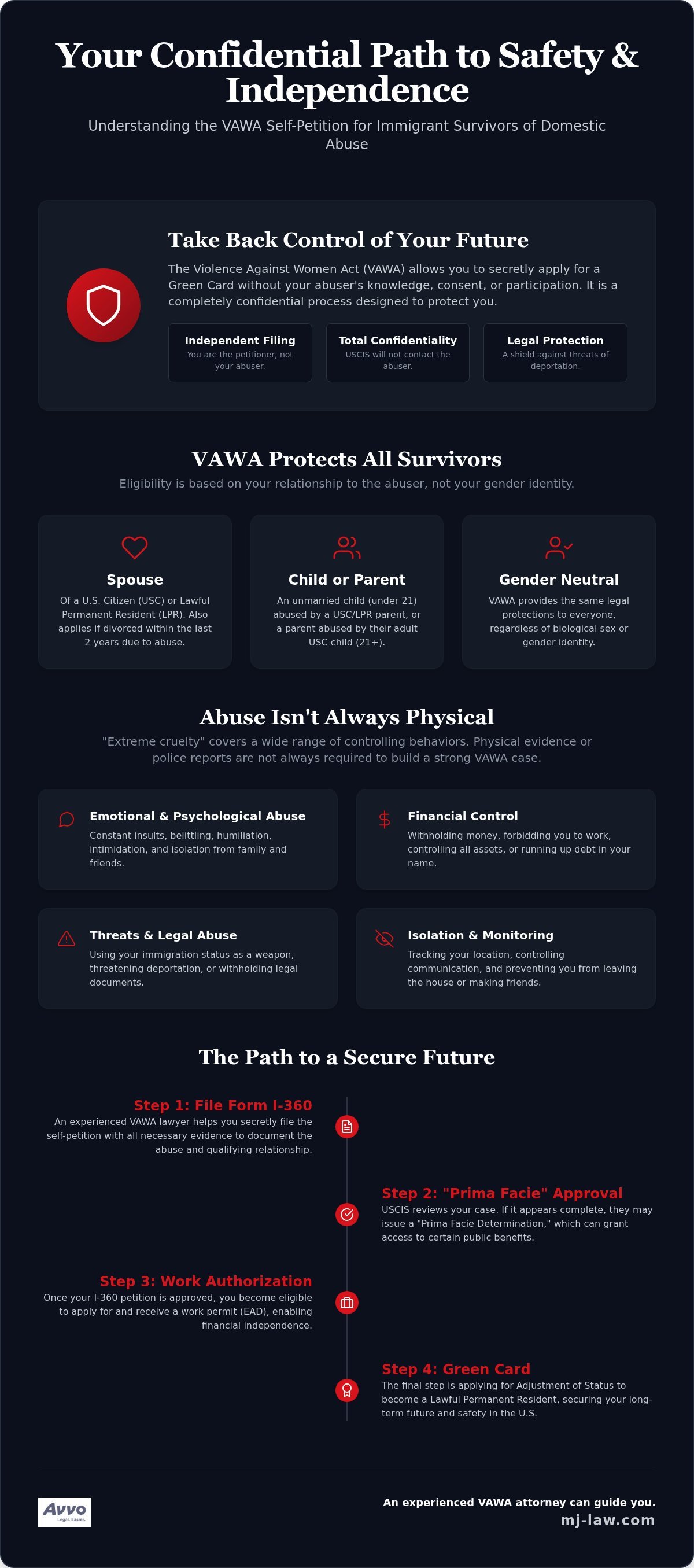
The Violence Against Women Act (VAWA) represents a critical turning point in U.S. immigration policy. Originally enacted to protect survivors of domestic violence, it serves as a provision of the Immigration and Nationality Act that allows certain non-citizens to seek legal status independently. The defining feature of this process is the “self-petition.” Normally, an immigrant relies on a family member to sponsor their residency. In abusive situations, this creates a dangerous power imbalance. VAWA corrects this by allowing you to file Form I-360 without the abuser’s involvement. It’s a confidential process designed to keep you safe while you pursue a Green Card.
It’s a common misconception that this law only applies to women. In reality, VAWA is gender-neutral. It provides the same legal protections to everyone, regardless of their biological sex or gender identity. Whether you are a husband, wife, parent, or child, the law focuses on the abuse you endured rather than who you are. Finding a dedicated VAWA lawyer San Jose ensures that your specific circumstances are documented correctly and that your identity is protected throughout the filing process.
The Core Purpose of VAWA in Immigration Law
Breaking the cycle of control is the primary goal of these protections. Abusers frequently use a victim’s immigration status as a weapon, threatening to call authorities or withdraw a pending petition if the victim tries to leave. By filing a self-petition, you effectively take that weapon away. This legal shield allows you to obtain work authorization and permanent residency on your own terms. It transforms your legal standing from a dependent beneficiary to an independent applicant, providing a foundation for financial freedom and physical safety in the Silicon Valley area.
Qualifying Relationships for San Jose Applicants
Eligibility for VAWA is tied to your relationship with a U.S. citizen (USC) or a Lawful Permanent Resident (LPR). You may qualify if you have suffered battery or extreme cruelty by:
- A USC or LPR spouse, even if you are now divorced, provided the marriage ended within the last two years due to the abuse.
- A USC or LPR parent.
- An adult U.S. citizen son or daughter who is at least 21 years of age.
Navigating these requirements requires precision and a deep understanding of federal law. A VAWA lawyer San Jose can help you gather the necessary documentation to prove these relationships, even if the abuser has withheld your marriage certificate or other vital records. Since 1985, our team has acted as a compassionate guide for survivors, ensuring their stories are presented clearly to immigration authorities. If you’re ready to explore your options, you can schedule a confidential meeting to discuss your case in a safe environment.
Defining “Extreme Cruelty” Beyond Physical Violence
Many survivors believe that without physical scars or a police report, their situation isn’t “bad enough” to qualify for legal relief. This is a dangerous misconception. The legal standard for a self-petition is “battery or extreme cruelty.” While battery refers to physical acts, extreme cruelty covers a broad spectrum of non-physical behaviors designed to control and demean. You don’t need a hospital record to prove your case. Instead, the VAWA self-petition process allows for a wide range of evidence to demonstrate a pattern of abuse. Reviewing a comprehensive VAWA evidence checklist can help you understand exactly which documents and personal statements may be used to build your case under the “any credible evidence” standard.
Working with an experienced VAWA lawyer San Jose helps you translate these lived experiences into the specific legal language required for a successful petition. We focus on the cumulative effect of the abuser’s actions. Even if no single event seems “extreme” on its own, a consistent history of intimidation and manipulation meets the legal threshold. For instance, a VAWA lawyer San Jose looks for patterns of coercive control, such as threats to call ICE or have you deported. If your spouse uses your immigration status to keep you silent, that’s a form of legal abuse recognized by federal authorities.
Psychological and Emotional Control
Abuse often starts with isolation. In a busy hub like San Jose, an abuser might prevent you from making friends, attending community events, or even speaking with neighbors. They might monitor your phone, track your location via GPS, or demand constant check-ins. Verbal abuse, such as constant belittling or attacking your character, also builds a case for extreme cruelty. These actions aim to strip away your confidence and keep you dependent, making the legal path to independence feel impossible.
Financial Abuse and Coercion
Living in Silicon Valley is expensive. Abusers often leverage this high cost of living to exert control by forbidding you from working or seizing your entire paycheck. Some abusers withhold social security cards, passports, or marriage licenses to prevent you from seeking help or applying for benefits. If you’re being forced into unpaid labor or find yourself drowning in debt because of your partner’s actions, you’re experiencing financial coercion. If these scenarios sound familiar, you may wish to discuss your situation privately with a professional who understands these dynamics.
The VAWA Application Process: 5 Steps to Legal Independence
Securing your future through the VAWA program involves a methodical five-step process designed to move you from a state of vulnerability to legal stability. First, you must prepare Form I-360. This stage requires a detailed personal statement that narrates your experiences with precision and clarity. A VAWA lawyer San Jose helps you structure this narrative so it aligns with the legal standards for Defining “Extreme Cruelty”. Second, you gather secondary evidence. If your abuser has hidden your marriage certificate or birth records, we can use affidavits from witnesses, medical records, or other alternative documents to prove your case.
Filing Your Petition with USCIS
All VAWA petitions are processed by the specialized Vermont Service Center. This office is specifically trained to handle sensitive cases with a high level of confidentiality. One of the most critical steps in this phase is establishing a “safe address.” This is a mailing address where the abuser cannot access your mail. USCIS will send all correspondence there, ensuring your safety isn’t compromised. Once the petition is reviewed for basic eligibility, you’ll receive a “Prima Facie” determination letter. This document is powerful; it allows you to access certain public benefits in California while your case is pending, providing a vital safety net.
Adjustment of Status in San Jose
The fourth step often happens concurrently with the initial filing. If you’re eligible, you can file Form I-485 to adjust your status to a permanent resident. This phase includes applying for an I-765 Work Permit and an I-131 Travel Document. Receiving work authorization is a significant milestone for survivors in the high-cost Silicon Valley area. It provides the financial means to live independently and support your children without relying on an abuser.
Finally, your case moves toward adjudication. While many VAWA cases are decided based on the written record alone, some applicants may be called for an interview at the local San Jose USCIS field office. If an interview is required, your VAWA lawyer San Jose will prepare you for the types of questions officers might ask and accompany you to the appointment. This steady, professional support ensures that your rights are protected until you receive your Green Card. If you’re ready to take this first step, you can book a private consultation to review your eligibility in a safe environment.
Evidence and Confidentiality: Protecting Your Case and Safety
Confidentiality is the cornerstone of the VAWA program. Under federal law, specifically 8 U.S.C. § 1367, immigration officials are strictly prohibited from contacting your abuser or disclosing that you’ve filed a petition. This legal shield ensures your safety remains the priority throughout the entire journey. Your attorney acts as a crucial buffer, receiving all correspondence and managing the legal complexities so you don’t have to engage directly with the system. This protection also prevents USCIS from using any information provided by the abuser to harm your case, effectively neutralizing their ability to use the legal system as a tool of control.
Proving abuse doesn’t always require a traditional paper trail. The legal standard for VAWA is “Any Credible Evidence.” This means that if you don’t have police reports or hospital records, we can still build a robust case using alternative documentation. A VAWA lawyer in San Jose understands how to compile a narrative that meets this standard, focusing on the quality and credibility of the information rather than just the quantity of official reports. We focus on the cumulative weight of your evidence to establish a clear pattern of battery or extreme cruelty. For a detailed breakdown of what to gather, our VAWA evidence checklist for 2026 outlines the specific documents, affidavits, and personal statements that can strengthen your petition under current USCIS policies.
Building a Strong Evidence File Without a Police Report
Many survivors in the Silicon Valley area rely on secondary evidence to prove their claims. This includes detailed declarations from friends, neighbors, or colleagues in San Jose who have witnessed the effects of the abuse. Medical records, notes from a licensed therapist, or intake forms from a domestic violence shelter provide significant weight to your file. We also focus on establishing your “Good Moral Character,” which is a mandatory requirement for the petition. This can be demonstrated through community involvement, stable employment history, or letters of recommendation from local community members who can attest to your integrity.
Safety Planning During the Legal Process
Your physical and digital security are paramount while your case is pending. We recommend establishing a safe mailing address, such as a P.O. Box or using our law office address, to ensure the abuser never sees USCIS mail. Digital safety is equally vital. We advise survivors to use secure browsers and change passwords on all accounts to prevent monitoring by the abuser. When you work with a VAWA lawyer San Jose, we establish clear, safe communication protocols from day one to protect your privacy. If you’re concerned about your current safety or want to know more about these legal protections, you should request a secure, confidential case evaluation today.
Why Consult an Experienced San Jose VAWA Attorney?
VAWA cases are significantly more complex than standard family-based petitions. While a typical marriage-based green card focuses on proving a bona fide relationship, a VAWA petition requires proving abuse while maintaining absolute confidentiality. This high-stakes environment is where the expertise of a VAWA lawyer San Jose becomes indispensable. Since 1985, our firm has provided the steady hand needed to navigate these intricate procedures. We understand that a single error or a missing document can lead to a “Request for Evidence” (RFE). An RFE can stall your case for months and increase your anxiety. By front-loading your petition with the right evidence, we aim to prevent these delays before they happen.
For many in our community, discussing trauma is easier in one’s primary language. We offer full bilingual support in English and Spanish. This ensures that every detail of your story is captured accurately and that you feel fully supported throughout the process. Our deep roots in the San Jose and San Francisco legal communities allow us to provide a level of local expertise that generic national firms simply cannot match. You aren’t just another case number; you’re a member of our community seeking a fresh start.
Navigating Complex Immigration Histories
Many survivors face additional hurdles, such as prior deportations, unlawful entries, or minor criminal records. These issues can feel like absolute barriers to legal status. However, VAWA provides specific waivers for certain immigration violations that are not available in standard family-based cases. In some situations, survivors may also need to address grounds of inadmissibility through an I-601 waiver of inadmissibility lawyer San Jose to clear the path toward permanent residency. If your situation began as a joint filing that went wrong, working with an experienced Marriage Green Card RFE lawyer can help you pivot your strategy toward a self-petition. We analyze your entire history to identify the safest and most effective path forward, ensuring that past mistakes don’t block your future safety. For survivors who have built exceptional careers in the tech sector, it may also be worth exploring whether an EB-2 NIW lawyer San Jose can offer an alternative employment-based route to permanent residency that bypasses the traditional sponsorship model entirely. Similarly, multinational executives working in Silicon Valley who need to transfer key leadership across borders may benefit from consulting an L-1A visa lawyer San Jose to explore intracompany transfer options that can also serve as a pathway to a permanent green card without relying on a sponsoring spouse.
Your Compassionate Guide in San Jose
Choosing the right legal partner is about more than just filing paperwork. It’s about finding someone who prioritizes your security and long-term stability. As your VAWA lawyer San Jose, we act as a compassionate guide, ensuring you feel heard and protected at every step. We take the burden of the legal system off your shoulders so you can focus on healing and building a new life for yourself and your children. Your journey toward independence starts with a single, safe step. We invite you to Schedule a confidential consultation to evaluate your eligibility and begin your path to safety.
Reclaiming Your Independence and Future Safety
You’ve learned that the path to legal residency doesn’t have to depend on an abusive partner or family member. Through a VAWA self-petition, you can secure work authorization and a Green Card independently; all while your safety remains protected by strict federal confidentiality laws. Whether you’ve faced physical harm or the weight of psychological and financial control, the law recognizes your right to seek a life free from intimidation.
Navigating these humanitarian cases requires a steady hand and deep local knowledge. MJ Law has served the San Jose community for over 30 years, helping survivors move from vulnerability to permanent stability. Our team provides bilingual support in English and Spanish, ensuring you’re fully understood as we navigate complex immigration histories together. Partnering with a dedicated VAWA lawyer San Jose gives you the professional buffer needed to handle USCIS procedures with confidence.
Don’t let the fear of your status keep you in a dangerous situation. Your safety and legal independence are within reach. Schedule a Confidential VAWA Consultation with MJ Law to discuss your eligibility today. You deserve a future built on security and peace.
Frequently Asked Questions
Do I need a police report to file for VAWA?
No, you don’t need a police report to qualify for relief. USCIS follows an any credible evidence standard, acknowledging that many survivors cannot safely contact law enforcement. You can use personal declarations, witness statements from friends, or records from a domestic violence shelter. While a police report is helpful, successful petitions often rely on psychological evaluations or medical records to prove extreme cruelty. A VAWA lawyer San Jose helps you identify the best alternative evidence for your case.
Can men apply for immigration relief under VAWA?
Yes, men are fully eligible to apply for these protections. The Violence Against Women Act is a gender-neutral law that protects spouses, children, and parents regardless of their biological sex or gender identity. The legal requirements for battery or extreme cruelty remain the same for all applicants. We’ve assisted many men in the Silicon Valley area in securing their legal status independently, ensuring they receive the same compassionate guidance and confidentiality as any other survivor.
Will my abusive spouse find out if I file a VAWA self-petition?
No, your abuser won’t be notified about your filing. Federal law mandates strict confidentiality for all VAWA cases. USCIS is legally prohibited from contacting the abuser or revealing any information about your petition. To ensure your safety, you should provide a safe address or use your attorney’s office for all correspondence. This prevents any mail from reaching your home where an abuser might find it, keeping your journey toward legal status completely private.
How long does the VAWA self-petition process take in 2026?
Processing times for 2026 depend on current USCIS workloads and staffing levels. Adjudication for Form I-360 typically ranges between 30 and 40 months. However, you don’t have to wait that long for all benefits. Most petitioners receive a Prima Facie determination within a few months, which can help with certain public benefits. It’s best to check the official USCIS website for the most current processing windows or discuss recent local timelines with your VAWA lawyer San Jose.
Can I include my children in my VAWA application?
Yes, you can generally include your unmarried children under age 21 as derivative beneficiaries. This means they can receive the same legal protections and path to a Green Card as you do. If they are in the United States, they may also be eligible for work authorization once the petition reaches certain stages. Protecting your children’s future is a primary goal of this law, ensuring the whole family can move toward a safe, stable life.
What happens if my abuser is a Green Card holder, not a U.S. citizen?
You are still eligible for relief if your abuser is a Lawful Permanent Resident (LPR). While some rules regarding the timing of your Green Card application may differ compared to those with U.S. citizen abusers, the protections against abuse remain the same. You can still file the self-petition independently. We’ll help you understand the specific visa availability dates that apply to your situation, ensuring you maintain legal protection throughout the wait.
Can I work while my VAWA petition is being processed?
Yes, you can obtain a work permit during the process. Once your Form I-360 is approved, or if you’ve filed a concurrent Form I-485 and it’s pending, you can apply for an Employment Authorization Document (EAD). This permit allows you to work legally anywhere in the United States. Having your own income is a critical step for survivors in San Jose, providing the financial independence necessary to maintain a safe and separate household.
What if I already divorced my abusive spouse?
You can still apply if your marriage ended within the last two years. You must demonstrate that there was a connection between the divorce and the domestic violence or extreme cruelty you experienced. It’s vital to file your petition before that two-year window closes. Even if you’ve already separated or legally ended the marriage, the law provides a pathway for you to secure your status and remain safely in the United States.