Imagine the relief of knowing you can apply for legal status without your spouse ever finding out, even if they’ve hidden your marriage certificate or destroyed your records. Many survivors in San Jose and the San Francisco Bay Area hesitate to come forward because they lack the “perfect” paper trail typically required for immigration. You might feel trapped, fearing that a lack of police reports or joint bank statements means your journey ends here. We understand that in an abusive situation, traditional documentation is often the first thing taken away from you.
This VAWA evidence checklist changes that narrative by focusing on the “any credible evidence” standard, a legal protection that allows you to use personal statements, texts, and affidavits to prove your case. In this guide, you’ll learn exactly which documents and testimonies you need to secure your status safely and 100% confidentially under the latest 2026 USCIS policies. We’ll walk through how to build a strong self-petition that bypasses your abuser entirely, giving you a clear, steady path toward a green card and the independence you deserve.
Key Takeaways
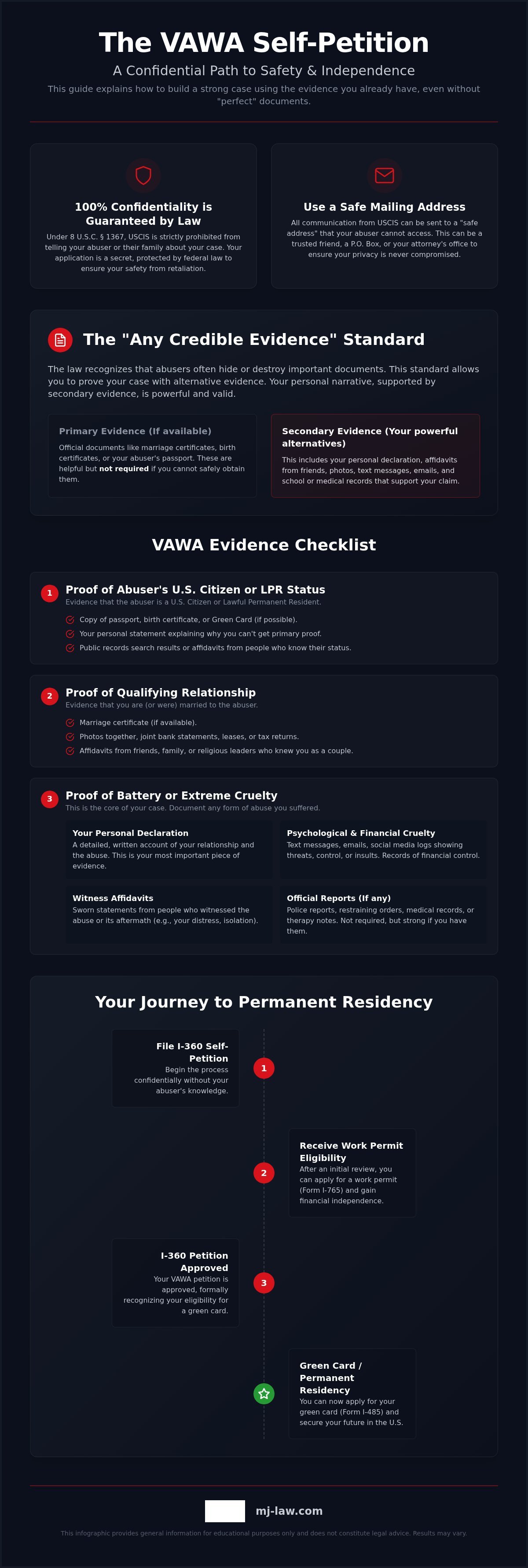
- Learn how federal law keeps your case 100% confidential and how to use a safe address to receive mail without your abuser’s knowledge.
- Understand why your personal narrative is powerful under the “Any Credible Evidence” standard, even if you don’t have police reports or a marriage certificate.
- Use this VAWA evidence checklist to identify alternative ways to prove your spouse’s legal status and your qualifying relationship safely.
- Discover how to document psychological and financial “extreme cruelty” using everyday evidence like text messages, emails, and social media logs.
- Get a realistic timeline for your self-petition and see when you’ll be eligible for a work permit as you move toward permanent residency.
Understanding VAWA Confidentiality Rules and Your Safety
Safety is the foundation of every VAWA case. If you’re worried about your spouse discovering your application, you aren’t alone. The legal framework behind the Violence Against Women Act includes strict confidentiality provisions designed specifically to protect survivors from retaliation. These rules ensure that the person who caused you harm cannot use the immigration system as a tool of further control or intimidation.
The VAWA 384 Prohibition
Under 8 U.S.C. § 1367, often called Section 384, USCIS officials are strictly prohibited from disclosing any information about your case to third parties. This protection is robust and specifically targets your abuser. Government employees who violate these rules face disciplinary action and significant financial penalties. This confidentiality remains in place even if you’re currently in removal proceedings, providing a shield against the disclosure of your status or location.
The policy goes even further by restricting the types of information USCIS can use to make decisions. The government is prohibited from making determinations based solely on information provided by the abuser or their family members. This prevents an abusive spouse from “tipping off” authorities with false accusations to trigger a deportation. A major policy update on December 22, 2025, further strengthened these confidentiality procedures, ensuring that your data remains shielded throughout the entire adjudication process. When you begin gathering items for your VAWA evidence checklist, you can do so with the confidence that the government is legally bound to keep your petition a secret.
Using a Safe Mailing Address
One of the most practical ways to stay safe is by designating a “safe address” on your Form I-360. This is a location where you can receive sensitive mail without it ever reaching your shared home. You don’t have to live at this address; it just needs to be a place where you can reliably and privately access your correspondence from the USCIS HART Unit.
While some survivors use a trusted friend’s home or a P.O. Box, these options can sometimes be unreliable for critical legal deadlines. For many of our clients in San Jose and San Francisco, using our MJ Law office as the safe mailing address provides the highest level of security. We act as a secure buffer, ensuring that no USCIS notices, receipts, or requests for evidence ever appear in your mailbox at home. This allows us to maintain a professional and confidential communication channel while we work together to build your case. If you have concerns about your current living situation, you can schedule a consultation to discuss how we protect your privacy throughout the process.
The ‘Any Credible Evidence’ Standard: Why Your Narrative Matters
The “Any Credible Evidence” standard is a unique legal protection created because the law recognizes that abusers often use documents as a form of control. If your spouse has locked away your passport or shredded your marriage certificate, it doesn’t disqualify you from seeking safety. Federal law at 8 U.S.C. § 1154(a)(1)(J) requires USCIS to consider any evidence you submit that’s believable and relevant to your claim. This flexibility is central to the VAWA Confidentiality Rules, ensuring that the lack of a “perfect” file isn’t a barrier to your legal status.
USCIS understands that in a domestic violence situation, primary documents are often missing or intentionally withheld. This standard allows us to build your case using alternative methods to prove each requirement of your self-petition. It shifts the focus from what you’ve lost to the truth of what you’ve experienced.
Primary vs. Secondary Evidence
Primary evidence typically includes official government documents like marriage licenses, birth certificates, or your abuser’s U.S. passport. When these aren’t available, we turn to secondary evidence. This category covers a wide range of items, such as affidavits from friends, school records showing a shared address, or even photos from family gatherings. USCIS evaluates both types of evidence based on their credibility and detail rather than dismissing secondary proof simply because it isn’t an official certificate.
The Power of the Personal Statement
Your personal declaration is the most critical component of your VAWA evidence checklist. It’s your opportunity to explain the history of your relationship and the specific instances of battery or extreme cruelty you’ve endured. A strong statement doesn’t just list facts; it provides the context that makes other pieces of evidence make sense to the officer reviewing your file. It’s the thread that connects your documents into a cohesive story of your life.
At MJ Law, we help San Francisco survivors organize these narratives to ensure they’re consistent and thorough. A well-drafted statement can bridge the gaps left by missing documents, but it must be precise to avoid a Request for Evidence (RFE). If you’re unsure how to start your story, you can discuss your situation with us in a safe, private environment. We specialize in identifying the secondary evidence that others might overlook, turning your lived experience into a compelling legal argument.
Comprehensive VAWA Evidence Checklist for Self-Petitioners
To succeed with your self-petition, you must satisfy four main categories of proof. While the “any credible evidence” standard is flexible, organizing your VAWA evidence checklist systematically helps USCIS officers approve your case without unnecessary delays. Each document serves to confirm your eligibility and protect your path to a green card.
Establishing the Abuser’s Status and Relationship
Proving your abuser is a U.S. citizen or Lawful Permanent Resident can be difficult if they’ve hidden their passport or birth certificate. We often use Freedom of Information Act (FOIA) requests to government agencies or secondary records like public filings to establish their legal status. For the relationship, you must show a “good faith marriage,” meaning you didn’t marry solely for immigration benefits. This involves providing photos, joint tax returns, or shared insurance policies. If the marriage ended in divorce or the abuser passed away, you generally have a two-year window from that event to file your petition.
Proving You Lived Together
Living together is a mandatory requirement, but USCIS doesn’t specify a minimum duration. In the San Jose area, we often use tech company employment records or pay stubs that list your shared home address. If your name wasn’t on the lease or utility bills, you still have options. We can utilize school records for your children, medical bills, or detailed affidavits from neighbors in Silicon Valley who saw you living together daily. The official Comprehensive VAWA Evidence Checklist provided by USCIS outlines these requirements, but we tailor your submission to reflect your specific local life and circumstances.
Proof of Good Moral Character
You must demonstrate that you are a person of good moral character. This usually involves providing police clearance certificates from every city you’ve lived in for at least six months during the last three years. If you have any history with law enforcement, it’s vital to have a professional review your records first. We also include character references from community leaders, employers, or friends in the Bay Area who can speak to your integrity and contributions to the community. This step ensures that your VAWA evidence checklist is complete and presents you in the best possible light to the HART Unit officers.
Building this list requires a methodical approach. By focusing on these four pillars, you create a foundation that is difficult for USCIS to contest, even without the abuser’s cooperation.
Documenting Abuse and Extreme Cruelty
Proving “battery or extreme cruelty” is a central requirement of your self-petition. While physical violence is a clear form of abuse, the law also recognizes psychological, emotional, and financial control as legitimate grounds for filing. For many survivors in the San Francisco Bay Area, the abuse is often subtle and leaves no physical scars, making the VAWA evidence checklist even more vital for documenting these non-physical patterns of harm.
Types of Evidence for Extreme Cruelty
Extreme cruelty includes behaviors used by an abuser to exert power and control over your life. We often see cases involving threats of deportation, where the spouse uses your immigration status as a weapon to ensure your silence. Other common examples include financial abuse, such as withholding money or preventing you from working, and social isolation from your family or friends. Current 2026 USCIS trends favor detailed behavioral logs that show a pattern of control over a long period rather than relying on a single isolated incident. You can document these patterns through several methods:
- Text messages or voicemails containing threats or insults
- Emails showing constant monitoring or harassment
- Social media logs that demonstrate stalking or public shaming
- Banking records that highlight financial restriction or exploitation
Professional Evaluations and Records
If you don’t have police reports or medical records, a psychological evaluation from a licensed professional in the San Jose area can serve as powerful evidence. These experts can diagnose conditions like PTSD or anxiety that result from long-term emotional abuse. Their expert witness letters provide the clinical context USCIS needs to understand the severity of the “extreme cruelty” you’ve experienced. Additionally, if you’ve ever sought an order of protection or a restraining order from San Jose or San Francisco courts, those records are essential additions to your file.
Third-party affidavits from friends, family members, or shelter workers also provide necessary corroboration. These statements describe what others have witnessed, such as your spouse’s temper or your visible distress. When combined with your personal narrative, these external perspectives create a comprehensive picture of the abuse. If you’re struggling to identify what counts as proof in your specific situation, you should book a confidential case review to ensure your application meets the highest evidentiary standards. We’ll help you organize your history into a compelling argument for the safety and status you deserve.
Next Steps: Filing Your VAWA Petition in San Jose
Filing your Form I-360 is the formal beginning of your path to legal independence. Once you’ve gathered all the items on your VAWA evidence checklist, your petition is mailed to the USCIS HART Unit at the Vermont Service Center. This specialized unit is trained to handle sensitive cases with the absolute confidentiality we discussed earlier. While the process is methodical, it requires patience and extreme precision to avoid unnecessary delays or denials.
Wait Times and Work Permits
According to USCIS data from March 2026, 80% of VAWA self-petitions are currently processed within 47.5 months. While this timeline feels long, you don’t have to wait until final approval to receive certain protections. Shortly after filing, you may receive a “Prima Facie” determination. This document acknowledges that you’ve met the basic requirements of the law and allows you to access certain public benefits in California while your case is pending.
Work authorization is another critical milestone in your journey. Depending on your specific situation, you may be eligible for an Employment Authorization Document (EAD) while you wait for a final decision. If your petition is approved, you’ll eventually move into the Adjustment of Status phase to receive your green card. MJ Law tracks every update through the Vermont Service Center, ensuring that you’re prepared for each stage of this professional process.
Why Local Representation Matters
Choosing a local VAWA lawyer San Jose provides a distinct advantage. While your initial petition is handled by a central unit, future interviews or complex adjustments often take place at the San Jose USCIS field office. Having a representative who understands the Silicon Valley legal landscape ensures your case remains on track and your privacy is maintained.
We specialize in preparing for Requests for Evidence (RFEs), which can add 6 to 12 months to your processing time. Following the major policy update on December 22, 2025, evidentiary bars have been raised, making professional preparation more important than ever. By conducting a thorough review of your VAWA evidence checklist before submission, we minimize these risks. To take the first step toward your new life, Schedule a confidential consultation with MJ Law today. We’re here to help you secure a safe and permanent future.
Start Your Journey Toward Independence
Securing your legal status through a self-petition is a brave step toward a life free from control. We’ve explored how federal law protects your privacy and why your personal story holds immense weight under the “any credible evidence” standard. By following a structured VAWA evidence checklist, you can build a compelling case even when an abuser has withheld or destroyed your official documents. This process is designed to empower you, allowing you to move forward without the abuser’s knowledge or consent.
With over 30 years of specialized immigration expertise, MJ Law serves as a reliable anchor for survivors in the San Jose and San Francisco communities. We provide bilingual support in both English and Spanish to ensure you feel heard and understood at every stage. You don’t have to navigate this complex legal landscape alone. Our local presence and deep roots in the Bay Area allow us to manage your case with the precision and care it requires. Secure your future with a confidential consultation at MJ Law and take the first step toward your permanent residency today. A brighter, more secure future is within your reach.
Frequently Asked Questions
Is my abuser notified when I file for VAWA?
No, your abuser is never notified. Federal law prevents USCIS from contacting the abusive family member or disclosing any information about your filing. This protection is part of the strict Section 384 confidentiality rules. By using a safe address for all correspondence, you ensure that the abuser never sees your mail, preventing them from using the immigration system to retaliate against you during the process.
Can I apply for VAWA if I am already divorced?
Yes, you can apply if your divorce was finalized within the last two years. You must demonstrate that the abuse occurred during the marriage or was a primary reason for the relationship’s end. This two-year window is a firm deadline, so gathering your documents and completing your VAWA evidence checklist quickly is essential to protect your eligibility for self-petitioning and securing your independent legal status.
What if I don’t have a police report to prove the abuse?
You don’t need a police report to file a successful claim. Under the “any credible evidence” standard, USCIS accepts personal declarations, witness affidavits, and psychological evaluations as valid proof of abuse. Many survivors of emotional or financial cruelty never contact law enforcement. The law is specifically designed to accommodate these situations, ensuring that a lack of formal criminal records doesn’t prevent you from seeking safety.
Do I need to be in the U.S. to file a VAWA self-petition?
Generally, you must be living in the United States at the time you file your petition. However, exceptions exist for certain individuals living abroad if the abuser is an employee of the U.S. government or a member of the uniformed services. Additionally, if the abuse occurred within the United States, you might still qualify for relief even if you’re currently located in another country.
How long does it take to get a work permit through VAWA in 2026?
In 2026, most applicants receive their work permit within 6 to 12 months after filing Form I-360 and the associated adjustment of status application. While the total processing time for a VAWA petition can reach 47.5 months for 80% of cases, the Employment Authorization Document is usually issued much earlier. This allows you to support yourself financially and gain independence while your case remains pending.
Can men apply for VAWA relief?
Yes, the Violence Against Women Act applies to all survivors regardless of gender. Men who have been abused by a U.S. citizen or green card holder spouse, parent, or child are fully eligible to self-petition. The evidentiary requirements and confidentiality protections are identical for everyone. This ensures that all survivors have a safe path to legal status and are protected from further harm by their abuser.
What is the “Prima Facie” notice and why is it important?
A “Prima Facie” notice is a preliminary determination that you’ve met the basic legal requirements for VAWA. It’s typically issued within a few months of your filing. This notice is vital because it serves as proof of your pending status, allowing you to qualify for certain public benefits, such as housing assistance or medical care, while USCIS continues the detailed review of your full VAWA evidence checklist.
Will filing for VAWA affect my current visa status?
Filing a VAWA self-petition doesn’t automatically cancel your current non-immigrant status. Instead, it provides an independent path to a green card that doesn’t rely on your abuser’s sponsorship. Because of strict confidentiality rules, your current status remains secure. USCIS is prohibited from using your VAWA application as a reason to initiate removal proceedings or notify your spouse about your attempt to secure legal residency.