
When searching for L-1A RFE trends 2026, it helps to separate verified agency data from individual case experiences and online commentary. A claimed trend may not explain the questions USCIS raised in your Request for Evidence. Your notice is the starting point for planning a response.
An RFE is not a final denial. It asks for clarification or additional evidence before USCIS decides the petition. The most useful response addresses the specific concerns in the notice. For an L-1A petition, that may mean explaining the beneficiary’s executive or managerial responsibilities and showing how the role fits within the organization.
This guide explains how to evaluate claims about RFE trends and review recurring eligibility questions without treating them as confirmed 2026 statistics. It also offers a practical method for turning each request into a focused response, supported by relevant records and consistent descriptions of the beneficiary’s duties, reporting lines, and company relationships. Legal guidance can help connect the wording of the notice to your company’s structure and the facts of the case.
Key Takeaways
- Distinguish verified agency data from online claims before drawing conclusions about L-1A RFE trends 2026.
- Use the concerns in your notice, not a generic trend list, to guide your evidence search.
- Turn each RFE request into a direct answer supported by relevant records, and assign someone to gather them.
- Check that descriptions of duties, reporting lines, and corporate relationships are consistent throughout the response.
- Consider legal review when the notice raises multiple issues, the corporate structure is complex, or records conflict.
L-1A RFE Trends in 2026: What the Available Evidence Can, and Cannot, Show
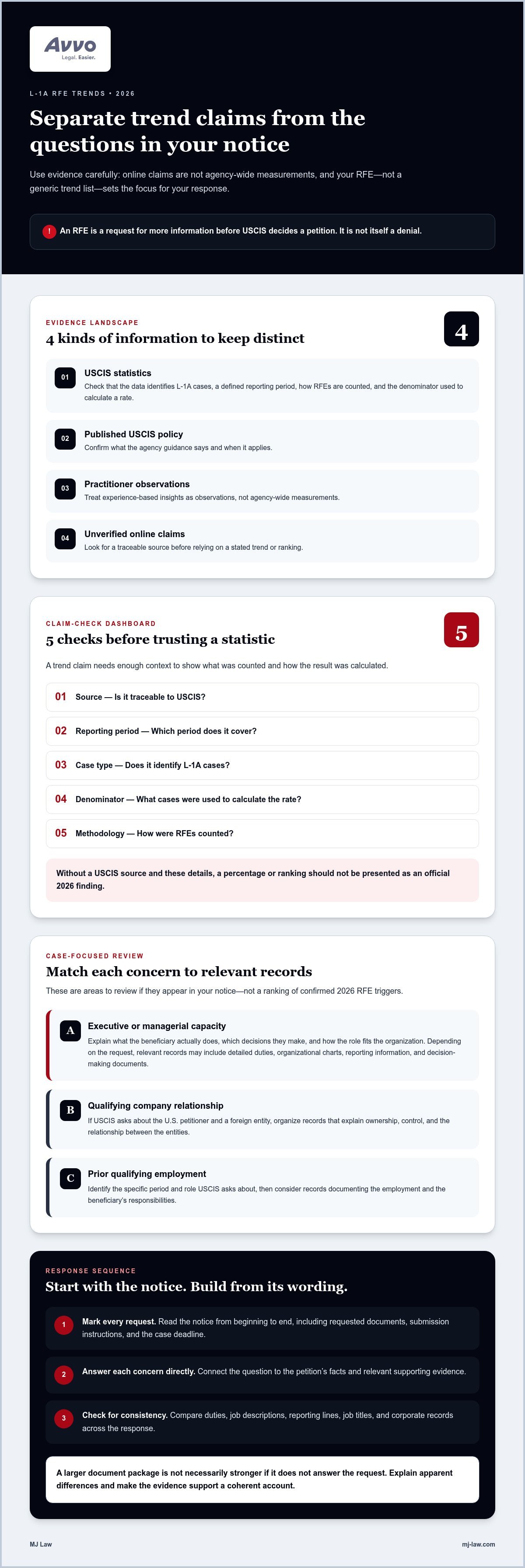
Claims about L-1A RFE trends 2026 need context. To establish an agency-wide trend, data must identify L-1A cases, define the reporting period, explain how RFEs are counted, and state the denominator used to calculate a rate. Figures that combine different visa categories, or anecdotes from individual cases, cannot show whether L-1A RFEs are increasing or identify the most frequent reasons for them.
Keep four types of information distinct: USCIS statistics, published USCIS policy, practitioner observations, and unverified online claims. When assessing a statistic, look for its source, reporting period, case type, denominator, and methodology. A general L-1 visa overview can explain the category, but it does not establish current RFE patterns.
What does an L-1A Request for Evidence mean?
An RFE is a USCIS request for additional information or evidence before the agency decides a petition. It identifies questions the petitioner is being asked to address. An RFE is a request for evidence, not itself a denial. A request for initial evidence is generally associated with evidence USCIS identifies as missing from the initial filing, while an RFE seeks additional information to assess the petition. Read the notice carefully: it gives the questions, submission instructions, and deadline for your case.
Are L-1A RFEs increasing in 2026?
The information in this article does not establish an increase. To demonstrate a trend, USCIS data would need to compare L-1A petitions across defined, comparable reporting periods. The calculation should explain how RFEs are counted and identify the denominator, such as petitions adjudicated or received. Without a USCIS source and those details, a percentage or ranking should not be presented as an official 2026 finding.
When reviewing a claim, ask what kind of evidence supports it:
- Official statistics: Check whether USCIS identifies the L-1A category, reporting period, and calculation method.
- Published policy: Confirm what the agency guidance says and when it applies.
- Practitioner observations: Treat these as experience-based insights, not agency-wide measurements.
- Online claims: Look for a traceable source before relying on a stated trend or ranking.
For your response, the trend question is secondary to the notice in front of you. Use its wording to identify what USCIS wants clarified, then connect each request to a direct answer and relevant supporting evidence.
L-1A RFE Issues to Review Without Mistaking Them for 2026 Statistics
The following are areas to review if they appear in your notice, not a ranking of confirmed 2026 RFE triggers. An RFE may focus on one issue or several. The specific concern is the one USCIS identifies in your case. Start with that wording, connect each question to the petition’s facts, and gather records that directly address it. A larger document package is not necessarily stronger if it does not answer the request.
How can USCIS assess executive or managerial capacity?
USCIS may need a clear account of what the beneficiary actually does, which decisions they make, and how their role fits within the petitioner’s organization. A senior title alone does not explain those facts. If the notice questions day-to-day responsibilities, for example, a title page or broad job description may not show how the person’s time is spent or what authority they exercise.
Consider what evidence directly addresses the concern. Depending on the request, useful records may include a detailed description of duties, organizational charts, reporting information, and documents showing decision-making responsibilities. Compare the descriptions in the petition and supporting records so they tell a consistent story. Check current agency materials for the legal standards and USCIS policy relevant to the petition.
What evidence can clarify qualifying employment and company relationships?
If the notice raises questions about the relationship between the U.S. petitioner and a foreign entity, organize records that explain ownership, control, and the relationship between the entities. Corporate documents are most useful when they support a coherent explanation, rather than appearing as an unexplained collection of filings.
For questions about prior qualifying employment, identify the specific period and role USCIS asks about. Then consider records that document the employment and the beneficiary’s responsibilities. New-office petitions and organizational changes can raise distinct, fact-dependent questions. Avoid assuming that a generic checklist or another company’s response applies to your case. Verify the requirements for the petition’s circumstances using current USCIS guidance.
A practical way to use L-1A RFE trends 2026 information is to treat recurring eligibility topics as prompts for careful review, not predictions about what USCIS will ask. Match each concern in the notice with relevant evidence, and explain apparent differences in job titles, reporting lines, or entity records. An attorney can help connect the notice language to your organization’s facts. You can schedule an immigration consultation with MJ Law to discuss your case.
How to Read an L-1A RFE and Prioritize Its Questions
A focused response starts with the notice, not a general checklist. Read it from beginning to end and mark every question, requested document, submission instruction, and stated deadline. USCIS may raise concerns in different parts of the notice, so answering the first question does not necessarily address the rest.
How should a petitioner organize the RFE notice?
Create an issue tracker that preserves USCIS’s wording. For each request, record the page or section of the notice, the response deadline, any delivery instructions, and who will gather the relevant information. Copy dates and instructions accurately, then confirm the response process against the notice and current USCIS instructions.
Some requests may overlap. A question about the beneficiary’s role, for example, may involve both a job description and the organization’s reporting structure. Note any shared records, but keep each USCIS question visible so that supporting one concern does not leave another unanswered.
How can evidence support a clear response?
For each issue, draft a direct factual answer and pair it with records that support the answer. Explain what each document demonstrates instead of submitting a large collection without context. If USCIS asks about reporting lines, an organizational chart may help show them. If the question concerns job responsibilities, records describing the role may be more relevant. The notice determines what evidence is responsive.
A simple working table can keep the response organized:
- USCIS request: Preserve the question as written in the notice.
- Factual answer: State the petitioner’s response clearly and specifically.
- Supporting evidence: List the relevant record and what it helps establish.
- Owner and status: Assign someone to obtain or review the record.
Check consistency across dates, role descriptions, reporting lines, entity names, and terminology in the response and supporting records. If documents appear to conflict, explain the difference with accurate context rather than ignoring it. Unrelated material can make the response harder to follow without resolving the stated concern.
For background on the category, review MJ Law’s L-1A visa guide. General eligibility information provides context, but your response still needs to address the specific questions and instructions in your notice. Use L-1A RFE trends 2026 as context, not as a substitute for a notice-by-notice evidence plan.
Building an L-1A RFE Response: Evidence, Consistency, and Timing
A strong response makes it easy to see how each item of evidence answers a question in the notice. Organize the packet around those questions, not around the order in which documents arrive. Keep a working checklist so every issue has a clear answer, relevant support, and someone responsible for confirming that the materials are complete.
What should an L-1A RFE response packet include?
Use headings that follow the RFE’s questions and include a document index to help the reviewer locate supporting materials. For each request, explain the relevant facts, identify the supporting records, and state what those records demonstrate. Include material that addresses the concern. Documents that do not connect to a request can make the response harder to follow.
- Question: Record each RFE request in the notice’s terms.
- Answer: Draft a concise, fact-based explanation for that request.
- Evidence: Identify the records that support the answer and what they show.
- Owner: Assign a person to gather, verify, or review each item.
- Final check: Review completeness, legibility, translations, and packet format against the notice and current USCIS instructions.
Before submission, compare names, dates, job duties, reporting lines, and entity relationships across the response, prior filings, and supporting records. Consistent descriptions help present a clear account of the organization and the beneficiary’s role.
How can employers address gaps or inconsistencies?
Do not alter, backdate, or overstate records to make them appear to support the petition. If a current document differs from an earlier filing, explain the difference accurately and provide context where the available records support it. Contemporaneous business records can help clarify facts when they relate directly to the question USCIS raised. Support broad claims about company growth, staffing, or an employee’s responsibilities with evidence rather than simply asserting them.
Build timing into the response plan. Use the deadline and delivery instructions stated in the RFE, and verify applicable requirements against current USCIS instructions. Do not rely on a general online estimate or assume another petitioner’s timeline applies. Leave time to collect records, resolve inconsistencies, review translations, and assemble the packet.
When organizational facts are complex or records conflict, legal review can help connect the notice’s requests to the evidence and identify gaps before submission. Each case depends on its own facts, so L-1A RFE trends 2026 should not replace a response tailored to your notice. To discuss an attorney review of your response plan, schedule an immigration consultation.
When to Get Legal Help With an L-1A RFE in San Jose or San Francisco
Some RFE responses involve more than collecting documents. Legal review may be especially useful when the notice raises several issues, the petitioner has a complex corporate structure, or records describe duties, reporting lines, or entity relationships differently. An attorney can review the notice alongside the petition and organizational facts, then help identify which evidence addresses each concern.
That review is case-specific. General discussion of L-1A RFE trends 2026 can provide context, but it cannot determine how USCIS will assess an individual petition or replace advice based on the notice and records. MJ Law handles L-1 matters and has assisted individuals, families, and businesses with visa applications, green cards, and U.S. citizenship for more than three decades. The firm is located in San Jose and serves clients in the San Jose and San Francisco area. These locations describe the firm’s service context, not local USCIS adjudication patterns.
What should an employer prepare for an attorney consultation?
Organize the key materials before discussing next steps. An orderly record helps counsel understand what USCIS asked, what the original filing said, and where further explanation may be needed.
- The complete RFE, including all pages and enclosures.
- A copy of the petition and its filing exhibits.
- Relevant organizational records, such as current and prior organization charts and documents describing relationships between entities.
- A timeline of the beneficiary’s roles and any material company or organizational changes.
- A list of questions about the deadline, submission instructions, or records that may need explanation.
Keep the notice’s stated deadline and instructions readily available. If records differ from earlier filings, note the differences and the known context rather than trying to revise or recreate documents.
How can case-specific guidance help Bay Area businesses?
Counsel can compare the RFE’s wording with the company’s actual structure, the beneficiary’s responsibilities, and the records already submitted. This review can help clarify which issues need a direct response, which documents are relevant, and where an explanation must account for inconsistencies. MJ Law offers consultations in English and Spanish, so employers and beneficiaries can discuss the facts in the language they are most comfortable using.
Before discussing case-specific options, gather the notice and petition record, then organize the questions and any evidence gaps. To review an L-1A RFE with counsel, schedule an immigration consultation. A careful review can help you understand the response process, without promising a particular outcome.
Take the Next Step With a Focused L-1A RFE Response
The most useful way to approach L-1A RFE trends 2026 is to distinguish verified agency information from general observations, then focus on the questions USCIS actually asked in your notice. A strong response maps each question to a direct factual answer and relevant evidence. Consistent records, clear explanations, and careful attention to the notice’s instructions help present your case clearly.
If the RFE involves multiple issues, complex company relationships, or inconsistent records, case-specific legal review can help connect the notice to your organization’s facts. MJ Law handles L-1 work visas and has assisted individuals, families, and businesses with immigration matters for more than three decades.
Schedule a consultation about your L-1A RFE to discuss your notice and petition record with MJ Law. A clear plan and appropriate support can help you approach the response process with greater confidence.
Frequently Asked Questions
What are the most common reasons for an L-1A RFE?
This article does not establish a verified 2026 ranking of L-1A RFE reasons. Depending on the facts and the notice, USCIS may ask for clarification about the beneficiary’s actual duties and managerial or executive role, the qualifying relationship between companies, or employment history and responsibilities. These are potential issues to assess, not a confirmed frequency list. Let the specific questions in your notice guide which facts and records you address.
Does receiving an L-1A RFE mean my petition will be denied?
No. An RFE asks the petitioner to provide additional information or evidence before USCIS makes a decision. It is not itself a denial. The eventual outcome depends on the petition’s eligibility, the facts and evidence, and how the response addresses the notice’s questions. Read the instructions carefully and respond with relevant, consistent support. If the concerns are complex or records conflict, case-specific legal review may help you plan a focused response.
How long do I have to respond to an L-1A RFE?
Use the response deadline and submission instructions stated in your specific RFE notice. Do not rely on a generic timeline from an online article or another petitioner’s case, because instructions and circumstances can differ. Review the notice promptly, note the deadline, and check current USCIS requirements that apply to your response. If you are unsure how to interpret the instructions or organize the filing, seek qualified legal guidance early enough to plan.
What evidence should I submit with an L-1A RFE response?
Submit evidence that directly answers the questions in your notice, not a universal checklist of documents. Depending on what USCIS asks, relevant materials may include records describing the beneficiary’s duties, organizational charts and reporting information, employment records, or company documents showing the relationship between entities. Explain what each item demonstrates and keep facts consistent across the response. Unrelated records can add volume without resolving the stated concern.
Can an employer continue operating while an L-1A petition has an RFE?
The answer depends on the beneficiary’s current immigration status, work authorization, the petition’s posture, and the rules that apply to the specific circumstances. An RFE alone does not establish whether a person may keep working or what the employer should do. Review the notice and relevant status documents, and get case-specific legal advice before making employment decisions. Avoid relying on broad online statements about what every employer or beneficiary can do.
Should I hire an immigration lawyer to respond to an L-1A RFE?
Legal help may be valuable when you need to interpret the notice, identify evidence gaps, or organize answers and supporting records. Prompt review is especially worth considering if the RFE raises multiple issues, the company structure is complex, or the petition and business records appear inconsistent. MJ Law handles L-1 work visas and has assisted individuals, families, and businesses with immigration matters for more than three decades in the San Jose and San Francisco communities.