Most couples assume multi-agency federal backlogs are completely out of their hands, but the most devastating delays in the K1 Fiance Visa process usually stem from preventable documentation missteps. When your life together is on pause, that uncertainty is deeply stressful. You shouldn’t have to spend months agonizing over shifting processing times, fearing a sudden Request for Evidence, or racing against the strict 90-day wedding clock after your partner arrives in California.
Securing your partner’s visa requires methodical preparation from day one. In this guide, you will learn the exact legal eligibility criteria, how to build an airtight bona fide relationship packet, and the post-entry requirements to adjust status to permanent residency after your wedding. We walk through the entire journey from the initial petition to your Bay Area green card interview, giving you a clear, predictable roadmap to reunite with absolute confidence.
Key Takeaways
- Learn the baseline legal qualifications for the K1 Fiance Visa, including the mandatory two-year in-person meeting rule and necessary proof of intent to marry.
- Discover how to coordinate your case smoothly across USCIS, the National Visa Center, and foreign consulates to prevent unnecessary processing bottlenecks.
- Compare the practical trade-offs between fiancé petitions and marriage-based immigrant visas regarding total costs, wait times, and immediate work permissions.
- Master the evidentiary hierarchy required by adjudicators to compile persuasive, verifiable proof of your genuine relationship.
- Understand your legal obligations following arrival in the United States, including the strict 90-day wedding deadline and the permanent residency adjustment process.
What Is the K-1 Fiance Visa and Who Is Eligible?
The K-1 non-immigrant visa category permits the foreign fiancé of a United States citizen to enter the country legally for the sole purpose of marriage. Governed under the Immigration and Nationality Act, this pathway functions as a hybrid classification. Although categorized as a temporary nonimmigrant entry, it operates with clear immigrant intent, leading directly toward permanent residency once the marriage takes place.
Only U.S. citizens can file a petition for a K1 Fiance Visa. Lawful permanent residents holding green cards are legally barred from using this route; they must sponsor their spouses through family-based immigrant petitions after marriage. Additionally, both partners must be legally free to marry at the exact moment the initial petition is filed. Any previous marriages anywhere in the world must be officially terminated, and both parties must hold a sincere, verifiable intent to conclude a legal marriage within exactly 90 calendar days of the foreign partner’s arrival in the United States.
Core Legal Requirements for the Petitioner and Beneficiary
Establishing baseline qualification demands definitive legal documentation from both parties before federal review begins:
- Petitioner Citizenship: You must prove U.S. citizenship using an official U.S. birth certificate, an unexpired U.S. passport, a Certificate of Naturalization, or a Consular Report of Birth Abroad.
- Legal Capacity to Marry: Both individuals must supply certified final divorce decrees, annulments, or death certificates terminating all prior unions.
- Financial Solvency: The sponsoring citizen must file Form I-134, demonstrating sufficient household income or verified liquid assets to prove the immigrant fiancé will not become a public charge.
- Beneficiary Admissibility: The visiting partner must pass criminal background checks, clear mandatory medical examinations, and establish that no prior immigration violations trigger grounds of inadmissibility.
The Two-Year In-Person Meeting Requirement
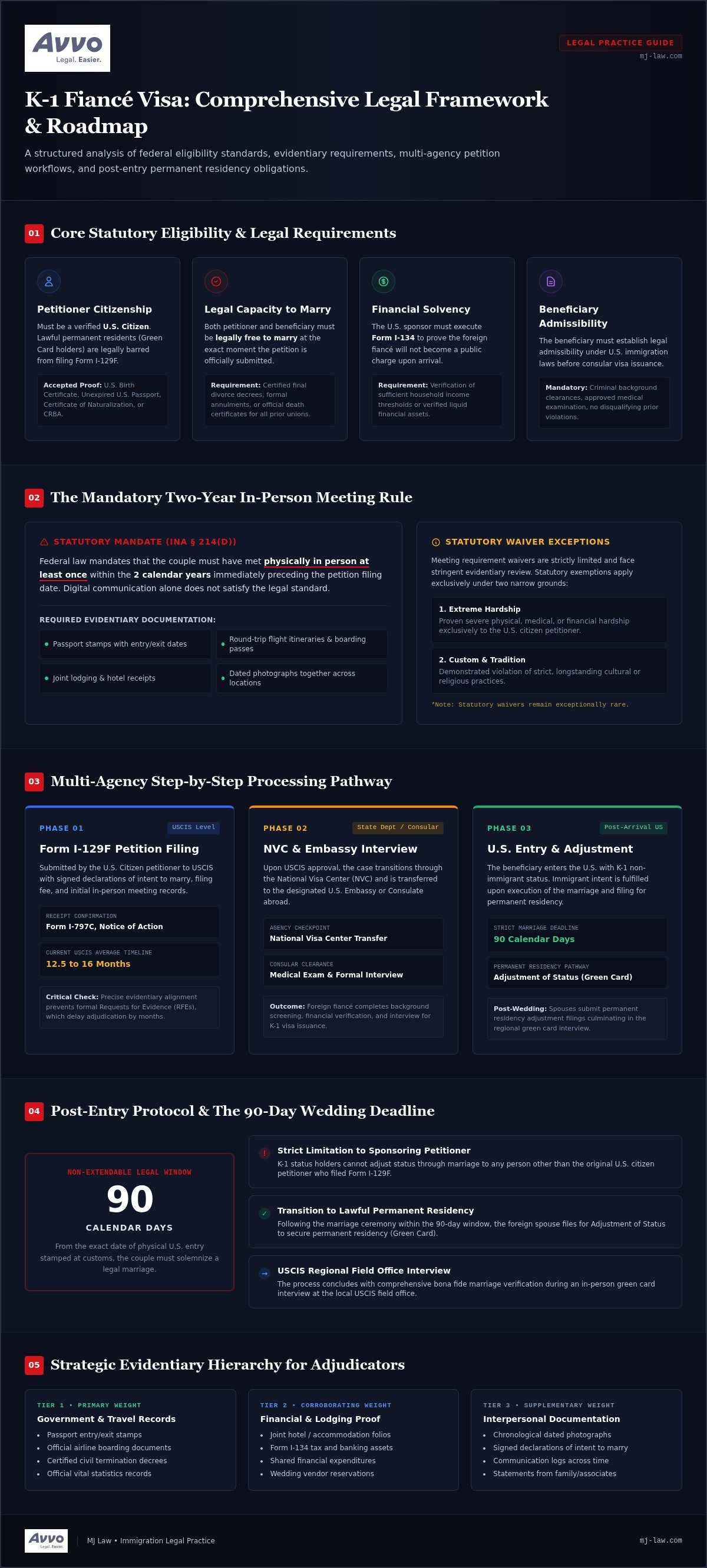
Federal statute dictates that you and your partner must have met physically in person at least once within the two calendar years immediately preceding the petition filing date. Phone calls, video chats, and digital messaging do not satisfy this standard, regardless of relationship duration. Adjudicators demand hard physical documentation, including stamped passport pages, round-trip flight itineraries, lodging receipts bearing both names, and dated photographs taken together across various settings.
Very narrow statutory exemptions exist under INA § 214(d). These waivers apply exclusively if you prove an in-person meeting would result in extreme hardship to the U.S. citizen petitioner, or if it violates strict, longstanding cultural or religious customs. These exceptions remain exceptionally rare and face rigorous evidentiary scrutiny.
The Step-by-Step K-1 Visa Process: From Petition to U.S. Entry
Government web portals often present the journey as isolated bureaucratic checkpoints, leaving couples unprepared for the handoffs between separate federal departments. Successfully securing a K1 Fiance Visa requires continuous administrative coordination across U.S. Citizenship and Immigration Services, the National Visa Center, and the Department of State. Proactive legal oversight ensures that critical files transfer smoothly between these distinct agencies without languishing in administrative limbo.
Understanding every phase keeps your application moving predictably. To review local filing dynamics and regional Bay Area considerations, consult the K-1 visa lawyer San Francisco guide. Couples managing complex relationship histories or strict international timelines often schedule a strategic case assessment to establish an airtight evidentiary record from the start.
Phase 1: Filing Form I-129F with USCIS
The U.S. citizen petitioner initiates the process by submitting Form I-129F alongside required filing fees, signed intent-to-marry statements, and initial meeting documentation. USCIS responds by mailing Form I-797C, Notice of Action, confirming receipt. Case processing currently averages 12.5 to 16 months at service centers. Formulating thorough documentation in strict compliance with USCIS fiancé visa guidelines prevents formal Requests for Evidence (RFEs), which stall case adjudication for several months.
Phase 2: NVC Processing and Embassy Stage
Once USCIS approves the petition, the physical and electronic case files move to the National Visa Center (NVC). The NVC assigns a unique consular case number and forwards the materials to the U.S. Embassy or Consulate in the beneficiary’s home country, a transition that generally takes 4 to 8 weeks. Upon notification from the overseas post, the foreign fiancé completes the online DS-160 visa application, pays the mandatory $265 Department of State consular processing fee, and schedules an appointment with an authorized panel physician for immigration health screenings.
Phase 3: The Consular Interview and Visa Issuance
The final phase culminates at the foreign beneficiary’s scheduled consular interview. The applicant must bring certified civil records, police clearances from every country of prior residence, updated financial affidavits, and recent correspondence proving an enduring bond. Consular officers ask detailed questions to verify genuine marital intent:
- Where and how did you first meet in person?
- What are your plans for living arrangements and employment after moving to the United States?
- What specific details do you know about your partner’s family, career, and daily routines?
Following interview approval, the consular post issues the K-1 visa foil in the beneficiary’s passport. This single-entry travel document generally remains valid for up to six months, giving your partner the legal window needed to finalize travel and enter the United States.
K-1 Fiance Visa vs. CR-1 Spousal Visa: Which Pathway Is Best?
Couples often assume the K1 Fiance Visa remains the fastest route to living together in the United States. Historically, fiancé petitions shaved many months off the wait compared to consular marriage processing. Shifting federal workloads have largely erased that speed gap. Choosing between entering as an engaged partner or arriving as a recognized spouse requires balancing overall processing durations, initial out-of-pocket government costs, and post-entry career mobility. For a deeper breakdown of domestic status changes versus overseas processing, explore our analysis of Adjustment of Status vs Consular Processing.
| Comparison Metric | K-1 Fiance Visa | CR-1 Spousal Visa |
|---|---|---|
| Total Timeline to U.S. Entry | 14 to 18 months | 13 to 17 months |
| Total Mandatory Government Fees | $2,380 ($3,270 with Work/Travel) | $1,305 (online) / $1,355 (paper) |
| Work Authorization Upon U.S. Entry | None (must file Form I-765 after wedding) | Immediate permanent right to work |
| Post-Arrival Status | Temporary visitor; requires Form I-485 adjustment | Lawful Permanent Resident (green card in hand) |
Timeline and Work Authorization Differences
Fiancé visa holders face a mandatory employment gap upon entering the country. A K-1 visa does not grant independent work authorization at arrival. Your partner cannot work legally until you marry, submit the post-wedding adjustment packet, and USCIS approves Form I-765. In contrast, the CR-1 spousal visa confers immediate Lawful Permanent Resident status upon entry. The endorsed passport stamp serves as immediate proof of green card status, enabling unrestricted employment and international travel from day one.
Total Filing Costs and Strategic Suitability
The two-step K-1 process requires paying the $675 Form I-129F petition fee, the $265 Department of State consular fee, and the $1,440 Form I-485 adjustment fee. Adding optional unbundled employment authorization ($260) and travel permission ($630) raises total federal filing fees to $3,270. Consular CR-1 spousal processing costs $1,305 to $1,355, saving nearly $2,000 in baseline government expenses. For couples planning foreign wedding celebrations or those where the immigrant spouse cannot afford months out of the global workforce, the spousal visa often serves as the stronger strategic choice.
Documentation Strategy: Proving a Bona Fide Relationship and Avoiding Pitfalls
Adjudicators evaluate your petition through an analytical lens designed to identify immigration fraud. Merely completing government questionnaires won’t suffice; you must establish a credible narrative of genuine marital intent. Reviewing a structured I-130 evidence checklist illustrates the evidentiary weight federal officers expect when inspecting relationship authenticity.
For tech professionals and entrepreneurs living in the San Francisco Bay Area and Silicon Valley, compiling evidence carries distinct hurdles. Fast-paced work schedules, frequent global business travel, and modern digital communication styles often lead couples to rely excessively on messaging logs while overlooking hard physical documentation. USCIS expects tangible, objective corroboration that your lives are intertwined.
Compiling High-Impact Proof of a Genuine Relationship
Evidentiary materials carry varying weight with reviewing officers. Build your packet prioritizing high-probative documentation over casual digital interaction:
- Primary Travel Records: Boarding passes, passport entry and exit stamps, coordinated airline bookings, and joint lodging confirmations showing trips taken together.
- Photographic History: Clear, chronological photographs spanning your relationship, depicting both partners in diverse settings alongside mutual friends and extended family.
- Third-Party Affidavits and Declarations: Formal sworn letters from friends and relatives attesting to your shared history, alongside mutual signed declarations confirming your legal intent to marry within 90 days.
- Selective Communication Logs: Sampled call records and chat histories demonstrating continuous contact over months, rather than overwhelming binders containing thousands of repetitive daily messages.
Red Flags That Trigger Requests for Evidence (RFEs) or Delays
Certain factual patterns draw heightened scrutiny from USCIS and consular officers. Significant age discrepancies, the absence of a shared spoken language, or extremely brief in-person meetings shortly before filing Form I-129F frequently trigger rigorous background checks. Complex Silicon Valley compensation packages (including unvested equity, incentive stock options, or fluctuating startup bonuses) also routinely provoke financial inquiries if base salary verification is missing from Form I-134.
Overlooking prior civil or criminal infractions presents another severe risk. An ambiguous record can stall a K1 Fiance Visa for a year or lead to an outright refusal. If federal adjudicators challenge your bona fides or question your supporting records, consulting an experienced marriage green card RFE lawyer in San Jose helps protect your petition. If you received a formal notice or want to bulletproof your filing before submission, book a direct consultation with our immigration attorneys to resolve potential red flags early.
After U.S. Arrival: The 90-Day Marriage Rule and Green Card Adjustment
Crossing through U.S. Customs and Border Protection is a major milestone, but arriving on a K1 Fiance Visa is only the midway point of your immigration journey. Physical admission triggers a strict, non-negotiable statutory deadline. To protect your partner’s legal standing and secure permanent residency without administrative friction, schedule an immigration consultation to organize your post-arrival filings well in advance.
The 90-Day Marriage Rule and What Happens If You Miss It
Under INA § 214(d), your foreign fiancé must marry you within exactly 90 calendar days of entering the United States, as marked on their initial Form I-94 arrival record. Federal immigration authorities cannot pause, extend, or waive this timeframe. Strict statutory provisions under INA § 245(d) also prevent your partner from adjusting status through any pathway other than marriage to the original citizen petitioner. They cannot adjust through employment sponsorship or marriage to someone else.
Missing this 90-day cutoff creates immediate legal jeopardy. The foreign partner falls out of lawful status, starts accruing unlawful presence, and becomes subject to removal proceedings. If an unavoidable emergency delays your ceremony past the 90-day mark, you must still marry the same petitioner. However, you can no longer file a standard K-1 adjustment; you must instead submit a standalone Form I-130 immigrant petition alongside Form I-485, creating extra procedural hurdles and processing delays.
Filing for Adjustment of Status (Form I-485)
Once you record your marriage certificate with the county clerk, you should submit your adjustment of status packet to USCIS without delay. This packet includes:
- Form I-485: The primary application to register lawful permanent residence.
- Form I-864: The legally binding Affidavit of Support showing household income at or above 125% of federal poverty guidelines ($27,050 for a two-person household in 2026).
- Ancillary Work and Travel Petitions: Concurrent submissions of Form I-765 for an Employment Authorization Document and Form I-131 for Advance Parole travel permissions.
- Form I-693: Medical examination verification and vaccination records completed by an authorized civil surgeon.
Local USCIS field offices in San Jose and San Francisco adjudicate these applications. When couples submit extensive evidence of commingled lives, such as joint residential leases and shared bank accounts, officers frequently waive the in-person interview. Because your marriage will be under two years old upon approval, USCIS issues a 2-year conditional green card. You must subsequently file Form I-751 within the 90-day window before that card expires to remove conditions and achieve unconditional permanent resident status.
Take the Next Step Toward Your Life Together
Bringing your partner to Northern California requires precision, patience, and proactive planning. From assembling an airtight evidentiary packet to managing post-arrival adjustment under the strict 90-day wedding rule, every procedural choice impacts your timeline. Securing a K1 Fiance Visa involves coordinating across multiple federal departments, but an organized legal strategy eliminates guesswork and keeps your path toward permanent residency predictable.
You don’t have to manage these intricate federal mandates alone. With over 30 years of experience assisting families across Silicon Valley and the wider Bay Area, MJ Law provides comprehensive bilingual legal representation in English and Spanish. Our attorneys offer a proven track record handling complex marriage green cards, waiver applications, and foreign consular processing. When you are ready to start this chapter with confidence, schedule a confidential consultation with MJ Law. We stand ready to help you build an enduring foundation for your life together in the United States.
Frequently Asked Questions
Can my fiancé work in the U.S. immediately upon arriving on a K-1 visa?
No, your fiancé cannot work immediately upon arrival. The K1 Fiance Visa does not grant automatic work privileges. While foreign fiancés can technically apply for a temporary 90-day work permit upon admission, processing times outlast the visa validity period. Practical employment authorization only becomes possible after you marry and submit Form I-765 alongside your green card adjustment application, which grants legal work authorization while permanent residency is pending.
What happens if we do not get married within the 90-day deadline?
Failing to marry within 90 days immediately voids your partner’s lawful status. Federal law prohibits extending this deadline or adjusting status through any alternative basis, such as employment or marriage to someone else. Your fiancé begins accruing unlawful presence and risks removal proceedings. If unexpected circumstances delay your wedding, consult an immigration attorney immediately to explore statutory remedies before taking further administrative steps.
Can a green card holder sponsor someone for a K-1 fiancé visa?
No, lawful permanent residents cannot file a fiancé petition. Under federal statute, only verified United States citizens possess the legal authority to petition an overseas partner through the K-1 category. If you hold a green card and wish to bring your partner to Northern California, you must marry abroad first and petition them for a spousal immigrant visa, or wait until you obtain U.S. citizenship through naturalization.
How much income does the U.S. citizen petitioner need to qualify?
The petitioning sponsor must demonstrate household income of at least 100% to 125% of the federal poverty guidelines on Form I-134 during consular processing, and at least 125% on Form I-864 for post-marriage adjustment. For a two-person household in 2026, the standard 125% threshold is $27,050. Bay Area tech workers relying on equity, RSUs, or startup options rather than standard W-2 salary often need substantial liquid asset documentation to satisfy USCIS reviewers.
Can my fiancé’s children come to the United States on the same petition?
Yes, unmarried children under the age of 21 can enter the United States alongside your partner under derivative K-2 status. You must list them on the initial Form I-129F petition filed with USCIS. Each child requires a separate consular visa fee and medical screening. After your wedding, eligible K-2 children can adjust status to permanent residency concurrently with your newlywed spouse through the San Jose or San Francisco USCIS field offices.
What should we do if our Form I-129F petition receives a Request for Evidence (RFE)?
Do not panic, but act promptly. An RFE means USCIS adjudicators require additional documentation before approving the K1 Fiance Visa petition. The notice specifies missing relationship proof, unresolved divorce documentation, or financial gaps, giving you a strict, non-extendable deadline to respond. Review the notice methodically, compile authenticated records that directly satisfy each listed inquiry, and retain experienced legal counsel to assemble an organized rebuttal to prevent outright denial.
Can my fiancé travel outside the U.S. while waiting for our green card after marriage?
Your partner must not leave the United States after marriage without an approved Advance Parole travel document. The initial fiancé visa is strictly a single-entry document that expires upon your partner’s physical entry. Departing the country before receiving travel authorization or final green card approval causes USCIS to deem your pending Form I-485 permanently abandoned, stranding your spouse overseas and forcing you to restart the lengthy consular spousal process from scratch.