
Securing a permanent future in the United States shouldn’t feel like a high-stakes gamble with your family’s security. For many tech professionals and entrepreneurs in San Jose, understanding the EB-5 visa requirements for California investors is the first step in a strategic financial move toward permanent residency. With minimum investment amounts currently set at $800,000 for Targeted Employment Areas and $1,050,000 for other projects, timing is critical. Since inflation adjustments are scheduled for January 1, 2027, the current landscape offers a specific window of opportunity for those ready to act.
You likely recognize that proving the legal source of your funds and choosing a stable project are the most stressful parts of this journey. It’s common to worry about capital preservation or the long wait times associated with USCIS processing. This guide provides a clear roadmap designed for high-net-worth individuals in the Silicon Valley ecosystem to master these complexities. We’ll explore the latest 2026 filing regulations, the advantages of reserved visa categories, and the specific steps required to ensure a streamlined path to U.S. citizenship for your entire family.
Key Takeaways
- Identify the 2026 investment thresholds of $800,000 for TEAs and $1,050,000 for standard projects to plan your capital allocation effectively.
- Master the EB-5 visa requirements for California investors, focusing on the core dual requirement of capital investment and the creation of 10 permanent U.S. jobs.
- Compare the passive nature of regional center investments against the active management required for direct investments to choose the right model for your lifestyle.
- Learn how to navigate the complex “Source of Funds” audit with a step-by-step roadmap designed to protect your assets and your residency status.
- Leverage local Silicon Valley expertise to manage the specific challenges of urban California TEA projects and concurrent filing strategies.
The 2026 EB-5 Landscape for California Investors: An Overview
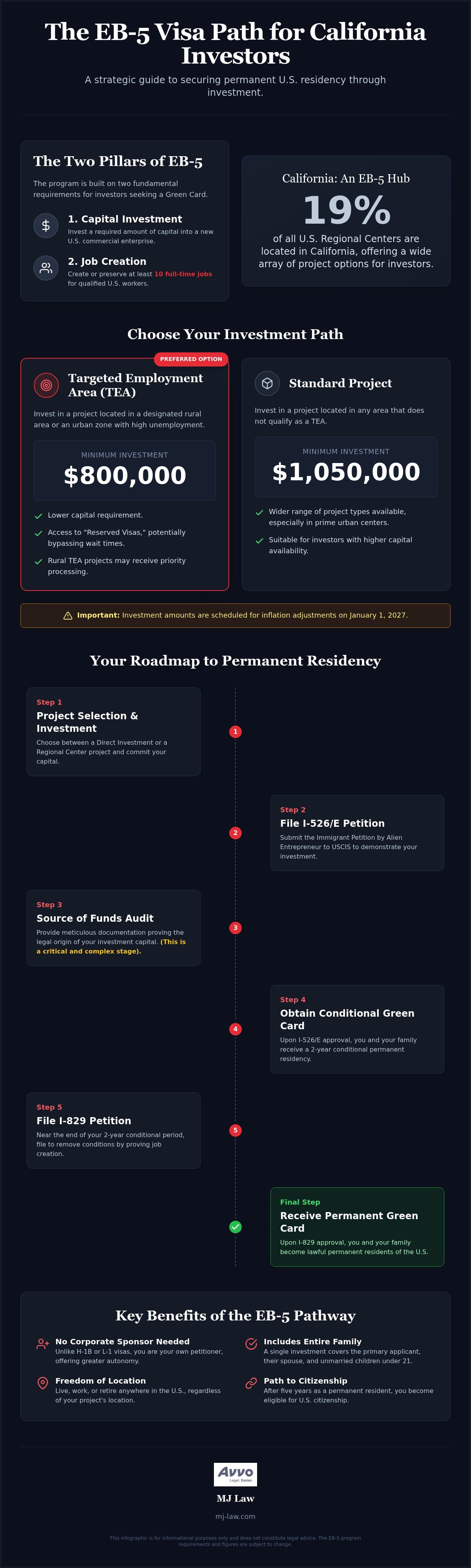
The EB-5 visa program, officially known as the Employment-Based Fifth Preference category, represents a unique intersection of economic development and immigration. For many families, it’s the most reliable path to permanent residency. The program hinges on two primary pillars: the investment of significant capital and the creation of at least 10 full-time jobs for U.S. workers. In 2026, California continues to lead the nation in EB-5 activity, hosting 19% of all regional centers. This concentration provides local investors with a wealth of project options, from San Jose tech hubs to infrastructure developments in rural counties.
Under the current 2026 regulations, the standard minimum investment is $1,050,000. However, projects located in Targeted Employment Areas (TEAs) qualify for a reduced threshold of $800,000. These TEAs include rural areas or urban zones with high unemployment. For those reviewing the EB-5 visa requirements for California investors, the “Reserved Visa” categories established by the 2022 Reform and Integrity Act are particularly valuable. These set-asides for rural, high unemployment, and infrastructure projects allow investors from backlogged countries to bypass traditional waiting lines, making the 2026 landscape more efficient than in previous years.
Who Qualifies as an EB-5 Investor?
The program is intentionally inclusive regarding professional background. You don’t need a specific degree or previous management experience to apply. The primary applicant, their spouse, and any unmarried children under the age of 21 are all eligible for Green Cards through a single investment. Meeting the EB-5 visa requirements for California investors involves proving you’re an individual who has placed, or is actively placing, the required capital at risk in a new commercial enterprise with the clear intent to create the necessary employment.
The Benefits of the EB-5 Pathway
One of the most significant advantages of this visa is its autonomy. Unlike H-1B or L-1 visas, you don’t need a corporate sponsor or a Labor Certification (PERM) from the Department of Labor. This independence allows you to live, work, or retire anywhere in the United States. You aren’t tied to the location of your investment project. This flexibility is ideal for Silicon Valley professionals who want to transition between startups or launch their own ventures while their family enjoys the security of permanent residency. After five years as a permanent resident, the path to U.S. citizenship becomes available.
Investment Thresholds and Targeted Employment Areas (TEA) in Northern California
The financial commitment is the cornerstone of any application. For those evaluating EB-5 visa requirements for California investors, the capital threshold depends entirely on the project’s location. The standard minimum investment sits at $1,050,000, while projects within a Targeted Employment Area (TEA) allow for a reduced amount of $800,000. These figures are current for 2026, though they’re scheduled for inflation adjustments on January 1, 2027. The EB-5 Reform and Integrity Act of 2022 (RIA) significantly changed how these zones are defined. Previously, individual states could designate TEAs, but that authority now rests solely with USCIS to ensure consistency across the country.
According to the Official EB-5 visa requirements, a TEA can be either a rural area or a location experiencing high unemployment. In Northern California, the “Rural” designation has become a strategic favorite because it grants investors priority processing. This can shave months or even years off the timeline compared to standard urban projects. High Unemployment TEAs must demonstrate an unemployment rate of at least 150% of the national average, a calculation that requires precise data analysis to satisfy federal auditors.
Identifying TEA Zones in San Jose and San Francisco
Finding an $800,000 entry point in the expensive Bay Area market is complex but possible. Urban TEAs are based on specific census tracts that meet strict unemployment criteria. The 2021 Behring Regional Center court case was a pivotal moment for California, as it challenged previous restrictive rules and helped stabilize the regional center model we use today. You must obtain a formal TEA designation letter from the project sponsor to confirm the lower investment tier applies. If you’re unsure if a specific Silicon Valley development qualifies, you can schedule a consultation to review current project maps.
Capital Requirements: What Counts as “Investment”?
Capital isn’t limited to cash sitting in a bank account. It can include equipment, inventory, or other tangible property, provided it’s valued at fair market prices. However, the “At-Risk” requirement is absolute. USCIS mandates that your capital must be subject to both the risk of loss and the potential for gain. In the context of 2026 tech-sector investments, “At-Risk” capital means the funds are fully committed to the enterprise without any contractual guarantee of repayment or a redemption agreement. This ensures the investment actually drives economic growth rather than serving as a secured loan.
Direct Investment vs. Regional Center: Selecting the Right Model
Choosing between a direct investment and a regional center is a decision that shapes your entire immigration experience. For those reviewing EB-5 visa requirements for California investors, the choice often comes down to how much control you want over the daily operations of the business. Direct investment involves a hands-on approach where you manage the new commercial enterprise yourself. In contrast, regional centers offer a passive model, allowing you to invest capital into a larger, third-party project. Understanding how the EB-5 program works helps clarify why each path carries a distinct risk profile under 2026 USCIS auditing standards.
The Regional Center Advantage for Passive Investors
This model is ideal for those who prefer to focus on their personal lives or other business interests while their capital works in the background. Regional centers pool funds from multiple investors to finance large-scale developments, such as mixed-use real estate or municipal infrastructure. The primary benefit here is the methodology for job creation. Unlike the direct model, regional centers can count indirect and induced jobs. This means you aren’t solely responsible for hiring 10 full-time employees on your own payroll. If you’re considering other business-related options, you might also find it helpful to review the E-2 Treaty Investor Visa Requirements for San Jose.
Direct EB-5 for Silicon Valley Entrepreneurs
Many tech founders in San Jose opt for direct investment because it allows them to fund their own startups or expansions. You maintain full equity and operational control. However, the documentation requirements are more rigorous. You must prove the creation of 10 direct, full-time W-2 positions for U.S. workers within the two-year conditional period. This path is often chosen by those who already have a viable business plan and the infrastructure to scale. For high-achieving professionals who may qualify based on their career accomplishments instead of capital, our EB-1A Extraordinary Ability Lawyer Guide offers an alternative perspective on priority green cards.
In 2026, the risk profile for both models has shifted due to the EB-5 Reform and Integrity Act. Regional centers now face stricter reporting requirements and annual audits, which provides a layer of transparency for investors. Direct investors must ensure their business plans are robust enough to withstand deep scrutiny of their employment records and financial statements. Whether you choose the active or passive route, the goal remains the same: preserving your capital while securing a permanent future for your family.
How to Navigate the EB-5 Application Process: A Step-by-Step Roadmap
The journey toward permanent residency is a methodical process that requires a steady hand to manage the administrative burden. Unlike other visa categories where the petition is the first step, the EB-5 path begins with a rigorous “Source of Funds” audit and project due diligence. This preparation phase is where the most critical work happens, as it forms the foundation of your entire case. For those navigating EB-5 visa requirements for California investors, understanding this timeline is essential for a successful outcome.
Documenting Your ‘Source of Funds’ in the Tech Sector
Silicon Valley investors often present unique financial profiles that require specialized documentation. If your capital originates from stock options, IPO exits, or cryptocurrency gains, USCIS expects a granular trail of every transaction. You must trace the path of capital from its original source, such as an employment contract or an initial investment, to the escrow account. Common pitfalls include missing tax return records or gaps in bank statements, which frequently trigger a Request for Evidence (RFE). Providing a clear, documented narrative of your wealth is the best way to avoid these delays.
Concurrent Filing: The Silicon Valley Shortcut
A significant benefit for investors already residing in the U.S. on O-1 or H-1B visas is the ability to utilize concurrent filing. By submitting Form I-485 alongside your initial I-526 or I-526E petition, you secure your right to stay in the country while the government reviews your case. This strategy also allows you to obtain an Employment Authorization Document (EAD) and a travel document, known as Advance Parole, relatively quickly. This provides professional flexibility while your green card is pending. If you’re currently on a work visa, you might benefit from speaking with an H-1B Visa Lawyer San Jose to coordinate your transition effectively.
Once your initial petition is approved, you’ll receive a conditional green card valid for two years. During this time, the investment must remain “at risk” and the job creation requirements must be met. In the final 90 days of this period, you file Form I-829 to remove these conditions and secure permanent status. Mastering the EB-5 visa requirements for California investors means staying diligent through every one of these phases, from the initial audit to the final removal of conditions. To ensure your documentation meets the highest standards before filing, you can book a strategy session to review your specific financial history.
Secure Your U.S. Future: How MJ Law Protects California Investors
Choosing the right legal partner is as critical as selecting the investment project itself. When you’re managing a high-stakes transition, having local representation in the heart of Silicon Valley provides a distinct advantage. MJ Law is located near the San Jose USCIS field office, offering a unique perspective on how local officers interpret EB-5 visa requirements for California investors. Our firm brings over 30 years of experience to every case, acting as a steady hand for families navigating the complexities of the U.S. immigration system.
Our approach to investor protection begins with exhaustive project due diligence. We don’t just look at the numbers; we evaluate the structural integrity of the enterprise to ensure it aligns with current federal standards. Because Silicon Valley wealth often involves complex “Source of Funds” narratives, like stock option exercises or venture capital distributions, our experience in this specific ecosystem is invaluable. We understand how to translate your professional success into a clear, compliant narrative that satisfies USCIS auditors.
Bilingual Expertise for Global Investors
Silicon Valley is a global community, and your legal team should reflect that diversity. We offer bilingual services in English and Spanish to ensure that every client feels heard and understood. Gabriel Jack and Michael Muston lead our firm with a partnership built on trust and a commitment to individual success stories. We recognize the cultural and financial nuances involved in international wealth transfers, ensuring that the transition of your capital is handled with the precision it requires. This collaborative relationship moves beyond a simple transaction; it’s a partnership dedicated to your family’s future.
Your Path to Permanent Residency Starts Here
The EB-5 program remains a premier choice for 2026 investors seeking a streamlined path to a green card and eventual citizenship. While the process is demanding, it’s manageable with the right roadmap. To prepare for your initial strategy session, gather your recent tax returns and a summary of your intended investment capital. We’ll review your goals and determine the most effective filing strategy for your specific situation. Don’t leave your family’s residency to chance. Book your EB-5 consultation with MJ Law today to begin your journey toward a secure U.S. future.
Take the Next Step Toward Your Silicon Valley Legacy
Securing your family’s future through investment is a sophisticated journey that requires both financial precision and legal foresight. By mastering the EB-5 visa requirements for California investors, you can strategically choose between passive regional center models and active direct investments in the tech sector. The foundation of a successful petition lies in an airtight “Source of Funds” narrative and meticulous project due diligence that withstands federal scrutiny.
With over 30 years of immigration law experience in Silicon Valley, MJ Law provides the steady hand needed to manage these high-stakes transitions. Our firm is located near the San Jose USCIS field office, offering a unique perspective on the local adjudication process. We specialize in the complex documentation required for tech professionals, including IPO exits and stock option distributions. Your residency is a legacy worth protecting with local, seasoned expertise. Schedule Your EB-5 Strategy Session with MJ Law today to begin your roadmap to permanent status. We’re ready to guide you home.
Frequently Asked Questions
What is the minimum EB-5 investment amount in California for 2026?
In 2026, the minimum investment is $800,000 for projects in Targeted Employment Areas (TEA) and $1,050,000 for non-TEA projects. These thresholds were established by the 2022 Reform and Integrity Act and are scheduled for an inflation adjustment on January 1, 2027. Many investors in San Jose seek out TEA projects to take advantage of the lower capital requirement. It’s vital to verify a project’s TEA designation to ensure it meets the specific EB-5 visa requirements for California investors.
Can I use a gift from a family member for my EB-5 investment?
You can use gifted funds for your investment, but the donor must provide the same level of documentation as a primary investor. USCIS requires a clear paper trail showing how the family member originally earned the capital. This might include tax returns, employment records, or investment statements. MJ Law specializes in documenting these complex wealth transfers for Silicon Valley families, ensuring that every gifted dollar meets the strict regulatory standards for lawful capital.
How long does it take to get a Green Card through the EB-5 program?
Processing times vary based on the project type and your country of origin. As of late 2026, the average processing time for an I-526E petition is approximately 35 months. However, rural TEA projects often receive priority processing, which can significantly shorten this window. For investors already residing in San Francisco or San Jose, concurrent filing allows you to live and work in the U.S. with a pending application, bypassing many traditional wait time frustrations.
What happens if the EB-5 project I invest in fails or goes bankrupt?
The “at-risk” requirement means your capital cannot be guaranteed against loss. If a project fails, your primary goal is to ensure that the 10 required jobs were still created, as this is necessary to remove conditions on your residency. If the job creation requirement isn’t met, your permanent green card status may be in jeopardy. This highlights the importance of thorough project due diligence and selecting stable developments with a proven track record of completion.
Can I transition from an H-1B or O-1 visa to an EB-5?
Transitioning from an H-1B or O-1 visa to an EB-5 is a common strategy for Silicon Valley professionals. The 2022 Reform and Integrity Act introduced concurrent filing, which allows you to submit your adjustment of status application at the same time as your investor petition. This grants you an “open” work permit and travel authorization. It provides significantly more professional flexibility than your original employer-sponsored visa while you wait for final green card approval.
Do I need to live in the same city as my EB-5 investment project?
No, you don’t need to live in the same city or state as your investment project. You have the freedom to live and work anywhere in the United States. Many of our clients invest in projects across the country but choose to stay in San Jose to remain close to the tech ecosystem. This flexibility is a major advantage for families who want to maintain their professional networks in California while their capital supports development elsewhere.
What is the difference between a conditional and permanent Green Card?
A conditional green card is the initial residency granted for a two-year period. It carries the same rights as a permanent card, but it’s temporary. To secure permanent status, you must file Form I-829 within the 90 days before your conditional card expires. In this filing, you must prove that your full investment remained at risk and that the 10 full-time jobs were successfully created or preserved for U.S. workers during those two years.
How many jobs must an EB-5 investment create for U.S. workers?
Every EB-5 investment must create or preserve at least 10 full-time jobs for qualifying U.S. workers. If you invest through a regional center, these can include indirect and induced jobs created by the project’s economic activity. In a direct investment model, you must show 10 direct, W-2 employees on your own payroll. Meeting these EB-5 visa requirements for California investors is the final hurdle to removing conditions and securing your permanent future in the United States.