
What if an investment appears to meet EB-5 requirements but does not fit your immigration circumstances? For San Jose investors searching “EB-5 investor visa attorney San Jose,” the key is to assess the immigration pathway, investment structure, and supporting evidence together before making major decisions. Eligibility depends on more than choosing a project: your case must also address the lawful source and movement of funds and the program’s job-creation requirements.
Questions about regional center versus direct investment, which records to gather, and how each stage works are reasonable. This 2026 guide explains core EB-5 requirements and application stages, compares the main investment routes, and outlines questions to raise with immigration counsel. MJ Law assists individuals, families, and businesses with immigration matters, including business and investor visas. Use this guide to prepare for a focused consultation and identify a considered next step.
Key Takeaways
- Learn how the EB-5 immigrant pathway differs from temporary business visas and what connects an investment to immigration eligibility.
- Understand the separate evidence needed to document where investment funds came from and how they moved.
- Compare direct and regional center routes by investor role, business structure, job evidence, and documentation needs.
- Use an organized preparation sequence to clarify your goals, gather records, and identify timing or visa-availability questions.
- An EB-5 investor visa attorney San Jose can help assess immigration goals, evidence, and filing strategy. Investment decisions also call for independent financial diligence.
Considering an EB-5 Investor Visa in San Jose? Start With the Immigration Pathway
EB-5 is a U.S. immigrant investor pathway that may lead to permanent residence when an investor’s qualifying investment meets program requirements, including job creation, and the investor satisfies applicable immigration rules. Unlike a temporary business visa, it is not simply permission to visit the United States to conduct business. It involves an investment-based petition and evidence supporting both the investment and the investor’s eligibility.
The investment must support a qualifying enterprise and the required job creation, while the investor must document that the case meets the program’s legal and evidentiary standards. The EB-5 visa program overview offers historical context, but individual decisions depend on current rules and the facts of the case.
What does the EB-5 program offer investors?
The program may provide a path to permanent residence for investors who qualify. It does not promise eligibility, approval, or a particular immigration outcome. An immigration petition and an investment decision address different questions: the petition concerns whether legal requirements are met, while the investment decision concerns the project’s terms, risks, and financial suitability.
Evidence about funds is an important part of the immigration analysis. Investors may need to explain both the lawful source of the capital and its path into the investment. These are related but distinct questions. Records showing how money was earned may not, on their own, show every transfer between accounts or countries. Organizing the history early can reveal what documentation exists and where an explanation may be needed.
Job creation and investment structure also shape how a case is evaluated. Relevant evidence varies by route and project. Immigration counsel can assess legal requirements and supporting records, but that review does not replace independent evaluation of the investment’s financial and business risks.
Why should San Jose investors assess the full picture?
San Jose’s place in Silicon Valley means investors may encounter a range of business and development contexts. A project’s location or connection to a thriving local economy does not, by itself, establish that it qualifies for EB-5 or aligns with an individual’s goals. Before committing capital or filing a petition, consider how the proposed structure, job evidence, funds history, and immigration plans fit together.
Immigration rules are federal, so living in San Jose does not change the legal requirements. Your personal circumstances can affect how those requirements apply. Visa availability and processing conditions can also change, so assess timing using current information rather than assumptions based on another investor’s experience.
Before taking action, write down the questions that matter to you: What immigration outcome are you seeking? How can you document your funds? What role would you have in the investment? An EB-5 investor visa attorney San Jose can help assess the legal and evidentiary issues in your circumstances. A focused consultation gives you a clearer starting point without confusing legal analysis with investment advice.
EB-5 Eligibility and Evidence: What an Investor Must Be Ready to Address
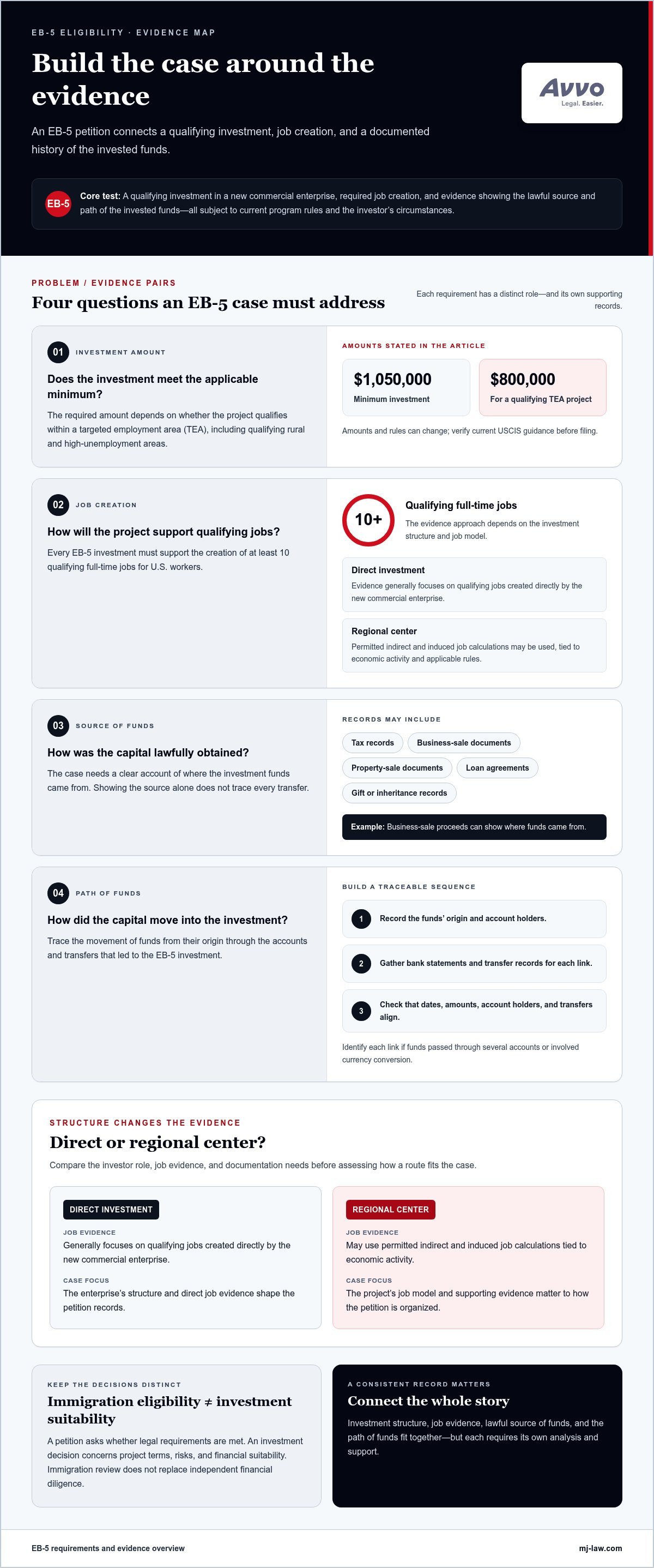
EB-5 eligibility involves connected requirements, each supported by its own evidence. As of October 2026, the minimum investment is $1,050,000, or $800,000 for a qualifying project in a targeted employment area, including qualifying rural and high-unemployment areas. The investment must be placed in a qualifying new commercial enterprise and lead to the required job creation. Amounts and rules can change, so verify current USCIS guidance before filing.
An EB-5 case must establish a qualifying investment in a new commercial enterprise, the required job creation, and the lawful source and path of the invested funds, subject to the investor’s circumstances and current program rules. The project structure affects how job creation is documented, while the investor’s financial history determines what evidence may be needed to explain the capital.
How do source and path of funds evidence fit?
Source of funds addresses how the investor lawfully obtained the capital. Path of funds traces how that capital moved from its origin into the EB-5 investment. Documenting one does not automatically document the other. For example, proof of proceeds from a business sale may show where funds came from, while bank statements and transfer records may be needed to trace how the proceeds reached the investment account.
Relevant records depend on the actual history. They may include tax records, business or property sale documents, bank statements, loan agreements, and records of gifts or inheritances. The goal is a consistent, traceable account, not simply a large stack of paperwork. Dates, amounts, account holders, and transfers should align across records. If funds passed through several accounts or involved currency conversion, identify each link and gather supporting documentation where available.
How are job creation and investment structure assessed?
Each EB-5 investment must support the creation of at least 10 qualifying full-time jobs for U.S. workers. For a direct investment, evidence generally focuses on qualifying jobs created directly by the new commercial enterprise. Regional center cases may use permitted indirect and induced job calculations tied to economic activity, subject to applicable program rules and evidence. Because the approaches differ, the project’s job model matters when organizing the petition.
A new commercial enterprise is the business activity receiving the investment under EB-5 rules. It can take different forms, and the enterprise and investment route determine which records are relevant. Project documents may describe the business plan, capital structure, and projected or actual job creation. Immigration counsel can assess how those materials relate to petition requirements. Legal representation does not guarantee a project’s financial performance or replace independent investment diligence.
Because the funds history and job evidence must fit the specific case, an EB-5 investor visa attorney San Jose can help identify evidence gaps and clarify the legal questions to resolve. A focused EB-5 case consultation can help organize those questions around your circumstances and proposed investment.
Direct EB-5 or Regional Center: Compare the Routes Before Choosing
Both routes connect an investment to EB-5 eligibility, but they differ in enterprise structure, the investor’s potential role, and how job creation is documented. Direct EB-5 generally ties the investment and job evidence to the investor’s business, while a regional center investment uses a regional center-associated structure that may count qualifying indirect and induced jobs under program rules.
Use this comparison to identify the questions that matter in your circumstances. It is a starting point, not a ranking of which route is best.
| Consideration | Direct EB-5 | Regional center EB-5 |
|---|---|---|
| Investor role | May be more closely connected to the business; the actual role depends on its structure. | Typically invests through a pooled structure rather than operating the underlying business directly. |
| Enterprise structure | Investment is made in a qualifying business the investor establishes or invests in. | Investment is associated with a regional center project and its enterprise structure. |
| Job evidence | Generally documents qualifying jobs created directly by the enterprise. | May include eligible direct, indirect, and induced job calculations under applicable rules. |
| Documentation focus | Business operations, investment records, and evidence of direct job creation may be central. | Project structure, offering materials, economic analysis, and investment and funds records may be relevant. |
What distinguishes a direct EB-5 investment?
With a direct investment, capital goes into a business that must meet EB-5 requirements, including creating at least 10 qualifying full-time jobs. The investor may have a hands-on connection to the enterprise, but the level of operational involvement depends on the business and legal structure. Evidence can include business records and employment documentation supporting the direct job count. Immigration review does not assess whether the business is financially sound.
What should investors understand about regional center cases?
Regional center cases use a structure connected to a regional center and may rely on permitted indirect or induced job calculations, rather than documenting only employees hired directly by the investor’s business. The project’s economic and legal documentation therefore matters to the petition, while its financial terms and risks require separate diligence. If you are comparing other investor pathways, the E-2 treaty investor visa guide explains a distinct route with different requirements.
Neither route is universally safer, easier, faster, or more profitable. Assess the project’s structure and evidence alongside your funds history, immigration goals, and willingness to participate in a business. An EB-5 investor visa attorney San Jose can help analyze how the route’s legal requirements relate to your case. Independent investment diligence remains essential. Compare the facts, not assumptions about which model is automatically preferable.
Preparing an EB-5 Case: Documents, Timing, and Questions to Organize
Good preparation starts before forms are filed. Organize the case so your immigration goals, funds history, proposed investment, and supporting records can be reviewed together. This is general preparation guidance, not an eligibility determination or prediction of timing. Other pathways may also merit separate analysis. For example, an EB-1A extraordinary ability petition is assessed under different criteria.
- Clarify your goals. Note who plans to immigrate, your preferred timing, and any current U.S. immigration status or travel considerations.
- Map the funds history. Record how the capital was obtained and each transfer leading to the proposed investment. Flag missing links instead of filling gaps with assumptions.
- Understand the investment structure. Gather available project or business materials and identify how the investment is organized and how it addresses job creation.
- Group and review records. Sort documents by the question they support, then note inconsistencies or missing items for legal review.
Which records should an investor begin organizing?
Create separate folders for identity and personal history, financial records showing how funds were obtained, records tracing transfers, and investment or enterprise documents. Depending on your circumstances, relevant financial records may include tax filings, business or property sale documents, bank statements, loan records, or gift and inheritance documents. Keep originals and clear copies, and create a brief timeline of important transactions.
Names, dates, and amounts should tell a consistent story across records. If documents are in another language, identify them for translation and preserve the original. Required translations must follow applicable filing instructions. List gaps, such as an unavailable bank statement or a transfer with limited records, and bring that list to counsel rather than altering or recreating documents.
What can change an EB-5 timeline or filing strategy?
Processing times and visa availability are separate considerations. As of late 2026, reported USCIS estimates were about 35 months for a non-rural regional center Form I-526E and about 36.5 months for a direct Form I-526. These estimates are not personal forecasts. Visa category, country of chargeability, the Visa Bulletin, petition processing, and whether the applicant proceeds through consular processing or may adjust status in the United States can all affect the path.
Concurrent filing of an adjustment application with an EB-5 petition depends on current law, visa availability, and the person’s circumstances. Check current USCIS instructions and the applicable Visa Bulletin before relying on a timeline or filing strategy. An EB-5 investor visa attorney San Jose can review your goals, records, and case-specific timing questions. You can also schedule an EB-5 consultation to discuss your preparation and circumstances.
Working With an EB-5 Investor Visa Attorney in San Jose
An EB-5 case brings together immigration goals, investment structure, and evidence. Counsel can assess how your circumstances relate to eligibility requirements, identify gaps or questions in your records, and consider filing strategy in light of current rules and visa availability. This guidance addresses the legal dimensions of a case. It cannot guarantee approval or replace independent financial and project diligence.
MJ Law’s practice includes business and investor visas, including EB-5. The firm has assisted individuals, families, and businesses with immigration matters for more than three decades, with a history dating to 1985. That experience informs a careful review of the facts and supporting evidence in an investment-based immigration matter.
What should an investor expect from an initial legal discussion?
Bring a concise outline of your immigration history and goals, your proposed investment route, and any available records about your funds and transfers. You do not need every document assembled before discussing the case. An initial conversation can help identify which questions need closer legal analysis and what information may clarify them.
MJ Law offers consultations in English and Spanish. To keep the discussion focused, organize your questions around these areas:
- Your immigration history, current status, and intended plans for yourself and family members.
- How you obtained the investment funds and what records trace their movement.
- The proposed direct or regional center structure and the materials you have reviewed.
- Questions about job-creation evidence, filing steps, visa availability, or timing.
An EB-5 investor visa attorney San Jose can connect these topics to the legal and evidentiary requirements that may apply to your circumstances. The purpose is to clarify issues and possible next steps, not to make assumptions based on another investor’s case.
How can San Jose investors take a considered next step?
Use the discussion to identify what remains to be evaluated: whether the pathway fits your immigration objectives, what evidence supports the case, how the route affects the petition, and which process questions depend on your location and circumstances. Counsel can assess immigration strategy and case-specific legal risks. Keep the investment’s financial suitability and project diligence as separate questions.
Investment decisions call for separate diligence into project terms, business assumptions, and financial risks. Keep those questions distinct from the legal assessment, and do not treat a favorable immigration analysis as a judgment about an investment’s performance. A considered decision accounts for both areas.
If you are ready to discuss your goals, available records, and questions about the EB-5 process, Schedule a consultation with MJ Law. The discussion can help identify issues to address and plan an informed next step without promising a particular immigration or investment outcome.
Take the Next EB-5 Step With Clarity
Before committing to an investment or filing plan, turn open questions into a short list: Which details of your immigration history may matter? What records support your funds history? What do you still need to understand about the proposed investment structure? Which timing assumptions need current verification? A discussion with an EB-5 investor visa attorney San Jose can help distinguish legal questions from investment decisions and identify issues that need closer review. The aim is not to force a quick yes or no, but to move forward with a clearer view of what is known, what needs evidence, and what cannot be predicted.
Bring the questions that feel hardest to resolve and any relevant records you already have. MJ Law’s practice includes business and investor visas, and consultations are available in English and Spanish. Legal guidance can help assess your immigration circumstances, but it cannot guarantee an outcome or replace independent financial and project diligence. Schedule a consultation with MJ Law to discuss your situation and identify a considered next step. Approach the process one informed decision at a time.
Frequently Asked Questions
What does an EB-5 investor visa attorney do?
An EB-5 attorney evaluates the immigration aspects of an investor’s case and helps prepare the petition and supporting evidence. This may include identifying issues in the investor’s immigration history, organizing documents about the funds, and assessing how the proposed structure relates to program requirements. An attorney can also explain filing steps and case-specific risks. Legal representation does not determine whether an investment is financially suitable or guarantee approval.
How much must an EB-5 investor invest in 2026?
In 2026, the minimum is $1,050,000 for a standard investment or $800,000 for an investment in a qualifying targeted employment area, including qualifying rural and high-unemployment areas. These are program minimums, not the full cost of an investment or immigration process. Thresholds and filing rules can change, so confirm current requirements with USCIS before committing funds or filing. Qualification for the reduced threshold must also be established.
Is a regional center EB-5 investment different from a direct investment?
Yes. A direct investment is generally tied to a business where qualifying jobs are documented directly. A regional center case uses an associated project structure that may count eligible indirect or induced jobs under applicable rules. The distinction can affect the investor’s role, enterprise documents, and job evidence. For example, a direct business may rely on its employment records, while a regional center petition may use project and economic documentation.
Can an EB-5 investor include eligible family members in an immigration case?
Generally, an investor may include a spouse and unmarried children under 21 as derivative beneficiaries, subject to applicable immigration rules. Each family member must meet relevant requirements, and age eligibility can be time-sensitive. The Child Status Protection Act may affect how a child’s age is calculated in some cases, but the result depends on petition and visa timing. Provide counsel with family members’ birth dates and marital status early for individualized review.
How does an investor document the lawful source of EB-5 funds?
Investors typically assemble records showing how the funds were lawfully obtained, such as tax records, business income documents, sale records, inheritance documents, or loan records, depending on the source. They should also preserve account statements and transfer records connecting the original funds to the investment. For instance, a business sale agreement may explain the source, while bank records help trace the proceeds. Evidence needs vary by individual history.
What happens after an EB-5 petition is approved?
Petition approval is not itself a permanent green card. The next step depends on visa availability and whether the investor completes consular processing abroad or is eligible to adjust status in the United States. After becoming a conditional permanent resident, the investor generally must later file Form I-829 to seek removal of conditions, providing evidence addressing investment and job-creation requirements. The applicable filing window and evidence depend on the case.
Can I file for adjustment of status while an EB-5 petition is pending?
Some investors in the United States may be able to file Form I-485 while an EB-5 petition is pending, but concurrent filing is not available in every case. Eligibility depends on factors including visa availability, the applicable Visa Bulletin chart USCIS accepts, the investor’s current status, and other adjustment requirements. Filing one form does not ensure approval of another. Have counsel review your immigration history and current filing conditions before submitting applications.
How long does the EB-5 process take for an investor in San Jose?
There is no single timeline based on living in San Jose. USCIS processing, visa availability, country of chargeability, investment route, and whether the case proceeds through consular processing or adjustment can all affect timing. Late-2026 estimates placed regional center I-526E processing at about 35 months for non-rural projects and direct I-526 processing at about 36.5 months. These are petition estimates, not predictions of when an investor or family will receive permanent residence.