
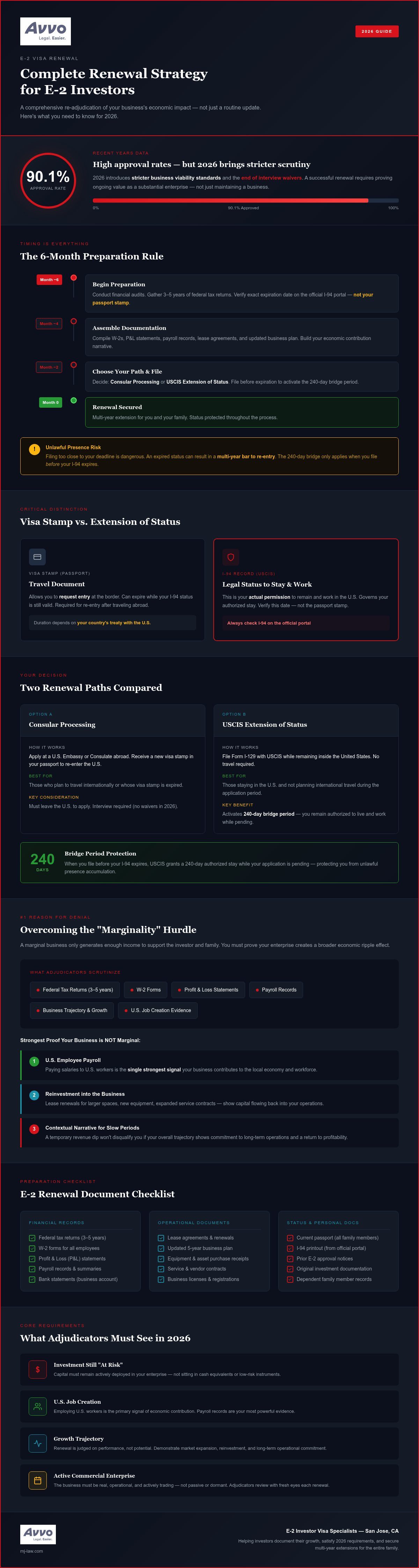
An E-2 visa renewal isn’t just a routine administrative update; it’s a comprehensive re-adjudication of your business’s economic impact and its right to remain in the United States. While the 90.1% approval rate seen in recent years offers confidence, the 2026 landscape introduces stricter scrutiny on business viability and the end of interview waivers. Successfully navigating the E-2 visa renewal process requires a shift in mindset from simply maintaining a business to actively proving its ongoing value as a substantial enterprise.
You’ve worked hard to establish your roots, and it’s understandable to feel concerned about being labeled a “marginal” business or confused by the technical differences between a visa stamp and an extension of status. We understand the weight of these transitions. This guide provides a clear, step-by-step strategy to document your growth, satisfy updated 2026 requirements, and secure a multi-year extension for you and your family. We will examine the specific documentation needed to prove your business is thriving, ensuring your professional journey and your family’s status in the U.S. remains secure and uninterrupted.
Key Takeaways
- Learn why starting your preparation six months in advance is essential to meet the evolving 2026 adjudication standards.
- Discover how to overcome the marginality hurdle by documenting your business’s economic impact and its role in creating U.S. jobs.
- Understand the critical differences between consular processing and USCIS extensions to choose the best path for your E-2 visa renewal process.
- Access a detailed checklist of the financial records and operational documents required to prove your enterprise is active and substantial.
- Find out how partnering with an experienced firm can help you navigate complex Requests for Evidence and secure your future in Silicon Valley.
Understanding the E-2 Visa Renewal Timeline & Requirements
The E-2 visa renewal process isn’t a simple administrative update or a guaranteed extension. It’s a comprehensive re-evaluation of your business’s continued eligibility under the E-2 Investor Visa program. Adjudicators examine your enterprise with fresh eyes to ensure it remains a real, active commercial entity. They’re looking for proof that your investment is still “at risk” and that the business has grown beyond “marginality.” In the eyes of the government, a marginal business is one that only generates enough income to support the investor and their family. To secure a renewal in 2026, you must demonstrate that your company contributes significantly to the U.S. economy, primarily through job creation or substantial profit margins.
Visa Stamp vs. Extension of Status
It’s vital to understand the difference between your visa stamp and your legal status. The visa foil in your passport is a travel document. It allows you to knock on the door of the United States and request entry. Your actual permission to stay and work is governed by your I-94 record. It’s common for a visa stamp to expire while your I-94 status remains valid for several months or even years. If you don’t plan to travel, you can file for an extension of status within the U.S. However, if you leave the country, you’ll need a new visa stamp from a consulate to return. Your strategy must account for 2026 reciprocity rules, as the duration of a renewed visa depends entirely on the specific treaty agreement between the U.S. and your country of citizenship.
The Critical 2026 Renewal Window
Timing is the most important factor in a successful E-2 visa renewal process. We advocate for a “6-month rule” when it comes to preparation. Starting half a year before your expiration date gives you the necessary time to conduct financial audits and gather three years of federal tax returns. You should always verify your exact expiration date on the official I-94 portal rather than relying on the date printed in your passport. Filing too close to the deadline is risky. An expired status can lead to “unlawful presence,” which may result in a multi-year bar to re-entry.
If you choose to file an extension with USCIS while remaining in the U.S., your legal stay is protected by a specific “bridge” period. This bridge allows you to continue living and authorized to work for up to 240 days while your application is pending. By initiating the process early, you ensure this period serves as a steady transition rather than a source of stress. This methodical approach is the best way to protect your investment and your family’s future.
Overcoming the “Marginality” Hurdle in 2026
The most common reason for a denial in the E-2 visa renewal process is the “marginality” rule. A marginal business is one that lacks the present or future capacity to generate more than enough income to provide a minimal living for the treaty investor and their family. To secure your status in 2026, you must prove your enterprise does more than just pay your personal bills. Under the official E-2 classification requirements, your business must demonstrate a significant economic contribution to the United States. Adjudicators want to see that your presence creates a ripple effect of financial activity, primarily through the employment of U.S. workers.
Financial documentation acts as the evidence for your growth narrative. While your initial application was based on potential, your renewal is based on performance. Adjudicators will scrutinize your federal tax returns, W-2s, and Profit and Loss (P&L) statements from the last three to five years. If your profits are modest, you can still overcome the marginality hurdle by highlighting your payroll. Paying salaries to U.S. employees is one of the strongest ways to prove your business is not marginal, as it shows you are supporting the local economy and workforce.
Proving Your Business is Substantial
A substantial enterprise is one that continues to evolve. We often encourage our clients to show how they are reinvesting profits back into the San Jose economy. This might include lease renewals for larger office spaces, new equipment purchases, or expanded service contracts. If you faced a “slow year” due to market shifts or a startup phase, your narrative must explain this context clearly. A temporary dip in revenue doesn’t disqualify you if your overall trajectory shows a commitment to long-term operations and a return to profitability. Consistent payroll records remain your most effective shield during these periods.
Updating Your E-2 Business Plan
Your original business plan was a roadmap for a new venture, but your 2026 update must be a strategic report on a proven entity. This document should detail your market expansion, updated five-year financial projections, and specific future hiring goals. It bridges the gap between what you’ve achieved and what you intend to build next. For a deeper look at these requirements, you can review our E-2 Visa Business Plan Lawyer: 2026 Investor Guide. If you’re unsure how to present your financial growth, discussing your specific business metrics with a professional can help clarify your path forward.
Consular Processing vs. USCIS Extension of Status
Investors navigating the E-2 visa renewal process must choose between two distinct legal paths: filing an extension of status with U.S. Citizenship and Immigration Services (USCIS) or applying for a new visa stamp at a U.S. Consulate abroad. This decision isn’t merely a matter of preference; it’s a strategic choice based on your international travel needs and your business’s daily operational requirements in Silicon Valley. Each path carries specific implications for your legal standing and your ability to cross borders.
The USCIS Path (Form I-129)
Filing Form I-129 allows you to maintain your legal status without leaving your business. This is often the preferred route for founders who cannot afford to be away from their U.S. operations for several weeks. In 2026, the California Service Center remains the primary hub for these petitions. While this method successfully extends your right to remain and work in the U.S., it has a significant limitation: it does not provide a travel document. If you have an approved extension but choose to travel abroad, you must still visit a consulate to obtain a new visa stamp before you can re-enter the country. For many, this path serves as a stable “bridge” while they focus on local growth.
The Consular Path (DS-156E)
The consular path is a true renewal of the visa itself. By applying at a U.S. Embassy or Consulate in your home country, you’re seeking a new visa foil for your passport, which typically grants a five-year validity period depending on your country’s reciprocity schedule. This is essential for investors who travel frequently for global business development. You must prepare for an in-person interview, as the policy update from October 2025 ended interview waivers for E-visa renewals. Coordinating this process for your household is also vital; you can find detailed strategies for your loved ones in our E-2 Visa Family: 2026 Guide.
Deciding whether the premium processing fee is worth the investment depends on your timeline. As of March 1, 2026, the premium processing fee is $2,965, which guarantees a response from USCIS within 15 business days. With standard processing times for Form I-129 often stretching between two and four months, premium processing offers a significant advantage for those facing tight deadlines or planning upcoming international travel. This expedited service provides the certainty needed to manage a growing enterprise without the distraction of a pending immigration status. Choosing the right avenue ensures that your focus remains on your business’s success rather than administrative delays.
Step-by-Step E-2 Visa Renewal Checklist
Preparing a meticulous filing package is the most effective way to minimize the risk of a Request for Evidence (RFE). The E-2 visa renewal process requires you to prove that the business you described in your initial application has become a functional, contributing reality. This involves a shift from speculative projections to historical data. Use the following five steps to organize your submission:
- Step 1: Financial Audit. Gather the last three years of federal income tax returns for the business. Include all 1099s and W-2s to show clear financial activity.
- Step 2: Operational Proof. Validate that your business is active. Provide copies of lease renewals, utility bills, and major vendor contracts for your San Jose or San Francisco office.
- Step 3: Impact Report. Document your U.S. workforce. List every employee, their specific role, and their citizenship or residency status.
- Step 4: Form Preparation. Complete Form I-129 for USCIS extensions or Form DS-156E for consular processing. Accuracy here is non-negotiable.
- Step 5: Legal Review. Compare your current data against your initial E-2 filing. You must explain any major shifts in your business model to maintain consistency.
Essential Financial Evidence
Adjudicators look for bank statements that show a consistent pattern of active transactions and healthy capitalization. These records prove the business isn’t just a “paper” company but a real commercial enterprise. You must also demonstrate a continued E-2 Visa Substantial Investment: 2026 Guide by showing how you’ve reinvested profits into growth. Finally, include your local business licenses and sales tax filings from your specific California location to prove you are in good standing with local authorities.
Personnel and Payroll Records
Your payroll is the heartbeat of a successful renewal. You should include quarterly wage reports, specifically IRS Form 941, to prove your history of U.S. job creation. An organizational chart is equally vital; it should clearly illustrate your executive or supervisory role within the company structure. To document the usage of independent contractors, provide copies of signed service agreements alongside IRS Form 1099-NEC to demonstrate the scale of your outsourced operations. If you’re concerned about how your payroll numbers will be viewed, you can schedule a document review to ensure your evidence meets the current 2026 standards.
Secure Your Future with MJ Law in San Jose
Silicon Valley is a unique economic ecosystem, and your immigration strategy should reflect that environment. At MJ Law, we’ve served as a steady hand for entrepreneurs and investors since 1985. Our firm provides the professional authority needed to manage the complexities of the E-2 visa renewal process, ensuring your business’s growth is presented with precision. We understand that a renewal is a high-stakes transition for your family and your enterprise. Our proximity to major USCIS field offices in San Jose allows us to stay synchronized with local adjudication trends, giving our clients a distinct advantage.
In 2026, the threshold for “marginality” and “substantiality” has become more rigorous. We specialize in navigating complex Requests for Evidence (RFEs) by anticipating the government’s questions before they’re even asked. Our bilingual team offers comprehensive support in both English and Spanish, bridging communication gaps for a diverse global investor community. We don’t just process forms; we build a collaborative partnership to protect the longevity of your U.S. status and ensure your business remains a reliable anchor for your family’s future.
30+ Years of Investor Visa Success
Our decades of experience with E-2 treaty investor requirements mean we’ve navigated nearly every scenario possible since our founding. This history allows us to provide a grounded, matter-of-fact presentation of your business’s capabilities. Whether you’re a tech founder or a retail business owner, we apply a corporate level of precision to your individual success story. Our methodical approach reinforces your credibility with adjudicators. For a deeper look at how we support local investors, visit our E-2 Visa Attorney San Jose guide.
Schedule Your 2026 Renewal Consultation
The best insurance for a successful E-2 visa renewal process is a proactive strategy session. During your initial consultation, we conduct an internal audit of your financials, payroll records, and operational proof. This methodical review identifies potential weaknesses in your “marginality” narrative before your application reaches an officer’s desk. We recommend bringing your last three years of federal tax returns and your current employee list to this meeting. Taking this first step allows us to establish a clear timeline and a structured path for your filing. Book your consultation with MJ Law today to secure your professional journey in the United States.
Securing Your Multi-Year Extension in 2026
Your journey as an investor in the United States is defined by growth and persistence. Successfully navigating the E-2 visa renewal process requires more than just submitting paperwork; it demands a clear demonstration of your business’s economic impact and a proactive approach to evolving 2026 standards. By starting your preparation early and focusing on job creation, you protect the roots you’ve planted in Silicon Valley. A successful renewal ensures your enterprise remains a stable foundation for your professional goals and your family’s future.
MJ Law provides the steady hand you need during these high-stakes transitions. With over 30 years of immigration expertise in San Jose and a bilingual English/Spanish legal team, we’re committed to your long-term success. We audit your financials and personnel records to ensure your case is presented with the highest level of precision. Secure your U.S. investment; schedule an E-2 renewal strategy session with MJ Law to review your documentation and build a robust filing strategy. Your commitment to innovation deserves a partner who understands the local landscape and the global stakes of your enterprise.
Frequently Asked Questions
Can I renew my E-2 visa if my business is currently losing money?
You can still renew if the business is currently unprofitable, provided you can prove it is not “marginal.” Adjudicators evaluate whether the enterprise has the future capacity to support you and make a significant economic contribution. In San Jose, demonstrating job creation or substantial reinvestment often offsets short-term financial losses. A well-documented explanation for the downturn, coupled with a five-year growth projection, is essential to secure your status.
What happens to my family members during the E-2 renewal process?
Family members generally file Form I-539 to extend their stay concurrently with the investor’s petition. In 2026, the filing fee for this form is $470 for all dependents included on the application. Spouses of E-2 investors maintain incident-to-employment authorization, meaning they don’t need a separate EAD to work in Silicon Valley. It’s critical to ensure their status remains valid to avoid unlawful presence while the primary E-2 visa renewal process is underway.
Is there a limit to how many times I can renew my E-2 visa?
There is no limit to the number of times you can renew an E-2 visa. As long as the business continues to meet the requirements of being a real, active, and non-marginal commercial enterprise, you can continue to extend your stay indefinitely. Many Silicon Valley entrepreneurs have successfully maintained their status for decades through MJ Law. Each renewal requires a fresh demonstration of the business’s viability and your ongoing role as a director or executive.
How much does the E-2 visa renewal process cost in 2026?
In 2026, government fees vary based on your filing path. For a USCIS extension, standard employers pay $1,015 for Form I-129 plus an Asylum Program Fee of $600. Small employers with 25 or fewer workers pay $510 plus a $300 Asylum Fee. If you choose consular processing, the DS-160 fee is $315, and a new $250 Visa Integrity Fee applies upon issuance. Premium processing for expedited 15-day decisions now costs $2,965.
What is the difference between an E-2 extension and a renewal?
An extension of status is filed with USCIS and allows you to remain in the U.S. legally, but it does not provide a travel document. A visa renewal occurs at a U.S. Consulate abroad and results in a new visa stamp in your passport for international travel. For San Francisco based investors, an extension is often a convenient way to stay focused on operations, while a renewal is necessary for those who must cross borders frequently.
Do I need a new business plan for every E-2 renewal?
Yes, you should provide an updated business plan that reflects your actual performance and future goals. While your initial plan was based on estimates, a renewal plan must highlight your historical growth and updated five-year projections. Adjudicators in 2026 place significant emphasis on the credibility of these projections to assess marginality. This updated document bridges the gap between your past achievements and your future economic contributions to the local San Jose economy.
Can I travel outside the U.S. while my E-2 extension is pending?
You should not travel outside the U.S. while a Form I-129 extension of status is pending with USCIS. Leaving the country during this time is generally considered an abandonment of the petition. If you have an urgent need to travel, you can upgrade to premium processing for a 15-day decision. Alternatively, you may choose to skip the USCIS extension entirely and apply directly for a new visa at a consulate in your home country.
What are the common reasons for E-2 renewal denials in 2026?
The most frequent reasons for denials in the E-2 visa renewal process include failure to overcome the marginality hurdle and insufficient proof of active operations. Adjudicators also look for discrepancies between your current financials and your original business plan. In 2026, increased scrutiny on business viability means that poorly documented payroll or a lack of U.S. job creation can lead to an unfavorable decision. Maintaining precise, transparent records is your best defense against these challenges.