What if your U.S. business expansion wasn’t a choice between professional growth and your family’s stability, but the very key that unlocks both? You likely understand the weight of moving your life across borders. It’s natural to feel anxious about whether your spouse can maintain their own career or if your children will face enrollment hurdles in American schools. You want to ensure that your investment doesn’t just build a business. You want a future where every member of your household can flourish.
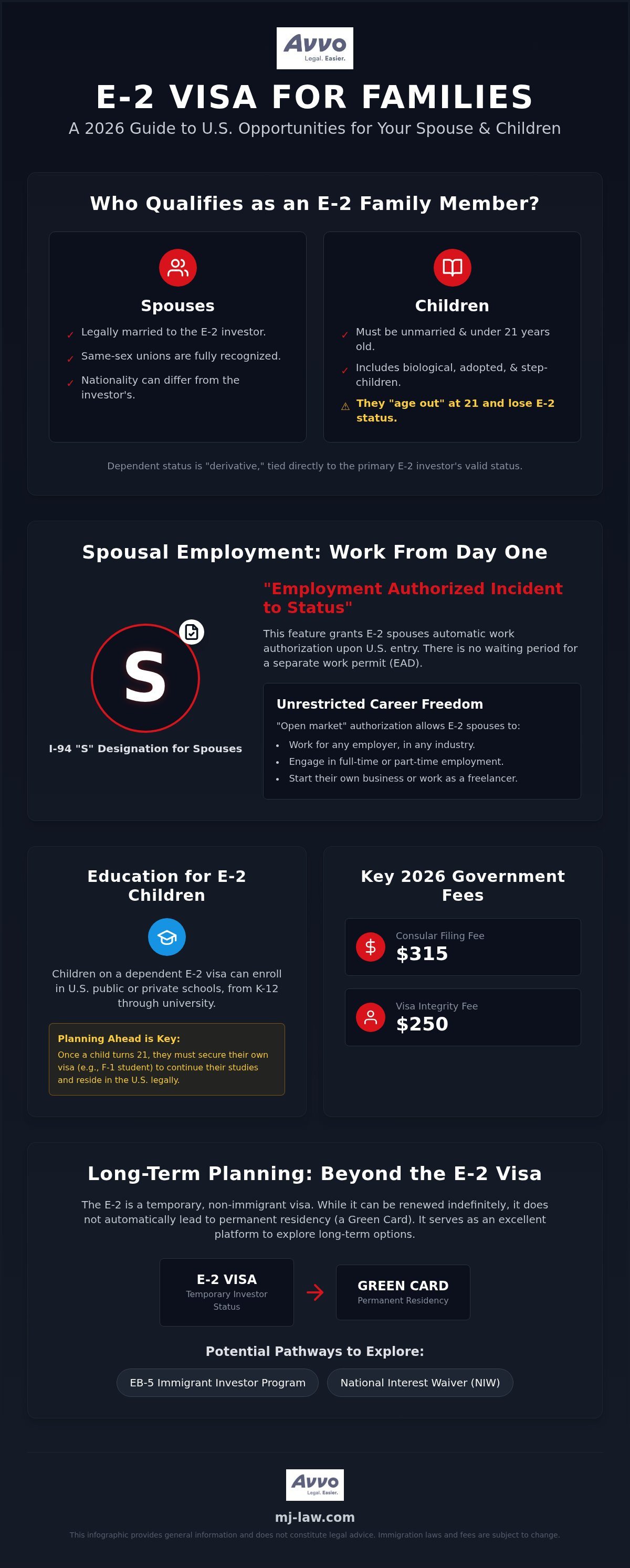
This 2026 guide clarifies exactly how E-2 visa family members can live, work, and study in the U.S. under your treaty investor status. Drawing on over 30 years of experience, we provide a clear roadmap for bringing your dependents with you, including the latest 2026 fee structures like the $315 consular filing fee and the $250 Visa Integrity Fee. You’ll gain the confidence that your spouse can secure employment via an Employment Authorization Document (EAD) and learn how to protect children before they turn 21. We’ll also explore the long-term path from a non-immigrant visa toward permanent residency options like the EB-5 or National Interest Waiver.
Key Takeaways
- Identify exactly which family members qualify for dependent status and how to navigate cases where spouses or children hold different nationalities.
- Explore the 2026 spousal work authorization rules that enable your partner to pursue career opportunities in the U.S. without a separate work permit.
- Learn how E-2 visa family members can enroll in U.S. schools and which local Silicon Valley districts offer the best transition for international students.
- Evaluate the most efficient application strategies, from gathering civil documents to choosing between consular processing and a change of status.
- Gain clarity on long-term immigration options that allow your family to transition from temporary investor status to permanent residency.
Who Qualifies as an E-2 Visa Family Member?
The E-2 treaty investor visa is structured to support the family unit, recognizing that business success often depends on personal stability. Under U.S. immigration law, the legal rights of E-2 visa family members are “derivative.” This means their status is directly linked to the principal investor’s approval. If the investor maintains their status, the family remains protected. A distinct advantage of this visa is that dependents don’t need to hold the same nationality as the treaty investor. A spouse or child from a non-treaty country can still qualify based on the principal’s eligibility.
For a comprehensive look at the legal framework and treaty requirements, this E-2 Visa Overview provides context on how these regulations apply globally. Understanding these boundaries early prevents delays in the application process and ensures that all E-2 visa family members are included in the initial planning stages.
Eligibility Requirements for Spouses
To qualify for derivative status, a spouse must be legally married to the principal investor. U.S. immigration authorities recognize all legal marriages, including same-sex unions, as long as the marriage was valid in the location where it was performed. When filing, you must present a valid marriage certificate. If your documents are in a language other than English, you’ll need to provide a full, certified translation. Keep in mind that a spouse’s legal stay is entirely dependent on the principal. They can remain in the country as long as the investor continues to meet all E-2 requirements and maintains a valid status.
Eligibility for Children Under 21
Children are eligible to join the principal investor if they are unmarried and under the age of 21. This eligibility extends to several categories of children:
- Biological children born to the treaty investor.
- Legally adopted children with finalized adoption decrees.
- Step-children, provided the marriage between the parent and the treaty investor occurred before the child reached the age of 18.
The “age 21” threshold is a critical deadline. Once a child turns 21, they “age out” and are no longer eligible for derivative E-2 status. If they wish to stay in the United States, they must transition to an independent visa category, such as an F-1 student visa. Similarly, if a child marries before age 21, they immediately lose their eligibility as a dependent. Monitoring these milestones is essential for long-term family planning in Silicon Valley, where educational paths often extend well into a child’s twenties.
Spousal Employment Rights: Working in Silicon Valley
For many E-2 visa family members, the ability for a spouse to contribute professionally is a primary concern. The transition to a new country shouldn’t mean the end of a career. Fortunately, the U.S. government recognizes the value of trailing spouses, particularly in high-growth regions like Silicon Valley. As of 2026, the rules governing spousal employment have been streamlined to prioritize speed and ease of entry into the workforce. This allows families to establish a dual-income household almost immediately after arrival.
Understanding ‘Employment Authorized Incident to Status’
‘Incident to status’ is the automatic right to work upon entry into the United States based on your specific visa category. In the past, spouses had to wait months for a physical Employment Authorization Document (EAD) to arrive in the mail. Today, that barrier is gone. According to the official E-2 Visa for Family Members guidance, the spouse’s work authorization is inherent to their admission to the U.S. in E-2 status.
When you pass through customs, your electronic I-94 arrival record should include a specific “S” designation next to the E-2 classification. This small letter carries significant weight. It acts as a List C document for Form I-9, the federal document used to verify employment eligibility. Employers in San Jose and across the country can accept the I-94 as proof that you’re legal to work. You don’t need to apply for a separate card, pay additional fees, or endure the anxiety of a pending application while a job offer sits on the table.
Career Opportunities for Spouses in the Tech Sector
This level of flexibility is rare in the U.S. immigration system. While other visa categories, such as the H-1B, often leave spouses in a state of professional limbo, E-2 visa family members enjoy “open” work authorization. This means a spouse can work for a tech giant, join a nimble startup, or even operate as a freelancer or independent consultant. There are no restrictions on the number of hours worked or the type of industry chosen.
In the heart of Silicon Valley, this freedom is invaluable. Spouses often find that their skills are in high demand in the San Francisco tech ecosystem. Whether you’re a marketing specialist, a data scientist, or a project manager, you can jump into the local economy without the need for a company to sponsor a separate visa. MJ Law works closely with families to ensure their documentation is pristine, helping you discuss your specific filing strategy to avoid common errors at the port of entry that could delay your start date.
Education and Stability for E-2 Children
One of the greatest benefits for E-2 visa family members is the access to the world-class education system in California. Unlike other visa categories that may restrict study options, children on E-2 status can attend U.S. public and private schools from kindergarten through high school without needing a separate student visa. This stability allows your children to integrate into the local community while you focus on growing your business. According to the E-2 Treaty Investors guidelines, unmarried children under 21 are fully authorized to engage in full-time study as a derivative benefit of your status.
School Enrollment in San Jose and San Francisco
Silicon Valley is home to some of the nation’s top-performing school districts, such as San Jose Unified, Santa Clara Unified, and Palo Alto Unified. To enroll, you’ll typically need to provide proof of residency, such as a utility bill or lease agreement, along with comprehensive vaccination records and previous academic transcripts. Transitioning from a foreign curriculum to the U.S. system can be a significant change, especially regarding grade placement and credit transfers. We recommend starting the enrollment process as soon as you have a local address to ensure a smooth start for the academic year. MJ Law provides the necessary legal documentation and status verification to assist district administrators, ensuring your child’s transition is handled with the precision it deserves.
Strategic Planning for Children Approaching Age 21
As children approach adulthood, the “aging out” rule becomes a primary concern for E-2 visa family members. On their 21st birthday, children lose their derivative E-2 status and must possess an independent visa to remain in the U.S. legally. Most families choose to transition their adult children to an F-1 student visa to complete their university degrees. It’s also beneficial to explore California’s specific residency rules. Many E-2 dependents who have lived in the state for over a year and meet specific criteria may qualify for in-state tuition at University of California (UC) and California State University (CSU) campuses. This can result in substantial savings compared to university rates for international students.
Early legal intervention is vital to avoid the pitfalls of unlawful presence. If a child turns 21 without a pending change of status application, they immediately lose their right to stay, which can lead to long-term bars on re-entering the United States. We advise starting this conversation at least 12 to 18 months before the child’s 21st birthday. This lead time allows for the preparation of F-1 applications or even exploring independent E-2 visas if the child is ready to launch their own business venture. You can schedule a consultation to review your family’s specific timeline and ensure your children have a clear path toward their own professional or academic goals.
The E-2 Family Application Process
Securing a future in the United States requires a methodical approach to the application process. For E-2 visa family members, the journey involves more than just proving a relationship; it requires demonstrating that the principal investor’s business is robust enough to sustain the entire household. The path you choose, whether filing from abroad or within the U.S., significantly impacts your timeline and travel flexibility during the transition.
Consular Processing vs. Adjustment of Status
Deciding between consular processing and a change of status is a strategic choice. Consular processing occurs at a U.S. Embassy or Consulate in your home country. This route typically results in a physical visa stamp in your passport, allowing for international travel. In 2026, consular review often takes between two to eight weeks, followed by visa issuance within 14 days of a successful interview. Alternatively, if you are already in the U.S. on a different visa, you might file Form I-539 to change status through the San Jose USCIS office. While this avoids international travel, standard processing for dependents can take several months, during which time you cannot leave the country without abandoning the application. For those navigating complex family dynamics, consulting a Family Immigration Lawyer San Jose can provide the necessary clarity on which path aligns with your long-term goals.
Essential Documentation Checklist
A successful application for E-2 visa family members rests on the quality of the evidence provided. You must establish a clear legal link to the principal investor while proving the financial viability of the move. Our firm recommends gathering the following documents early:
- Proof of Relationship: Original marriage certificates and birth certificates for all children. These must be accompanied by certified English translations and, depending on the country of origin, an apostille for international recognition.
- Principal Status Verification: A copy of the investor’s approved I-129 petition, their E-2 visa stamp, or their most recent I-94 record.
- Financial Sufficiency: Evidence that the E-2 business is not “marginal.” You must show that the enterprise generates enough income to support the investor and all dependents without relying on public funds.
The final step is the visa interview. While the principal investor faces questions about the business plan and investment source, the interview for family members focuses on the legitimacy of the marriage and parental ties. Consular officers look for consistency and honesty. Preparing for these interactions with a seasoned guide ensures that your family presents a unified and credible case. To ensure your paperwork meets the rigorous 2026 standards, schedule a review of your application materials with our San Jose team.
Long-Term Planning: From E-2 to Permanent Residency
Building a life in Silicon Valley requires foresight. While the E-2 is technically a temporary non-immigrant visa, it provides a stable platform for permanent residency applications that can secure your family’s future in the United States. Many investors view the E-2 as a vital first step, but for E-2 visa family members, the ultimate goal is often finding a permanent anchor in the community. This transition requires careful management of “non-immigrant intent,” as the E-2 requires you to intend to depart when your status ends, while a Green Card application signals an intent to stay permanently.
Green Card Paths for E-2 Families
In the tech-heavy landscape of San Jose and San Francisco, many investors find they qualify for employment-based Green Cards. The EB-1A category is particularly relevant for founders with a record of extraordinary success in their field. You can explore our EB-1A Guide to see if your professional achievements meet these high standards. Alternatively, the EB-2 National Interest Waiver (NIW) is a popular route for those whose business ventures provide significant benefit to the U.S. economy or technological advancement.
Securing a Green Card fundamentally changes the daily lives of E-2 visa family members. It removes the “aging out” risk for children, allowing them to remain in the country past their 21st birthday. It also grants spouses permanent, unrestricted work authorization that is no longer tied to the principal investor’s business. In some cases, a family-based petition may become available if a dependent child or spouse eventually marries a U.S. citizen. Regardless of the path, the transition from E-2 to permanent residency can take anywhere from 12 to 60 months, making early planning essential for maintaining legal status throughout the process.
Why Local Expertise in San Jose Matters
The immigration landscape in Northern California is unique. The San Jose and San Francisco USCIS offices have specific procedural quirks and high caseloads that can impact your filing timeline. Working with a team that understands these local nuances ensures your applications don’t stall due to administrative errors. MJ Law has spent over 30 years acting as a bridge between business investment and family security in this region. Our bilingual team, fluent in English and Spanish, provides a personal touch that larger, purely corporate firms often lack. We don’t just process forms; we build multi-generational legal strategies that grow alongside your business. To begin mapping out your family’s future, schedule your E-2 family consultation with MJ Law today.
Securing Your Family’s Future in Silicon Valley
Transitioning your family to the United States is a significant undertaking that requires more than just a business investment. It demands a strategy that protects your spouse’s career and your children’s educational path. By understanding the 2026 “incident to status” work rules and the critical age 21 threshold, you’re better prepared to navigate the complexities of life in San Jose and San Francisco. Success for E-2 visa family members depends on a proactive approach that balances immediate business needs with long-term residency goals.
MJ Law brings over 30 years of experience to the heart of San Jose, offering bilingual support in English and Spanish. We specialize in the unique intersection of Silicon Valley business and family immigration law. Our team is ready to act as your reliable anchor during this transition, ensuring every detail of your family’s status is handled with precision. Book a Family Visa Consultation with MJ Law to discuss your specific roadmap. We look forward to helping your family thrive in their new home.
Frequently Asked Questions
Can my spouse work immediately upon arriving on an E-2 visa?
Yes, your spouse is authorized to work immediately upon entry because their status is “Employment Authorized Incident to Status.” Under the 2026 regulations, the “S” designation on the I-94 arrival record serves as sufficient proof for employers. This eliminates the need to wait for a physical Employment Authorization Document (EAD). Your spouse can join a tech firm or start a local business without additional filing delays.
Do my children need a separate student visa to attend school in San Jose?
No, children don’t need a separate F-1 student visa to attend school while on E-2 status. As E-2 visa family members, unmarried children under 21 have the right to enroll in public or private K-12 schools. In Silicon Valley districts like San Jose Unified, you simply provide proof of residency and your visa documentation. This benefit provides stability for your family while you focus on your business investment.
What happens to my family’s E-2 status if my business fails?
If the principal investor’s business fails and they lose their E-2 status, the family’s derivative status also ends. Because their legal right to stay is tied to your approval, they would need to transition to a different visa category or depart the U.S. It’s vital to monitor business health and consult with our San Jose team early if you anticipate changes to your investment’s viability.
Can my children stay in the U.S. after they turn 21?
Children lose their E-2 derivative status on their 21st birthday. To remain in the U.S. legally, they must transition to an independent visa category, such as an F-1 student visa or an employment-based visa. We recommend beginning this transition at least one year before they turn 21. This ensures they avoid “aging out” and maintains their legal presence in the San Francisco Bay Area.
Does my family need to be the same nationality as me for the E-2 visa?
No, your spouse and children don’t need to share your nationality to qualify as E-2 visa family members. While the principal investor must be a national of a treaty country, their dependents can be from any country. This flexibility is a significant advantage for multinational families moving to Silicon Valley. As long as the principal’s status is valid, the family’s derivative status remains protected.
How long does it take to process E-2 visas for family members in 2026?
Processing times vary based on your filing location. In 2026, consular processing typically takes two to eight weeks for document review, with visa issuance occurring within two weeks of a successful interview. If you’re filing a change of status within the U.S. at the San Jose USCIS office, standard processing takes two to four months. Premium processing is available for the principal’s I-129, which can expedite the overall family timeline.
Can E-2 family members travel outside the U.S. and return easily?
Yes, family members can travel internationally provided they have a valid E-2 visa stamp in their passports. If you changed status within the U.S., you’ll need to visit a U.S. Consulate abroad to obtain a visa stamp before re-entering. Always ensure your I-94 record is updated correctly upon return to maintain your work and study authorization in the San Francisco and San Jose regions.
Can my spouse start their own business in Silicon Valley on an E-2 derivative visa?
Yes, your spouse has the full legal right to start and operate their own business. Because E-2 spousal work authorization is “open,” they aren’t restricted to a specific employer. They can launch a startup in San Jose or work as an independent consultant. This freedom allows both partners to contribute to the Silicon Valley economy while building a multi-generational legacy for their family.