A strong E-1 assessment starts with the treaty-country trade record, not a generic business-visa checklist. If you’re looking for an E-1 treaty trader visa lawyer San Jose, ask how counsel will examine your nationality, the company’s ownership, and the pattern of trade between the United States and the treaty country. A business plan alone may not show the scale and continuity of the transactions relevant to an E-1 review.
It’s understandable to be unsure whether your trade activity qualifies or which records will help explain it. This guide covers the main eligibility questions, documents to begin gathering, and ways to compare attorneys by relevant experience, a clear process, and responsive communication.
Before speaking with counsel, organize records showing who owns the business, what it trades, and how transactions have developed. MJ Law is a San Jose immigration law firm, with consultations in English and Spanish. For business owners in San Jose and San Francisco, the firm’s local presence can make it easier to discuss your company’s structure and records. Ask whether the firm currently handles E-1 treaty trader matters and use the conversation to raise questions about your trade activity.
Key Takeaways
- E-1 review considers treaty-country nationality, qualifying trade, and the applicant’s role. A general business profile alone does not address these factors.
- Organize records that explain trade volume, continuity, counterparties, and transaction types. Don’t assume there is a single transaction count or dollar threshold.
- Compare E-1’s trade focus with E-2’s investment focus and other possible routes. Discuss which options fit your circumstances with counsel.
- When assessing an E-1 treaty trader visa lawyer San Jose, ask how they’ll review your treaty nationality, company structure, trade evidence, and duties. Clarify the scope of support and next steps.
- Before consulting MJ Law, ask whether the firm currently handles E-1 matters. Prepare questions about your trade structure and immigration concerns.
What an E-1 treaty trader visa lawyer in San Jose should assess first
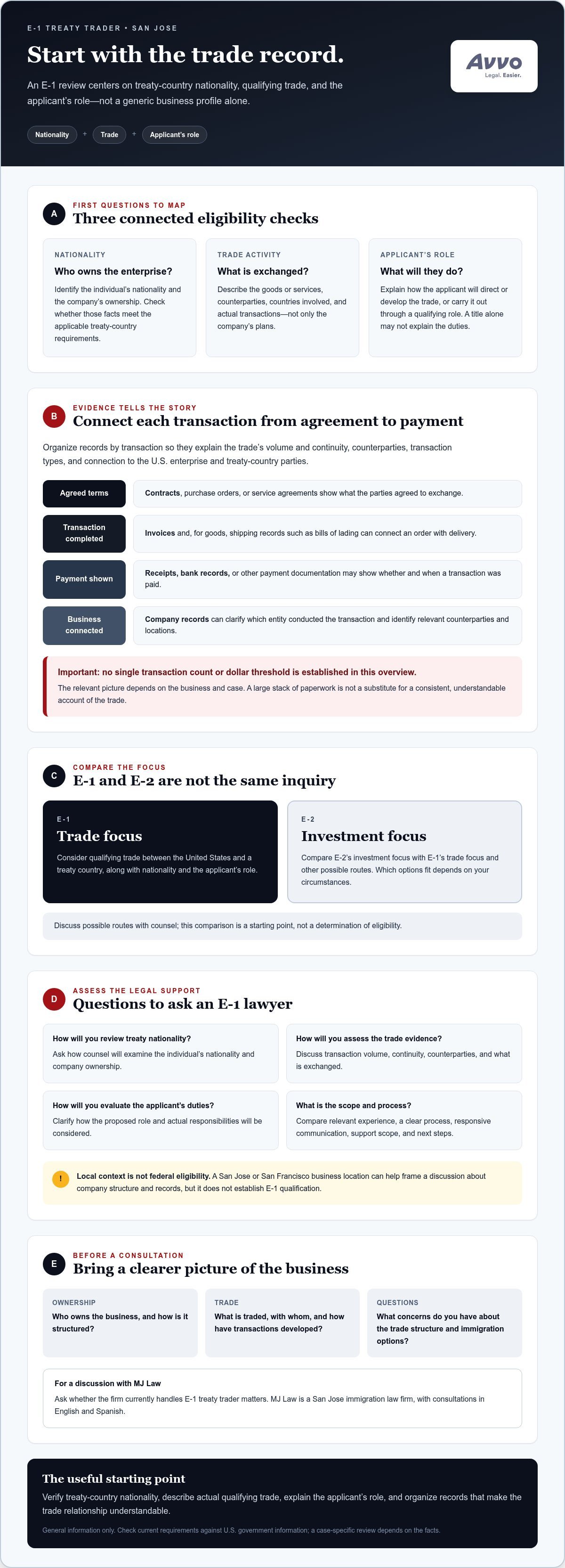
E-1 classification concerns qualifying trade between the United States and a country with the required treaty relationship with the United States. Before discussing forms or filing strategy, an E-1 treaty trader visa lawyer San Jose should help identify the threshold questions: whether the individual and business meet applicable nationality requirements, whether their transactions constitute qualifying trade, and whether the applicant’s role fits the classification.
The answers depend on the facts of the business and applicant. The E-1 Treaty Trader Visa overview may provide background, but check treaty-country eligibility and current requirements against U.S. government information, including the Department of State’s treaty-country resources and relevant USCIS guidance.
Which E-1 eligibility questions matter at the outset?
Start by mapping the trade and the people behind it. A useful initial review asks:
- Nationality: What is the individual’s nationality, and who owns the trading enterprise? Do those facts meet the applicable treaty-country nationality requirements?
- Trade activity: What goods or services are exchanged, who are the counterparties, and which countries are involved? Records should describe actual transactions, not only the company’s plans.
- Applicant’s role: Will the applicant direct or develop the trade, or carry it out through a qualifying role? A title alone may not show what the person will actually do.
For example, invoices, contracts, shipping or service records, and payment documentation may help explain how the trade operates. Which records matter depends on the business. No single document or broad company description resolves every eligibility question.
Why San Jose business context does not replace federal eligibility
A Silicon Valley address may explain where a business operates, but it doesn’t establish that the company or applicant meets E-1 requirements. Local counsel can help discuss a San Jose or San Francisco-area company’s structure and records, while the immigration classification is governed by federal standards. Business location and legal eligibility are separate considerations.
Quotable takeaway: “Before assessing an E-1 case, verify treaty-country nationality, qualifying U.S.-treaty-country trade, and the applicant’s role against current U.S. government information.”
This is general information, not a legal opinion or a finding that any particular reader qualifies. A case-specific review can identify which questions need attention and what evidence may help answer them.
How E-1 treaty trader eligibility and trade evidence fit together
Trade evidence helps explain how the business relationship works in practice. A reviewer may look beyond the company’s stated purpose to understand the volume and continuity of transactions, who the counterparties are, and what is exchanged. Don’t assume there is a minimum transaction count or dollar threshold based on this overview. The relevant picture depends on the facts. The USCIS information on E-1 treaty trader qualifications is a useful starting point for understanding the government’s framework.
For an E-1 treaty trader visa lawyer San Jose, the task is not simply to collect a large stack of paperwork. It is to assess whether the records tell a consistent, understandable story about the trade and its connection to the U.S. enterprise and treaty-country counterparties.
What records can help explain a trade relationship?
Group records by transaction instead of treating them as unrelated files. Depending on the business and case, examples may include:
- Terms of the transaction: Contracts, purchase orders, or service agreements describing what the parties agreed to exchange.
- Completion and movement: Invoices and, for goods, shipping records such as bills of lading that connect an order with delivery.
- Payment: Receipts, bank records, or other payment documentation that may show whether and when a transaction was paid.
- Business connection: Company records clarifying which entity conducted the transaction and identifying relevant counterparties and their locations.
These are examples, not a universal checklist. Record needs may vary with the facts, filing route, and current agency or consular instructions. Before sending sensitive commercial, financial, or customer information, ask counsel which materials are relevant and how to share them. An index organized by date, counterparty, transaction type, and document can make an initial review easier.
How should an applicant describe their role?
Explain the applicant’s actual responsibilities and how they relate to directing or developing the trade. Separate ownership from day-to-day duties: an ownership interest, executive responsibilities, operational work, or specialized tasks are distinct facts, and none should be treated as qualifying on its own. A clear job description, reporting structure, and examples of decisions or work can help counsel understand the role.
Coherent evidence connects the transactions, the trading business, and the applicant’s responsibilities without asking any one document to prove the whole case. To discuss your trade structure and immigration questions, you can arrange a consultation with MJ Law.
E-1 vs. E-2 and other visa routes: what should you compare?
A business may involve both cross-border sales and investment, but those facts don’t make E-1 and E-2 interchangeable. The key distinction is the activity each classification addresses. The comparison below is a starting point, not a determination of which route fits a particular case.
| Route | Primary focus | Questions to explore |
|---|---|---|
| E-1 | Qualifying trade between the United States and a treaty country | What is traded, with whom, and how does the applicant’s role relate to that trade? |
| E-2 | Qualifying investment in a U.S. enterprise | What is the investment and business structure, and what role will the applicant have? |
| Other routes | Depends on the classification | Does the case involve a qualifying company transfer or another employment-based basis? |
When is E-1 different from E-2?
E-1 centers on qualifying trade; E-2 centers on qualifying investment. Neither category is automatically better, and an E-1 case shouldn’t be assessed using an assumed E-2 investment test. For a more detailed comparison, see this overview of E-1 visa vs. E-2 visa. Readers considering an investment-based option can also review MJ Law’s E-2 treaty investor visa guide.
If a company invests in U.S. operations and conducts international trade, the facts may call for a closer comparison rather than a quick label. Nationality, ownership and business structure, intended role, and immigration history can all affect pathway analysis. A case-specific legal review can clarify which questions to investigate.
When might another business visa deserve review?
Other business or employment-based classifications may be worth discussing if the facts point beyond treaty trade or investment. For example, an L-1A route may warrant review if the individual’s proposed move relates to a qualifying transfer within an international company. It isn’t a general substitute for E-1 or E-2. See the L-1A intracompany transfer guide if that kind of company relationship may apply.
“Compare visa categories by the activity they’re designed to address: trade, investment, a qualifying company transfer, or another employment basis.” An E-1 treaty trader visa lawyer San Jose can help organize those distinctions around your facts, without assuming in advance which classification is right.
How to evaluate an E-1 treaty trader visa lawyer in San Jose
Choosing counsel is easier when you assess how they approach your facts, not just whether they handle immigration matters generally. Use these questions to understand whether a prospective E-1 treaty trader visa lawyer San Jose can explain the analysis, scope, and process for your situation.
Questions to ask before hiring immigration counsel
- What relevant immigration experience do you have? Ask about business immigration experience and whether the attorney currently handles E-1 treaty trader matters. Don’t rely on a general practice-area label alone.
- How will you assess my case? Ask how the review will address treaty nationality, trade records, company ownership and structure, and the applicant’s duties. Find out what information counsel needs before recommending a filing strategy.
- Who will work on the matter? Clarify who will review the facts, prepare or review case materials, and communicate with you. Ask how to raise questions and how often you can expect updates.
- What does the engagement include? Request a clear explanation of the proposed scope, fee terms, and included work. Ask how additional issues, new evidence, or agency or consular requests may affect the scope.
- What are the next steps and timing dependencies? Ask what information you must provide, what decisions remain, and which parts of the process depend on government review or consular procedures. Local representation doesn’t guarantee faster processing, approval, or a particular consular outcome.
Warning signs and realistic expectations
Pause if someone guarantees approval or claims special access they can’t clearly explain. Those statements don’t replace a careful review of your facts. Ask for a reasoned explanation if the suggested route appears disconnected from the documented trade activity. A useful assessment should identify what’s known, what remains uncertain, and what information or evidence could address open questions.
Before engaging counsel, make sure you understand who is responsible for gathering business records, providing accurate details about the company and the applicant’s role, and reviewing drafts or responding to requests. Clear responsibilities can prevent confusion as the matter progresses.
If you’re ready to discuss your immigration questions and trade structure, schedule an immigration consultation. Ask whether the firm currently handles E-1 treaty trader matters when arranging your discussion.
Preparing for an E-1 consultation with MJ Law
A focused first discussion can identify which questions need further review and what information may be missing. MJ Law is a San Jose immigration law firm whose practice areas include business and investor visas. The firm offers consultations in English and Spanish. When you contact the firm, ask whether it currently handles E-1 treaty trader matters and can discuss the issues raised by your trade structure. That check is important when looking for an E-1 treaty trader visa lawyer San Jose.
What to gather before the first discussion
You don’t need a complete filing package before an initial conversation. A concise overview can help frame your questions. Consider preparing:
- A short description of the business, its ownership, and what it sells or provides.
- A list of the countries involved in the trade and examples of transactions, including the transaction type, counterparties, and approximate dates.
- A summary of the applicant’s position, responsibilities, and connection to the business’s trade activity.
- Relevant immigration history, along with any known deadlines or planned travel that may affect timing.
These notes can support an initial discussion, but they don’t establish eligibility. Don’t send confidential business or financial records until the firm explains its intake and document-sharing process and confirms which materials are appropriate to provide.
What a useful first consultation should clarify
A productive discussion should help you understand whether the facts warrant further E-1 eligibility analysis and what remains unclear. Ask which details about nationality, trade activity, business structure, and the applicant’s role need more information. The conversation should distinguish an initial assessment from a final legal conclusion.
Discuss possible filing routes only after the relevant circumstances have been reviewed. The appropriate process can depend on the individual’s situation and current government or consular instructions, so ask what additional facts or documents are needed before deciding on next steps.
Use the conversation to raise your questions, understand the proposed scope of support, and confirm whether MJ Law currently handles E-1 matters. Schedule a consultation with MJ Law.
Take the Next Step With a Clearer E-1 Plan
An E-1 assessment should connect treaty-country nationality, the pattern of qualifying trade, and the applicant’s role to clear supporting evidence. Comparing E-1 with E-2 or other immigration routes also calls for a careful look at business structure, the individual’s circumstances, and the activity each classification addresses. When choosing an E-1 treaty trader visa lawyer San Jose, ask how counsel will review those facts, explain the scope of work, and communicate next steps.
MJ Law is a San Jose immigration firm with business and investor visas among its practice areas. Consultations are available in English and Spanish. Before scheduling a discussion about your trade structure and immigration questions, ask whether the firm currently handles E-1 matters.
Schedule a consultation with MJ Law to discuss your circumstances and the questions to address next. A clear review of the facts can help you approach the process with a better understanding of the issues.
Frequently Asked Questions
Is my country eligible for an E-1 treaty trader visa?
Check your country against current U.S. government information, including the Department of State’s treaty-country list. Eligibility isn’t established by an individual’s nationality alone. The case may also depend on the nationality and ownership of the trading enterprise, the trade between the United States and treaty country, and the applicant’s role. Because treaty information and case facts matter, confirm current requirements before relying on an online summary.
What qualifies as trade for an E-1 visa?
E-1 trade generally involves an exchange of goods or services between the United States and a treaty country. The specific transactions matter: reviewers may consider what is exchanged, who the counterparties are, the countries involved, and whether records show an ongoing pattern of trade. Don’t assume a single transaction count or dollar figure based on a general overview. Contracts, invoices, and payment or shipping records may help explain the activity.
Can a startup or small business qualify for an E-1 visa?
A company’s size alone doesn’t determine whether an E-1 case may qualify. The analysis focuses on applicable treaty-country nationality requirements, the company’s qualifying trade, and the applicant’s role in directing or carrying out that activity. A newer or smaller business should be prepared to explain its actual transactions and structure, not just its plans. Discuss those facts with immigration counsel before drawing conclusions about eligibility or choosing a filing route.
What documents should I bring to an E-1 visa lawyer?
Bring a short business overview, ownership information, a list of trade countries, and examples of relevant transactions. Depending on your case, contracts, invoices, shipping records, payment documentation, and other business records may help explain the trade. Include a summary of the applicant’s duties and relevant immigration history. This is a starting point, not a universal checklist. Ask counsel which records are relevant and how to share confidential materials securely.
What is the difference between an E-1 and E-2 visa?
E-1 focuses on qualifying trade between the United States and a treaty country, while E-2 focuses on qualifying investment in a U.S. enterprise. They aren’t interchangeable categories, and neither automatically suits every business owner. Nationality, ownership, business structure, the applicant’s intended role, and immigration history may affect which options merit review. If a business involves both trade and investment, discuss the facts with counsel rather than assuming one category is the better fit.
Can an E-1 visa lead directly to a green card?
No. E-1 is a nonimmigrant classification and doesn’t itself grant lawful permanent residence or create a direct path to a green card. Someone in E-1 status may explore a separate immigrant pathway, but the options and requirements depend on that person’s circumstances. Any plans involving a different immigration route should be assessed individually with qualified counsel. Don’t assume that eligibility for E-1 also establishes eligibility for permanent residence.
How do I choose an E-1 treaty trader visa lawyer in San Jose?
Ask about relevant immigration experience and whether the lawyer currently handles E-1 matters. Find out how they’ll analyze treaty nationality, trade records, company structure, and the applicant’s duties, and who will communicate with you. Clarify the proposed scope, fee terms, timing dependencies, and your responsibilities. A credible discussion should set realistic expectations, explain uncertainties, and avoid guarantees. If you’re in San Jose or San Francisco, confirm service availability before sharing confidential business records or engaging counsel. Schedule a consultation with MJ Law to discuss your questions and next steps.