
The visa that seems to fit your business plan may not be the one your company can support. In the L-1A vs E-2 visa decision, the key distinction isn’t investment size alone: it’s whether you’re transferring as a qualifying manager or executive within a related overseas business, or investing as a treaty-country national in a U.S. enterprise.
It’s understandable to focus first on the U.S. business you want to build. But an existing overseas company doesn’t automatically support an L-1A petition, just as investing in a business doesn’t by itself establish E-2 eligibility. For an E-2, the investment is assessed in relation to the business, which must also be viable. The company relationship, your role and nationality, the investment, and the business plan all matter. The right choice can also affect your family’s plans and future immigration options.
This guide compares the two visas’ eligibility rules, business requirements, family considerations, and long-term possibilities. It also explains which details to organize before discussing a case strategy with immigration counsel, so you can assess your options with greater clarity.
Key Takeaways
- Use the L-1A vs E-2 visa comparison to assess whether your strongest basis is a qualifying multinational role or a treaty-based investment.
- Check treaty-country nationality and the current eligibility list before building an E-2 strategy around your investment.
- Compare your ownership structure, job duties, business plan, and family goals instead of relying on investment size alone.
- Neither visa automatically grants permanent residence, so weigh future immigration plans alongside immediate business needs.
- For an L-1A review, begin organizing entity records, organizational charts, role descriptions, and evidence of your foreign employment.
L-1A vs. E-2 visa: Why the right choice starts with your business model
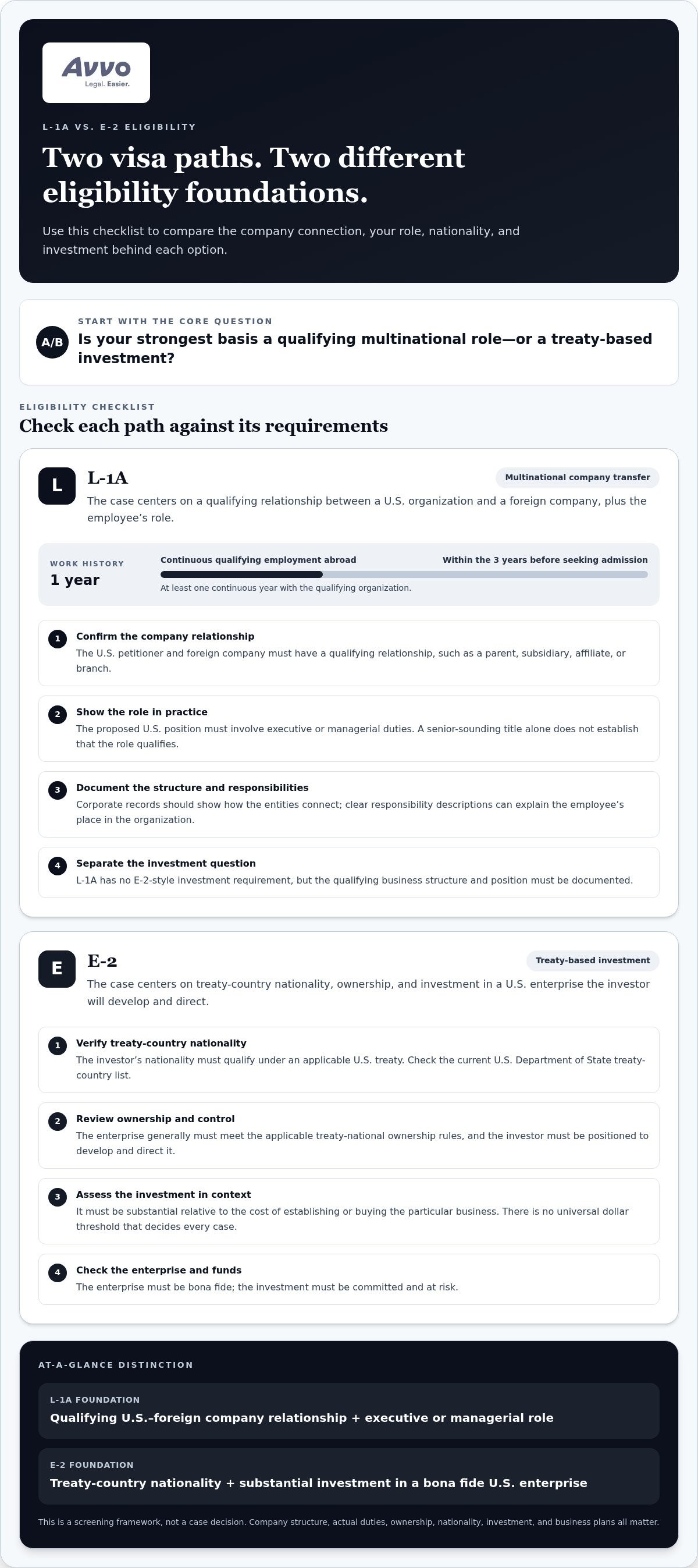
The L-1A and E-2 both support business activity in the United States, but they rely on different eligibility frameworks. L-1A eligibility is based on a qualifying relationship between a U.S. organization and a foreign company, along with the applicant’s executive or managerial role. E-2 eligibility is based on treaty-country nationality and investment in a U.S. enterprise the investor will develop and direct.
In plain terms: An L-1A transfers a qualifying manager or executive within a multinational business. An E-2 allows an eligible treaty-country national to enter the U.S. to direct an enterprise backed by a substantial investment.
That distinction is a starting point, not a verdict. Your nationality, company ownership and structure, actual job duties, business plans, and personal goals all affect which path is worth examining. A title or investment figure alone won’t answer the question. For a general overview of L classifications and their background, see the L-1 visa reference.
| Visa | Central eligibility question |
|---|---|
| L-1A | Is there a qualifying U.S.-foreign company relationship, and will the applicant work in an executive or managerial capacity? |
| E-2 | Does the investor have treaty-country nationality and a substantial investment in a bona fide U.S. enterprise they will develop and direct? |
What does an L-1A visa generally require?
The U.S. petitioner and foreign company must have a qualifying relationship, such as a parent, subsidiary, affiliate, or branch relationship. The employee generally must have worked abroad for the qualifying organization for at least one continuous year within the three years before seeking admission to the United States. The proposed U.S. role must involve executive or managerial duties in practice. A senior-sounding title by itself doesn’t establish that the role qualifies, so be prepared to explain the employee’s actual responsibilities and place in the organization.
What does an E-2 visa generally require?
The investor must be a national of a country that has an applicable treaty with the United States. Ownership matters because the enterprise generally must have the required treaty-national ownership, and the investor must be positioned to develop and direct it. The investment must be substantial in relation to the cost of establishing or buying the particular business, and the enterprise must be bona fide. There’s no universal dollar threshold that decides every case.
So, the practical L-1A vs E-2 visa comparison begins with the business model: an established international company may support an employee transfer, while a new U.S. venture may call for an investment-based analysis. Consider the applicant, company structure, and business plan together. General eligibility rules provide a useful framework, but applying them to a specific case requires a closer review of the facts.
L-1A vs. E-2 eligibility: Compare company history, nationality, and investment
The practical difference is what each application must establish. An L-1A case centers on a qualifying relationship between foreign and U.S. entities, as well as the employee’s qualifying work history and role. An E-2 case centers on treaty-country nationality, ownership, and a substantial investment in a U.S. enterprise. Compare these foundations before deciding which option better fits your plans.
| Eligibility factor | L-1A | E-2 |
|---|---|---|
| Business connection | Qualifying relationship between the U.S. petitioner and a foreign entity | U.S. enterprise with ownership that meets applicable treaty-nationality rules |
| Applicant’s role | Executive or managerial position in the United States, supported by actual duties | Investor develops and directs the enterprise |
| Investment | No E-2-style investment requirement, but the qualifying business structure and position must be documented | Substantial investment relative to the business, committed and at risk |
| Nationality | No treaty-country nationality requirement | Applicant’s nationality must qualify under a U.S. treaty |
This table is a screening tool, not a case decision. The L-1A visa requirements guide offers a deeper discussion of eligibility. For general E-2 criteria, consult the official E-2 Treaty Investor visa information from USCIS.
How does an existing multinational company affect L-1A eligibility?
An established overseas company can provide the foundation for an L-1A petition if it has a qualifying relationship with the U.S. petitioner, such as a parent, subsidiary, affiliate, or branch relationship. The applicant generally must have at least one continuous year of qualifying employment abroad within the three years before the petition, and the U.S. role must involve executive or managerial duties. Corporate records should show how the entities are connected. Clear descriptions of responsibilities can also demonstrate how the proposed position fits within the business.
How do nationality and investment shape E-2 eligibility?
E-2 eligibility depends on treaty-country nationality. The applicant’s nationality and the enterprise’s ownership structure must satisfy the applicable treaty rules, so use the current U.S. Department of State treaty-country list rather than relying on an outdated source. The investment must be substantial in proportion to the cost of the specific business and genuinely committed and at risk. There is no single investment figure that determines every case.
For the L-1A vs E-2 visa decision, compare the company’s cross-border structure and your employment history with your nationality, ownership, and investment evidence. A focused business visa consultation can help connect those facts to your plans.
L-1A vs. E-2: Which visa fits your role, company, and long-term plans?
Neither visa automatically grants permanent residence. A temporary visa classification authorizes a qualifying stay; permanent residence requires a separate green card basis and process. The L-1A may align with a multinational company transferring an executive or manager, while the E-2 may fit a treaty-country investor who plans to direct a U.S. venture. Your existing business, day-to-day responsibilities, investment plans, and longer-term goals help distinguish the options.
Think beyond the initial move. L-1A status depends on continuing qualifying employment and a qualifying relationship between the U.S. and foreign entities. E-2 status depends on continued treaty eligibility and an operating enterprise that meets the visa’s requirements. The L-1A may provide a basis to explore a separate employment-based green card option, such as EB-1C, if its requirements are met. That outcome isn’t automatic. E-2 status itself does not provide a direct green card category.
When might an L-1A structure align with your plans?
Imagine an established foreign company opening or operating a U.S. entity and assigning an executive to lead its American operations. This structure may be worth examining if the companies have a qualifying relationship, the executive has the required foreign employment history, and the U.S. role’s actual duties are managerial or executive. USCIS outlines the employer and employee criteria in its L-1A visa requirements. Any later green card strategy needs its own eligibility review.
When might an E-2 structure align with your plans?
An eligible treaty-country national investing in and directing a U.S. business may consider E-2 when the plan is to build or operate that enterprise personally. The investment must be committed and at risk, and the business must be viable under the applicable standards. Evidence should connect the funds, ownership, operating plan, and investor’s role. Continued eligibility also depends on meeting treaty rules and maintaining a qualifying enterprise.
For the L-1A vs E-2 visa decision, map the immigration requirements against how you’ll actually run the U.S. business and what you hope to do next. A case-specific review can help identify where the facts support a strategy and where they need closer analysis. Business owners in San Jose, San Francisco, and Silicon Valley can arrange a business immigration consultation to discuss their plans.
How to assess your L-1A or E-2 case before taking the next step
A focused review starts with the facts, not assumptions about which visa is faster or more likely to succeed. Use this sequence to prepare for a case-specific discussion:
- Map your goals. Define your U.S. business plans, intended role, family priorities, and longer-term immigration objectives.
- Identify the eligibility facts. For L-1A, map the foreign and U.S. entities, your overseas employment, and your proposed duties. For E-2, review treaty nationality, ownership, investment, and how you’ll direct the enterprise.
- Organize supporting documents. Gather records that connect each eligibility requirement to evidence, and note any gaps or inconsistencies.
- Assess risks and plan next steps. Flag questions about corporate structure, funding, operations, or job responsibilities. Filing procedures, policies, and individual circumstances can affect strategy, so avoid relying on general processing estimates or assuming an approval outcome.
This preparation makes the L-1A vs E-2 visa comparison more concrete. It helps reveal which eligibility framework your records support and what needs further analysis.
What should an L-1A applicant organize?
Start with records showing the relationship between the foreign and U.S. entities, such as formation, ownership, and corporate documents. Add evidence of your foreign employment and a detailed description of the proposed U.S. position. An organizational chart can clarify reporting lines, while business operations records help explain the company’s structure and the work the role will oversee.
- Foreign and U.S. entity records, including ownership documentation
- Employment evidence and role descriptions for both the foreign and U.S. positions
- Organizational charts and records illustrating business operations
What should an E-2 applicant organize?
Bring records connecting your nationality and ownership to the applicable treaty requirements. Organize a clear trail for investment funds, evidence of funds committed to the enterprise, and business records that show what the company will do. A business plan and operational materials should explain your responsibilities and how you’ll develop and direct the enterprise.
- Nationality and ownership documentation
- Source-of-funds records, investment commitments, and transaction documents
- Business plans, enterprise records, and an outline of your management role
Keep documents current and consistent, and write down unresolved questions rather than filling gaps with assumptions. An immigration strategy consultation can help you review the applicant, company, and business plan together and identify practical next steps.
Choosing between L-1A and E-2 with experienced immigration counsel
There’s no universal winner in the L-1A vs E-2 visa comparison. The stronger option depends on how your company is structured, your role, your nationality, the source and use of funds, and what you hope to accomplish in the United States. Reviewing these facts together can reveal whether the case is supported by an intracompany transfer, a treaty-based investment, or requires further analysis before you make business decisions.
MJ Law has assisted immigration clients for more than three decades and handles both L-1 employment and E-2 investor visa matters. For business owners in San Jose, San Francisco, and Silicon Valley, a focused discussion can connect the visa criteria to the actual corporate structure and operating plan, while keeping general eligibility information distinct from advice on a specific case.
What should a visa strategy discussion clarify?
A useful strategy discussion should identify which facts support or complicate each option, what evidence could address key questions, and how the business plan fits the proposed role or investment. It should also consider procedural requirements without promising an outcome or assuming a particular timeline. Keep near-term status objectives separate from long-term immigration planning, since a future permanent residence strategy involves its own eligibility requirements.
How can San Jose and Silicon Valley business owners prepare?
Bring a concise overview rather than trying to assemble every possible document in advance. A clear timeline and company summary can make the central questions easier to assess.
- Business timeline: Note the foreign company’s history, plans for U.S. operations, and any steps already taken.
- Ownership and company structure: Summarize owners, related entities, and how the U.S. business connects to any overseas business.
- Proposed role: Describe your planned responsibilities and who will report to you or direct your work.
- Investment and operations: For an E-2 discussion, outline the funding committed or planned, its source, and how the enterprise will operate.
- Personal and family priorities: Prepare questions about timing, dependents, and longer-term immigration goals.
Use the meeting to raise uncertainties, including gaps in company records, questions about ownership, or how the proposed position reflects your real duties. Addressing them before significant business or immigration decisions can help you understand what needs attention and what the next steps may involve. Consultations are available in English and Spanish.
Schedule an immigration consultation to discuss how your business structure, role, and goals shape the L-1A and E-2 analysis.
Choose a visa strategy grounded in your business facts
The L-1A vs E-2 visa decision depends on more than your plans to launch or expand in the United States. An L-1A analysis centers on qualifying company relationships, employment history, and the proposed executive or managerial role. An E-2 analysis centers on treaty-country nationality, ownership, investment, and the enterprise you’ll direct. Neither option automatically grants permanent residence, so consider your long-term goals separately.
Preparing company records, role details, ownership information, and investment documents can make a strategy discussion more focused. MJ Law has assisted immigration clients for more than three decades and handles both employment-based and investor visa matters. Consultations are available in English and Spanish for business owners in San Jose, San Francisco, and Silicon Valley.
If you’re weighing these options for your U.S. business plans, schedule an immigration strategy consultation to discuss how your circumstances may fit each framework. A clear review of your goals and supporting facts can help you take the next step with greater confidence.
Frequently Asked Questions
What is the main difference between an L-1A and an E-2 visa?
The L-1A is for a qualifying executive or manager transferring from a foreign company to a related U.S. entity. The E-2 is for an eligible treaty-country national investing in and directing a U.S. enterprise. In the L-1A vs E-2 visa comparison, the central question is whether eligibility rests on a qualifying multinational employment relationship or treaty-based nationality and investment. Your company structure, role, and personal circumstances help determine which framework to assess.
Can I qualify for an E-2 visa if my country has no treaty with the United States?
Generally, you can’t qualify as an E-2 principal based solely on nationality from a country without an applicable treaty. E-2 eligibility depends on treaty-country nationality, and ownership of the enterprise must also meet the applicable rules. If you hold another nationality, that may affect the analysis. Check the current U.S. Department of State treaty-country list and have your nationality and ownership structure reviewed under current requirements.
How much investment is required for an E-2 visa?
There’s no fixed minimum investment amount that guarantees E-2 eligibility. The investment must be substantial in relation to the cost of establishing or purchasing the particular business, and the funds generally must be committed and at risk. The amount needed therefore depends on the enterprise and its business plan. A case review considers the investment alongside ownership, business viability, and your role in developing and directing the company.
Does an L-1A or E-2 visa lead to a green card?
Neither visa automatically grants permanent residence. L-1A status may allow an eligible executive or manager to explore a separate employment-based green card option, such as EB-1C, but that route has its own requirements. E-2 status does not itself provide a direct green card category. Any permanent residence plan needs a separate eligibility analysis, including consideration of your circumstances, timing, and how you intend to pursue that process.
Can a startup qualify for an L-1A visa?
Yes, a startup may qualify, but forming a U.S. company alone isn’t enough. The case must establish a qualifying relationship with a foreign entity, the applicant’s qualifying employment abroad, and a U.S. position involving executive or managerial duties. A new U.S. office may also raise questions about its operations and ability to support the proposed role. The company’s structure, staffing, business activity, and supporting records all matter.
Can my spouse and children accompany me on an L-1A or E-2 visa?
Yes, eligible spouses and unmarried children under 21 may generally apply for dependent status with the principal visa holder. Work authorization rules differ: spouses of E-2 visa holders are eligible for work authorization, and L-2 spouses may also be eligible to work under applicable rules. Dependent children generally aren’t authorized to work based on their dependent status. Review current requirements and how a move may affect each family member’s plans.
How do I decide whether an L-1A or E-2 visa fits my business?
Compare your company’s cross-border relationship and your qualifying employment history with your nationality, ownership, investment, and plans to direct the U.S. enterprise. Then consider your proposed duties, family needs, and longer-term immigration objectives. The right analysis depends on how these facts work together, not on a universal preference. MJ Law has assisted immigration clients for more than three decades and offers consultations in English and Spanish for business owners in San Jose and San Francisco.