What makes a strong O-1A case isn’t necessarily the longest résumé. It’s a record that makes achievements clear and independently verifiable. The O-1A visa requirements can feel subjective, especially when it’s not obvious how awards, research, leadership, or other accomplishments fit the legal standard. A strong career record matters, but the petition must also show how that record supports eligibility.
This guide explains the O-1A eligibility framework and the kinds of evidence that may help demonstrate sustained recognition in science, education, business, or athletics. You’ll learn how USCIS evaluates achievements, why context and documentation matter, and how to present evidence as a coherent account of your work and standing in your field.
You’ll also learn who must file the petition, what the filing process involves, and which planning steps to discuss with immigration counsel. For professionals, founders, and employers in San Jose and Silicon Valley, understanding these requirements can help clarify what a case-specific review should address before a petition is prepared.
Key Takeaways
- The O-1A standard focuses on sustained national or international acclaim, assessed in the context of your field and record of achievement.
- The O-1A visa requirements include a major internationally recognized award or evidence meeting at least three of the listed criteria, followed by a broader review of the case.
- Meeting three criteria alone doesn’t guarantee approval. Clear, verifiable evidence can help explain the significance of your work.
- Identify who may petition for you and when an agent, itinerary, or multiple engagements may be relevant to the filing.
- Prepare for a case review by defining your field, organizing dated source documents, and mapping achievements to the criteria and proposed U.S. work.
What Are the O-1A Visa Requirements for Extraordinary Ability?
The O-1A is a U.S. nonimmigrant classification for people with extraordinary ability in the sciences, education, business, or athletics. Under USCIS guidance, a person must demonstrate sustained national or international acclaim and recognition for achievements in their field. In practical terms, the standard calls for more than doing a job well. The evidence must show that the person’s work has earned recognition beyond ordinary professional competence.
Concise definition: Extraordinary ability means a record of achievement and recognition showing that someone has risen to the top of their field, not simply that they are qualified or successful in their profession.
USCIS explains the O-1A classification and its evidentiary framework in its O-1 visa guidance. For a broader overview of the category and its different classifications, see the O visa article. A notable job title, advanced degree, or successful business venture may provide context, but none establishes eligibility on its own. The petition must connect the person’s achievements to recognition in the claimed field.
Who May Qualify for O-1A Classification?
O-1A covers achievement in the sciences, education, business, and athletics. Evidence must relate to the field in which extraordinary ability is claimed. A researcher might document influential work in a scientific discipline; a founder or executive might show recognition for contributions in business; an athlete might provide evidence of distinction in their sport. These are examples, not automatic qualifications. A title or role describes what someone does. The petition must show why their achievements have drawn meaningful recognition in that field.
What Does Sustained Recognition Mean?
Recognition is best understood as a broader record, not one impressive item considered in isolation. Public acclaim can be relevant, but professional recognition or evidence that a person’s work has influenced their field may also help explain the record. The evidence should make clear who recognized the achievement, why that recognition matters, and how it relates to the applicant’s work.
There is no simple formula for turning a successful career into an O-1A case. USCIS evaluates the petition under the applicable evidentiary standards and considers whether the record supports the claimed level of ability. An assessment should look beyond the number or prestige of achievements to their context, credibility, and connection to sustained recognition. That distinction is central to understanding the O-1A visa requirements and identifying which records may help demonstrate eligibility.
How Do the O-1A Evidence Criteria Support Eligibility?
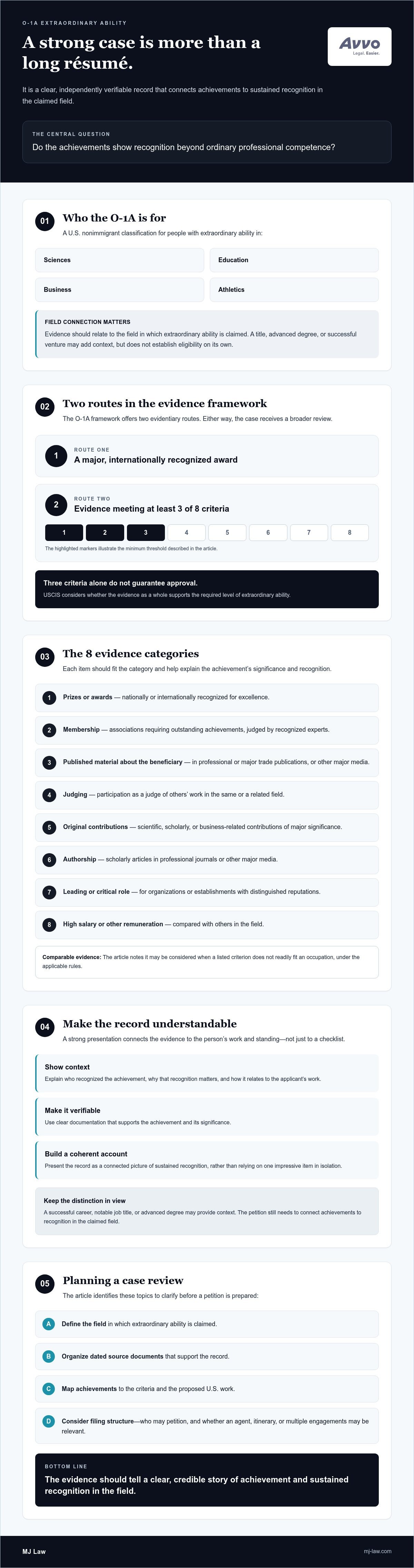
The O-1A evidentiary framework offers two routes. A person may qualify based on a major, internationally recognized award, or by submitting evidence that satisfies at least three of the eight criteria listed in the regulations. The U.S. Citizenship and Immigration Services (USCIS) explains these routes in its O-1 nonimmigrant visa guidance.
Meeting the minimum number of criteria is a starting point, not an automatic approval. USCIS assesses whether the evidence, considered as a whole, supports the required level of extraordinary ability. Each item should do more than fit a category. It should help show the achievement’s significance and its recognition in the applicant’s field.
What Are the Main O-1A Evidence Categories?
The regulations list these eight categories. The exact requirements for each matter, so confirm the current wording and whether a category fits the beneficiary’s occupation.
- Nationally or internationally recognized prizes or awards for excellence.
- Membership in associations that require outstanding achievements, as judged by recognized experts.
- Published material about the beneficiary in professional or major trade publications or other major media.
- Participation as a judge of others’ work in the same or a related field.
- Original scientific, scholarly, or business-related contributions of major significance.
- Authorship of scholarly articles in professional journals or other major media.
- A leading or critical role for organizations or establishments with distinguished reputations.
- High salary or other remuneration compared with others in the field.
Some occupations may not readily fit a listed criterion. In that situation, comparable evidence may be considered under the applicable rules. It isn’t a general substitute for evidence that fits a category. Explain why the listed criterion doesn’t readily apply and how the alternative evidence is comparable.
How Should Evidence Demonstrate the Achievement?
Build each exhibit around a specific achievement. For example, a judging invitation alone may not explain the significance of the role. Records of the selection process, the event, and the field may provide useful context. For a contribution, documentation should help establish what the work was, why it mattered, and how its importance is recognized beyond the applicant’s own statements.
Evidence quality and context matter alongside criterion count because USCIS must be able to verify the achievement and understand its significance. Independent records, reliable publication details, award documentation, and clear explanations can make the evidence easier to assess. Promotional claims without supporting documentation may carry less persuasive weight.
Because the O-1A visa requirements depend on how evidence fits a particular field and record, applicants may find it helpful to discuss their evidence with immigration counsel before preparing a petition.
Who Files an O-1A Petition and What Must It Include?
The person seeking O-1A classification is the beneficiary, but generally can’t file the petition independently. A U.S. employer or agent files Form I-129 with U.S. Citizenship and Immigration Services (USCIS). The filing must connect the beneficiary’s qualifications to specific proposed work in the United States. USCIS outlines the petition framework in its O-1 Visa requirements guidance.
Can an Employer or Agent Petition for the Beneficiary?
An employer may petition for a beneficiary it plans to employ. An agent may file in certain arrangements, such as representing multiple employers or coordinating engagements, or may act on behalf of an employer. The right structure depends on who will employ the beneficiary and how the work is arranged. A founder seeking O-1A classification through a U.S. company should also confirm that the company’s role as petitioner is properly documented.
The petition generally includes information about the proposed work, the terms of the engagement, and the beneficiary’s qualifications. If the work involves multiple events or locations, contracts or summaries of oral agreements and an itinerary may help explain the engagements, dates, and locations. Requirements depend on the facts and current USCIS instructions, so the filing should reflect the actual work plan rather than rely on a generic job description.
What Is the Consultation Requirement?
An O-1A petition generally requires a written advisory opinion, often called a consultation, from an appropriate peer group, labor organization, or management organization. The relevant organization depends on the beneficiary’s occupation and the nature of the proposed work. The opinion typically addresses the work and the beneficiary’s qualifications. If the petitioner believes an exception applies, it should verify that position against current USCIS rules and the specific circumstances rather than assume a consultation can be omitted.
Plan for several distinct steps. First, the U.S. petitioner prepares and submits the petition with supporting evidence and any required consultation. If USCIS approves it, that approval addresses the petition, not every step needed to travel or begin work. A beneficiary outside the United States may still need to apply for an O visa at a U.S. consulate. Visa issuance and admission are separate decisions. Someone already in the United States may have a different status-related process, depending on the request and their circumstances.
Because petitioner structure, engagements, and consultation requirements can affect how the O-1A visa requirements apply, a case-specific review can help identify issues to address before filing. Applicants and petitioners may schedule an immigration consultation to discuss their circumstances.
What Common O-1A Eligibility Misunderstandings Should Applicants Avoid?
A common mistake is to treat O-1A eligibility as a checklist with a guaranteed outcome. The criteria help organize evidence, but they don’t replace the broader assessment of whether the record demonstrates extraordinary ability. Applicants should also avoid assuming that only household-name fame counts or that an impressive career summary automatically proves eligibility.
Does Meeting Three Criteria Guarantee O-1A Approval?
No. Evidence meeting at least three of the listed criteria may satisfy the regulatory threshold for the evidence route, but it doesn’t guarantee approval. USCIS evaluates the petition as a whole to determine whether the evidence establishes the required level of distinction. A document may appear to fit a category yet offer little insight into the achievement’s significance or the beneficiary’s recognition in the field.
That’s why a persuasive petition explains how the evidence fits together. It should address the quality and context of each achievement, rather than simply count exhibits or assert that the applicant is exceptional. No single category, award, or credential guarantees a particular result.
Can a Strong Résumé Be Enough?
A résumé is a useful starting point, but it usually summarizes achievements rather than independently proving them. Job titles, degrees, career milestones, and business success can help establish background. They don’t necessarily show that the beneficiary’s work has earned recognition beyond their employer or immediate professional circle. Supporting records should verify key claims and explain why the accomplishments matter in the field.
Recognition doesn’t have to mean broad public fame. Depending on the occupation, relevant recognition may come from experts, professional organizations, publications, or others familiar with the field. The important distinction is whether the record offers persuasive, verifiable support rather than relying only on self-description or promotional language.
Also check the connection between past accomplishments and the proposed U.S. work. Strong credentials in one area may not, by themselves, explain why the beneficiary is qualified for a different role or how the planned work relates to the claimed field of extraordinary ability. The petition should make that relationship clear.
Finally, petition eligibility is not the same as visa issuance or permission to travel and work. USCIS petition approval does not itself guarantee a visa, admission at a port of entry, or a particular outcome in a separate status process. The next steps depend on where the beneficiary is and their individual circumstances. Understanding these distinctions can help applicants assess the O-1A visa requirements without mistaking any one factor for a guarantee.
If you’re weighing how your achievements relate to the proposed work, schedule a case-specific immigration consultation to discuss your circumstances.
How Can O-1A Applicants Prepare Their Next Steps in Silicon Valley?
A focused preparation process can help turn a complex career history into a clearer picture of potential eligibility. The O-1A visa requirements depend on the person’s field, achievements, proposed U.S. work, and petitioner arrangement. Organize those pieces before assessing how they fit together.
What Should Applicants Organize Before a Case Review?
Start with a concise career chronology and a description of the work planned in the United States. Identify the likely petitioner, such as an employer or agent, and gather a basic outline of the role, engagements, or projects. Then organize potential evidence by achievement and relevant criterion. For each item, note its source, date, and what it may help establish.
- Define the field: Describe the area in which you claim extraordinary ability and keep it consistent with your achievements and proposed work.
- Map achievements: Connect each accomplishment to a possible criterion without assuming that a category match proves eligibility.
- Preserve records: Keep source documents, publication details, dates, translations when needed, and independent corroboration together.
- Identify gaps: Flag missing context, inconsistencies, or claims that rely mainly on self-description for qualified counsel to assess.
Evidence patterns can differ across Silicon Valley. A founder may have records tied to business activity and the significance of their contributions, while a researcher may have scholarly work, judging activity, or recognition from others in the field. These are possible evidence types, not shortcuts or guarantees. Present the record accurately rather than overstating what a document proves.
If you’re also considering permanent residence, the EB-1A extraordinary ability guide can help you explore that separate pathway. O-1A and EB-1A have different legal standards and processes, so don’t assume evidence or eligibility for one automatically establishes eligibility for the other.
When Should Someone Seek O-1A Legal Guidance?
Case-specific legal guidance may be useful when it’s difficult to define the field, match achievements to the criteria, choose a petitioner structure, or address prior immigration history. MJ Law serves the San Jose and Silicon Valley community, with consultations available in English and Spanish. A review can help identify questions to address, but it can’t guarantee a particular outcome.
To discuss your circumstances, schedule an immigration consultation.
Turn Your O-1A Preparation Into a Clear Plan
The O-1A process is easier to assess when you separate the core questions: Do your achievements show recognition in your field? Does the evidence support that story? Is there a suitable U.S. petitioner and proposed work? The O-1A visa requirements call for more than a strong résumé or a count of qualifying categories. The record must make the significance of your achievements clear and verifiable.
Before moving forward, organize your career history, supporting records, and details about the proposed U.S. work. Then consider how the evidence fits your field and circumstances. A case-specific review can help identify issues to discuss without assuming a particular outcome.
MJ Law has assisted individuals, families, and businesses with immigration matters for more than three decades. Based in San Jose, the firm serves the Silicon Valley community, with consultations available in English and Spanish. Schedule an immigration consultation to discuss your situation and possible next steps.
With careful preparation and appropriate guidance, you can approach the process with greater clarity and confidence.
Frequently Asked Questions
What are the basic requirements for an O-1A visa?
Applicants must show extraordinary ability in the sciences, education, business, or athletics, with sustained national or international acclaim in their field. The O-1A visa requirements can be met through a major internationally recognized award or, generally, evidence satisfying at least three of the eight regulatory criteria. A U.S. employer or agent must file the petition, and the evidence must support the claimed field and proposed U.S. work. Meeting a threshold alone doesn’t guarantee approval.
Do you need to meet three criteria for an O-1A visa?
Not always. The evidentiary route generally requires evidence meeting at least three of the eight criteria, but a person with a major internationally recognized award may qualify through a separate route. Satisfying three criteria doesn’t guarantee approval. USCIS evaluates the record as a whole to determine whether it establishes the required level of distinction. The relevance, reliability, and context of the evidence matter, so criterion count is only one part of the eligibility analysis.
Can I apply for an O-1A visa without an employer?
You generally can’t file an O-1A petition on your own. A U.S. employer or qualifying agent must petition for you. An agent may file in certain work arrangements, such as representing engagements with multiple employers. A founder may also be able to use their own U.S. company as the petitioner, but the company and proposed work must fit applicable requirements. The right structure depends on the facts, so confirm it before preparing a petition.
How long does it take to get an O-1A visa?
As of September 2026, regular USCIS processing takes approximately 11 to 14 months for 80% of O-1 petitions. Optional premium processing requires USCIS to take action within 15 business days, but that action could be an approval, denial, or request for evidence. These figures don’t include evidence preparation or, where needed, consular visa processing. Check current USCIS information before making plans.
Can a startup founder qualify for an O-1A visa?
Yes, a startup founder may qualify if they meet the extraordinary-ability standard and have a suitable U.S. petitioner. USCIS policy guidance issued in 2025 clarified that a founder may use their own U.S. company to petition. That arrangement doesn’t establish eligibility by itself. The petition still needs evidence of the founder’s recognition and a clear account of the proposed work. Company structure and supporting documentation should be reviewed in context.
Is O-1A status the same as an EB-1A green card?
No. O-1A is a temporary nonimmigrant classification tied to approved work in the United States. EB-1A is an immigrant classification that may provide a path to permanent residence for people who meet its separate requirements. The categories have some similarities, but their standards, petition procedures, and immigration outcomes differ. Evidence relevant to one may also be useful in considering the other, but eligibility for O-1A doesn’t automatically establish EB-1A eligibility.