
What if the success of your visa application isn’t about the specific dollar amount you spend, but rather the ratio of what you’ve committed? You’ve likely spent years building your savings and dreaming of launching a business in Silicon Valley. It’s natural to feel a sense of dread at the thought of a denial after putting your life’s work on the line. The definition of an E-2 visa substantial investment often feels frustratingly vague. This is especially true when you’re trying to navigate the high entry costs of the San Jose market.
We understand that you need more than just legal definitions; you need a strategy that works. This guide will demystify the “substantiality” requirement by explaining the proportionality test in clear, functional terms. We’ll show you how to structure your capital to satisfy immigration officers in 2026. You’ll learn how to prove your funds are truly at risk, why service-based models differ from capital-intensive ones, and how to build a roadmap that secures your professional future in the United States.
Key Takeaways
- Learn how to define an E-2 visa substantial investment as a ratio of the total business value rather than a fixed dollar amount.
- Master the Proportionality Test to determine the exact percentage of capital you must commit based on your specific industry and startup costs.
- Identify which tangible and intangible assets qualify as at-risk capital to maximize your total investment figure and satisfy consular officers.
- Structure your business plan to overcome the marginality requirement by demonstrating a clear path toward significant economic contribution.
- Gain specific insights for the Silicon Valley and San Jose markets where investment expectations reflect the higher cost of regional business entry.
What Does ‘Substantial Investment’ Actually Mean for an E-2 Visa?
The term “substantial” often creates anxiety for entrepreneurs because it lacks a fixed price tag. Unlike other visa categories that demand a specific, six-figure sum, the E-2 visa substantial investment requirement is defined by its relationship to the business itself. In 2026, immigration officers continue to focus on whether the capital committed is sufficient to ensure the business isn’t just a concept, but a viable, operating entity. The core purpose is to verify that you’re personally and financially tethered to the success of the venture.
Adjudicators look for an investment that is “at risk,” meaning the funds are irrevocably committed to the business and subject to loss if the enterprise fails. This requirement prevents individuals from simply placing money in a bank account to secure a visa. You must show that the capital is active and working toward the business goals described in your plan.
The Three-Pronged Legal Definition
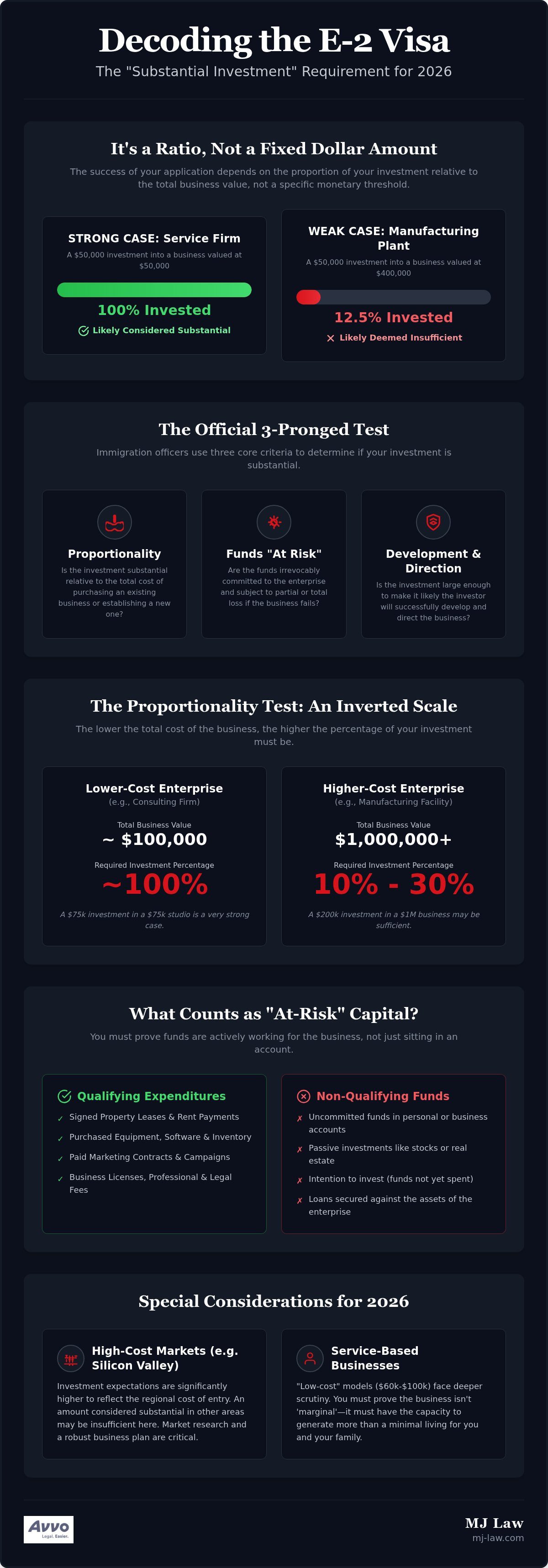
To evaluate your application, authorities use a three-part test that looks beyond your bank balance. First, they measure the investment against the total cost of either purchasing an existing business or establishing a new one from scratch. Second, the funds must represent a clear financial commitment that would cause the investor a real loss if the business fails. Finally, the amount must be large enough to support the likelihood that you’ll successfully develop and direct the enterprise. This ensures the E-2 investor visa remains a tool for genuine economic growth rather than a mere transactional entry permit.
Why Fixed Minimums are Misleading
Many applicants mistakenly search for a magic number, but a “one size fits all” approach doesn’t exist in immigration law. A $50,000 investment might be perfectly substantial for a specialized consulting firm in San Jose that only requires a small office and high-end software. However, that same $50,000 would likely be deemed insufficient for a manufacturing plant where the equipment alone costs $400,000. Substantiality functions as a sliding scale where the required percentage of investment decreases as the total value of the enterprise increases.
The 2026 regulatory environment places a heavy emphasis on the quality of the investment. It’s not enough to show the money exists; you must demonstrate it’s been spent on the needs of the business. This includes signed leases, purchased inventory, or paid marketing contracts. By focusing on the industry-specific needs of your business model, you can present a compelling case that your E-2 visa substantial investment is the foundation of a sustainable American enterprise.
The Proportionality Test: How USCIS Calculates Your Investment
The proportionality test is the mathematical heart of your application. It weighs the amount you’ve spent against the total value of the business. USCIS uses an “inverted scale” logic, meaning the lower the total cost of the enterprise, the higher the percentage of that cost you must invest. For instance, if you’re starting a small service firm worth $100,000, you’ll likely need to invest nearly 100% of that capital. Conversely, a multi-million dollar manufacturing facility might only require a 10% or 15% investment to be considered substantial. This flexibility allows for a wide variety of business models to meet the E-2 Treaty Investor qualifications.
Calculating the Proportionality Ratio
Determining your ratio starts with establishing the “total value” of the enterprise. For an existing business, this is usually the purchase price. For a new startup, it’s the total amount required to get the business operational. You must use market research or professional appraisals to justify these figures. A common mistake that triggers a Request for Evidence (RFE) is failing to account for all necessary startup costs, such as equipment, licenses, and initial marketing. If your E-2 visa substantial investment only covers half of the actual startup needs, the ratio will likely fail the test. Consider these two scenarios: a $75,000 investment in a $75,000 graphic design studio (100% ratio) is often stronger than a $200,000 investment in a $1,000,000 retail chain (20% ratio).
The 2026 Standard for “Low-Cost” Enterprises
In 2026, service-based businesses face specific hurdles. While current standards suggest that an E-2 visa substantial investment of $60,000 to $100,000 can be sufficient for service models, these “low-cost” applications often receive deeper scrutiny. Officers want to ensure the business isn’t “marginal,” meaning it must generate more than just a living for you and your family within five years of commencing normal business activities. If you’re building a business in a high-cost area, you might find our E-2 Visa Attorney San Jose: 2026 Treaty Investor Guide particularly useful for understanding regional expectations.
Success depends on proving that every dollar spent is essential for the business to function. We’ve helped many entrepreneurs navigate these complex calculations by aligning their financial data with legal requirements. If you’re unsure if your current capital meets the threshold, you can schedule a time to discuss your specific ratio with our team. We focus on providing the steady guidance needed to turn your investment into a successful visa approval.
Qualifying Assets: What Counts Toward Your E-2 Investment Total?
Building a successful application requires a clear understanding of which assets actually contribute to your investment total. While cash is the most common form of capital, it’s not the only way to meet the requirements. An E-2 visa substantial investment can include tangible items like specialized machinery and inventory, as well as intangible assets such as intellectual property, patents, or trademarks. The key is demonstrating that these assets are essential to the business and have been irrevocably committed to the enterprise.
Beyond physical goods, you can also count certain operational expenses toward your total. This includes prepaid rent for your commercial space, marketing contracts, and professional fees for legal or accounting services. These expenditures prove that the business is moving toward an active state. However, keep in mind that personal expenses, such as your own housing or transportation, never count toward the business investment total.
Cash vs. Committed Capital
One of the most frequent points of confusion involves cash held in a business bank account. Simply having $100,000 in a corporate account does not qualify as an investment because those funds are not yet “at risk.” To count toward your total, the money must be spent on business necessities. If you’re purchasing an existing business, using an escrow account is an effective strategy. It shows an irrevocable commitment to the purchase while protecting your capital until the visa is granted. Adjudicators will also scrutinize the legal source of these funds, so maintaining a clear paper trail is vital to meeting USCIS E-2 Visa Requirements.
Inventory and Equipment Valuation
For many entrepreneurs, the bulk of their capital is tied up in the tools of their trade. Whether it’s high-end servers for a tech startup or kitchen equipment for a restaurant, these purchases are central to your case. If you’re transferring equipment from a foreign entity to your new U.S. startup, you must provide independent appraisals or invoices to prove their fair market value. Every dollar must be tied to a specific business necessity. This ensures that the investment is viewed as a legitimate foundation for a commercial enterprise rather than a collection of unrelated assets.
Navigating asset valuation is a meticulous process that requires precision. It’s often helpful to have a professional review your financial records to ensure they align with current standards. If you’re currently gathering your documentation, you can connect with our team for a consultation to review your asset list and confirm your investment structure is sound.
Meeting the Marginality Requirement Alongside Substantiality
A frequent hurdle for applicants is the marginality requirement. Even if you satisfy the criteria for an E-2 visa substantial investment, your application can fail if the business is deemed “marginal.” A marginal business is one that lacks the present or future capacity to generate more than enough income to provide a minimal living for you and your family. To succeed, you must demonstrate that your enterprise will make a significant economic contribution within five years of commencing normal business activities. A robust initial investment serves as a vital buffer, proving you have the infrastructure to grow beyond a solo operation.
The Role of the Business Plan
Your business plan acts as the connective tissue between your capital and your future success. It’s not enough to spend money; you must show how that spending creates a scalable entity. Financial projections should be grounded in reality and directly reflect the size of your E-2 visa substantial investment. If you’re investing $100,000 into a San Jose tech startup, your plan should detail how those funds support the milestones needed to exceed minimal living expenses. For entrepreneurs exploring different entry strategies, reviewing the L-1A vs E-2 Visa for San Francisco Business Owners can help clarify which visa path better supports a high-growth business model.
Job Creation and Economic Impact
One of the most effective ways to overcome marginality concerns is through a clear hiring plan. By using your investment to recruit local San Jose talent, you provide concrete evidence of your business’s economic impact. Hiring U.S. workers proves that the enterprise is designed to be more than a self-employment vehicle. It also justifies your role as an investor who will “develop and direct” the business in a managerial or executive capacity. In the high-cost Bay Area market, showing that you can support a payroll is a powerful indicator of a viable, non-marginal venture.
Proving that your business is built for longevity requires a steady hand and a methodical approach to documentation. We’ve spent over 30 years helping investors align their financial commitments with the strict expectations of USCIS and consular officers. To ensure your business plan and investment strategy meet the 2026 standards for non-marginality, schedule a consultation with our experienced legal team today.
Strategic E-2 Planning for Silicon Valley and San Jose
Launching a business in Silicon Valley requires a nuanced approach to the E-2 visa substantial investment requirement. In a region known for its high cost of living and competitive labor market, what qualifies as “substantial” is often higher than in other parts of the country. Officers are aware that rent for commercial space in San Jose or payroll for specialized tech talent carries a premium. Your financial commitment must reflect these local economic realities to be seen as credible and sufficient for business success.
Many entrepreneurs in the Bay Area transition to the E-2 category from other nonimmigrant visas, such as the H-1B or O-1. This transition requires careful planning to ensure that the capital used for the investment was earned and documented legally while in your previous status. We assist founders in navigating these complex transitions, ensuring that their past professional success in the U.S. serves as a foundation for their new entrepreneurial journey. Leveraging local San Jose business resources, from specialized incubators to regional market data, further bolsters your petition by showing a deep integration into the local economy.
Local Market Realities and USCIS Scrutiny
The “lean” startup model is popular in the tech world, but it requires extra documentation for immigration purposes. If your business has low physical overhead, you must provide detailed evidence of other substantial costs. This might include software development, intellectual property filings, or high-value consulting contracts. Working with a San Jose-based immigration attorney provides a distinct advantage. We understand the local business climate and can help you justify your investment amounts based on regional benchmarks for rent and professional services, ensuring your “lean” model doesn’t look undercapitalized to an adjudicator.
Next Steps: From Investment to Approval
The journey from initial capital commitment to visa approval is methodical. You should expect a timeline of several months to prepare a comprehensive business plan and gather the necessary financial documentation. This preparation is critical for the consular interview. During this meeting, you’ll need to speak confidently about your financial commitment and the business’s projected growth. Our firm brings over three decades of experience to this process, acting as a steady guide through the intricate procedures of the U.S. immigration system.
Our bilingual team is dedicated to providing the personal touch and precision required for high-stakes investor cases. We believe in a collaborative relationship that prioritizes your individual success story. If you’re ready to build your future in San Jose, schedule a consultation with MJ Law to begin structuring your petition with expert oversight.
Securing Your Entrepreneurial Future in Silicon Valley
Mastering the E-2 visa substantial investment requirement is the first step toward successfully launching your business in the United States. As we’ve explored, substantiality is defined by the mathematical relationship between your capital and the total value of your enterprise. By ensuring your funds are truly at risk and demonstrating that your business will contribute significantly to the local economy, you can navigate the scrutiny of immigration officers with confidence. Whether you’re starting a lean tech firm or purchasing an established business, your success depends on a methodical approach to financial documentation.
Navigating these complexities requires a steady, experienced hand. With over three decades of experience in the Silicon Valley legal community, MJ Law provides the reassuring expertise needed for both family immigration and complex investor visas. Our bilingual team offers comprehensive support in English and Spanish, ensuring you have a reliable partner at every stage of the process. Book Your E-2 Visa Consultation with MJ Law to begin structuring your investment strategy with a firm that understands the high-stakes reality of the San Jose market. We look forward to helping you turn your professional vision into a reality.
Frequently Asked Questions
Is there a minimum dollar amount for the E-2 visa substantial investment?
No official minimum dollar amount exists for an E-2 visa substantial investment. Instead, the law relies on the proportionality test to determine if your capital is sufficient relative to the business’s total value. While some service-based startups succeed with amounts near $80,000, high-cost markets like San Jose typically require larger commitments to prove the venture is viable. We’ve found that a higher investment often leads to a smoother adjudication process in the Bay Area.
Can I use a loan to meet the E-2 substantial investment requirement?
You can use loan proceeds as part of your investment, provided the debt isn’t secured by the assets of the E-2 enterprise itself. The funds must be “at risk,” meaning you’re personally liable for the capital. If you use a personal loan or a mortgage on your primary residence, those funds qualify. However, a loan secured by the business equipment or inventory you’re purchasing doesn’t count toward the substantiality requirement.
Does the money have to be spent before I apply for the visa?
Most of the capital must be spent or irrevocably committed before you submit your application. USCIS and consular officers want to see that the business is nearly ready to start operations. Simply holding cash in a corporate bank account isn’t enough to satisfy the “at risk” requirement. You should document purchases of equipment, signed lease agreements, and marketing expenses to prove you’ve moved past the initial planning phase.
What happens if my business costs much less than $100,000?
If your total startup costs are relatively low, you’ll need to invest a much higher percentage of that total to qualify. For a business valued at $60,000, an investment of 100% is often necessary. Officers scrutinize these “low-cost” petitions more closely to ensure the business isn’t marginal. We help entrepreneurs in San Francisco document every specific business necessity to justify their investment ratio and prove the venture’s sustainability.
Can I include my living expenses in the investment total?
Personal living expenses, such as your rent, groceries, or personal vehicle costs, never count toward the E-2 visa substantial investment. The capital must be dedicated solely to the commercial enterprise’s operations and growth. While you need to show you have enough personal funds to support your family without relying on the business immediately, those funds are kept separate from the “at-risk” capital used to establish or buy the company.
How do I prove the “source of funds” for a substantial investment?
Proving the legal source of funds requires a clear, documented paper trail from the origin to the business account. You’ll need to provide bank statements, tax returns, pay stubs, or records from the sale of property or other assets. If the funds were a gift, you must document the donor’s source of that wealth. Our firm’s thirty years of experience helps clients organize these complex financial records to meet strict federal standards.
What is the difference between “substantial” and “marginal” in E-2 terms?
Substantiality refers to the amount of capital you’ve committed relative to the business’s total cost, while marginality refers to the business’s capacity to support more than just your family. A business that only supports the investor is considered marginal and won’t qualify. Your investment must be large enough to facilitate growth and hiring, ensuring the enterprise makes a significant economic contribution to the San Jose community.
Does buying an existing San Jose business make it easier to prove substantiality?
Buying an existing business often simplifies the proportionality test because the purchase price establishes a clear “total value” for the enterprise. In the San Jose market, an existing company with a proven track record and active payroll provides strong evidence that the investment isn’t marginal. It’s often easier to show that the funds are “at risk” when they’re tied to an established operation with physical assets and a verified history of revenue.