
In a region where “changing the world” is a standard mission statement, how do you prove to the government that your specific contributions are truly extraordinary? For many tech founders and researchers, the line between high achievement and legal “extraordinary ability” feels frustratingly thin. If you’re feeling uncertain about your case or worried about the 20% RFE rate currently seen in petitions, consulting an O-1A visa RFE lawyer San Jose professionals trust is a critical first step. It’s completely normal to feel confused about how to document intangible innovations or leadership roles in a way that satisfies a USCIS officer.
This article provides a comprehensive, attorney-vetted checklist designed to help you evaluate your eligibility and build a bulletproof evidence portfolio for 2026. We promise to give you the clarity needed to transform your career milestones into a compelling legal narrative. You’ll learn exactly which documents to collect, how to frame your Silicon Valley success in legal terms, and what it takes to secure a confident approval without the stress of a Request for Evidence.
Key Takeaways
- Learn why the “Two-Step” Kazarian analysis means that simply meeting three criteria is no longer enough for an approval in today’s competitive landscape.
- Utilize a comprehensive checklist for all eight USCIS criteria, specifically framed for the unique roles and contributions found in Silicon Valley.
- Identify the most common reasons for a Request for Evidence and see how an O-1A visa RFE lawyer San Jose experts trust can help you avoid “circular arguments.”
- Master the “Evidence Matrix” technique to stress-test your portfolio and ensure every document serves a strategic purpose in your filing.
- Understand how to leverage decades of local legal expertise to navigate the latest 2026 USCIS policy shifts regarding startup founders and STEM talent.
The O-1A Visa Evidence Checklist: Defining the Extraordinary in 2026
The O-1 Visa remains one of the most prestigious paths for foreign talent in the United States. It’s specifically designed for individuals who have risen to the very top of their field. In 2026, the standard for “extraordinary” in Silicon Valley has become more nuanced. Simply being a high-level engineer at a major firm isn’t enough. You must demonstrate sustained national or international acclaim that distinguishes you from your peers. This requires a strategic approach to documentation that goes beyond just listing your job duties.
The Kazarian Standard: Beyond the 8 Criteria
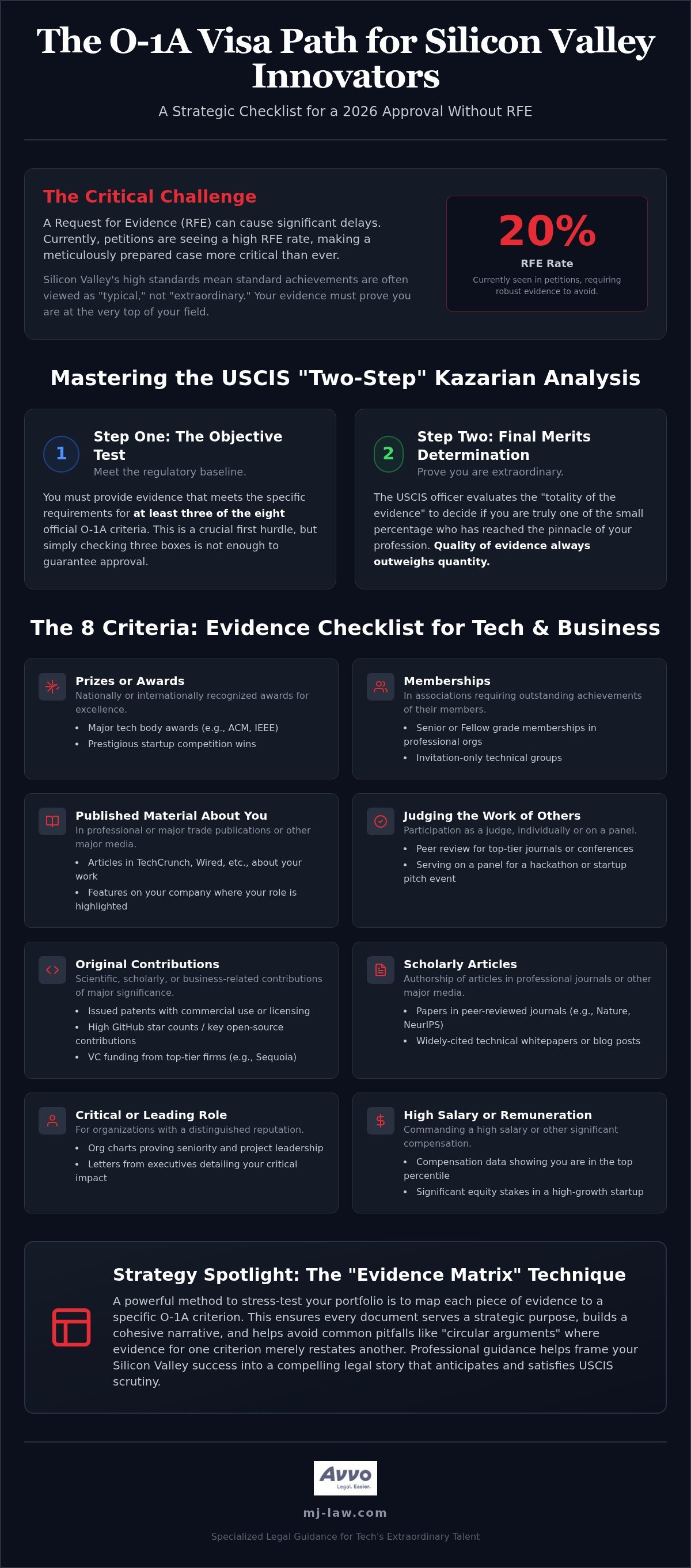
USCIS adjudicators use a two-step “Kazarian” analysis to evaluate your petition. Step one is an objective check: does your evidence meet the regulatory definition of at least three of the eight criteria? While this is a vital hurdle, it’s not the finish line. Many applicants assume that checking three boxes guarantees an approval, but that’s a common misconception that leads to avoidable delays.
Step two is the Final Merits Determination. Here, the officer looks at the “totality of the evidence” to decide if you are truly one of the small percentage of individuals who have reached the pinnacle of their profession. Quality always beats quantity. A single, high-impact award from a major tech body carries more weight than ten minor certificates from local meetups. An experienced O-1A visa RFE lawyer San Jose professionals rely on will focus on the substance of your impact rather than just the volume of papers. We help you curate evidence that proves your standing in the field, ensuring your petition withstands this holistic review.
Why Silicon Valley Talent Needs a Specialized Approach
If you live in San Jose, your petition is usually processed by the California Service Center. Adjudicators here are deeply familiar with the tech ecosystem. They understand what a “Series B” startup is, but they also have higher expectations. They don’t just want to see that you worked for a successful company; they need proof that your specific role was critical to that success. Standard startup achievements, like hitting a growth milestone, are often viewed as “typical” rather than extraordinary in this region.
This unique evidentiary bar requires a strategy that translates tech-speak into legal arguments. For those in creative or design roles within tech, it’s also vital to understand the O-1A vs O-1B Visa distinction, as the evidence required for “extraordinary achievement” in the arts differs from “extraordinary ability” in science or business. Working with a dedicated O-1A visa RFE lawyer San Jose can ensure your specific Silicon Valley narrative meets these rigorous standards and anticipates the specific scrutiny of local adjudicators.
The 8 USCIS Criteria: A Detailed Evidence Checklist for Tech and Business
While the legal baseline requires meeting at least three of the eight criteria, the way you document those achievements determines your success. For San Jose tech professionals, this means translating complex software architecture or venture capital milestones into the specific language of the official USCIS O-1A criteria. Adjudicators aren’t always engineers; they need to see clear, third-party proof that your work has moved the needle in your industry.
Documenting Original Contributions and Key Roles
Proving “original contributions of major significance” is often the strongest part of a Silicon Valley petition. It’s not enough to show you wrote code; you must show that your code changed how others work. Evidence for this often includes:
- Patents and IP: Issued patents or pending applications accompanied by evidence of commercial use or licensing by major firms.
- Software Repositories: High GitHub star counts or contributions to open-source projects that have been adopted by companies like Google, Meta, or Nvidia.
- Venture Capital: Documentation of successful funding rounds from top-tier firms like Sequoia or Andreessen Horowitz, where your technical expertise was a primary driver for the investment.
To prove a “critical or lead” role, you need more than a job title. USCIS looks for evidence that you were essential to a specific project’s success. This might include organizational charts showing your seniority or letters from founders detailing how your leadership saved a product launch. If you’re unsure if your role meets this high bar, you might schedule a consultation to review your specific career trajectory.
Awards and Press: What Counts in 2026?
USCIS distinguishes between “local” and “nationally recognized” prizes. An “Employee of the Month” award at a San Jose startup won’t qualify. However, being named to a Forbes 30 Under 30 list or winning a prestigious pitch competition at Y Combinator carries significant weight. We often see clients confuse internal recognition with the “extraordinary” standard required by law. Working with an O-1A visa RFE lawyer San Jose professionals trust ensures you don’t waste time on evidence that doesn’t move the needle.
Media coverage must be about you and your specific work. Articles in TechCrunch, Wired, or the San Jose Mercury News are excellent, provided they focus on your achievements rather than just your company. If your evidence in these categories is particularly strong, you may also be a candidate for permanent residency, which you can explore in our EB-1A Extraordinary Ability Lawyer: The Silicon Valley Guide to Priority Green Cards. The key is to demonstrate that your reputation extends beyond your immediate employer.
Common Reasons for O-1A RFEs in Silicon Valley (And How to Avoid Them)
Receiving a Request for Evidence (RFE) can feel like a significant setback, yet current trends suggest that approximately 1 in 5 O-1A petitions faces this extra scrutiny. In Silicon Valley, the bar for extraordinary ability is exceptionally high, and adjudicators often challenge evidence that would be accepted in other regions. This is where the guidance of an O-1A visa RFE lawyer San Jose professionals trust becomes indispensable. Our firm’s experience as a Marriage Green Card RFE Lawyer in San Jose has given us deep insights into how USCIS structures their challenges, allowing us to build more resilient initial filings.
The “Circular Argument” RFE is a frequent obstacle. USCIS might admit you won a specific award but then argue that the award itself isn’t “nationally or internationally recognized.” To avoid this, you must document the award’s history, the prestige of the judges, and the caliber of previous winners. Simply meeting the official USCIS O-1A criteria on paper isn’t enough; you must prove the context of that achievement.
The “High Salary” trap is another local nuance. A salary that seems extraordinary in the Midwest might be considered average for a lead engineer in the South Bay. We help clients use industry-specific data, such as Radford surveys or OES statistics, to prove their compensation truly sits at the top of the market. Adjusting for the local cost of living and tech industry standards is vital to silencing USCIS skepticism regarding your income level.
Proving ‘Major Significance’ in a Saturated Market
In 2026, simply holding a patent isn’t a guaranteed win. USCIS now looks for proof of “major significance,” meaning your innovation has influenced the industry at large, not just your specific employer. We encourage applicants to use concrete metrics like user growth, revenue generated by the technology, or high citation counts. If your software architecture has been adopted by a major tech firm or integrated into a widely used open-source framework, that real-world impact is far more persuasive than the patent filing itself.
The Importance of Independent Expert Opinions
Letters from your current boss or former colleagues are often dismissed as biased or “conclusory.” To satisfy the Final Merits Determination, you need letters from independent experts who know of your work through its reputation but have no personal or professional connection to you. These letters should avoid subjective praise and instead focus on technical, objective explanations of why your contributions are original and significant. A seasoned O-1A visa RFE lawyer San Jose can help you identify and vet these independent voices to ensure their testimony carries the necessary legal weight.
How to Compile and ‘Stress-Test’ Your Evidence Portfolio
Compiling your O-1A petition is an exercise in strategic storytelling. In Silicon Valley, where high-level achievement is dense, your evidence must be organized so that a busy adjudicator can identify your extraordinary ability within seconds. This is why many local professionals partner with an O-1A visa RFE lawyer San Jose experts rely on. We don’t just gather papers; we architect a narrative that guides the officer through your most impactful work. The goal is to make the approval feel like the only logical conclusion.
Start by creating an “Evidence Matrix” before you build your formal exhibit list. This internal tool maps every document to the specific USCIS criteria it supports. For instance, a technical white paper you authored might satisfy both “Scholarly Articles” and “Original Contributions” if it has been widely cited by industry peers. Mapping your evidence this way ensures you don’t overlook a document’s multi-layered value and helps you identify gaps in your portfolio early in the process.
Organizing Your Exhibits for USCIS Clarity
Your exhibit list should mirror the eight criteria exactly. Use a clear table of contents with numbered tabs for each section to provide a roadmap for the officer. If you’re submitting a 50-page technical report, don’t expect the adjudicator to find your name on page 34. Use yellow highlighting on physical copies or digital call-out boxes on PDF filings to draw attention to key facts, such as your specific role or the specific number of users impacted by your innovation. Additionally, ensure all foreign language documents include certified English translations; even a small oversight here can trigger a delay.
The 3-Question Stress Test for Every Document
Before adding any document to your final filing, put it through our three-question stress test to ensure it meets the 2026 evidentiary standards:
- Is this document from an independent source? Letters from current colleagues are weaker than reports from third-party analysts or press coverage from reputable tech journals.
- Does this document name me specifically? Broad praise for your company or a project doesn’t count toward your individual ability unless you are credited by name.
- Does this document explain the impact of my work on the field at large? Describing what you did is helpful, but describing how it changed the industry is what proves extraordinary ability.
If a document fails these questions, it likely needs supplemental evidence or a stronger expert letter to be effective. The petitioner cover letter then acts as the legal brief that connects these dots. It shouldn’t just repeat your resume; it should articulate your value in the specific legal terms USCIS expects. If you’re feeling overwhelmed by the organization of your case, you can schedule a professional portfolio review to ensure your filing is bulletproof before it reaches the service center.
Consulting an O-1A Visa RFE Lawyer in San Jose: Protecting Your Career
Navigating the O-1A process in a high-stakes environment like Silicon Valley requires more than just meeting the basic criteria. It’s about sophisticated risk management. With current trends showing that approximately 1 in 5 petitions receives a Request for Evidence, a professional review is no longer a luxury. It’s a strategic necessity for those who cannot afford a disruption in their career trajectory. An O-1A visa RFE lawyer San Jose professionals trust can identify subtle weaknesses in your evidence before they become legal hurdles that stall your progress.
Being based in the South Bay provides a distinct advantage for our clients. We understand the local tech ecosystem’s nuances, from the specific language used in venture capital term sheets to the hierarchical structures of the region’s largest tech giants. This local presence allows us to offer a level of insight that goes beyond generic immigration advice. We know how to frame your “extraordinary” role in the context of the San Jose market, ensuring your achievements aren’t dismissed as standard industry performance.
The MJ Law Advantage: Decades of Silicon Valley Expertise
MJ Law has been a reliable anchor in the South Bay for over 30 years. Led by Gabriel Jack and Michael Muston, our firm has successfully navigated the O-1 standard’s evolution from the early tech boom of the 1990s through the AI-driven shifts of 2026. This longevity provides us with institutional knowledge that newer firms simply don’t possess. We’ve seen how USCIS policy shifts over decades, and we use that experience to anticipate trends before they impact your case.
Our approach is inherently collaborative and client-centered. We don’t just provide a checklist; we act as a compassionate guide through a complex legal landscape. We work closely with you to translate your technical innovations and leadership milestones into a narrative that resonates with USCIS adjudicators. Furthermore, we recognize the global nature of Silicon Valley talent. Our firm offers bilingual consultations in English and Spanish, ensuring that we can support the diverse professional community that calls the South Bay home.
Ready to Secure Your O-1A Visa?
Your career is your most valuable asset, and your immigration status is the foundation it sits on. Don’t leave your Silicon Valley future to chance or a template-based filing that fails to capture your unique impact. A personalized strategy session can provide the clarity you need to move forward with absolute confidence. We invite you to schedule a consultation with MJ Law today to discuss your eligibility and begin building a bulletproof portfolio. By partnering with an experienced O-1A visa RFE lawyer San Jose, you’re choosing a steady hand that has successfully navigated countless complex scenarios for the world’s top talent.
Taking the Next Step Toward Your Extraordinary Career
Building a successful O-1A petition requires more than just a list of achievements; it demands a strategic narrative that highlights your unique impact on the industry. By utilizing the Evidence Matrix and stress-testing every document against the 2026 standards, you can transform your professional milestones into a compelling case for approval. Remember that meeting the three-criteria threshold is only the beginning of the journey. The final merits determination remains the ultimate hurdle where quality and independent recognition outweigh mere volume.
Navigating these complexities doesn’t have to be a solo effort. With over 30 years of experience in the South Bay, MJ Law provides the steady hand and local expertise needed to secure your status. Whether you need strategic RFE defense or a comprehensive portfolio review, an O-1A visa RFE lawyer San Jose can protect your career interests. We offer bilingual support in English and Spanish to ensure clear communication throughout the process. Don’t leave your Silicon Valley future to chance. You can Book a Consultation with MJ Law in San Jose today to start building your bulletproof petition. Your extraordinary contributions deserve a clear path forward.
Frequently Asked Questions
How many criteria must I meet for the O-1A visa?
You must meet at least three of the eight specific criteria defined by USCIS. However, simply meeting the minimum doesn’t guarantee approval. Adjudicators perform a final merits determination to see if you are truly at the top of your field. Providing evidence for four or five criteria often creates a more resilient petition. This strategy helps buffer against potential challenges during the review process and provides a clearer picture of your sustained national or international acclaim.
Can I apply for an O-1A visa if I don’t have a PhD?
Yes, a PhD is not a requirement for the O-1A visa. While advanced degrees can support your claim of extraordinary ability, USCIS also recognizes professional achievements like high salaries, critical roles in distinguished organizations, and original contributions to the tech industry. Many successful applicants in Silicon Valley are startup founders or senior engineers who’ve demonstrated significant impact through their work rather than academic credentials alone. Your practical influence on the field is what matters most.
What qualifies as ‘nationally or internationally recognized’ in Silicon Valley?
Recognition must extend beyond your immediate company or local meetup group. In the South Bay, this often includes coverage in major tech publications like TechCrunch or Wired, or winning awards from prestigious bodies like the IEEE. Being a featured speaker at a global conference like Google I/O or AWS Re:Invent also serves as strong evidence. The key is proving that your reputation is acknowledged by experts outside your personal professional circle and has reached a national scale.
How long does it take to gather evidence for an O-1A petition?
Most applicants spend between four to twelve weeks compiling a comprehensive evidence portfolio. This timeline depends on how quickly you can secure independent expert letters and document your past achievements. If you’re facing a tight deadline, USCIS offers premium processing which guarantees a response within 15 business days for an additional fee. Planning early allows you to refine your narrative and ensure every exhibit meets the necessary legal standards before your submission reaches the service center.
What should I do if I receive an RFE for my O-1A visa?
You should immediately review the specific points challenged by USCIS and consult an O-1A visa RFE lawyer San Jose professionals trust to draft a robust response. An RFE is an opportunity to provide missing context or stronger evidence rather than a denial. We focus on addressing the adjudicator’s concerns with objective data and independent expert opinions to move the case toward a successful final merits determination. Our firm’s 30 years of experience helps us anticipate these challenges.
Can I move from an O-1A to a Green Card (EB-1A) later?
Many individuals use the O-1A as a stepping stone to an EB-1A permanent residency petition. The evidentiary standards for both categories are very similar, making the transition logical for high-achievers. Since you’ve already compiled much of the required documentation for your O-1A, the process for the green card becomes more streamlined. Our firm has assisted many Silicon Valley professionals in navigating this exact transition over the last three decades, ensuring their long-term career security in the United States.
Is a high salary in San Jose enough to meet the ‘High Remuneration’ criterion?
A high salary alone isn’t sufficient; you must prove your compensation is significantly higher than others in similar roles. USCIS adjudicators are aware of the high cost of living in San Francisco and San Jose, so they compare your earnings against specific industry benchmarks like OES data. We help you present your salary and equity packages in a way that clearly demonstrates you’re among the top earners in your specialized field. This requires detailed documentation of market averages.
Does winning a startup pitch competition count as a major award?
It depends on the prestige and reach of the competition. Winning a well-known event like the Y Combinator Demo Day or a TechCrunch Disrupt prize carries significant weight as a nationally recognized award. However, smaller, local pitch events might not meet the threshold on their own. We look for evidence regarding the competition’s selectivity, the reputation of the judging panel, and the caliber of the other participants to build your case. Contextualizing the award is vital for success.