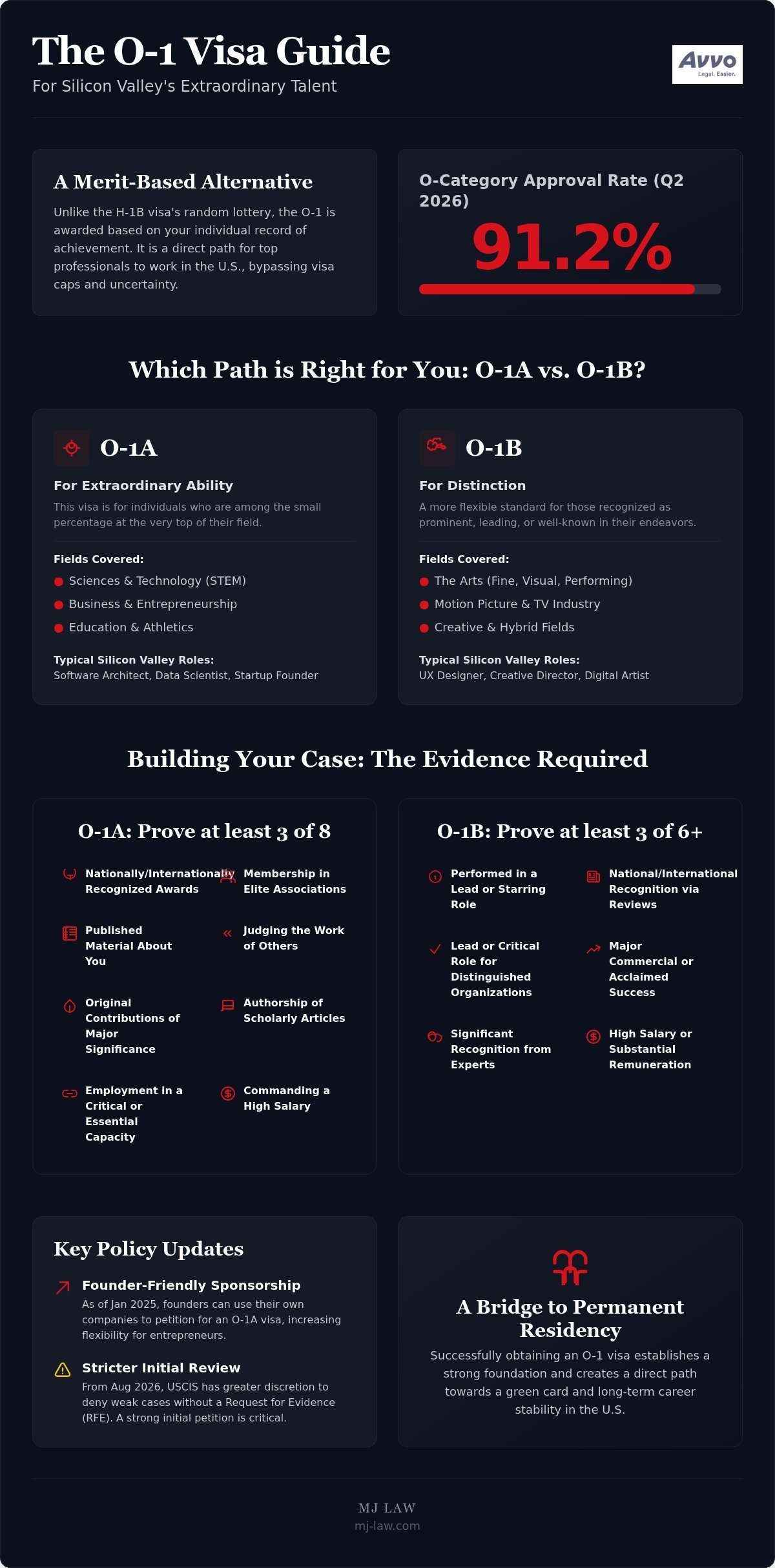
Did you know that while the H-1B lottery remains a game of chance, 91.2% of O-category petitions were approved in the second quarter of 2026? You have likely spent years building a career in Silicon Valley, only to feel held back by the uncertainty of traditional visa caps. It is common to feel confused about the distinction between an O-1A vs O-1B visa, especially when your technical role blurs the line between business and art.
This guide helps you determine which path best fits your unique achievements. We will break down the specific evidentiary standards for each category, provide a clear checklist for your petition, and show you how this visa creates a direct bridge to a permanent green card. By understanding the latest 2026 policy shifts, including new rules on RFE discretion and founder sponsorship, you can approach your application with the confidence of a seasoned expert. We will explore how to build a case that stands up to the increased scrutiny of modern immigration standards and positions you for long-term success.
Key Takeaways
- Learn the fundamental differences between O-1A for STEM and business and O-1B for the arts to target the correct evidentiary standard.
- Discover strategic ways to choose between the O-1A vs O-1B visa if your Silicon Valley role involves a mix of technical and creative expertise.
- Identify the specific documentation required to meet the eight O-1A criteria or the six O-1B criteria to prove your extraordinary ability.
- Understand the 2026 application timeline and the critical role your U.S. petitioner plays in the submission process.
- See how securing an O-1 visa creates a steady path toward permanent residency and long-term career stability in the U.S.
Understanding the O-1 Visa Framework for Silicon Valley Talent
The O-1 visa serves as a powerful, merit-based tool for professionals who have reached a high level of success in their respective fields. Unlike the H-1B visa, which relies on a random lottery system, the O-1 is based entirely on your individual record of achievement. This makes it an attractive option for Silicon Valley’s top engineers, founders, and creatives, especially considering that 91.2% of O-category petitions were approved in the second quarter of 2026. Within the O-1 visa framework, applicants must choose between two primary paths. This decision, often framed as the O-1A vs O-1B visa, depends on your specific field and the nature of your professional contributions.
Many people assume “extraordinary ability” is reserved for Nobel Prize winners or world-famous celebrities. In reality, USCIS looks for a sustained record of acclaim that sets you apart from your peers. With over 30 years of experience, MJ Law has seen how this standard is applied across diverse tech and business roles. This standard is often more attainable than candidates realize, provided the evidence is presented through a clear, strategic narrative that highlights your unique impact on the industry.
The ‘Extraordinary Ability’ vs. ‘Distinction’ Standards
The legal requirements for these categories are not identical. The O-1A standard requires you to prove you are among the small percentage who have risen to the very top of your field in sciences, education, business, or athletics. Conversely, the O-1B standard for the arts is defined as “distinction.” This means you must be recognized as prominent, leading, or well-known in your artistic endeavors. Because distinction is interpreted as a high level of achievement rather than being at the absolute pinnacle, the O-1B standard is technically considered more flexible than the O-1A.
O-1A vs. O-1B: Which Field Does Your Role Fall Under?
Choosing the right category is the first critical step in your petition. O-1A is the standard path for those in STEM fields, high-level business management, and scientific research. If you are a software architect, a data scientist, or a startup founder, this is likely your category. The January 2025 policy update even allows founders to use their own companies to petition for their O-1A visas, providing more flexibility for entrepreneurs.
The O-1B path covers the fine arts, visual arts, and performing arts. It also includes a specialized sub-category for the Motion Picture and Television (MPTV) industry. Understanding where a role like a UX designer or a creative director fits is essential. While a UX designer might lean toward O-1A for their technical business impact, they might qualify for O-1B if their work is primarily recognized for its artistic and visual merit. If you’re unsure about your specific case, you can schedule a consultation to discuss your options.
O-1A Visa Requirements: The High Bar for Tech and Business
Securing an O-1A visa requires proving that you possess “extraordinary ability” in the sciences, education, business, or athletics. This is defined as being part of the small percentage of individuals who have risen to the very top of their field. While winning a major, internationally recognized award like a Nobel Prize provides an immediate path, most Silicon Valley professionals find success by meeting at least three of the eight specific evidentiary criteria. Understanding the nuances of the O-1A vs O-1B visa is essential because the O-1A standard is generally considered more rigorous, requiring objective proof of sustained national or international acclaim.
In 2026, USCIS has increased its focus on the quality and credibility of evidence. Following the August 5, 2026, policy update, officers have greater discretion to deny petitions without first issuing a Request for Evidence (RFE) if the initial filing is missing key documentation. This shift emphasizes the need for a comprehensive initial submission that satisfies the official O-1A and O-1B requirements through a clear, evidence-based narrative.
The 8-Point Criteria for O-1A Success
To qualify through the three-criteria route, you must provide documentation for at least three of the following areas:
- Awards: Receipt of lesser nationally or internationally recognized prizes for excellence.
- Memberships: Belonging to associations that require outstanding achievements of their members.
- Published Material: Professional or major trade publications about you and your work.
- Judging: Participation as a judge of the work of others in your field.
- Original Contributions: Evidence of original scientific, scholarly, or business-related contributions of major significance.
- Scholarly Articles: Authorship of articles in professional journals or major media.
- Critical Employment: Performance in a lead or critical role for organizations with a distinguished reputation.
- High Salary: Command of a high salary or other significantly high remuneration relative to others in the field.
STEM-Specific Evidence for San Francisco Innovators
For those in the tech sector, evidence often looks different than in academia. Original contributions might include patents that have been widely adopted, significant GitHub contributions to major open-source projects, or technical white papers that influenced industry standards. Silicon Valley founders can effectively leverage successful venture capital funding rounds as evidence of the major significance of their business contributions. A startup founder can establish a critical role by providing detailed organizational charts and evidence that their leadership directly led to significant venture capital rounds or proprietary technology development. If you are preparing a high-stakes petition, you may wish to consult with our team to ensure your evidence meets the current 2026 standards.
O-1B Visa Requirements: The Standard of Distinction for Creatives
While the O-1A is geared toward scientific and business excellence, the O-1B category focuses on individuals with “distinction” in the arts. This standard is defined as being renowned, leading, or well-known in your specific creative field. For many digital professionals in Silicon Valley, such as UX designers, architects, or creative directors, the O-1A vs O-1B visa decision often comes down to how their work is recognized by others. If your impact is measured by aesthetic innovation or visual storytelling rather than business metrics alone, the O-1B may offer a more flexible path. Even with recent trends in O-1A visas showing increased interest in STEM-based paths, the O-1B remains a vital route for the creative talent that powers modern tech platforms.
The O-1B classification is not limited to traditional painters or actors. It’s a broad category that includes any field of creative endeavor. MJ Law has successfully partnered with countless creative professionals over three decades to frame their technical skills within this artistic framework. The goal is to prove that you’ve achieved a level of skill and recognition substantially above that ordinarily encountered in your field.
Proving Distinction in the Arts
To qualify for an O-1B visa in the general arts, you must meet at least three of six evidentiary criteria. These criteria focus on your reputation and the commercial or critical impact of your work. Documentation must show that you’ve reached a high level of achievement evidenced by a degree of skill and recognition significantly above that of your peers.
- Leading Roles: Evidence that you’ve performed, or will perform, services as a lead or starring participant in productions or events which have a distinguished reputation.
- National or International Recognition: Critical reviews or other published materials in major newspapers, trade journals, or magazines by or about you.
- Organizational Impact: Performance in a lead, starring, or critical role for organizations and establishments that have a distinguished reputation.
- Commercial Success: A record of major commercial or critically acclaimed successes, such as title, rating, or standing in the field.
- Expert Testimonials: Significant recognition for achievements from organizations, critics, government agencies, or other recognized experts in your field.
- High Remuneration: Evidence that you’ve commanded, or will command, a high salary or other substantial remuneration for services.
MPTV Achievement: A Higher Tier of O-1B
Professionals in the Motion Picture and Television (MPTV) industry are held to a different, higher standard than those in the general arts. Instead of “distinction,” MPTV applicants must demonstrate “extraordinary achievement.” This means a very high level of accomplishment evidenced by a degree of skill and recognition significantly above that ordinarily encountered. USCIS scrutinizes these cases more closely, looking for evidence like IMDB credits, box office numbers, and major industry awards. If you’re navigating these complex requirements, you can book a consultation to ensure your creative portfolio is presented with the necessary legal precision.
O-1A vs. O-1B: Key Differences and Hybrid Role Strategies
Deciding between the O-1A vs O-1B visa is rarely a simple binary choice for Silicon Valley professionals. While the O-1A requires meeting three of eight high-level business or scientific criteria, the O-1B only requires three of six criteria focused on artistic distinction. For many in tech, the lines blur. A UX designer might qualify for O-1A if their work focuses on data-driven conversion metrics and business scaling, yet they could just as easily qualify for O-1B if their portfolio emphasizes visual innovation and aesthetic leadership. This strategic framing is critical because the O-1B standard of “distinction” is often easier to satisfy than the “extraordinary” standard required for O-1A.
Founders often face a similar dilemma when launching a tech startup. Framing your leadership as purely “Business” (O-1A) focuses on venture capital, revenue, and market share. However, if your role involves the “Creative Direction” of a digital product or the artistic vision behind a platform, you might find a safer path through O-1B. Choosing the category where your peer group is less saturated can significantly improve your chances of a smooth approval without an RFE.
The Evidentiary Overlap: What Counts for Both?
Certain types of evidence are universal indicators of high-level talent. Press coverage in major trade publications and a high salary relative to your peers serve as strong evidence regardless of which category you choose. Letters of recommendation that highlight your “Critical Role” can also be repurposed, though they must be tailored to the specific legal language of your chosen path. A leading role in a San Jose startup satisfies both O-1A and O-1B logic by proving critical business impact while establishing the individual as a prominent figure in an organization with a distinguished reputation.
Strategic Framing: Choosing the Path of Least Resistance
Success often depends on analyzing the strength of your evidence against the specific USCIS standard. If your achievements are highly technical or quantitative, O-1A is the natural choice. If your work is more subjective, visual, or recognized through artistic awards, O-1B offers a more flexible evidentiary framework. It is often helpful to have a professional audit of your portfolio to identify which storytelling framework presents the strongest case for your background.
Planning for your immediate work authorization is only the first step. Many of our clients use the O-1 as a bridge to permanent residency. You can learn more about this transition by consulting an EB-1A Extraordinary Ability Lawyer to align your current petition with your long-term green card goals. If you are ready to evaluate your specific role and determine the best path forward, you can schedule a strategic consultation with our team today.
Navigating the O-1 Application Process in Silicon Valley
The journey toward securing your visa begins with a clear strategic assessment. Once you have determined your path between the O-1A vs O-1B visa, the process moves into a rigorous evidence-gathering phase. You must have a U.S. petitioner, which can be a traditional employer, an agent representing multiple clients, or even your own company as a founder. Following the filing of Form I-129, premium processing offers a response within 15 business days for a fee of $2,965. Standard processing currently averages 11 to 13 months as of August 2026. This visa offers a unique advantage of indefinite extensions, providing a level of stability that is often unavailable through the H-1B lottery system. Under the January 2025 policy update, USCIS may even grant full three-year extensions for beneficiaries starting new projects with the same employer.
Beyond immediate work authorization, the O-1 serves as a strategic fast track to permanent residency. The evidentiary standards for the O-1A and O-1B categories align closely with the requirements for an EB-1 green card. By building a strong O-1 case now, you are essentially creating the foundation for your future green card petition. This transition allows many Silicon Valley professionals to move from a nonimmigrant status to a permanent one without the long wait times associated with other employment-based categories. It’s a logical progression for those who have already proven their extraordinary status to the government.
Building Your Evidence Portfolio
Creating a successful petition requires more than just a list of accomplishments. You need a cohesive narrative that connects your achievements to the legal standards of your field. This involves soliciting effective expert opinion letters from recognized Silicon Valley leaders who can attest to your specific impact. Organizing hundreds of pages of documentation into a structured, persuasive format is a complex task. To ensure your file is comprehensive and meets the 2026 evidentiary standards, you should schedule a consultation to begin your portfolio audit.
The MJ Law Advantage for O-1 Petitions
With over three decades of experience, MJ Law understands the nuances of the San Jose and San Francisco tech landscapes. We don’t rely on generic templates. Instead, we work as your partner to build a specific extraordinary story that resonates with USCIS officers. Our team provides bilingual consultations and a steady hand through every stage of the process. If you’re exploring other pathways or facing a career change, we can also help you find an H-1B Transfer Attorney San Jose to handle alternative visa options and job transitions.
Securing Your Professional Future in Silicon Valley
Choosing between the O-1A vs O-1B visa is the first step toward long-term career stability in the United States. Throughout this guide, we’ve explored how the O-1A standard focuses on technical and business excellence, while the O-1B offers a flexible path for creative leaders through the “distinction” standard. Success in 2026 requires a deliberate approach to evidence, ensuring your professional narrative aligns with the latest USCIS scrutiny. By framing your achievements correctly now, you don’t just secure work authorization; you build the necessary foundation for a future EB-1A green card petition.
With over 30 years of experience, MJ Law acts as a steady hand for innovators navigating these complex legal waters. Our San Jose-based experts maintain a high success rate for tech and artist petitions because we understand the nuances of the local market. We treat every case as a partnership, focusing on your individual success story rather than a generic template. If you’re ready to take the next step, book a consultation with MJ Law to evaluate your O-1 eligibility. Your extraordinary career deserves a secure path forward, and we’re here to guide you through every stage of the journey.
Frequently Asked Questions
Can I switch from O-1B to O-1A if my job role changes?
Yes, you can transition between categories by filing a new I-129 petition with USCIS. This often happens in San Jose when a designer moves into a high-level technical leadership role. You’ll need to provide new evidence that satisfies the O-1A criteria rather than the artistic standards of the O-1B. It’s a strategic move that requires a fresh narrative to demonstrate your top-tier status in a scientific or business field.
What is the processing time for an O-1 visa in 2026?
As of August 2026, standard processing for O-1 petitions at the California Service Center typically takes between 11 and 13 months. If you need a faster decision for a Silicon Valley start date, you can opt for premium processing. For a fee of $2,965, USCIS guarantees a response within 15 business days. This expedited service is highly recommended for professionals who don’t want to risk lengthy gaps in their work authorization.
Do I need a college degree to qualify for an O-1A or O-1B visa?
A college degree is not a mandatory requirement for either visa category. While educational credentials can support your case, the O-1 focuses on your sustained national or international acclaim. Many successful applicants in the San Francisco tech scene qualify through patents, high salaries, or critical roles at distinguished companies rather than traditional academic paths. Your portfolio of achievements and industry recognition carries significantly more weight than a diploma in this specific petition.
Can my spouse work in the U.S. if I have an O-1 visa?
Spouses and children of O-1 visa holders are eligible for O-3 nonimmigrant status. Unfortunately, the O-3 visa doesn’t currently grant work authorization in the United States. Your dependents can attend school or engage in volunteer work, but they cannot accept paid employment. If your spouse requires work authorization, it’s essential to discuss alternative visa strategies with a qualified attorney to ensure your family’s long-term goals are met in San Jose.
What happens if my O-1 visa petition is denied?
If your petition is denied, you have several professional options to consider. You can file a motion to reopen or reconsider, or you can submit a new petition with stronger evidence. Many applicants also explore alternative pathways such as an H-1B transfer or an EB-1 green card. Our firm acts as a steady hand during these stressful transitions, helping you analyze the denial notice to build a more robust and successful second application.
How many times can I extend my O-1 visa status?
There is no limit to the number of times you can extend your O-1 status. USCIS typically grants an initial stay of up to three years. After that, you can apply for extensions in increments of one to three years, provided you continue to perform the same type of extraordinary work. This indefinite nature provides a reliable anchor for your career in San Francisco while you evaluate long-term residency options like a green card.
Is it easier to get an O-1A or an O-1B?
The O-1B is often considered more flexible because the legal standard is “distinction” rather than the “extraordinary ability” required for O-1A. Distinction means you are prominent or leading in your field, which is technically a lower bar than being in the small percentage at the absolute top. However, the best choice depends entirely on your specific evidence. Comparing the O-1A vs O-1B visa requires a careful audit of your professional accolades and industry impact.
Can I apply for an O-1 visa if I am self-employed or a freelancer?
You cannot technically be self-employed in the traditional sense, but you can apply as a freelancer through a U.S. agent. Additionally, a January 2025 policy update formally allows founders to use their own companies to petition for their O-1A visas. This is a significant advantage for Silicon Valley entrepreneurs who wish to maintain control over their startups while securing high-level work authorization. You just need to establish a valid employer-employee relationship with your entity.