Coming forward to help the police shouldn’t feel like a risk to your future in the United States, yet for many survivors in the Bay Area, it’s the most terrifying step of all. You might worry that reporting a crime will lead to deportation or that the police will simply refuse to help you with your immigration paperwork. These fears are valid, especially when your safety and your family’s stability are on the line. Securing a U visa law enforcement certification is the essential first step toward legal status, but the process often feels like a maze of red tape and uncertainty.
We understand that you’re looking for more than just a signature; you’re looking for a path to peace of mind. This guide explains exactly how to obtain the mandatory Form I-918 Supplement B and how to demonstrate your helpfulness to local authorities. You’ll learn which agencies in San Jose and San Francisco are responsible for signing these documents and what to do if you encounter a refusal. By breaking down the 2026 certification trends and local requirements, we’ll help you handle this legal hurdle with confidence and clarity.
Key Takeaways
- Identify the specific qualifying crimes and “helpfulness” standards required to secure a signed Form I-918 Supplement B.
- Learn how to navigate the unique policies and request procedures for a U visa law enforcement certification within the San Jose and San Francisco police departments.
- Understand how to overcome common certification hurdles, including cases where the perpetrator hasn’t been caught or the investigation is closed.
- Discover the critical role this certification plays as the mandatory gatekeeper for your entire U visa application process.
- Find out how experienced legal guidance can help you communicate safely and effectively with local agencies while protecting your rights.
Understanding the U Visa Law Enforcement Certification (Form I-918 Supplement B)
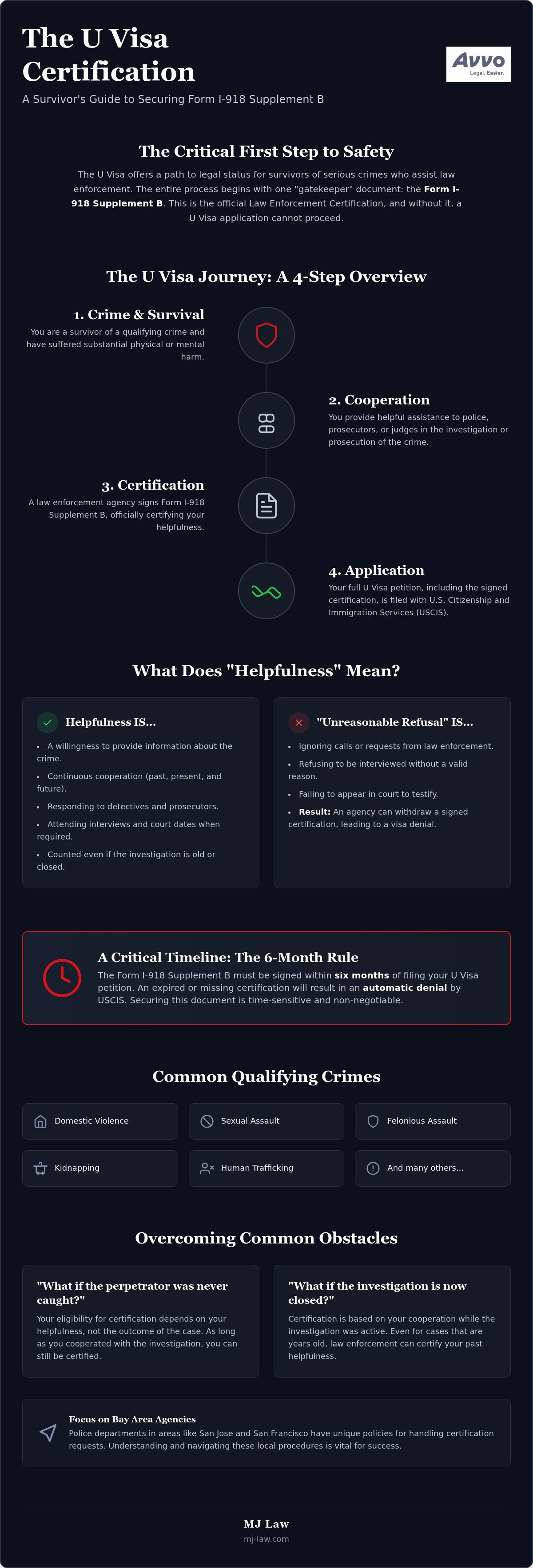
The Form I-918 Supplement B acts as the official confirmation that you’ve cooperated with authorities during the investigation or prosecution of a qualifying crime. This document is the cornerstone of the U visa application process. It’s often called a “gatekeeper” document because, without it, you can’t even begin your formal petition with USCIS. Form I-918 Supplement B is the essential verification of victim cooperation required by USCIS to move forward with a petition.
This certification serves a dual purpose. For the community, it’s a tool that helps law enforcement solve serious crimes by encouraging victims to come forward. For you, it’s a powerful legal shield that acknowledges your courage and opens the door to living and working legally in the U.S. Obtaining a U visa law enforcement certification isn’t just a paperwork hurdle; it’s the foundation of your future security. By bridging the gap between victim safety and public justice, this form makes the entire U visa program possible.
The Role of the Certifying Agency
Specific officials hold the power to sign your certification, including police, prosecutors, and judges. These agencies don’t grant the visa itself; they only certify your helpfulness in an investigation. Because signing is discretionary, agencies aren’t legally forced to participate. This makes professional advocacy essential to ensure local departments understand their authority and the facts of your cooperation. Our team leverages decades of experience to facilitate these communications, ensuring your story is presented accurately to the right officials.
Why Certification is a Mandatory Step
The U visa law enforcement certification must be signed within six months of filing your petition. If it’s missing or expired, USCIS will automatically deny your request for U-1 nonimmigrant status. This document creates the legal foundation for your case and can even support a VAWA self-petition or other family-based immigration options. Precision here is non-negotiable for a successful outcome. Because the window for filing is so tight, we prioritize securing this signature early in the legal process to protect your eligibility.
Qualifying Crimes and the ‘Helpfulness’ Requirement
The federal government maintains a specific list of criminal activities that qualify a victim for protection. These include serious offenses such as domestic violence, sexual assault, felonious assault, kidnapping, and human trafficking. To meet the U Nonimmigrant Status requirements, you must prove that you suffered substantial mental or physical abuse as a result of these crimes. Simply being a victim isn’t enough; you must also possess specific information about the crime that can assist investigators. Helpfulness is determined by the agency based on the victim’s willingness to provide information.
Obtaining a U visa law enforcement certification is a collaborative process that relies on your transparency. You have an ongoing duty to cooperate with the police or prosecutors throughout the life of the case. If you unreasonably refuse to provide assistance after the certification is signed, the agency has the power to withdraw their support. This withdrawal can lead to the immediate denial of your petition by USCIS. We work closely with our clients to ensure they understand how to maintain this U visa law enforcement certification eligibility through every stage of the legal process.
Defining ‘Helpfulness’ in the Eyes of the Law
Law enforcement evaluates helpfulness based on your actions from the moment the crime is reported. You can qualify for certification even if the investigation ended years ago, as long as you were helpful while it was active. This includes past, present, and future cooperation. An “unreasonable refusal” typically occurs if a victim stops responding to detectives, fails to show up for interviews, or skips court dates without a valid reason. In certain scenarios, indirect victims like parents or spouses may qualify if the direct victim is deceased or a minor.
Common Qualifying Crimes in the Bay Area
In San Jose and San Francisco, we frequently see cases involving domestic abuse and aggravated assault. California penal codes, such as those for corporal injury on a spouse or stalking, map directly to the federal qualifying list. If your case involves abuse by a family member, you should also review our VAWA evidence checklist to see if you have additional pathways to status. Local agencies in Santa Clara and San Francisco counties are familiar with these dynamics, but presenting your history of cooperation clearly is vital for success.
If you’re unsure if your experience meets these standards, you can schedule a confidential consultation to review the details of your police report with our experienced team.
Navigating the Certification Process with Local Bay Area Agencies
Navigating the local law enforcement landscape in the Bay Area requires a nuanced understanding of how different departments operate. While federal law sets the standards, the San Jose Police Department (SJPD) and the San Francisco Police Department (SFPD) have their own internal protocols for processing requests. These differences can impact how quickly you receive your document and which specific evidence you need to provide. To ensure your case receives the attention it deserves, you can book a consultation to discuss your specific local agency.
Santa Clara County and San Francisco County handle these requests through different administrative lenses. Santa Clara County often centralizes its U visa law enforcement certification requests through specific units, whereas San Francisco may involve more collaboration with the District Attorney’s office. If your case resulted in charges or went to trial, the District Attorney is often the most appropriate entity to certify your helpfulness. They have a direct record of your testimony or cooperation during the prosecution phase, which can simplify the verification process.
Steps to Request a Signature in San Jose
In San Jose, the process typically begins with the Records Division or the specific Investigative Unit that handled your case, such as the Family Violence Unit. Submitting a formal request letter prepared by an attorney is highly recommended. These letters clearly outline how your assistance met the legal threshold, which often helps the certifying official make a faster decision. In 2026, wait times for SJPD certifications vary based on the complexity of the case, but having a complete and well-organized packet can significantly reduce administrative delays.
Working with the San Francisco District Attorney
San Francisco provides robust support through its Victim Services Units. These advocates can be instrumental in helping victims communicate with certifying officials. A common concern in the city involves “cold cases” where an investigation hasn’t led to an arrest. Fortunately, SF agencies often recognize that a victim’s helpfulness isn’t diminished simply because the perpetrator wasn’t caught. California state law, specifically SB 674, provides a strong legal backbone for survivors seeking a U visa law enforcement certification. This law encourages agencies to sign certifications when the victim has been helpful and hasn’t unreasonably refused to assist, regardless of the case’s final outcome.
Overcoming Common Obstacles and Certification Denials
Not every request for a U visa law enforcement certification results in an immediate signature. Some agencies may initially refuse because they misunderstand the specific legal requirements or rely on restrictive internal policies. For instance, a common obstacle is the “Closed Case” myth. Officers might believe they lack the authority to sign if the investigation has ended or if the perpetrator was never apprehended. This is incorrect. Federal law allows agencies to certify helpfulness even years after a case is closed, provided the victim cooperated when the opportunity existed.
Timing is another critical factor that creates stress for survivors. Once a U visa law enforcement certification is signed, you only have six months to file your petition with USCIS. If an agency delays their response, you may find yourself rushing to meet this strict deadline. A denial from one agency isn’t the end of the road for your U visa; it’s often an invitation to seek a more informed second opinion or an alternative path.
What to Do if an Agency Refuses to Sign
If you receive a denial, you have the right to request a second look. This often involves an appeal to a supervisor or the Chief of Police to clarify the facts of your cooperation. In some cases, we look toward alternative certifiers. While police departments are the most common signers, judges, the Department of Labor, and even Child Protective Services have the authority to sign Supplement B in specific circumstances. Our role at MJ Law involves intervening directly to educate these agencies on their discretionary power and the humanitarian intent of the law.
Dealing with Old Crimes or Expired Certifications
There is no statute of limitations on the crime itself when it comes to U visa eligibility. Whether the incident happened last month or ten years ago, you can still apply as long as you were helpful. However, if your signed certification expires before you can file with USCIS, you must go through the re-certification process. This requires the agency to sign a fresh copy of the form. For those who may have prior immigration issues that complicate their filing, we often combine this strategy with the I-601 waiver process to address grounds of inadmissibility.
Don’t let a “no” from a local department stop you from protecting your family’s future. You can schedule a strategic review of your case to explore every available option for certification and legal status.
Securing Your Future: How MJ Law Manages Your U Visa Journey
MJ Law has spent over 30 years building a reputation as a trusted partner for Silicon Valley families. We understand that securing a U visa law enforcement certification is only the first step in a much longer journey toward stability. Our firm doesn’t just file paperwork; we provide a steady hand to guide you through the intricate procedures of federal immigration law. Because we have deep roots in the San Jose and San Francisco legal landscape, we know how to present your case to local officials effectively. Our bilingual team ensures that Spanish-speaking survivors feel heard, respected, and protected from the very first consultation.
We take a partnership approach to every case. This means we handle the entire process on your behalf, from the initial U visa law enforcement certification request to the final I-918 petition and work permit applications. You won’t have to face the police or USCIS alone. We act as your advocate, ensuring your cooperation is documented accurately and your rights are upheld at every turn. Our goal is to turn a traumatic experience into a foundation for a legal and secure life in the United States.
Preparing for the Next Steps After Certification
Once the police or District Attorney signs your Form I-918 Supplement B, we move quickly to file your petition with USCIS. Under the current Bona Fide Determination (BFD) process, many applicants can receive a four-year work permit while waiting for their final visa. As of August 2026, the processing time for a BFD is approximately 35 months for 80% of applicants. While final U visa approvals are currently being issued for cases filed in 2017 and 2018, the work permit provides immediate relief and protection from deportation. After three years in U status, you may then be eligible to apply for a green card.
Your Compassionate Guide in San Jose
Local expertise is vital because every county in the Bay Area has its own administrative hurdles. We understand the specific requirements of Santa Clara County and how to address the concerns of local investigators. Confidentiality and survivor safety are our highest priorities; we maintain a secure environment where you can speak freely about your experiences. We’ve successfully navigated countless scenarios for our clients, balancing professional precision with a personal touch. If you’re ready to take the next step toward legal status, you can schedule your confidential consultation with MJ Law today.
Take the First Step Toward Your Legal Security
Securing a U visa law enforcement certification is a significant milestone that transforms your cooperation with the police into a bridge toward a stable future. As we have explored, the process requires a precise understanding of qualifying crimes, local agency protocols in San Jose and San Francisco, and the resilience to handle potential administrative delays. While the legal landscape can feel intimidating, you don’t have to navigate these procedures alone. Having a steady hand to manage the details of your certification and petition ensures that your story is told with the authority it deserves.
With more than 30 years of specialized immigration experience, our team provides the local expertise and bilingual support needed to advocate for survivors in the Silicon Valley community. We understand the nuances of Santa Clara County’s legal system and are committed to protecting your confidentiality throughout this journey. You deserve to feel safe and supported as you pursue a path to permanent residency and peace of mind.
Secure your future—schedule a confidential U visa consultation with MJ Law. We’re here to help you move forward with confidence.
Frequently Asked Questions
Can the police deport me if I ask for a U visa certification?
No, requesting a certification does not trigger deportation proceedings. The U visa program was specifically designed by Congress to protect survivors and encourage them to report crimes without fear of immigration consequences. In San Jose and San Francisco, local law enforcement policies prioritize victim safety and community trust. Agencies focus on the details of the criminal investigation rather than your status, providing a secure environment for you to share essential information.
How long does it take for a San Jose agency to sign the Supplement B?
Processing times at the San Jose Police Department vary based on the specific investigative unit and their current caseload. Generally, you can expect a response within several weeks to a few months. Because the U visa law enforcement certification is only valid for six months after it is signed, we monitor local trends closely. This ensures your full petition is ready for filing the moment the signed document is returned to our office.
What if the person who committed the crime against me was never arrested?
You can still qualify for a certification even if an arrest was never made. The law requires that you were helpful in the investigation, not that the investigation resulted in a conviction or even an arrest. If you filed a report and remained willing to assist detectives, you have met the helpfulness standard. This is common in San Francisco cases where a suspect cannot be located but the victim provided all available information.
Is there a fee to get the law enforcement certification signed?
There is no government fee to have a law enforcement agency review or sign Form I-918 Supplement B. Furthermore, USCIS does not charge a filing fee for the U visa petition or the initial work permit application. While you will be responsible for your own legal representation fees, the actual U visa law enforcement certification process is intended to be accessible to all victims regardless of their financial situation or resources.
Can I get a U visa if the crime happened many years ago in San Francisco?
Yes, you can apply for a U visa even if the crime occurred many years ago. There is no expiration date on the criminal activity itself for immigration purposes. As long as you cooperated with the San Francisco Police Department or District Attorney when the crime was reported, you can request a certification today. We often assist clients with older cases by retrieving archived police reports to prove their historical helpfulness to local authorities.
What happens if the police officer who handled my case has retired?
You can still obtain a signature even if the original responding officer has retired or left the department. The authority to sign resides with the head of the agency or a designated certifying official, such as a sergeant or lieutenant. These officials review the official police records to verify your cooperation. In San Jose, these requests are processed through administrative channels that don’t depend on the current employment status of individual officers.
Do I need a lawyer to request the law enforcement certification?
While you aren’t legally required to have an attorney, professional guidance is highly recommended. Agencies have broad discretion when it comes to signing, and a lawyer can ensure your request highlights exactly how you met the “helpfulness” criteria. Our firm uses 30 years of experience to draft comprehensive cover letters that address local agency concerns in the Bay Area, significantly reducing the risk of a misunderstanding or an administrative denial.
Can a judge sign my U visa certification instead of the police?
Yes, a judge has the legal authority to sign your certification if they had jurisdiction over the criminal case. This is a helpful alternative if a local police department has a restrictive signing policy. Other investigative agencies, including the Department of Labor and Child Protective Services, also possess this authority. We analyze your specific situation to determine which certifying official in San Jose or San Francisco is the best fit for your unique case history.