What if the difference between your family’s future in the U.S. and a multi-year delay isn’t the forms you file, but the story your documents tell? You’ve likely spent hours worrying about whether your proof of marriage is enough or if a simple translation error will stall your application. It’s a heavy burden to carry when the stakes involve your spouse or children. This lawyer-verified guide provides a comprehensive I-130 petition evidence checklist designed to help you build an RFE-proof case and secure your family’s future with confidence.
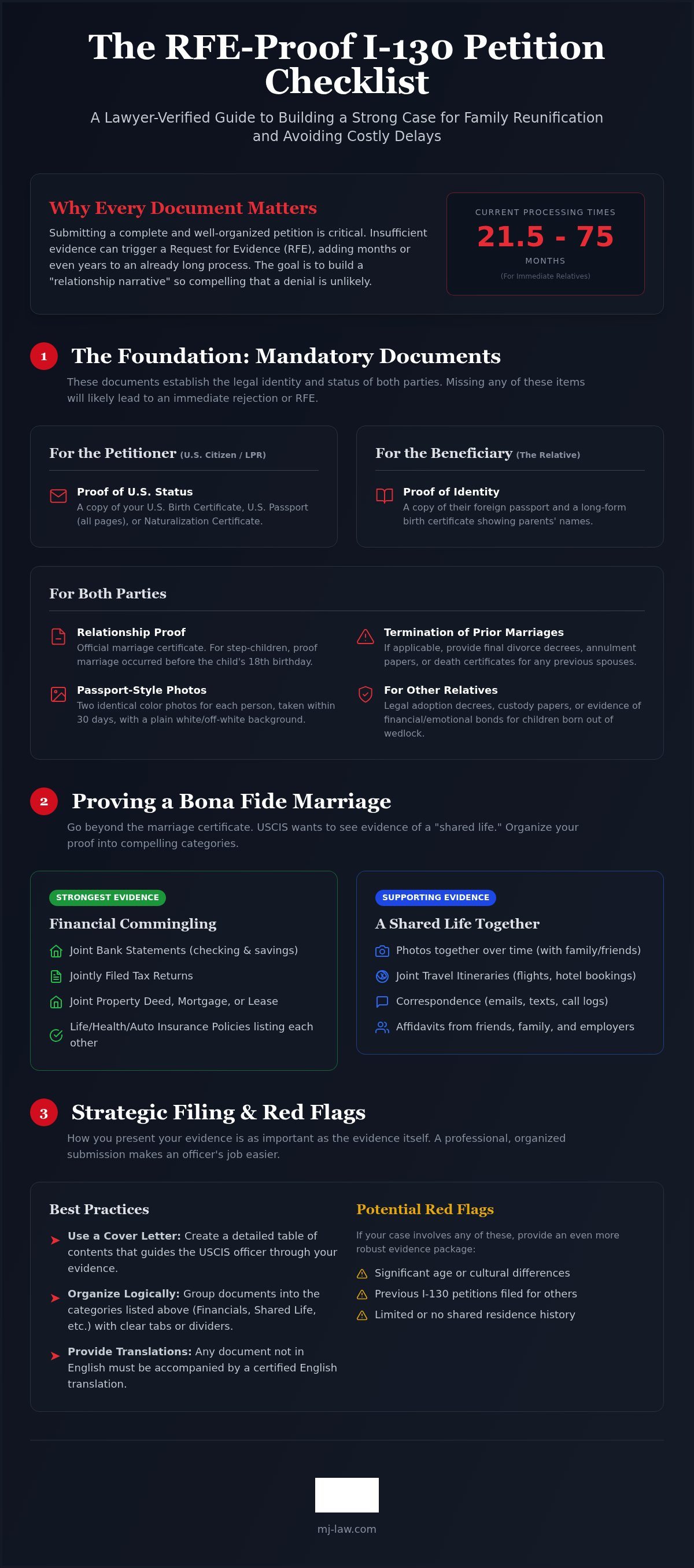
We understand that current processing times, which can range from 21.5 to 75 months for immediate relatives, create an environment of intense stress. You want to get this right the first time to avoid unnecessary setbacks or heart-wrenching separations. This article simplifies the complexities of Form I-130 by offering a clear, methodical path forward. We’ll explore the specific documents needed to prove a bona fide relationship, clarify the 2026 filing fee structures, and provide a printable checklist to ensure you submit a complete and professional petition that USCIS can approve.
Key Takeaways
- Understand the legal standard of “preponderance of the evidence” and how to build a relationship narrative that makes a denial unlikely.
- Access a detailed I-130 petition evidence checklist that covers everything from mandatory identity documents to sophisticated proof of financial commingling.
- Learn how to document a “shared life” beyond the marriage certificate by presenting joint bank statements, tax returns, and social evidence effectively.
- Master the art of strategic filing by using a professional cover letter to guide USCIS officers through your organized evidence categories.
- Recognize potential red flags, such as previous marriages or significant age gaps, that require a more robust evidence strategy to avoid a Request for Evidence.
Understanding the I-130 Petition and Why Evidence is Critical
Formally known as the Petition for Alien Relative, Form I-130 serves as the legal foundation for family reunification in the U.S. It’s the first official step a U.S. citizen or lawful permanent resident takes to help a family member obtain a green card. However, simply filing the form isn’t enough to guarantee a path forward. You must satisfy the “preponderance of the evidence” standard, which means you need to prove it’s more likely than not that your relationship is genuine. This is why preparing a thorough I-130 petition evidence checklist is your most valuable tool during the initial filing phase.
In San Jose, the local field office sees thousands of applications each year. A weak initial submission doesn’t just slow things down; it invites intense scrutiny. If your evidence is thin, you risk a “Notice of Intent to Deny” (NOID) or an outright denial, which can permanently impact your family’s ability to live together. Our firm has seen how a steady hand and meticulous documentation can transform a stressful process into a successful reunion.
Qualifying Relationships for I-130 Petitions
The amount and type of evidence you need often depends on the specific family category. Immediate relatives, which include spouses, parents, and unmarried children under 21 of U.S. citizens, generally face shorter wait times because visas are always available. In contrast, preference categories for siblings or adult children involve annual limits and significantly longer processing windows. Every relationship requires a different approach to documentation. A tailored I-130 petition evidence checklist for non-traditional family structures might include:
- Legal adoption decrees or finalized custody papers for adopted children.
- Marriage certificates showing the union occurred before a step-child turned 18.
- Proof of financial support and emotional bonds for children born out of wedlock.
The Consequences of Insufficient Evidence
Submitting an incomplete packet often triggers the “Request for Evidence” (RFE) cycle. This isn’t just a minor administrative hurdle. An RFE can add months or even years to an already lengthy processing time, which currently ranges from 21.5 to 75 months for many immediate relatives. If you receive one, you’ll likely need the help of a Marriage Green Card RFE Lawyer in San Jose to course-correct and provide the specific proof USCIS is demanding.
The ultimate risk is a denial. Once USCIS denies a petition based on lack of evidence, it creates a record that follows the beneficiary in future applications. It’s far more effective to build a “relationship narrative” from day one than to try and fix a broken case later. By organizing your documents logically, you present yourself as a detail-oriented and reliable petitioner, which helps the officer move toward a natural approval.
The Mandatory I-130 Petition Evidence Checklist
Building a successful case starts with establishing the legal identity and status of both parties. This foundation ensures the petitioner has the right to file and the beneficiary is eligible to receive the benefit. According to official USCIS I-130 Petition Information, you must provide clear, legible copies of primary identity documents. Without these, your petition will likely face immediate rejection. A complete I-130 petition evidence checklist begins with these non-negotiable items:
- Proof of Petitioner’s Status: A copy of your U.S. birth certificate, all pages of your U.S. passport, or your Naturalization Certificate.
- Beneficiary’s Identity: A copy of their foreign passport and a birth certificate.
- Legal Termination of Prior Marriages: If either spouse was married before, you must submit final divorce decrees, annulment papers, or death certificates.
- Passport-Style Photos: Two identical color photos of the petitioner and two of the beneficiary, taken within the last 30 days.
The photos must follow specific USCIS standards. They should have a plain white or off-white background and show a full-face, frontal view. If you’re feeling overwhelmed by the technicalities of these requirements, you might want to schedule a brief discussion to ensure your packet meets every standard.
Primary Civil Documents
Birth certificates should be the “long-form” version. This version is essential because it lists the names of both parents, which helps establish biological relationships for certain categories. Marriage certificates must come from a recognized government authority. A religious certificate from a church or mosque is often insufficient on its own unless it’s legally registered with the state.
Translation rules are incredibly strict. You cannot translate your own documents, even if you’re fluent in both languages. Every foreign language document must be accompanied by a full English translation that the translator has certified as complete and accurate. The translator must also certify that they are competent to translate from the foreign language into English.
Secondary Evidence for Missing Documents
Sometimes, primary documents aren’t available due to government records being destroyed or never created. If you can’t obtain a birth certificate, you must first get a “certificate of non-availability” from the relevant government agency in that country. Only then can you submit secondary evidence. Reliable secondary options include:
- Affidavits of Birth: Written statements by at least two people (typically older relatives) who have personal knowledge of the birth.
- Religious Records: Certificates of baptism or similar rites that occurred shortly after birth.
- School Records: Early childhood records that show the date of birth and parents’ names.
When using affidavits, the person signing must provide their full name, address, and details about how they know the facts. These statements carry more weight when they’re notarized and include a copy of the affiant’s own ID. This methodical approach to secondary evidence shows USCIS that you’ve done your due diligence, which helps maintain the momentum of your application.
Proving a Bona Fide Marriage: Beyond the Marriage Certificate
A marriage certificate proves a legal union, but USCIS officers are trained to look for a “shared life” that extends far beyond a piece of paper. This concept, known as a bona fide marriage, requires you to show that you didn’t enter the union solely for immigration benefits. To meet this standard, you must demonstrate financial and social commingling. Curating this part of your I-130 petition evidence checklist is often the most time-consuming step, yet it’s the most effective way to RFE-proof your application.
Officers look for “skin in the game.” They want to see that your lives are intertwined in ways that would be difficult or costly to fake. This includes sharing the same roof, combining your bank accounts, and naming each other as beneficiaries on important legal documents. When you present a narrative of a shared life, you move the conversation away from suspicion and toward a natural approval. LGBTQ+ couples pursuing a same-sex marriage green card San Jose residents can be proud of face the same bona fide marriage standard and benefit from the same evidence-building strategies outlined here.
Financial Commingling in Silicon Valley
For families in the San Jose area, your professional lives often provide unique opportunities for high-quality evidence. Beyond standard joint bank statements and credit card accounts, Silicon Valley tech workers can leverage employer-provided benefits. Joint Restricted Stock Unit (RSU) beneficiary designations or listing a spouse on a 401k plan are powerful indicators of a long-term commitment.
Health insurance enrollment records showing both spouses on the same plan are equally persuasive. However, the gold standard for USCIS remains joint tax filings. Submitting a “Married Filing Jointly” return from the IRS provides a high level of credibility that few other documents can match. If you haven’t yet combined these aspects of your life, you might consult with our team to discuss how to build a stronger financial profile before you file.
Social and Narrative Evidence
Social evidence helps humanize your case. While many couples think they need hundreds of photos, variety matters more than quantity. USCIS prefers seeing photos taken over a long period, in different locations, and with different people. A mix of wedding photos, quiet dinners at home, and outings with friends in the San Jose community tells a much more compelling story than fifty selfies taken in the same week.
Travel records add another layer of authenticity. Joint flight itineraries, hotel bookings, and even shared ride-share receipts demonstrate that you spend your leisure time together. If you have children together, their birth certificates are considered some of the strongest evidence of a bona fide relationship. For those without children, sworn affidavits from friends, family, or colleagues can fill the gap. These statements should be specific, detailing how the person knows you and describing observations of your relationship in daily life.
Finally, don’t overlook proof of a shared residence. Joint leases, mortgages, or even utility bills like water and electricity addressed to both of you at the same San Jose address provide the physical “anchor” your case needs. By grouping these documents logically, you create a roadmap that makes it easy for an officer to see the truth of your marriage. For couples who are not yet married and are navigating the fiancé visa process instead, working with a K-1 visa lawyer San Francisco families rely on can help you build an equally compelling case before you ever reach the I-130 stage.
Strategic Filing: Organizing and Preparing Your Evidence
How you present your documents is just as important as the documents themselves. An officer at the San Jose field office may review dozens of files in a single day; your goal is to make their job as easy as possible. A well-organized I-130 petition evidence checklist doesn’t just list items. It groups them into a logical narrative that leads the officer toward a natural approval. You should always start with a professional cover letter. This letter acts as a roadmap and a table of contents, clearly identifying the petitioner, the beneficiary, and the specific categories of evidence you’ve included.
In 2026, you must decide between digital and paper filing. USCIS strongly encourages online filing by offering a $50 discount; the online filing fee is currently $625, while paper filing costs $675. If you choose to file by mail, remember that as of October 28, 2025, USCIS no longer accepts checks or money orders for most paper filings. You’ll need to use electronic payment methods. Regardless of the method, always maintain a “shadow file.” This is an exact copy of everything you submitted. It’s essential for your future interview and provides a safety net if any documents are misplaced during processing.
Best Practices for Document Presentation
When preparing a paper filing, avoid using bulky binders or heavy clips. USCIS prefers that you use ACCO fasteners or simple rubber bands to keep documents together. Use “Exhibits” to label your evidence clearly. For example, you might label your financial documents as Exhibit A and your social evidence as Exhibit B. This level of precision shows that you are a detail-oriented petitioner. Ensure every foreign document has a certified English translation attached directly behind the original copy. If you’re unsure if your packet is truly “RFE-proof,” you can request a document review with our team to gain peace of mind.
Local Considerations for San Jose and San Francisco Filers
Living in Silicon Valley presents unique challenges for establishing a “shared residence.” Given the high cost of living, many couples in San Jose or San Francisco live with roommates or in non-traditional housing. If your name isn’t on a formal mortgage or lease, you can provide a sworn affidavit from your landlord or primary leaseholder. This statement should confirm that you and your spouse live together at the address.
The San Jose Field Office is familiar with these local housing nuances. However, you must be proactive in explaining them. Working with a Family Immigration Lawyer San Jose can help you frame these specific local factors in a way that satisfies USCIS requirements. By addressing these details early, you demonstrate a level of transparency that builds trust with the reviewing officer.
When to Consult an I-130 Attorney in San Jose
While following a standard I-130 petition evidence checklist provides a strong foundation, some situations require a deeper strategic layer. Immigration officers are trained to look for patterns, and certain facts can trigger immediate suspicion, even in a genuine marriage. When the stakes involve your family’s permanent reunification, professional oversight ensures your evidence isn’t just complete, but persuasive. A local expert can help you frame your story in a way that software or generic guides simply cannot.
Red Flags That Require Professional Review
Red flags don’t mean your case will be denied, but they do mean you’ll face higher scrutiny. Common issues include significant age differences between spouses, a very short courtship before marriage, or a history of previous marriages that ended shortly before the current union. If either party has faced prior marriage fraud allegations or visa denials, your initial filing must be exceptionally robust. Other red flags include:
- Inconsistencies in your address history or employment records across different government forms.
- A lack of traditional joint financial evidence, which is common in new marriages but requires alternative “soft” proof to be successful.
- Spouses who don’t share a common fluent language, which often prompts deeper questioning during interviews.
The most critical scenario involves filing while a beneficiary is in removal proceedings. In these cases, the legal burden of proof is significantly higher. You must provide “clear and convincing evidence” of a bona fide marriage rather than the standard “preponderance of the evidence.” Navigating this high-stakes environment without a steady hand can lead to devastating results for your family. Bay Area couples who began their journey on a K-1 fiancé visa and are now transitioning to a marriage-based green card may also benefit from reviewing the comprehensive 2026 fiancé visa guide for San Francisco to understand how their prior visa history affects the current filing.
Partnering with MJ Law for Your I-130 Petition
MJ Law has served the Silicon Valley community since 1985. With over three decades of experience, we understand the specific nuances of the San Jose and San Francisco USCIS landscape. We don’t just help you check boxes; we partner with you to build a methodical relationship narrative. Our team reviews your I-130 petition evidence checklist through the lens of a seasoned officer, identifying gaps before they become problems.
Our firm offers bilingual support in English and Spanish, ensuring that diverse families feel heard and understood throughout the process. Choosing a partner with local expertise provides peace of mind. You’ll know your file is organized for the maximum chance of approval, protecting your family from the stress of an RFE or a NOID. If you’re ready to move forward with confidence, schedule a consultation with MJ Law to review your evidence and finalize your strategy.
Securing Your Family’s Future with Confidence
Filing for family reunification is more than a legal requirement; it’s a profound life transition. We’ve explored how a meticulous I-130 petition evidence checklist serves as the foundation for a successful application. By moving beyond mandatory forms to present a compelling narrative of financial and social commingling, you significantly reduce the risk of heart-wrenching processing delays. Organizing your documents with the precision expected by the San Jose field office ensures that your case stands out for its clarity and completeness.
MJ Law offers over 30 years of Silicon Valley immigration experience. Our team provides bilingual English and Spanish representation, specializing in complex family reunification cases that require a steady, expert hand. You don’t have to face the stress of potential red flags or documentation gaps alone. You can Book a Consultation with MJ Law today to ensure your evidence is ready for submission. We’re here to act as your reliable anchor throughout this journey, helping you navigate every intricate procedure with professional precision. Your family belongs together, and we’re committed to helping you make that a reality.
Frequently Asked Questions
What is the most important evidence for an I-130 marriage petition?
The most important evidence is documentation showing financial commingling, specifically joint tax returns and bank statements. USCIS views these as the gold standard because they represent a high level of mutual trust and legal responsibility. When you follow a professional I-130 petition evidence checklist, you’ll see that naming your spouse as a beneficiary on life insurance or retirement accounts carries similar weight. These documents prove you are building a future together rather than just sharing an address.
Can I file an I-130 without a lawyer if my case is simple?
You can file an I-130 without a lawyer if your case is straightforward and you have no history of immigration issues. However, even “simple” cases can face delays if the initial filing is disorganized or thin on evidence. Many families choose to work with a firm like MJ Law to ensure their packet is RFE-proof from day one. Professional review is especially critical if you have non-traditional housing arrangements or complex financial records.
How many photos should I include in my I-130 evidence packet?
You should include approximately 10 to 20 high-quality photos that show your relationship progressing over time. Variety matters more than quantity; USCIS wants to see you with different groups of friends and family in various locations. Avoid submitting dozens of selfies taken at the same event. Instead, pick images from your wedding, holidays, and casual outings. This approach helps humanize your file and provides a clear visual narrative of your shared life together.
What happens if I cannot provide a birth certificate for the I-130?
If a birth certificate is unavailable, you must first obtain a formal certificate of non-availability from the government agency in your home country. Once you have this, you can submit secondary evidence such as religious records, school documents, or sworn affidavits from relatives. These affidavits should be written by individuals with personal knowledge of the birth. This multi-step process ensures USCIS accepts your alternative documentation without triggering an immediate and stressful Request for Evidence.
Does USCIS check social media for I-130 relationship evidence?
USCIS officers have the authority to review public social media profiles to verify the authenticity of a relationship. While it’s not a mandatory part of every review, inconsistencies between your filing and your digital presence can lead to suspicion. It’s important that your public posts don’t contradict the timeline or facts presented in your petition. Maintaining a private profile is fine, but ensure the information you’ve shared publicly aligns with your official and documented relationship narrative.
How long does it take for USCIS to review I-130 evidence in 2026?
As of August 2026, processing times for Form I-130 vary based on the petitioner’s status and the specific field office. For immediate relatives of U.S. citizens, the typical range is between 21.5 and 75 months. Because there is no premium processing option for this form, your best strategy is to submit a complete I-130 petition evidence checklist at the start. A perfect initial filing prevents the added delays caused by a preventable Request for Evidence.
Do I need to provide original documents or copies for the I-130?
You should submit clear, legible photocopies of your documents rather than the original versions. USCIS typically doesn’t return original documents sent by mail, so keeping your originals safe is vital for your records. You’ll need to bring the original birth certificates, marriage licenses, and divorce decrees to your green card interview for the officer to inspect. If you’re filing online, ensure your scans are high-resolution and every page of the document is readable.
What if my spouse and I don’t have a joint bank account yet?
If you don’t have a joint bank account yet, you can provide other strong evidence of a shared life. Focus on joint lease agreements, utility bills in both names, or health insurance policies that list both spouses. You can also include proof of shared travel or naming each other as emergency contacts at work. These items demonstrate financial and social ties that are just as valid as a bank statement when organized correctly within your evidence packet.