Federal law creates an invisible, ironclad wall between your immigration application and the person who harmed you. If you are living in fear that filing for legal status will alert an abusive spouse or family member, you aren’t alone. It is a heavy burden to carry, and the fear of violent retaliation often feels like a permanent barrier to your freedom. However, the VAWA confidentiality rules established under 8 U.S.C. § 1367 are designed specifically to ensure that USCIS never discloses your information to your abuser. You don’t have to choose between your safety and your legal journey.
In this guide, you’ll discover how these federal statutes safeguard your privacy and prevent your personal data from being weaponized against you. We will break down the December 2025 USCIS policy updates so you understand exactly how your journey is protected in 2026. You will also receive a concrete checklist to manage official correspondence safely, ensuring no mail ever reaches a shared marital address. By understanding these protections, you can move forward with the confidence that the law is acting as your advocate, providing a steady hand as you seek the stability you deserve.
Key Takeaways
- Understand how 8 U.S.C. § 1367 acts as a federal shield, legally prohibiting government officials from disclosing your petition to unauthorized parties.
- Learn how VAWA confidentiality rules prevent federal agencies from sharing your data or contacting the abusive relative during the adjudication process.
- Discover the statutory protections that stop immigration authorities from using malicious tips or false accusations from an abuser to negatively impact your case.
- Access a practical checklist for safeguarding your filing, including instructions for establishing a secure mailing address to prevent discovery at home.
- Explore how seasoned legal counsel acts as a protective buffer, managing all government communication to ensure your immigration journey remains confidential.
Understanding VAWA Confidentiality Rules: 8 U.S.C. § 1367 Explained
When you file for immigration relief as a survivor of abuse, your physical safety often hinges on absolute privacy. The foundational protection for your case is found in 8 U.S.C. Section 1367. This federal statute codifies the VAWA confidentiality rules, ensuring that government officials cannot disclose the existence of your petition to anyone outside of authorized federal channels. It isn’t just an administrative courtesy; it’s a strict legal right. The law recognizes that for many, the act of seeking help is a significant risk. By prohibiting the release of information, the statute creates a secure environment where you can pursue status without fear of your abuser being tipped off by the very agencies meant to process your application.
The Core Purpose of Statutory Non-Disclosure Protections
These protections serve a vital role in dismantling the power dynamics inherent in abusive relationships. Often, an abuser uses a partner’s lack of legal status as a tool for coercive control, threatening deportation to ensure silence. Section 1367 breaks this cycle. It encourages survivors to report harm and seek a Violence Against Women Act (VAWA) self-petition by removing the threat of government-sanctioned exposure. These rules also extend to minor children and dependent parents who are included in the filing. Simply put, 8 U.S.C. § 1367 serves as a statutory shield that prioritizes survivor safety over an abuser’s desire for information or control.
Which Government Agencies Must Comply with Privacy Rules?
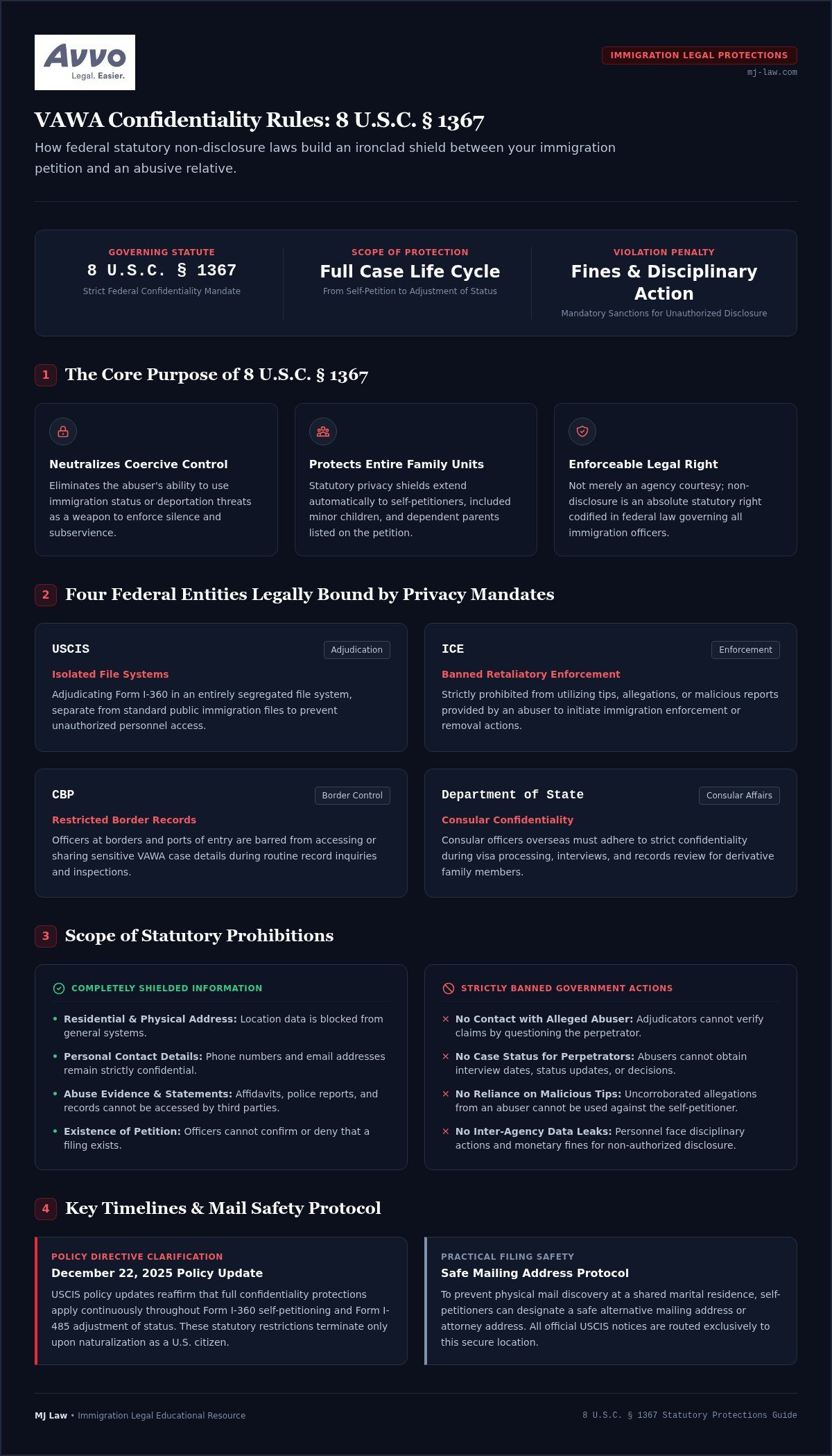
The mandate for silence isn’t limited to a single office. Multiple branches of the Department of Homeland Security and the Department of State are bound by these privacy requirements:
- USCIS: The agency adjudicating Form I-360 must keep all records in a protected file system, separate from standard immigration files.
- ICE: Agents are prohibited from using information from an abuser to initiate enforcement or removal proceedings against a petitioner.
- CBP: Officers at borders and ports of entry cannot access or share sensitive VAWA data during routine inspections or record inquiries.
- Department of State: Consular officers must maintain strict confidentiality when reviewing records for overseas processing or visa interviews.
The law carries heavy consequences for those who violate these boundaries. Unauthorized disclosure can lead to severe disciplinary actions for federal employees and civil monetary fines. While a December 22, 2025, policy update clarified that these protections terminate upon naturalization, they remain absolute throughout the entire self-petition and adjustment of status process. You aren’t just asking for privacy; you’re exercising a federally protected right that keeps your location and legal journey hidden from those who intend to cause you harm. This legal buffer allows you to focus on your future while the government handles your case in a secure, confidential environment.
Prohibited Information Sharing: What DHS and USCIS Cannot Disclose
Federal agencies operate under strict mandates regarding the data they collect during your self-petition. Under the USCIS VAWA Confidentiality Protections, specific categories of personal data are shielded entirely from outside inquiry. This protection covers your residential address, contact details, and the evidence you provide regarding the abuse. Adjudicators are legally barred from confirming the existence of a case to anyone who isn’t authorized. Non-authorized government personnel and third parties cannot access these databases. The system is intentionally siloed to ensure that your private information doesn’t leak into general immigration files.
Strict Bans on Contacting the Alleged Abuser
In standard marriage-based green card cases, USCIS might contact a spouse to verify details. In a VAWA case, this is strictly prohibited. Adjudicators cannot verify marriage or relationship claims by questioning the perpetrator. They also don’t confirm whether an application has been lodged or denied. This means your abuser cannot call USCIS to request case updates, status reports, or check for scheduled interview notices. The agency staff is trained to provide no information, protecting you from the risk of discovery. These VAWA confidentiality rules serve as a firewall, ensuring that the person who caused the harm has no way to track your legal progress.
Exemption from Public Records and FOIA Requests
Transparency laws like the Freedom of Information Act (FOIA) generally allow the public to request government records, but VAWA files are a major exception. Self-petition documents are exempt from standard public release under specific federal exemptions. If an abuser tries to request your Alien Registration Number or your physical address through a FOIA request, their inquiry will be rejected. Even state court subpoenas, often used in contentious divorce proceedings, cannot compel the federal government to release a protected VAWA file. This federal supremacy ensures that your safety isn’t compromised by local legal maneuvers. If you’re worried about how to start this journey securely, you can schedule a confidential consultation with our San Jose team to discuss your options in English or Spanish.
Abuser Retaliation: How the Law Blocks Malicious Tips and False Accusations
A common tactic in abusive relationships involves the threat of “calling immigration” to trigger a deportation. This form of coercive control relies on the victim’s fear of the system. Fortunately, VAWA confidentiality rules provide a robust defense against these malicious actions. Under 8 U.S.C. § 1367, the government is generally prohibited from making adverse determinations about your admissibility or deportability based solely on information provided by your abuser. This means a vengeful phone call or a letter full of false accusations cannot be the single reason you are removed from the country.
If you are facing these threats, consulting a VAWA Lawyer San Jose can help you document the retaliation and strengthen your case. An experienced advocate ensures that any negative information introduced by a prohibited source is properly challenged and countered with credible evidence. Having a steady legal hand to manage these interactions prevents an abuser from gaining a foothold in your immigration process.
The Prohibition on Adverse Determinations Using Abuser Evidence
Statutory protections require USCIS officers to exercise extreme caution when they receive unsolicited “tips” about a self-petitioner. Officers are trained to screen incoming correspondence to identify if the source is an angry spouse or a family member with a motive to cause harm. When unsubstantiated allegations of marriage fraud arrive, the agency doesn’t take them at face value. Instead, they apply strict corroboration standards. The evidentiary bar is set high to shield you from malicious reporting; an officer must find independent, credible evidence before they can use an abuser’s tip to negatively impact your legal standing. While a December 2025 policy update allows for more discretion in how this information is used during the initial I-360 review, it remains a prohibited source for final decisions on your right to remain in the United States.
Enforcement Protections at Sensitive Locations
Safety extends beyond the paperwork and into the physical world. Federal policy restricts immigration enforcement actions at “sensitive locations” to ensure survivors can seek help without the threat of arrest. These protected areas include:
- Domestic violence shelters and community centers offering victim services.
- Counseling centers and medical facilities providing trauma care.
- Courthouses and family law facilities where you might be seeking a restraining order.
If an enforcement action is ever considered at one of these sites, it requires mandatory, high-level supervisory certifications. These rules exist to ensure that the person who harmed you cannot use the legal system or public spaces as a trap. The law prioritizes your ability to seek safety and legal relief over an abuser’s attempt to weaponize your immigration status. By maintaining these boundaries, the legal system creates a safe path for you to transition from a state of fear to one of legal security.
Practical Safety Checklist: Safeguarding Your Self-Petition from Discovery
Filing an immigration petition securely requires proactive planning alongside the legal protections provided by federal law. While the VAWA confidentiality rules legally bind government agencies to secrecy, you must still take practical steps to secure your personal environment. This checklist provides actionable guidance to ensure your paperwork and communications remain entirely hidden from an abuser, minimizing the risk of accidental discovery at home.
Designating a Secure Alternate Mailing Address
The most critical step in protecting your privacy is controlling where physical mail arrives. On Form I-360, you have the right to designate an alternate safe mailing address, such as your attorney’s office or a trusted friend’s PO Box. Never list your marital residence if the abuser still maintains physical access to the mailbox. Once this safe address is established, USCIS will send all official notices, receipt numbers, and work authorization cards exclusively to that secure location. This adjustment completely removes the risk of an abuser intercepting a government envelope in the daily mail.
Digital Privacy and Secure Communication Habits
Modern surveillance requires careful digital hygiene when researching legal resources or emailing counsel. To maintain a secure communication channel, implement the following habits:
- Establish a brand-new, private email account using a clean, unmonitored device.
- Avoid using shared household Wi-Fi networks or family cellular accounts for making legal calls or checking case updates.
- Disable location sharing, cloud backup photo syncing, and auto-fill passwords on your personal smartphones and tablets.
Gathering Case Documentation Safely
Amassing the necessary evidence for a self-petition must be done quietly. Collect primary documents like marriage certificates, birth records, and financial statements gradually, without confronting your partner or raising suspicion. Store electronic copies of these items on encrypted cloud drives completely outside of any domestic computers. If primary records remain trapped inside a residence and are unsafe to retrieve, don’t panic. You can seek guidance on utilizing secondary evidence, such as detailed affidavits and witness statements, to satisfy the evidentiary requirements. Secure legal representation ensures that your physical mail is buffered completely through a law firm, keeping your home life uninterrupted. If you need a trusted advocate to manage your filing securely, reach out to MJ Law today to establish a private communication plan.
Navigating Your VAWA Petition with Experienced San Jose Legal Representation
While federal statutes provide the legal framework for your protection, navigating the practical application of these laws requires a dedicated advocate. An attorney serves as your primary point of contact, ensuring that the VAWA confidentiality rules are strictly respected by every agency official involved in your case. This level of professional protection is especially vital when dealing with complex family immigration representation, where the lines between marital evidence and survivor safety can sometimes blur. Having a seasoned professional at your side ensures that the system works for you, not against you.
How Legal Representation Creates an Added Safety Barrier
When you retain a firm, you sign Form G-28, which officially notifies USCIS that you have legal counsel. This document ensures that all official correspondence, including sensitive Requests for Evidence (RFEs), is sent directly to your attorney’s office rather than your residential address. Your advocate manages all inquiries from USCIS officers and handles field office interviews, allowing you to remain one step removed from the government bureaucracy. If an agency staff member mistakenly asks for documentation that requires contacting the abuser, your lawyer can immediately intervene to remind the official of their statutory obligations under Section 1367. We also specialize in preparing robust responses if USCIS issues difficult evidence requests, ensuring that your privacy is maintained while satisfying the legal requirements for your self-petition.
Taking the First Confidential Step in Silicon Valley
Seeking help is a significant step toward reclaiming your life. At MJ Law, we draw on over 30 years of legal experience to guide survivors in Northern California through these intricate procedures. Whether you prefer to communicate in English or Spanish, our bilingual team ensures you understand every nuance of the law without needing outside translators who might compromise your privacy. Consultations remain protected by strict attorney-client privilege from the moment you reach out, regardless of whether you eventually retain our services. This professional boundary means you can speak freely about your situation, knowing your information is held in the strictest confidence. We understand the unique challenges faced by Silicon Valley communities and provide the steady, compassionate guidance needed to navigate these transitions safely.
You don’t have to face the immigration system alone while managing the weight of your personal safety. Taking control of your future starts with a secure, private conversation. If you’re ready to discuss your case in a protected environment, schedule a discreet consultation with our San Jose team. We’re here to provide the reassuring expertise and authoritative representation you need to move forward with confidence.
Securing Your Path to Safety and Legal Status
Navigating the immigration system while managing personal safety is a profound challenge, but you don’t have to do it alone. The federal VAWA confidentiality rules ensure that your journey toward a green card remains private, protecting you from the risk of abuser retaliation or government data leaks. By utilizing statutory non-disclosure protections and establishing secure communication channels, you can seek the relief you deserve without compromising your physical security.
MJ Law has spent over 30 years assisting Northern California families with complex immigration relief. Our team provides bilingual legal guidance in both English and Spanish to Silicon Valley communities, ensuring every client understands their rights with complete clarity. We have a proven record of structuring confidential filings and managing alternate address protections to keep our clients safe from discovery. Your future shouldn’t be defined by fear, and the law provides the tools to help you transition to a stable, lawful life in the United States. If you’re ready to take the next step, schedule a confidential consultation to protect your future. We’re here to serve as your steady, professional anchor throughout this process.
Frequently Asked Questions
Can USCIS contact my abusive spouse to verify our marriage?
USCIS is legally prohibited from contacting your abusive spouse or any qualifying relative to verify the details of your marriage or the abuse you suffered. Under federal law, adjudicators must rely on the evidence you provide and are barred from reaching out to the perpetrator for any reason. This ensures your abuser remains unaware of your filing, preventing them from using the immigration process as a tool for further harassment or coercive control.
What happens if my abuser files a false complaint with immigration?
If an abuser submits a malicious tip or false accusation to trigger your deportation, the VAWA confidentiality rules require USCIS to treat that information with extreme skepticism. Officers are trained to identify retaliatory reports from prohibited sources. Federal law generally prevents immigration authorities from making adverse decisions about your case based solely on information provided by the person who harmed you, requiring them to find independent, corroborating evidence before taking any negative action.
Where will USCIS send receipt notices and biometric appointment letters?
USCIS will send all official correspondence, including receipt notices and biometric appointment letters, to the safe mailing address you designate on your Form I-360. If you have legal representation in San Jose, these documents are typically sent directly to your attorney office. This protocol ensures that sensitive government mail never arrives at a shared residence where an abuser could intercept it, keeping your legal journey entirely private and secure from discovery.
Can an abusive partner access my VAWA case records through FOIA?
An abusive partner cannot access your records through the Freedom of Information Act (FOIA). Federal law specifically exempts VAWA self-petitions and related files from public disclosure to protect survivor safety. Even if an abuser attempts to use a state court subpoena during a divorce or custody battle, federal authorities will generally refuse to release the protected file. Your personal data and the details of your application remain shielded from anyone not authorized by law.
What are the penalties if an immigration officer violates Section 1367?
Immigration officers who willfully violate Section 1367 face serious consequences, including internal disciplinary action and civil monetary penalties. The law allows for fines of up to $5,000 for each unauthorized disclosure of a petitioner’s information. These strict penalties reflect the government’s commitment to maintaining the integrity of the VAWA confidentiality rules. Federal employees are regularly trained on these privacy mandates to ensure that survivor data is handled with the highest level of security.
Can I apply for VAWA confidentiality protection if I already divorced my abuser?
You can still benefit from confidentiality protections even if you are already divorced, provided you file your self-petition within two years of the divorce and can demonstrate that the abuse was a central reason for the marriage’s end. The statutory shield applies to all VAWA self-petitioners regardless of their current marital status. As long as your case is pending or active, the government is bound by the same non-disclosure requirements that protect married petitioners.
Does hiring an immigration lawyer in San Jose help protect my confidentiality?
Hiring an experienced immigration lawyer in San Jose provides an essential layer of security for your case. Your attorney acts as a formal buffer, managing all communication with USCIS and ensuring that no notices are sent to an unsafe location. At MJ Law, we use our 30 years of experience to structure your filing with maximum privacy. We provide bilingual support in English and Spanish, allowing you to discuss your case securely within the protection of attorney-client privilege.