What if a law enforcement certification is only one part of a U visa case, not a decision that you’ll receive one? If you’re searching for a U Visa lawyer San Francisco, it’s understandable to have questions about whether the crime and your circumstances qualify, what contacting authorities may involve, and how sensitive information will be handled.
U visa eligibility and law enforcement certification are connected, but they serve different purposes. A certification addresses your helpfulness in an investigation or prosecution. USCIS makes the immigration decision after reviewing the petition and supporting evidence. Neither a police report nor a signed certification alone guarantees approval.
This article explains the main eligibility elements, what certification does and doesn’t establish, and how evidence may support a petition. It also outlines practical steps to consider before approaching a certifying agency in the San Francisco area. A legal consultation can be an opportunity to discuss your individual facts and possible next steps without assuming that you qualify or that a particular outcome is assured.
Key Takeaways
- Assess the full eligibility picture rather than assuming a crime or personal circumstance automatically qualifies.
- A signed Form I-918, Supplement B supports a U visa petition, but it doesn’t grant immigration status or guarantee USCIS approval.
- Organized records and a clear timeline can help explain the case. What’s relevant depends on the individual facts.
- Before contacting an agency in San Francisco, consider your immediate safety and seek guidance about which agency may be appropriate.
- A U Visa lawyer San Francisco search can be a starting point for discussing eligibility, certification, evidence, and possible next steps.
What Is a U Visa, and Who May Qualify in the San Francisco Area?
U nonimmigrant status is a form of temporary immigration status for certain people who have been victims of qualifying criminal activity in the United States and meet specific legal requirements. It isn’t a general visa for anyone who has experienced harm. The U visa overview provides background, but USCIS rules and current filing guidance control how an individual petition is assessed.
Experiencing a crime can raise difficult questions about safety, privacy, and immigration status. Those concerns deserve careful attention. A person’s options depend on the circumstances, and no single path applies to every case.
What are the basic U visa eligibility requirements?
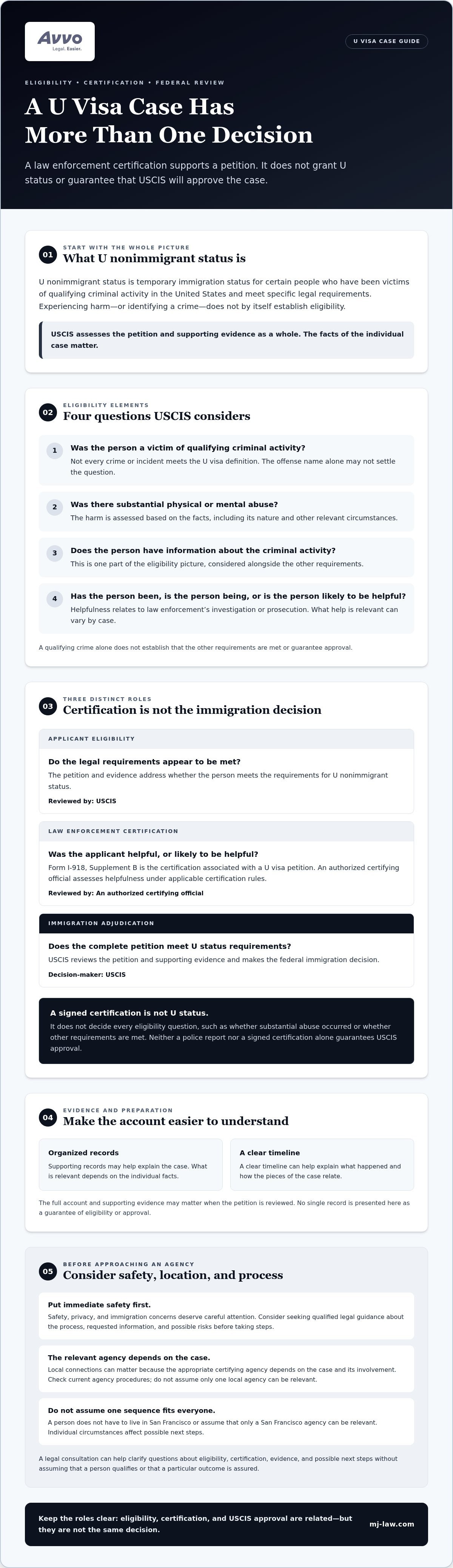
USCIS evaluates several elements together. In general, a petitioner must show that they:
- Were a victim of criminal activity that qualifies under U visa law. Not every crime or incident meets the definition, and the name used for an offense alone may not settle the question.
- Suffered substantial physical or mental abuse as a result of the qualifying activity. This is assessed based on the facts, including the nature of the harm and other relevant circumstances.
- Have information about the criminal activity.
- Were helpful, are being helpful, or are likely to be helpful to law enforcement in the investigation or prosecution. What help is relevant can vary with the case.
A qualifying crime is only one part of the analysis. It doesn’t establish that the other requirements are met or guarantee that USCIS will approve a petition. Supporting records and the full account of what happened may matter when the case is reviewed.
Questions about contacting authorities or sharing sensitive details are understandable. Before taking steps, a person can seek qualified legal guidance about the process, information that may be requested, and possible risks. Don’t assume every matter requires the same contact or sequence of actions.
Why does location matter for a San Francisco applicant?
Local connections can matter when seeking a law enforcement certification because the appropriate certifying agency depends on the case and its involvement. Certification is separate from the immigration decision: the agency’s role is not to grant U status, and USCIS adjudicates the petition. An applicant doesn’t have to live in San Francisco or assume that only one local agency can be relevant. Check current agency procedures before making a request.
A U Visa lawyer San Francisco search may help someone identify questions to discuss about location, certification, and individual circumstances. MJ Law is based in San Jose and serves the broader local community, but it does not have a San Francisco office. A consultation can help clarify possible next steps without promising eligibility or an outcome.
U Visa Eligibility and Law Enforcement Certification Are Separate Parts of the Case
A U visa petition involves related but distinct questions: whether the applicant meets the immigration requirements, whether an authorized official will certify the applicant’s helpfulness, and whether USCIS approves the petition. Keeping these roles separate helps avoid a common misunderstanding: a signed certification is not the same as U status.
| Part of the case | What it addresses | Who evaluates it |
|---|---|---|
| Applicant eligibility | Whether the person meets the legal requirements for U nonimmigrant status, supported by the petition and evidence. | USCIS reviews eligibility as part of the petition. |
| Law enforcement certification | Whether the applicant has been, is being, or is likely to be helpful in the investigation or prosecution, under applicable certification rules. | An authorized certifying official. |
| Immigration adjudication | Whether the complete petition meets the requirements for U nonimmigrant status. | USCIS makes the federal immigration decision. |
What does Form I-918 Supplement B establish?
Form I-918, Supplement B is the law enforcement certification associated with a U visa petition. An authorized official assesses the applicant’s helpfulness in connection with the criminal activity, as applicable under certification rules. The certification does not decide every eligibility question, such as whether the applicant experienced substantial abuse or meets other requirements. The USCIS explanation of U Nonimmigrant Status eligibility describes the federal requirements and relevant forms.
A certifying official’s signature supports the petition, but it doesn’t award immigration status. Applicants also shouldn’t assume that a particular agency must sign in every case. The appropriate official can depend on the circumstances and the agency’s involvement.
Who makes the final U visa decision?
USCIS adjudicates the immigration petition by reviewing the application and supporting evidence. Certification is one part of the process, not an immigration approval. A signed Supplement B doesn’t guarantee that USCIS will find the full case eligible or approve it.
For someone searching for a U Visa lawyer San Francisco, understanding these separate roles can help focus questions about the case: what the certification addresses, what other evidence may be needed, and what USCIS must assess. A legal consultation can provide an opportunity to discuss individual facts and possible next steps. You can schedule a conversation about immigration questions without treating certification or approval as assured.
What Evidence Can Help Explain a U Visa Case?
There isn’t one document checklist that fits every U visa case. Records may help explain what happened, the harm involved, and a person’s interactions with authorities, but a particular document doesn’t establish eligibility by itself. USCIS’s information on U Nonimmigrant Status describes the petition and supporting materials. Which evidence is relevant depends on the individual facts.
A lawyer reviewing a potential case may use available documents and a clear account of events to identify what is known, what may need clarification, and which questions to address. You don’t need to gather everything before seeking guidance. Protect your safety first, and don’t take risks to obtain records or contact someone who may pose a threat.
Which documents might an applicant discuss with counsel?
Depending on the circumstances, a person may discuss available incident or police records, court documents, and medical records related to the reported harm. A personal statement, messages, photographs, or other supporting materials may also be relevant for counsel to assess. These are examples, not required items or a guarantee that a petition will qualify.
Keep existing records intact. Don’t alter, discard, or fabricate documents, and preserve originals when it’s safe to do so. If records are difficult to access, incomplete, or contain sensitive details, note that for discussion rather than trying to obtain them in a way that could create risk. Before sharing private materials, ask how they can be provided and handled securely.
How can a clear case timeline support review?
A simple timeline can make a complicated history easier to discuss. When safe and manageable, note known or approximate dates for the incident, agency interactions, court events, and assistance provided in an investigation or prosecution. Include what you remember without filling gaps with guesses.
If dates differ across records or parts of your recollection are unclear, flag those points for review. Don’t try to make accounts appear consistent by changing details. Organize evidence around the eligibility questions rather than collecting it indiscriminately.
For someone consulting a U Visa lawyer San Francisco, an organized summary can make an initial conversation more focused. It can also help identify records worth discussing, while leaving legal relevance and next steps for careful review. Handle sensitive information thoughtfully, and remember that no single piece of evidence guarantees a result.
How to Explore U Visa Certification in San Francisco Safely
Considering a certification request can feel sensitive, particularly if you’re concerned about safety, privacy, or your immigration situation. You don’t need to approach an agency before understanding your options. A careful first step is to prioritize immediate safety, organize what you already know, and seek qualified immigration guidance about possible next steps.
There’s no single sequence that fits every case. If there’s an urgent safety concern, focus on reaching appropriate emergency or support services rather than collecting documents or pursuing a certification. Otherwise, keep notes and records somewhere you consider secure, and avoid sharing sensitive information with people or through channels you don’t trust.
How should a reader identify a possible certifying agency?
The appropriate certifying agency depends on the facts and which authority had relevant involvement in the investigation or prosecution. Don’t assume the agency closest to where you live, or the first agency you contact, is necessarily the right one. Confirm which official may consider a certification request and what process applies to your case.
Local practices can differ and may change. Check current information through official agency channels or ask qualified counsel to help clarify where to direct questions. Before contacting an agency, consider what information it may request and whether you have privacy or safety concerns. Avoid relying on old instructions or informal advice instead of current, case-specific guidance.
What should someone prepare before seeking legal guidance?
A short private summary can make a conversation more focused. If it’s safe, note what happened in broad terms, any agencies or authorities involved, and assistance you may have provided. Add questions you want answered, such as how certification differs from USCIS review or which local process may apply. Mark uncertain details as uncertain rather than trying to fill gaps.
Bring only records you can access safely. Available incident or court documents, for example, may be useful to discuss, but don’t delay urgent safety support to collect paperwork. You also don’t need to contact an alleged offender or take a risk to obtain additional evidence.
For someone searching for a U Visa lawyer San Francisco, an initial consultation can be a chance to discuss individual facts, privacy concerns, and potential next steps without assuming eligibility or a particular outcome. MJ Law is based in San Jose and offers consultations in English and Spanish. A consultation does not guarantee case acceptance or certification. Schedule an immigration consultation to discuss your questions.
When Can a U Visa Lawyer San Francisco Help Clarify Your Options?
A legal consultation may be useful when you want to consider eligibility, certification questions, available evidence, and possible procedural risks together. Reviewing these issues can help identify what is clear, what needs more information, and what questions to ask before taking another step. It’s an opportunity to discuss your individual facts, not a prediction of the result.
Be cautious of anyone who suggests that hiring a lawyer can force an agency to sign a certification or guarantee USCIS approval. A lawyer can help you understand the process and consider how your circumstances may fit the requirements, but certifying officials and USCIS make their own decisions.
What questions can a consultation help answer?
You might ask which eligibility elements appear relevant to your circumstances and which facts or records may need closer review. If certification is a concern, ask which agency may be relevant based on the case and how to verify its current procedure through official information. You can also discuss potential next steps and risks or uncertainties that deserve attention.
Bring a short list of questions and, if you can do so safely, a brief summary of the situation. You don’t need to have every document or detail resolved before asking for guidance. A careful discussion can help distinguish known facts from unanswered questions without assuming that a particular route is available.
How can readers take a measured next step?
Choose a private, secure way to communicate about sensitive information. Before sending documents or describing personal details, ask how to share them appropriately. If you’re more comfortable speaking in Spanish or prefer English, MJ Law offers consultations in both languages.
MJ Law is an immigration firm based in San Jose that serves clients across the region; it does not have a San Francisco office. If you’re searching for a U Visa lawyer San Francisco, a consultation can provide an opportunity to discuss your questions and possible next steps without promising that the firm will accept a matter or that certification or approval will follow. Schedule an immigration consultation.
Take a Careful Next Step
A U visa case involves more than identifying a qualifying crime. The applicant’s circumstances and supporting evidence matter, while law enforcement certification and USCIS adjudication serve different roles. Understanding that distinction can help you ask focused questions and avoid assuming that any single document or decision guarantees an outcome.
If you’re considering speaking with a U Visa lawyer San Francisco, use the conversation to discuss your individual facts, questions about certification, and concerns about sharing sensitive information. MJ Law is based in San Jose and serves the broader region. The firm has assisted clients with immigration matters for over three decades, and consultations are available in English and Spanish.
A consultation is an opportunity to explore possible next steps, not a promise of eligibility, certification, or approval. Schedule an immigration consultation to discuss your questions. Taking time to understand your options is a meaningful step forward.
Frequently Asked Questions
Who qualifies for a U visa?
A person may qualify if they were a victim of criminal activity covered by U visa law, suffered substantial physical or mental abuse, have information about the activity, and were, are, or are likely to be helpful to authorities investigating or prosecuting it. They must also meet other applicable requirements. These elements are assessed together, so experiencing a crime alone doesn’t establish eligibility or guarantee approval.
Does a law enforcement certification guarantee U visa approval?
No. Form I-918, Supplement B documents an authorized official’s certification of the applicant’s helpfulness under applicable rules. It supports the petition but doesn’t grant immigration status or establish every eligibility requirement. USCIS reviews the full petition and supporting evidence and makes the immigration decision. A signed certification is an important part of the process, not a promise that the petition will be approved.
Can I apply for a U visa if I did not report the crime immediately?
A delay in reporting doesn’t automatically answer whether you may qualify. U visa eligibility includes helpfulness to authorities, and the relevant facts can vary, including whether you later provided information or assistance. A certifying official evaluates the certification request under applicable rules, while USCIS reviews the petition. If you’re concerned about the delay, explain what you remember to qualified counsel rather than guessing or changing details.
What crimes qualify for a U visa?
U visa law covers specified criminal activity, including examples such as domestic violence, sexual assault, trafficking, kidnapping, and felonious assault, as well as certain related or similar activity. This isn’t a complete list, and the label used in a police or court record may not settle whether the activity qualifies. USCIS considers the legal requirements and circumstances. A crime alone doesn’t establish that the other U visa criteria are met.
How do I get U visa certification in San Francisco?
Start by determining which agency or authorized official had relevant involvement in the investigation or prosecution. The appropriate certifier and request process depend on the case, and local procedures can change. Check current instructions through official San Francisco area agency channels or consult qualified immigration counsel before submitting sensitive information. A U Visa lawyer San Francisco search can help you identify questions to ask, but no lawyer can compel an official to certify a case.
Can a U visa applicant include family members?
Some U visa petitioners may be able to seek derivative status for eligible family members, but who may qualify depends on the principal applicant’s age and the family relationship. A spouse or child may be eligible in some circumstances, but don’t assume every relative can be included. USCIS requirements and filing instructions apply to derivative petitions, so confirm current rules and discuss family circumstances with qualified counsel.
Should I speak with a U visa lawyer before contacting a certifying agency?
Speaking with qualified counsel first may help you understand which agency could be relevant, what its current process is, and how to raise privacy or safety concerns. It isn’t a requirement to consult a lawyer before contacting an agency, and legal guidance can’t guarantee certification or USCIS approval. MJ Law is based in San Jose, serves the broader region, and offers consultations in English and Spanish to discuss individual facts and possible next steps.