
Canadian and Mexican citizens may qualify for TN status when they have prearranged professional employment in the United States in an eligible occupation. A TN visa lawyer in San Jose can help assess whether your citizenship, profession, qualifications, and job fit those requirements. According to U.S. Citizenship and Immigration Services, qualified applicants may be admitted in TN status for up to 3 years.
It’s understandable to focus first on whether your profession appears on the approved list. Your education, the U.S. position’s duties, and the application route matter too, and the process differs for Canadian and Mexican citizens.
This article covers the main eligibility criteria, how TN status extensions work, and how TN employment compares with other employment-based options. It also explains what to consider when planning an initial application or reviewing longer-term work plans.
Key Takeaways
- Assess whether your citizenship, profession, qualifications, and arranged U.S. job align with TN eligibility requirements.
- Understand how the application route differs for Canadian and Mexican citizens.
- Learn what to consider when planning TN status extensions and maintaining authorized employment.
- Compare TN status with other employment-based immigration options to clarify your longer-term work plans.
- See how immigration legal assistance can help organize your case and evaluate the next steps.
Am I Eligible for the TN Visa?
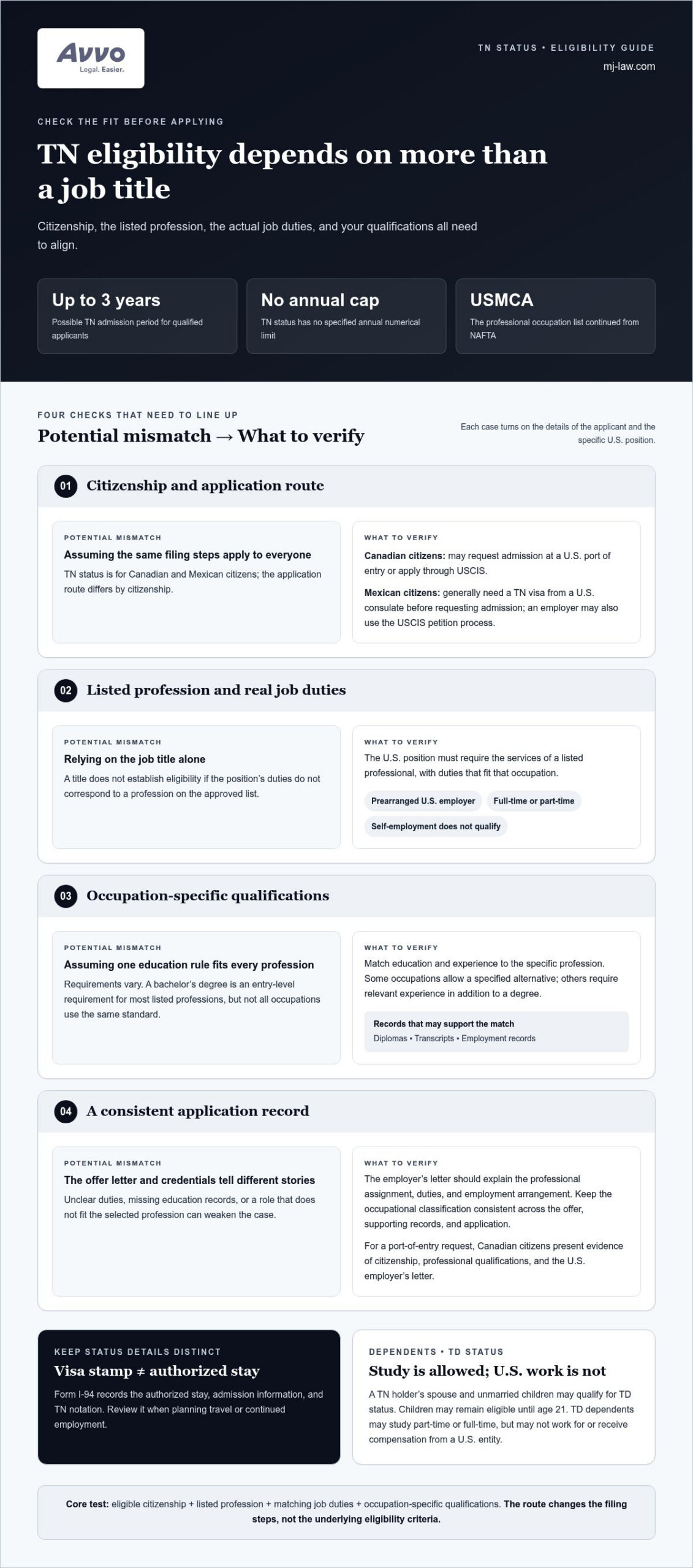
TN status may fit Canadian and Mexican citizens with prearranged professional employment in the United States. Eligibility depends on citizenship, the occupation, the job’s professional requirements, and the applicant’s qualifications. Qualified Canadian and Mexican citizens may be admitted to the United States in TN status for up to 3 years, according to U.S. Citizenship and Immigration Services.
The North American Free Trade Agreement (NAFTA) established the professional occupation list used for TN eligibility. NAFTA was renegotiated as the United States-Mexico-Canada Agreement (USMCA) in 2018, and the change did not alter TN eligibility requirements. A job title alone does not establish eligibility; the position and the applicant’s credentials must match the listed profession.
Which occupations qualify for a TN visa under USMCA? Eligible professions are listed among the professional occupations established under NAFTA and continued under USMCA. Lawyers are one example, but the specific role and required qualifications still matter.
Education requirements depend on the occupation. Some professions require a bachelor’s degree, while others may allow a specified alternative or require additional experience. If you are relying on a degree, connect it to the profession and the duties in the U.S. employer’s offer. Diplomas, transcripts, and other relevant records can help show that you meet the occupation’s requirements.
Canadian citizens may request TN admission at a U.S. port of entry or apply through U.S. Citizenship and Immigration Services (USCIS). Mexican citizens generally need a TN visa from a U.S. consulate before requesting admission; an employer may also use the USCIS petition process. Either way, the application must establish the applicant’s citizenship and qualifications and explain the professional role.
Dependents have a separate status pathway. A TN holder’s spouse and unmarried children may qualify for TD status, and children may remain eligible until age 21. TD dependents may study part-time or full-time in the United States, but they may not work for or receive compensation from a U.S. entity.
Common reasons for concern include ineligible citizenship, a job outside the listed professions, unclear duties, or education that does not meet the occupation’s requirements. A TN visa lawyer in San Jose can compare the job offer, occupation, and supporting records, then identify documentation gaps before you file or request admission.
For a port-of-entry application, Canadian citizens present evidence of citizenship, professional qualifications, and the U.S. employer’s letter when requesting TN status. USCIS also offers a petition route. Mexican citizens still need the required visa to request admission. The route changes the filing steps, not the underlying eligibility criteria.
Nonimmigrant work visas for employers and professionals
TN status is a temporary work option based on a professional role and a U.S. employer’s specific hiring need. Both the worker’s credentials and the position’s duties shape the application.
Professional Qualifications
Each TN profession has its own qualification standard, so match your education and experience to that occupation’s requirements. A bachelor’s degree is an entry-level requirement for most listed professions, but experience cannot replace a degree when the profession requires one. Some occupations allow an alternative qualification; others require relevant experience in addition to a degree. Review the occupation’s criteria alongside your diplomas, transcripts, and employment records.
Qualifying Jobs and Requirements
The position must require the services of a NAFTA professional, and its duties must correspond to a profession on the approved list. A job title alone does not establish that connection. For example, an employer in San Francisco should describe the professional work, required credentials, and how you will perform the duties. TN employment must be prearranged with a U.S. employer; self-employment does not qualify. The job may be full-time or part-time.
Employers play a central role in documenting the position. A clear offer letter should explain the professional assignment, duties, and expected employment arrangement. Your records should support the same occupational classification. If the employer describes routine tasks but the selected profession requires specialized services, that mismatch can weaken the case. Compare the proposed work with your qualifications before assembling the application.
TN status has no specified annual numerical limit. Applicants must still meet the profession-specific criteria and establish both their qualifications and the professional nature of the role. Employers should keep the requested classification consistent across the offer letter, supporting records, and application. A careful review can flag gaps such as missing education records or duties that do not clearly fit the profession.
Dependents have separate work restrictions. A spouse or child in TD status may study in the United States but cannot work for or receive compensation from a U.S. entity. Keep this distinction in mind when planning household employment and education. A TN professional’s authorization applies to qualifying employment; dependent status does not provide work authorization.
For employers and professionals in San Jose or elsewhere in the Bay Area, a focused consultation can help organize the job description and credentials around the relevant TN category. You can schedule a TN employment consultation to discuss the application process and the records involved.
TN status duration and extensions
Keep the expiration date on your Form I-94 in view: it records the authorized stay, admission information, and TN notation. A visa stamp and an authorized period of stay serve different purposes, so workers should review the document that records their current status before planning travel or continued employment. For Canadian citizens, a border inspector may issue an I-94 with an expiration date 12 months away.
TN status extensions have no limit on the number a person may obtain. Extensions are usually granted for 3 years, according to the available topic information, but the approval and I-94 determine the period granted in an individual case. Keep the employer, job description, and professional basis consistent when preparing an extension request. A change in the work arrangement can require a fresh review of the supporting materials.
Canadian citizens can seek an extension without leaving the United States when their employer files Form I-129 with the Nebraska Service Center. The filing should support the continuing professional role and the worker’s qualifications. Plan around the current I-94 expiration date, rather than assuming that a pending filing or an old visa stamp defines the authorized stay.
Spouses and unmarried children can qualify for TD nonimmigrant status while accompanying a TN professional. Children remain eligible until they turn 21. TD status permits study, including full-time or part-time enrollment, but it does not authorize dependents to work for or receive compensation from a U.S. entity. Families should account for that restriction when planning household income, school enrollment, and a spouse’s employment plans.
Arrests require careful handling in immigration matters. If a TN holder or dependent has an arrest record, preserve the charging papers and final court records, then review them with an immigration lawyer before an extension, visa application, or request for admission. The record and case outcome provide essential context; withholding or mischaracterizing details can create additional problems in an immigration filing.
U.S. Citizenship and Immigration Services handles employer-filed petitions, while Customs and Border Protection reviews admission at ports of entry. Those steps make it important to track both petition paperwork and the I-94 record. Keep copies of approval notices, employer letters, and dependent status documents together, and note each expiration date for the worker and family members.
North American Free Trade Agreement professional status is temporary, so recurring extensions require attention to the ongoing job and documentation. A TN holder considering permanent residence should discuss how that goal fits with current nonimmigrant status before taking steps that could affect travel or future filings. A focused review of the I-94, extension history, family records, and any arrest documentation helps clarify the practical issues to address.
TN visas as an employment-based immigration option
TN status supports temporary professional employment in the United States, not permanent residence. To compare it with other employment-based options, start with the job, the employer, and your longer-term plans.
Employer Sponsorship and Job Offers
TN status requires a U.S. employer and a prearranged professional position. The employer’s offer should describe the role and duties clearly enough to connect them with an eligible profession. Self-employment is not permitted, so an independent business arrangement cannot replace the required employer relationship. Review the offer alongside your credentials instead of relying on the job title alone.
Prearranged U.S. Employment
Arrange the professional job before applying for TN status. It may be full-time or part-time, but the position must require a NAFTA professional’s services. For example, a consulting assignment needs an employer and defined professional duties, not simply a plan to seek clients after arrival. The proposed work and application should describe the same employment arrangement.
This employer-based structure distinguishes TN status from open-ended work permission. Authorization is tied to qualifying professional employment, making the U.S. employer, position, and duties central to the case. If the role changes, reassess whether the new work still fits the profession and stated arrangement. Review a promotion or revised assignment before relying on old application materials.
The free trade agreement provides the framework for eligible professional categories, but TN remains a nonimmigrant classification. It allows temporary employment under qualifying conditions; it does not itself provide a green card or permanent residence. This distinction matters if you want to work now while considering a separate immigration plan for the future.
Employment-based immigration can involve different routes, depending on the worker’s goals and circumstances. A professional comparing TN status with options such as H-1B or L-1 should consider the job structure, employer’s role, and applicable eligibility criteria. Those classifications have distinct requirements, so TN eligibility alone doesn’t establish eligibility for another work visa or a green card.
Family plans also affect the comparison. A TN professional’s spouse and children may qualify for TD status, but TD status does not authorize work for or compensation from a U.S. entity. Weigh that restriction alongside employment and schooling plans. Children in TD status may study in the United States, while a spouse seeking employment needs a separate work-authorized basis.
For a longer-term plan, separate the immediate work question from the permanent-residence question. First, assess whether the U.S. job and your qualifications fit TN criteria. Then consider whether an employment-based green card or another immigration path matches your goals. This helps you treat temporary work authorization and future residence as related but separate decisions.
TN visa legal assistance in the Bay Area
A TN case involving a San Jose employer still depends on federal eligibility criteria, not the city where the job is located. An attorney can review the proposed role, your credentials, and the application route together. This structured review helps Canadian and Mexican professionals identify which parts of the case need clear documentation before seeking temporary work status.
Start by comparing the employer’s offer with the profession’s requirements. The job description should explain the professional duties, and your education and experience records should support your qualifications. A broad title may need a more precise description of the actual work. A TN visa lawyer in San Jose can assess whether the documents present a consistent account of the position and your qualifications.
The application route also shapes preparation. Canadian citizens may request TN admission at a U.S. port of entry or use the USCIS petition process. Mexican citizens need a TN visa to request admission and generally apply through a U.S. consular process. For Mexican applicants, the DS-160 is part of the visa application process. Reviewing the route early helps organize the right materials for the relevant decision-maker.
A focused review organizes records around the questions that determine eligibility, rather than producing a pile of unrelated paperwork. Before a consultation, gather:
- Proof of Canadian or Mexican citizenship.
- Education records and evidence of professional qualifications.
- The U.S. employer’s letter describing duties and employment terms.
- Current immigration documents, including an I-94 when applicable.
- Dependent records if a spouse or children will accompany the worker.
San Jose and Bay Area employers can use this preparation to clarify the position before submitting an application. The employer’s letter, your credentials, and the requested occupation should align. If they do not, identify the inconsistency and address it with accurate job details or appropriate supporting records. A lawyer can also distinguish an eligibility issue from a missing-document issue, helping you focus your next steps.
If you are applying with family, discuss TD status alongside the TN application. A spouse or child may need separate supporting records, and TD status permits study but not employment for a U.S. entity. Coordinating those records with the principal applicant’s documents can clarify the family’s immigration needs and help each person understand the limits of their status.
Choose legal assistance that addresses the actual decision points: occupation, job duties, qualifications, application route, and family documentation. That scope is more useful than a general discussion of immigration options alone. If you’re preparing a TN filing or reviewing a work plan in the Bay Area, schedule a TN immigration consultation to discuss the case documents and eligibility questions.
MJ Law: Family Immigration Services
MJ Law helps individuals and families assess immigration options connected to work and family plans. If you are weighing TN status against another employment-based path, MJ Law’s employment-based visa services can help you review how a work option fits your plans. For questions involving a spouse or children, its Family Immigration Services can address related immigration needs, including situations beyond dependent status.
Consider contacting MJ Law when organizing employment records, planning an extension, or assessing how temporary work status relates to longer-term goals. The right next step depends on whether your main concern is professional employment, family status, or both. Schedule a consultation with MJ Law to discuss your immigration needs.
Plan Your Next Immigration Step
Your next steps can shape both your immediate work plans and longer-term immigration goals. Before deciding on a new role, extension, or future residence, organize your priorities and the documents that explain your situation. A TN visa lawyer in San Jose can help assess how those goals fit together and identify the questions to address first.
MJ Law offers Employment-Based Visas, Business and Investor Visas, and Family Immigration Services for individuals considering work- and family-related immigration options. A consultation can focus on the path relevant to your circumstances, rather than treating every immigration goal as the same process.
Contact MJ Law about your TN visa to discuss your situation and possible next steps. With a clear plan, you can move forward with greater focus and confidence.
Frequently Asked Questions
Need to apply for a TN visa?
It depends on your citizenship: Canadian citizens can request TN status without first obtaining a TN visa, while Mexican citizens need a TN visa to request admission. In either case, build the application around the actual U.S. job, not just your professional title. Gather a detailed employer letter and records connecting your education to the proposed duties.
What are some examples of situations where I might need an immigration lawyer to help with a TN visa?
Legal guidance can help when your job title does not clearly describe your duties, your education followed a different path, or an employer changed the position after preparing its letter. It can also help when planning an extension or coordinating immigration paperwork for accompanying family members. Comparing a revised job description with the original application, for example, can reveal issues to address before filing.
Can my spouse and kids come with me on my TN visa?
Yes. Your spouse and unmarried children may qualify for TD dependent status while accompanying you. Their applications are separate from the TN professional’s case, so prepare records establishing each family member’s relationship to the principal applicant. TD status allows study but not employment for, or compensation from, a U.S. entity. Account for that restriction when planning household finances and a spouse’s career.
What jobs qualify to be considered professional?
A qualifying job must fit a profession on the TN occupation list and require professional services. Lawyers are one example of an eligible profession, but the job’s duties and your credentials must support the category. A title such as “consultant” alone does not show that the position qualifies. Compare the employer’s actual work description with the occupation’s requirements before relying on the title.
What could happen if I don’t hire an immigration lawyer?
You can prepare an application without legal representation, but you and the employer must still organize the evidence and explain how the role fits a TN profession. A vague job letter or credentials that do not support the selected category can make the case harder to assess. Inconsistent duties across documents, for example, may obscure the position’s professional nature. Careful review helps identify gaps before submission.
Are there TN visa lawyers in San Jose, CA?
Yes. MJ Law is an immigration law firm in San Jose, California, serving individuals, families, and businesses with immigration matters. If you are looking for a TN visa lawyer in San Jose, focus the discussion on your citizenship, occupation, employer letter, and application route. These details frame the case-specific questions and help identify records relevant to your work plans.
How can I assess San Jose TN visa lawyer reviews and ratings?
Look at the review platform, the overall rating, and whether reviewers describe relevant immigration matters. MJ Law’s Google profile has more than 400 five-star reviews and a 4.8 rating. Reviews can offer context about client experiences, but they don’t determine whether a particular TN case meets eligibility requirements. Assess your own case through its occupation, employer documentation, and supporting credentials.
How do I choose a TN visa lawyer in San Jose?
Choose counsel whose immigration practice covers employment-based matters and whose review considers the job, your professional credentials, and the filing route together. MJ Law offers Employment-Based Visas and is based in San Jose, serving workers and employers in the San Jose and San Francisco area. Bring your employer letter and education records to a consultation so you can address the key issues in your case directly.