
The marriage-based green card process may take 10 months to over two years. A spousal green card attorney in San Francisco can help identify which application route fits your situation, but the first distinction is whether the foreign spouse is already in the United States or applying from abroad. A U.S. citizen or resident may begin by filing Form I-130, Petition for Alien Relative, with U.S. Citizenship and Immigration Services.
It’s understandable to want a reliable timeline before making decisions about work, travel, and life together. The process for a spousal green card depends in part on where the spouse applies from and how the case moves through its required steps.
This article explains key timing factors, the difference between Adjustment of Status and consular processing, and what to expect if a spouse receives conditional permanent residence. It also discusses when a waiver may be relevant, helping you understand the process and the questions to address as the case moves forward.
Key Takeaways
- Marriage-based green card timelines can range from 10 months to over two years, with the process depending in part on whether the spouse applies from inside or outside the United States.
- Adjustment of Status and consular processing follow different steps; where the spouse lives helps determine which route applies.
- A conditional green card comes with a later filing step, and the timing of that petition matters.
- Divorce or other personal circumstances may affect whether a waiver is relevant to removing conditions.
- Learn what to consider when choosing legal support and how MJ Law’s family immigration services may fit your situation.
How Long Does the Marriage-Based Green Card Process Take?
A marriage-based green card may take from 10 months to over two years, depending on the application route and case circumstances. The first step is identifying where the spouse will apply from and what evidence supports the petition.
Marriage Green Card Processing Timelines
Processing estimates describe different routes, not a guaranteed completion date. The overall process may take from 10 months to over two years. For Adjustment of Status applicants, work authorization and advance parole may take a few months to more than six months to process. Those applications have their own timelines and do not by themselves indicate when the green card will be approved.
For a useful estimate, separate the petition stage from later application review, document checks, and any interview. A case may take longer if USCIS requests additional evidence or a required step remains incomplete. Consider the application route, the forms involved, and the status of each pending step rather than relying on a single broad average.
Filing Form I-130
A U.S. citizen or resident seeking a marriage-based immigration benefit for a spouse may begin by filing Form I-130, Petition for Alien Relative, with U.S. Citizenship and Immigration Services. The petition establishes the claimed qualifying relationship. Its evidence should tell a consistent story through identity records, the marriage certificate, and documentation of the couple’s shared life.
Prepare clear copies of identity documents for both spouses, the marriage certificate, and relevant records showing the relationship. Financial documents may also be needed as the case progresses. Keep names, dates, and prior-marriage records consistent across forms and supporting documents. A missing translation or unexplained discrepancy can prompt questions and add work.
Eligibility: The process is for spouses seeking an immigration benefit through marriage to a U.S. citizen or resident. Same-sex couples are eligible for marriage-based spousal visas and green cards on the same terms as opposite-sex couples. The couple’s immigration histories and chosen application route also affect how the case proceeds.
Do you need an attorney? No, an attorney is not required to submit a spousal green card application. Legal guidance can help organize evidence, address a complicated immigration history, and prepare for an interview or a request for additional information.
How to compare San Francisco immigration attorneys: Consider experience with marriage-based cases, how clearly each attorney explains the steps and evidence, and whether the advice addresses your circumstances. A spousal green card attorney in San Francisco can explain how the proposed route relates to the spouse’s location and immigration history.
What are the USCIS filing fees in 2026? The total depends on which forms the case requires, so there is no single fee total that applies to every couple. Form selection and whether the spouse applies from inside the United States affect which filing fees are relevant.
How do interviews work? In most marriage-based green card cases, both spouses attend an in-person interview at a local USCIS field office. The officer may ask about the relationship and information in the petition. Do not assume the interview will be waived when planning the case timeline.
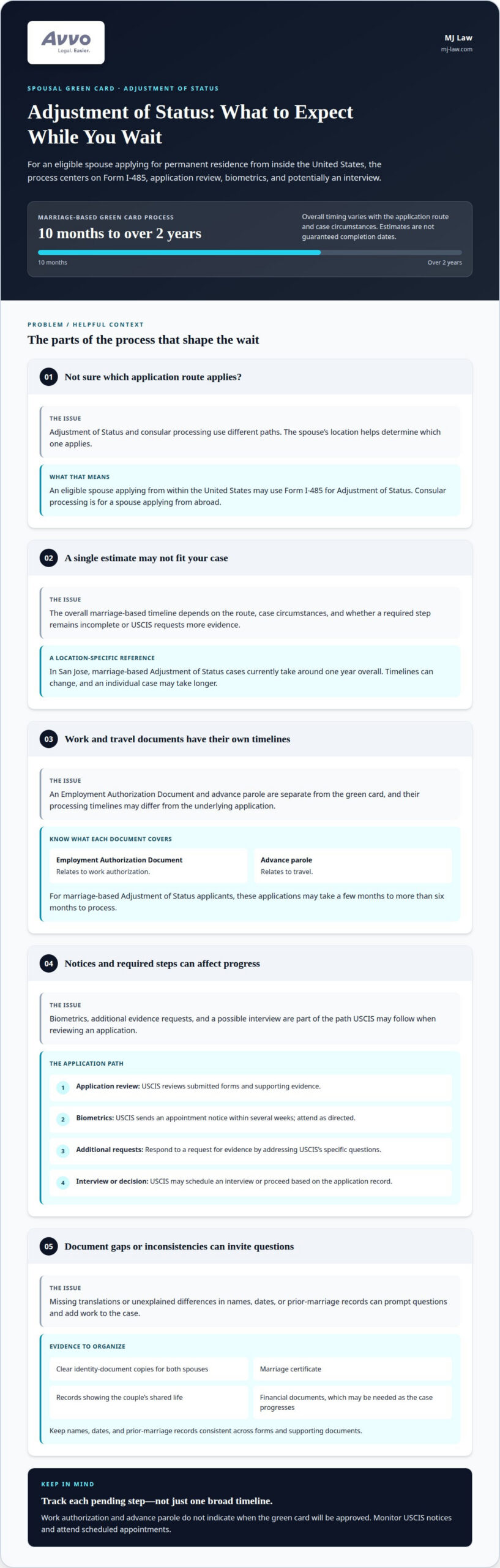
Adjustment of Status for Spouses Already in the US
Adjustment of Status lets an eligible spouse apply for permanent residence from within the United States. The route centers on Form I-485 and involves application review, biometrics, and potentially an in-person interview.
U.S. Citizenship and Immigration Services states that an immigrant spouse applying for a marriage-based green card from within the United States may use Form I-485 to apply for adjustment of status. The spouse’s location matters: this route addresses applications made inside the country, while consular processing is for a spouse applying from abroad. Choosing the process therefore begins with where the immigrant spouse is living and how the case will proceed.
After USCIS receives an Adjustment of Status application, it sends a biometrics appointment notice within several weeks. Biometrics are part of the application process, so monitor USCIS notices and attend the scheduled appointment. In San Jose, marriage-based Adjustment of Status cases currently take around one year overall, although timelines can change. The actual timeline also depends on processing and whether USCIS requests more evidence.
Work authorization is a separate consideration while waiting for a green card. For marriage-based Adjustment of Status applicants, an Employment Authorization Document and advance parole may take a few months to more than six months to process. These documents serve different purposes: the Employment Authorization Document relates to work authorization, while advance parole relates to travel. Neither is the green card itself, and their processing timelines may differ from the underlying application.
- Application review: USCIS reviews the submitted forms and supporting evidence.
- Biometrics: The applicant receives an appointment notice and attends as directed.
- Additional requests: A request for evidence requires a response addressing USCIS’s specific questions.
- Interview or decision: USCIS may schedule an interview or proceed based on the application record.
Marriage-based Adjustment of Status interviews may take place at a local field office. At the interview, USCIS reviews the application and may ask about information in the record. Keep copies of submitted forms and supporting documents organized so both spouses can refer to consistent details if interviewed.
Immigration law can become more complicated when a spouse has a prior immigration history, inconsistent records, or a request for additional evidence. A law firm providing representation can help organize the application, prepare responses, and explain how Adjustment of Status differs from consular processing. Those factors matter in Northern California cases, where the route depends on the spouse’s location and circumstances. To discuss how these steps fit your situation, schedule an Adjustment of Status consultation.
Conditional permanent residence and removing conditions
A spouse who receives a conditional green card has a follow-up filing to complete before that status expires. This filing addresses whether the marriage was genuine and whether the spouse can move from conditional residence to permanent residence without conditions. Keep the approval and expiration dates visible to help plan this next stage.
U.S. Citizenship and Immigration Services states that a spouse seeking to remove conditions on residence files Form I-751, Petition to Remove Conditions on Residence. USCIS also states that the petition must be filed within the 90 days before the two-year conditional residence expires. That filing window is tied to the conditional residence expiration date, not simply to a convenient point in the couple’s calendar.
A spouse with conditional permanent residence has a filing to address near the end of the two-year period. Couples generally submit the petition together, with evidence supporting that they entered the marriage in good faith. Useful records can show their shared life and continuing relationship. Organize the evidence so it is consistent with the information provided during the original green card process.
- Identify the expiration date: Use the conditional residence document to establish the filing window.
- Prepare Form I-751: Complete the petition and assemble supporting evidence about the marriage.
- Review consistency: Check that names, dates, and relationship details align across the petition and records.
- Submit within the filing window: File during the 90 days before conditional residence expires.
Divorce does not automatically prevent a former spouse from seeking to remove conditions. An immigrant who is divorced from a U.S. citizen spouse may still file Form I-751, and USCIS may approve a waiver if it believes the immigrant entered the marriage in good faith. The circumstances surrounding the marriage and its end shape the evidence and waiver basis presented.
Other circumstances may also support filing without the former spouse. An immigrant may file an I-751 alone after domestic violence during the marriage or if deportation would cause extreme hardship. These situations require a different explanation and supporting record from a joint petition. An immigration attorney can help individuals assess which basis fits their history and prepare evidence that addresses it directly.
After approval of an I-751 petition, the spouse’s status extends to a 10-year green card. Failing to file can put conditional status at risk, because USCIS may terminate it. Removing conditions is distinct from applying for citizenship: it first resolves the conditions on residence and establishes the next step in the spouse’s immigration process.
Consular processing for a spouse living abroad
When the immigrant spouse lives abroad, the case proceeds through consular processing rather than Adjustment of Status. The U.S.-based spouse begins by filing Form I-130, Petition for Alien Relative, with U.S. Citizenship and Immigration Services. After USCIS reviews the petition, the case moves to the National Visa Center (NVC) for further processing before a consular interview.
The process has several distinct stages. USCIS typically processes an immigrant petition for a spouse abroad in about six months. The NVC typically takes about three months to review the case. Scheduling and completing the consular interview may take six months to a year or more. These are estimates for separate stages, not a combined processing promise. The time spent at each stage affects the overall wait.
For couples in the Bay Area or elsewhere in California, the spouse’s overseas location determines which U.S. consular post handles the interview. The sequence remains important: first the I-130 petition, then NVC review, followed by interview scheduling and the consular appointment. Couples should keep application details and supporting records consistent as the case moves between USCIS, the NVC, and the consular post.
- Begin with the petition: The U.S. citizen or resident files Form I-130 to establish the qualifying marriage relationship.
- Move through NVC review: After USCIS processing, the case proceeds to the NVC for review.
- Attend the consular interview: The spouse completes the interview at the assigned U.S. consular post.
- Plan around visa validity: U.S. Department of State guidance says a spouse with an approved immigrant visa must enter the United States within six months of visa issuance.
That final six-month period makes travel planning a practical part of the process. Consider the visa issuance date alongside travel arrangements and plans for the spouse to join their partner. If the visa expires before entry, the couple may face additional immigration steps, so pay attention to its validity period as soon as it is issued.
Consular processing differs from Adjustment of Status because the spouse applies through a U.S. consulate abroad rather than applying for a green card from within the United States. The routes have different stages and timing factors, and the spouse’s location is the central distinction. When considering the routes, look at where the immigrant spouse lives and the sequence required for each process.
For a couple living apart, mapping the I-130, NVC review, interview, and visa-entry stages can clarify what comes next. A spousal green card attorney in San Francisco can help assess how consular processing fits the couple’s circumstances and organize the case across its stages.
How to find a reputable spousal green card attorney in San Francisco
When choosing legal representation, consider focused immigration experience, relevant credentials, and clear explanations of the work involved. A good fit can connect the spouse’s circumstances to the appropriate application route and explain how the attorney will handle evidence, questions, and case developments.
Start with the attorney’s immigration background. Amie D. Miller has focused exclusively on immigration issues since 1999 and is certified by The State Bar of California as a Specialist in Immigration and Nationality Law. The certification is a relevant credential to consider when evaluating experience in a specialized practice area. It does not, by itself, establish how an attorney will approach your particular marriage-based case.
Recognition can offer another point of context, but it should be considered alongside the attorney’s actual immigration work. Amie D. Miller has been selected to the Northern California Super Lawyer list every year from 2009 to the present. The list recognizes the top 5 percent of attorneys in their field. Such recognition is one consideration, not a substitute for understanding the proposed legal strategy, communication, and scope of representation.
In an initial discussion, focus on whether the attorney explains the practical work involved. A useful case discussion identifies the central facts, records that may support the marriage, potential gaps or inconsistencies, and the next procedural steps. For example, a prior immigration filing may call for a different analysis than a straightforward record. The explanation should make those distinctions clear.
- Relevant experience: Look for a practice focused on immigration and marriage-based cases.
- Credentials: Consider specialist certification and relevant professional recognition.
- Case analysis: Assess whether the discussion addresses your history and the evidence your case needs.
- Communication: Look for clear explanations of responsibilities, updates, and responses to USCIS notices.
- Representation scope: Understand which parts of the petition and later case stages the legal work covers.
Compare the substance of the explanations, not just general assurances. An attorney can describe their approach to reviewing evidence, preparing clients for a scheduled interview, and responding if USCIS requests more information. Specific answers help you understand the representation before deciding how to proceed.
A spousal green card attorney in San Francisco may be especially useful when the case involves prior immigration issues, a complicated relationship record, or a waiver question. To discuss the facts and possible next steps for your marriage-based case, schedule a spousal green card consultation.
MJ Law: Marriage based green card
MJ Law assists spouses seeking a marriage-based green card through its family immigration practice. Legal support can help you understand which application route fits your circumstances, prepare a petition, respond to case questions, or address conditional residence and waiver issues.
For couples, a practical next step is to clarify where the immigrant spouse will apply from, identify any complexities in the immigration history, and consider what evidence is available. A discussion with MJ Law can help establish the legal support appropriate to the case and how to move forward.
To discuss your marriage-based green card situation, contact MJ Law.
Take the Next Step With a Clear Plan
Turn the information in this guide into a plan for your family’s circumstances. A spousal green card attorney in San Francisco can help assess which process fits, identify issues that need attention, and prepare you for decisions ahead. Legal guidance can be especially useful when your immigration history, relationship records, or plans make the case less straightforward.
MJ Law offers Family Immigration Services, including marriage-based green card assistance. The firm also handles Business and Investor Visas and Employment-Based Visas, which may be relevant when a family’s immigration planning involves more than one pathway. The right focus depends on the question you need to resolve.
Bring your questions and relevant case details to a conversation about possible next steps. Contact MJ Law about your case to discuss your situation. A thoughtful plan can help you move forward with greater clarity.
Frequently Asked Questions
Are Same-Sex Couples Eligible for Marriage-Based Immigration Benefits?
Yes. Same-sex couples in the United States are eligible for marriage-based spousal visas and green cards on the same terms as opposite-sex couples. The marriage and the immigrant spouse’s circumstances determine which application route applies. For example, spouses applying from within the United States follow a different process from couples where one spouse lives abroad. Eligibility does not depend on whether the spouses are same-sex or opposite-sex.
Do I Qualify for a Fiancé or Marriage Visa?
Your relationship status helps distinguish these options. A fiancé visa, such as the K-1, relates to a couple planning to marry; a marriage-based visa applies when the couple is already married. A marriage-based green card petition is available when one spouse is a U.S. citizen or resident. Which route fits also depends on where the foreign partner lives and whether the couple has already married.
How Do I Know If My Marriage Interview Is Waived?
Do not assume the interview is waived unless you receive an official case update confirming that no interview is required. Most marriage-based green card cases involve an in-person interview for both spouses at a USCIS field office. Keep submitted forms and relationship records organized while the case is pending. If USCIS schedules an interview, follow the notice’s instructions and prepare to discuss information in the application.
How Do I File an Immigration Application If My Spouse Is Living Abroad?
For a spouse living abroad, the U.S.-based spouse begins with an immigrant petition. The case then proceeds through National Visa Center review and a consular interview. Keep case information consistent as it moves between agencies and the assigned consulate. After visa issuance, the spouse must enter the United States within six months, according to the U.S. Department of State. The visa’s issue date helps guide travel planning.
What Happens If My Spouse’s Visa Is Denied?
A denial means the application did not result in visa approval; the next step depends on the reason stated in the decision. Read the notice carefully and identify the specific issue, such as missing evidence or information needing clarification. Keep the denial notice with the submitted application. An immigration attorney can review the record and explain which possible response fits the stated grounds.
What Is the Process for Applying for a Spousal Visa?
The process starts with a petition establishing the qualifying marriage relationship. The next steps depend on the immigrant spouse’s location: an eligible spouse inside the United States can apply for Adjustment of Status, while a spouse abroad proceeds through consular processing. Keep copies of every form and notice in one case file to track requests, interview instructions, and decisions as the application advances.
What Are the Eligibility Requirements for a Marriage-Based Green Card?
The couple must have a qualifying marriage, and the petitioning spouse must be a U.S. citizen or resident. Eligibility also depends on the immigrant spouse’s circumstances and application route. A prior immigration history or discrepancies between application records can raise issues that need careful review. For example, a prior filing under a different name should be addressed consistently across current forms and supporting records.
What Documents Are Required for a Marriage-Based Green Card Application?
Documents generally include identity records for both spouses, a marriage certificate, and financial evidence relevant to the application. Organize the file by category and keep a copy of each submitted item. Check that names and dates match across the petition and supporting records. For example, document a name change clearly. The supporting evidence depends on the couple’s application route and personal history.