
A promising business plan alone doesn’t qualify a company for an E-2 visa. A business immigration law firm in San Francisco can assess whether the enterprise is active, for-profit, bona fide, and capable of generating more than marginal income, as required by 8 C.F.R. § 214.2(e). The key question is whether the business meets these standards, not simply what industry it operates in.
It’s understandable to want a clear answer before investing time and resources in an immigration plan. This article explains which businesses may qualify for E-2 classification and how employment-based green cards can support hiring and retention. It also covers how business immigration counsel can help organize the business plan and financial records that support an application.
From investor visa eligibility to employer-sponsored Green Cards, the right approach depends on a business’s goals, structure, and workforce needs. The sections ahead explain the main considerations and how legal guidance can bring them together for businesses in San Francisco and San Jose.
Key Takeaways
- Understand which features of an investor’s business matter when assessing E-2 eligibility and preparing an application.
- See how employment-based green card options can support workforce planning and long-term employee retention.
- Learn how counsel can coordinate visa strategies for professionals and internationally hired employees with an employer’s hiring needs.
- Recognize how a clear business plan and consistent financial records can strengthen an immigration case.
- Identify when focused immigration and nationality law experience can help address business and employment immigration needs.
How can business immigration counsel help foreign investors secure an E-2 Treaty Investor visa in California?
For a foreign investor, the E-2 analysis starts with the business and its operating plan. Counsel can also assess whether work visas fit a company’s hiring needs.
Qualifying Businesses for E-2 Visas
According to 8 C.F.R. § 214.2(e), an E-2 business must be an active, for-profit, bona fide enterprise capable of generating more than marginal income. The industry alone doesn’t decide eligibility. Counsel can examine the company’s business model, operations, financial records, and plan to assess whether the enterprise meets these standards.
This assessment connects the investor’s plans with evidence about the business. A company still preparing to operate may need a different analysis from an established enterprise with customers, revenue, and documented activity. Counsel can organize the business plan and financial records to present a consistent picture of how the venture operates and generates income.
Visa Requirements and Processing Times
H-1B visas generally concern professional roles, while L-1 visas relate to transferring employees within a company. The firm states that O-1 extraordinary ability applicants must provide evidence of sustained national or international acclaim under 8 C.F.R. § 214.2(o). E-2 cases focus on the qualifying enterprise. Processing times vary by visa category and filing path, so the route and application details shape the timeline.
When choosing California counsel, look for a California State Bar license and experience with immigration and business immigration matters. Ask how the lawyer assesses visa fit, organizes supporting records, and manages the filing process. The work should match your needs: an employer hiring a professional has different planning concerns from an investor documenting an operating business.
For an internationally hired professional, H-1B planning begins with the position and the employee’s qualifications. Counsel can review those details and coordinate the application with the employer’s hiring plan. A small business considering H-1B sponsorship should also account for how the role fits its operations, rather than treating the filing as separate from the job.
L-1 planning centers on an employee moving within a company. Counsel can assess the proposed transfer and organize information about the employee and the business relationship. For example, a company expanding into the United States may need to align its staffing plan with the employee’s role at the U.S. operation.
O and P visas address different talent needs. O-1 classification involves evidence of sustained national or international acclaim; P visas may be relevant to athletes, entertainers, and artists. Counsel can identify which route matches the person’s work and prepare the supporting record. That distinction matters for a Northern California employer hiring a performer rather than a corporate professional.
Immigration planning can also involve an employee’s longer-term path, including citizenship and naturalization. A separate status issue or deportation concern requires focused assessment, not assumptions based on an employer visa. Counsel can develop a coherent strategy connecting the employee’s role, the company’s records, and the visa category under consideration.
Employment-based green cards
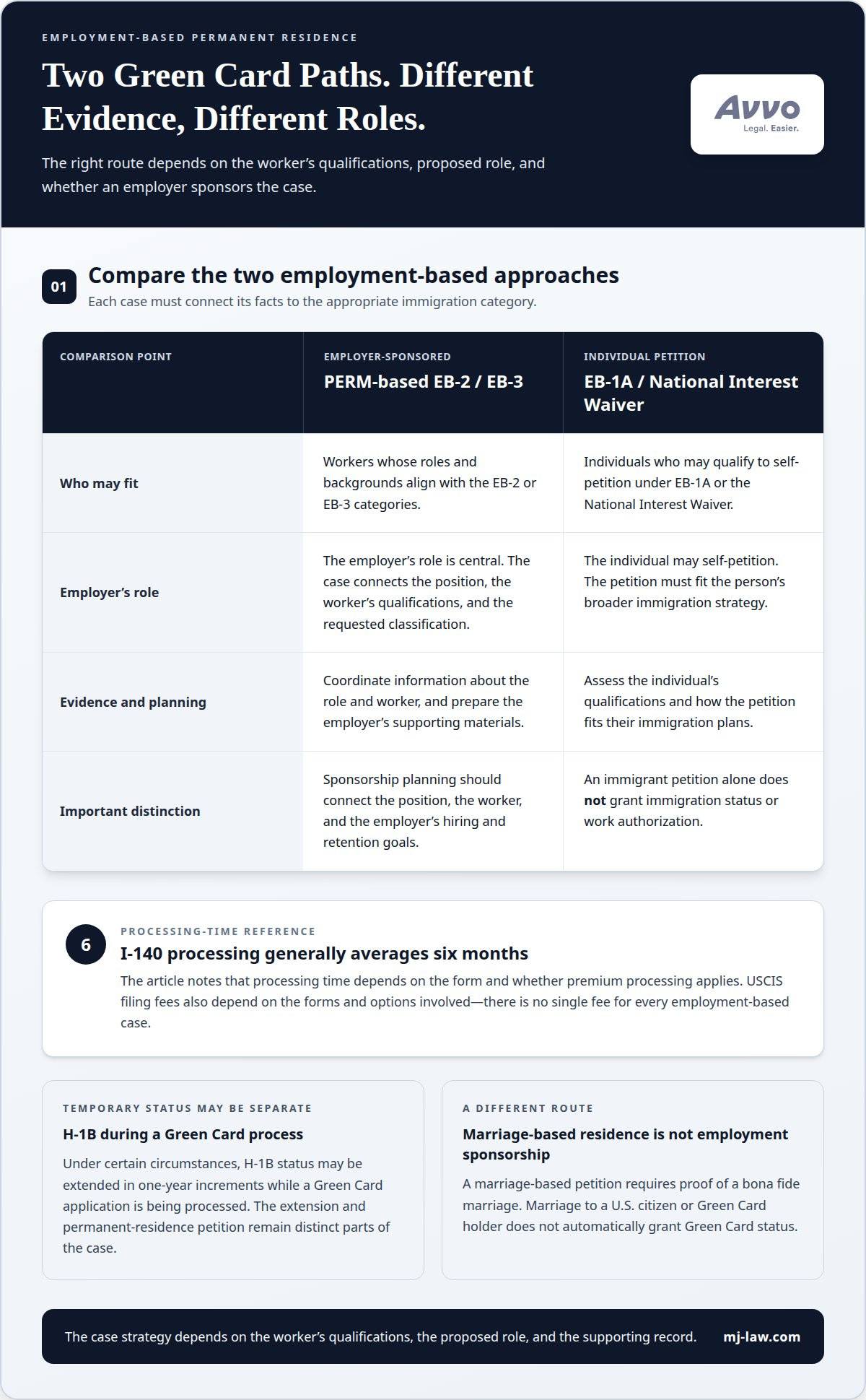
Employment-based permanent residence can offer a qualifying worker a path to a Green Card through a job or, in some categories, an individual petition. The appropriate route depends on the worker’s qualifications, the proposed role, and whether an employer sponsors the case. An immigration attorney can assess those facts against relevant categories before documents are assembled.
For employer-sponsored cases, PERM-based EB-2 and EB-3 sponsorship may fit workers whose roles and backgrounds align with those categories. The employer’s role is central: the case must connect the position, the worker’s qualifications, and the requested immigration classification. Lawyers can help coordinate that information and prepare the employer’s supporting materials. This planning also helps businesses consider how sponsorship fits hiring and retention goals.
Some individuals may qualify to self-petition under EB-1A or the National Interest Waiver. An immigrant petition alone does not grant an EB-1A or NIW self-petitioner immigration status or work authorization. That distinction matters for employment planning: a petition and permission to remain or work are separate issues. Counsel can explain how the petition fits into the individual’s broader immigration strategy.
Processing time depends on the form and whether premium processing applies. I-140 processing generally takes an average of six months. USCIS filing fees depend on the forms and options involved, so there is no single fee that covers every employment-based visa and Green Card case.
H-1B status may, under certain circumstances, be extended in one-year increments while a Green Card application is being processed. That can matter to a worker whose temporary status is nearing its end, but the extension and permanent-residence petition remain distinct parts of the case. An attorney can review the filing sequence and identify how the worker’s current status relates to the employer’s sponsorship plan.
Marriage-based permanent residence follows a different route from employment sponsorship. A marriage-based petition requires proof of a bona fide marriage under the Immigration and Nationality Act. Marriage to a U.S. citizen or Green Card holder does not automatically grant Green Card status. This route may suit someone whose eligibility comes through a spouse rather than a job.
For an employer, the practical first step is to assess the position, the worker’s qualifications, and the intended sponsorship category together. For an individual, counsel can compare employer-sponsored options with potential self-petition eligibility and explain how status and work authorization fit into the plan. A focused employment-based immigration discussion can help clarify which records and decisions matter for the case.
Employer-sponsored hiring and employee retention
Employer-sponsored immigration planning connects hiring needs with each worker’s visa or permanent-residence strategy. A business immigration law firm serving San Francisco can assess the role, the employee’s background, and the company’s records together, helping employers coordinate immigration steps with recruitment and retention plans.
For a skilled professional, the job’s duties, degree, and experience help shape the immigration analysis. An employer considering PERM-based EB-2 or EB-3 sponsorship must align the position and worker with the selected category. Legal representation can coordinate the sponsorship process and supporting materials. A San Jose employer hiring for a San Francisco team, for example, may need consistent information about the position and its organizational context.
Retention planning matters when an employee’s current status and a Green Card application overlap. H-1B extension processing usually averages around 2-3 months. Employers can account for that timing when planning staffing and filing steps. Counsel can review the worker’s status and the company’s hiring needs, then explain how each part affects workforce planning.
Investors and key employees may need different strategies. An investor’s case focuses on the enterprise and the investor’s role; a key employee’s case turns on the job, qualifications, and suitable employment-based route. A firm serving San Francisco businesses can help distinguish these needs instead of assuming one visa strategy fits every hire.
When comparing immigration lawyers, consider relevant business immigration experience, employer casework, and how clearly each attorney explains the process. Client reviews can offer context about communication, but do not establish whether a lawyer’s approach fits a particular employer. A business immigration law firm serving San Francisco should explain how its work addresses your company’s hiring needs.
Attorney fees depend on the case and are given after a quote request. The scope of representation, visa category, number of employees, and filing stages affect the work involved. Employers can use those factors to understand how a proposed engagement relates to their staffing plans.
Immigration compliance problems can expose employers to scrutiny, penalties, or disruption to an employee’s work authorization. Reviewing hiring and case records can help identify inconsistencies before they complicate sponsorship or retention plans. For example, a mismatch between the described role and the employer’s records may need attention during case preparation.
A consultation helps counsel understand the position and the employee’s circumstances. Employers can prepare the role description, hiring timeline, résumé and degree information, current immigration documents, and relevant company records. These materials help connect the worker’s situation with the employer’s staffing objectives.
Business and employment immigration services can address recruitment, sponsorship, and retention as related decisions. A company planning to hire a professional and later pursue a Green Card can consider both stages early, creating a clearer basis for coordinating workforce needs with immigration planning.
Business plans and financial documentation
For an E-2 case, the business plan and financial records should tell a consistent story about the enterprise. Under 8 C.F.R. § 214.2(e), the business must be active, for-profit, bona fide, and capable of generating more than marginal income. Counsel can assess how the plan describes the company’s operations and how its records support that description.
A business plan should explain what the business does, how it will operate, and how it expects to generate income. For example, a California company planning to provide professional services can connect its proposed services with its staffing and operating model. The description should be coherent and align with the company’s actual activities and financial documentation.
Financial records provide context for business operations. Counsel can organize relevant records and compare them with the plan’s account of revenue, expenses, and activity. If the plan describes an operating enterprise, the supporting documents should help explain those operations. If the business is still developing, distinguish current operations from projected activity.
A useful preparation process starts by identifying the filing’s purpose and the evidence available. Counsel can review the business plan, identify gaps or inconsistencies, and organize supporting materials around the claims in the case. This step-by-step review helps present a clear account rather than a collection of disconnected documents.
For an investor, the business plan also helps explain the intended role in the enterprise. Counsel can compare that explanation with financial records and operating details. Records for a separate employer-sponsored petition serve a different purpose. Keeping the case narratives distinct helps prevent one set of documents from standing in for another.
A business immigration consultation can focus on the enterprise, its records, and the intended filing. The discussion can clarify which documents support current operations, which describe future plans, and how they relate. What matters is evidence that addresses the relevant requirements, not simply the volume of documents submitted.
Business immigration documentation also differs from evidence used for marriage-based Green Cards or asylum cases. Those matters involve different facts and filing objectives. Separating the records by case helps counsel build a focused presentation, whether an investor seeks to obtain an E-2 visa or an employer prepares an employment-based petition.
For an E-2 enterprise, counsel’s review can connect the business plan, financial documentation, and filing strategy into one consistent record. That preparation helps identify which materials explain the company’s activities and which support its projected operations, without treating projections as established financial results.
Immigration and nationality law specialization
Immigration matters can involve business petitions, family applications, permanent residence, or citizenship. A lawyer’s experience should match the issue at hand. An employer planning a workforce petition, for example, needs different guidance from an individual preparing a naturalization application. A focused review starts by identifying the person’s current status and desired outcome.
Specialized analysis distinguishes a petition from the immigration status it may support. An approved petition does not, by itself, resolve every separate status or work authorization question. Counsel can map the filings, identify dependencies, and explain what each step addresses, helping prevent an outstanding issue in one part of a case from being mistaken for a decision on another.
Nationality law experience matters in naturalization cases, too. Form N-400 begins the U.S. naturalization process, and applicants in the United States must be at least 18 years old when filing. Naturalization generally requires permanent residence for three to five years, depending on the applicant’s circumstances. A case review can identify the relevant timeline and application issues.
Different immigration matters call for different legal frameworks. For example, an I-601A provisional unlawful presence waiver requires showing extreme hardship to an applicant’s U.S. citizen or lawful permanent resident spouse or parent under 8 C.F.R. § 212.7(e). That standard differs from the evidence and analysis involved in an employer’s Green Card petition. A specialist should explain the distinction clearly.
Reviewing documentation is another practical way to assess legal experience. Counsel can compare facts across forms, supporting records, and prior filings, then identify inconsistencies that need attention. If an agency request remains outstanding, the response should address the specific issue raised rather than add unrelated material. This keeps the application focused on its purpose.
Immigration defense is also distinct from business sponsorship and nationality applications. For example, 28 U.S.C. § 2241 is identified as a basis for federal habeas corpus petitions challenging ICE detention. A business immigration consultation should therefore clarify whether the concern involves an employer petition, a Green Card, or a separate immigration matter requiring another strategy.
To assess fit, ask how the lawyer would organize the case, which legal issues need attention, and how status questions relate to the outcome you seek. A business owner may need an employer-petition strategy; an individual may need guidance on permanent residence or naturalization. Clear answers help you understand the proposed work and decisions ahead.
For an immigration consultation focused on your matter, schedule a discussion about the relevant filings, records, and status concerns.
MJ Law: Family Immigration Services
MJ Law helps businesses and individuals develop focused immigration strategies. Turn to the firm when an investor needs guidance on a business visa, an employer is planning employment-based sponsorship, or an artist needs an appropriate visa strategy.
MJ Law also handles family immigration matters, including marriage-based Green Cards. Because the right path depends on the person’s circumstances and goals, counsel can help identify which immigration issue should guide the next steps.
For guidance tailored to your business or immigration matter, contact MJ Law.
Set a clear direction for your immigration plans
Your next step is to connect your immigration goals with decisions ahead for your business or family. A business immigration law firm serving San Francisco and San Jose can help assess which matters need attention first and how employer sponsorship, investor plans, and individual immigration goals relate. A focused discussion can turn a broad concern into a practical legal plan.
MJ Law offers Business and Investor Visas and Employment-Based Visas for business-related immigration needs. The firm also offers Family Immigration Services when family matters are central to your plans. Choosing the right starting point helps keep your next decisions focused on the situation you need to address.
Bring your questions about hiring, a business venture, or an employee’s immigration plans to the conversation. You can discuss your business immigration needs with MJ Law and consider a clear path forward with professional guidance.
Frequently Asked Questions
What types of businesses qualify for an E-2 visa?
An E-2 candidate must be an active, for-profit, bona fide enterprise capable of generating more than marginal income. The industry or company size alone doesn’t determine eligibility. A technology company, consulting practice, or retail business still needs evidence that its operations and financial position support the criteria. The analysis focuses on how the enterprise functions and is supported, rather than simply the label attached to its business activity.
Are you searching for a top immigration lawyer in San Francisco, California?
Look for immigration counsel whose experience matches your matter. A business immigration law firm serving San Francisco may handle employer petitions, investor visas, or employment-based applications, but the relevant experience depends on your needs. Ask how the attorney would approach your case, explain the process, and coordinate the employer’s and worker’s roles. A clear discussion helps you assess whether the lawyer’s approach suits your situation.
What is considered a “substantial investment” for an E-2 visa?
Assess an investment in relation to the specific business rather than relying on a single dollar threshold. The business model, operating needs, financial records, and planned activities help show the investment’s role in the enterprise. Counsel can review whether the documentation presents a coherent picture of the venture.
Which San Francisco law firms specialize in business immigration?
MJ Law handles business and employment immigration matters for clients in the San Jose and San Francisco area. When evaluating whether a firm fits your needs, consider the type of case, such as an investor visa, employer petition, or worker’s application. Ask how counsel will coordinate the company’s objectives with the individual’s immigration matter. These may require distinct strategies, even when they relate to the same hire or business plan.
What business immigration services do San Francisco law firms offer?
Business immigration services may include guidance on investor visas, employment-based visas, and employer petitions for foreign workers. Some practices also handle O and P visa matters for artists, entertainers, or athletes. If you are hiring internationally, clarify how counsel will address both the company’s filing and the worker’s case. MJ Law also handles family immigration matters, including marriage-based Green Cards, for clients with related family immigration needs.
Which U.S. visa options are available for employers hiring foreign workers?
Available options depend on the worker’s role, qualifications, and relationship to the employer. H-1B visas may suit professional positions, while L-1 visas can address transfers within a company. O visas relate to people with evidence of extraordinary ability, and P visas may fit athletes, entertainers, and artists. Employers pursuing permanent residence for workers may also consider employment-based Green Card sponsorship, including PERM-based EB-2 or EB-3 cases.
How can I verify a business immigration lawyer’s California license and credentials?
Look for a California State Bar license and experience with immigration and business immigration matters. Ask how the lawyer assesses visa fit, organizes supporting records, and manages the filing process.
How can a San Francisco employer sponsor a foreign worker, step by step?
Assess the position, the worker’s qualifications, and the intended sponsorship category together. For H-1B sponsorship, review the professional role and qualifications; for PERM-based EB-2 or EB-3, align the position and worker with the category, then coordinate supporting materials and filing steps.