
A strong career record alone doesn’t establish eligibility for an EB-2 National Interest Waiver. A national interest waiver green card lawyer in San Francisco will assess whether you qualify for EB-2 as an advanced-degree professional or person of exceptional ability, then connect your proposed endeavor and supporting evidence to the required legal test. According to U.S. Citizenship and Immigration Services, that test follows the three-prong framework from Matter of Dhanasar.
It’s understandable to focus on degrees, achievements, and recognition, but an NIW petition also asks whether your proposed work has substantial merit and national importance, whether you’re well positioned to advance it, and whether waiving the job offer and labor certification requirements would benefit the United States. Each part calls for a clear explanation supported by evidence.
This article explains how advanced-degree and exceptional-ability eligibility work, what evidence can support an NIW petition, and how EB-2 NIW differs from EB-1A. You’ll get a practical foundation for understanding the criteria and deciding what questions to address as you consider your immigration options.
Key Takeaways
- Understand the three-part NIW test and how it connects your proposed endeavor to the national interest.
- See how education, professional experience, and other evidence can support EB-2 eligibility.
- Learn how to organize petition materials so they build a clear, consistent case for your qualifications and plans.
- Compare the distinct eligibility standards for EB-2 NIW and EB-1A to identify which pathway may better fit your profile.
- Explore when immigration counsel can help assess your employment-based options and prepare a petition strategy.
What Is the EB-2 National Interest Waiver?
The EB-2 National Interest Waiver (NIW) combines two questions: whether you qualify for EB-2 and whether your proposed endeavor meets the waiver standard. Unlike the usual employer-sponsored route, an NIW may let a qualifying applicant seek a waiver of the job-offer and labor-certification requirements.
EB-2 Eligibility Pathways
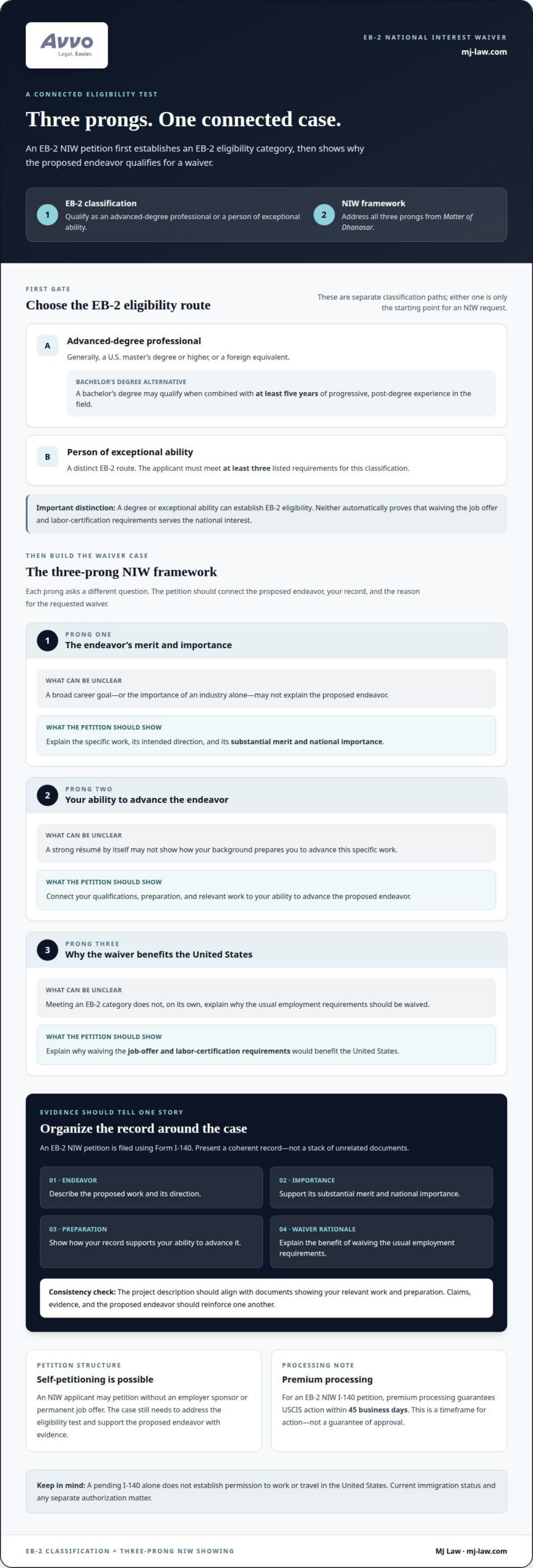
First, establish eligibility under one of EB-2’s two categories: advanced-degree professional or individual of exceptional ability. An advanced degree generally means a U.S. master’s degree or higher, or a foreign equivalent. A bachelor’s degree may also qualify when combined with at least five years of progressive, post-degree experience in the field, according to U.S. Citizenship and Immigration Services.
Exceptional ability is a separate route, not a substitute for the NIW test. An applicant must meet at least three listed requirements for this EB-2 classification, according to U.S. Citizenship and Immigration Services. The evidence should show how the applicant’s background fits the chosen category, rather than relying on a strong résumé alone.
These are distinct steps. A degree or exceptional ability can establish the underlying EB-2 classification, but neither automatically proves that a waiver serves the national interest. The applicant must also present a proposed endeavor and evidence that address the NIW framework. A job offer and labor certification are usually part of the employment-based process, but an NIW applicant may request their waiver.
National Interest Waiver Eligibility Framework
USCIS evaluates an EB-2 NIW petition under the three-prong framework from Matter of Dhanasar, according to U.S. Citizenship and Immigration Services. The applicant must show that the proposed endeavor has substantial merit and national importance, that they are well positioned to advance it, and that waiving the job offer and labor certification requirements would benefit the United States.
The three prongs work together. The first focuses on the proposed endeavor, not simply your occupation or the importance of your industry. The second considers your preparation and ability to advance that specific work. The third asks why the United States would benefit from waiving the usual employment requirements. A persuasive petition connects the endeavor, your record, and the requested waiver.
A broad career goal, for example, may not explain what you plan to do. A focused endeavor statement identifies the work, its intended direction, and its potential importance. The supporting evidence then needs to show that you’re prepared and able to advance it. The record should make each part of the framework clear and credible.
An NIW applicant may self-petition without an employer sponsor. The waiver request therefore depends on the applicant’s own qualifications, proposed endeavor, and supporting record. U.S. Citizenship and Immigration Services also states that an applicant’s spouse and unmarried children under age 21 can become permanent residents. This may make the petition relevant to a family’s longer-term immigration planning.
NIW petition preparation and supporting evidence
A strong petition connects your proposed endeavor to evidence of your qualifications and plans. It also addresses each NIW prong clearly and considers filing options and timing.
Evidence Collection and Petition Preparation
U.S. Citizenship and Immigration Services states that an EB-2 NIW petition is filed using Form I-140. The petition should present a coherent record, not a stack of unrelated documents. Organize evidence around the proposed endeavor, its substantial merit and national importance, your ability to advance it, and the benefit of waiving the job offer and labor certification requirements.
For example, your project description should align with documents showing your relevant work and preparation. An immigration attorney can help identify gaps, organize exhibits, and ensure the petition’s claims match the evidence.
Self-Petitioning Without an Employer Sponsor
NIW applicants can self-petition without an employer sponsor or permanent job offer. The petition therefore centers on your proposed endeavor and qualifications, rather than an employer’s offer and labor certification. It still needs to explain how your work meets the NIW framework and why you’re positioned to advance it.
Self-petitioning doesn’t mean you must prepare the case alone. A review with an immigration attorney can help organize the evidence and clarify the petition’s central argument.
Processing time varies with USCIS workloads and the applicant’s priority date. U.S. Citizenship and Immigration Services states that premium processing for an EB-2 NIW I-140 petition guarantees USCIS action within 45 business days. That is a timeframe for action, not a guarantee of approval.
A pending I-140 alone doesn’t establish permission to work or travel in the United States. Your current immigration status and any separate authorization matter; the petition itself doesn’t resolve those questions.
You can self-petition without a lawyer, but the petition still needs to meet the eligibility test and present supporting evidence. Gaps between your claims, evidence, and proposed endeavor can weaken the case.
Evidence gaps may include an unclear endeavor, limited support for its national importance, or an insufficient record of how you can advance it. A request for evidence may ask for more support or clarification on a point USCIS considers insufficient.
Visa availability depends on the priority date and country of chargeability. Even after I-140 approval, the applicant must complete the permanent-residence process when a visa number is available.
If your petition is delayed, eligible premium processing may provide a defined period for USCIS action. After a denial, review the reasons in the decision to determine whether a response or revised filing could address the weaknesses.
San Francisco EB-2 immigration legal services
NIW representation connects your immigration record to your proposed endeavor and its national importance. MJ Law serves clients in San Jose and the San Francisco area, helping organize filing strategy, evidence, and next steps. A national interest waiver green card lawyer in San Francisco can assess how your qualifications and plans fit the petition’s legal framework.
San Francisco NIW Legal Representation
NIW legal representation can include eligibility analysis, petition preparation, evidence organization, and responses to USCIS correspondence. A clear connection between your background, proposed endeavor, and waiver request is central. For example, an attorney can assess whether your documents explain how your past work positions you to advance the endeavor.
San Francisco immigration law services should address the specific EB-2 classification and NIW standard, not treat every employment petition as the same. If you’re considering a national interest waiver green card lawyer in San Francisco, focus on how the legal strategy would address your record and proposed work.
USCIS Filing Fees and Legal Fees
USCIS filing fees and attorney fees are separate costs. Government filing costs depend on the form and applicable filing requirements; legal fees depend on the case and agreed scope of representation. When discussing representation with an attorney, clarify what legal work is covered and which filing tasks are included.
Case complexity, the amount of evidence, and the support needed to prepare the petition can affect legal fees. Keep legal fees and government filing costs distinct when planning your filing.
Comparing NIW Green Card Lawyers
To compare experienced NIW lawyers in San Francisco, focus on the substance of the legal analysis rather than broad claims about extraordinary results. A useful discussion should explain how counsel would assess your EB-2 eligibility, proposed endeavor, evidence, and each NIW prong. It should also clarify who prepares the petition and what the representation covers.
Look for a case-specific explanation of the legal issues, including how your record may demonstrate substantial merit and national importance. Understanding the reasoning behind a strategy helps you assess more than its conclusion.
Questions for a Lawyer Consultation
Ask how the attorney would assess your qualifications, define your endeavor, and connect your evidence to the NIW requirements. You can also discuss which documents may strengthen the case, where evidence gaps may arise, and what the proposed representation includes.
Clarify how the attorney will communicate about USCIS notices, timing, and response needs. A focused NIW case consultation can help you understand the legal issues and identify practical next steps.
What qualifies as an “advanced degree” for EB2 purposes?
EB-2 eligibility can rest on an advanced degree or exceptional ability. For an NIW applicant, meeting one of these classification pathways is a separate step from showing that the proposed endeavor meets the waiver standard. Reviewing education, work history, and the petition route together helps clarify which evidence matters.
A U.S. master’s degree or higher, or a foreign equivalent, can qualify as an advanced degree. A bachelor’s degree may also qualify when combined with at least five years of progressive, post-degree experience in the field, according to U.S. Citizenship and Immigration Services. The experience must follow the degree and show progression, rather than merely documenting time spent working.
For example, if you have a bachelor’s degree, connect your post-degree experience to the relevant field and show how your responsibilities developed. If you’re relying on a master’s degree, establish its level and relationship to your professional area. Either way, your record should present a consistent account of your education, experience, and proposed work.
Exceptional ability is the other EB-2 pathway. It concerns expertise significantly above that ordinarily encountered in the sciences, arts, or business. An applicant must meet at least three listed requirements for this classification, according to U.S. Citizenship and Immigration Services. One listed EB-2 exceptional-ability criterion is 10 years of full-time experience in the field, according to U.S. Citizenship and Immigration Services. That criterion is one possible way to qualify, not a substitute for meeting the NIW standard.
Distinguish evidence of experience from evidence of achievement. Employment records can establish roles and duration, while professional recognition or other records may support different exceptional-ability criteria. The relevant question is whether each document supports the specific criterion you claim. Organizing the record clearly helps the reviewer see that connection without having to infer it.
Employer ability to pay matters in an employer-sponsored EB-2 case. The employer must demonstrate a continuing ability to pay the offered wage as of the priority date, using an annual report, federal income tax return, or audited financial statement. That requirement addresses the offered position and employer. An NIW request, by contrast, seeks to waive the job-offer and labor-certification requirements, so the petition’s focus is the applicant’s own eligibility and proposed endeavor.
These distinctions help shape the evidence plan. First, identify the EB-2 pathway. Then match each claimed qualification to documents that support it, while keeping employer wage evidence separate from an NIW self-petition. The priority date and proposed endeavor also belong in the broader case analysis, but neither changes the meaning of an advanced degree or exceptional ability.
Comparing EB-2 NIW with EB-1A
EB-2 National Interest Waiver and EB-1A are separate immigrant classifications with different eligibility requirements and legal standards. Comparing them means looking beyond an impressive résumé: each pathway asks for a different case theory, so the evidence must support the classification you pursue.
For an EB-2 NIW petition, the analysis begins with EB-2 eligibility through an advanced degree or exceptional ability. The applicant then connects a proposed endeavor to the national interest and addresses the waiver framework. The case therefore links the applicant’s qualifications with the work they plan to advance and the reason a waiver would benefit the United States.
EB-1A focuses on extraordinary ability. That distinction makes the role of achievements central to comparing the two options. A record of professional accomplishments may help explain an applicant’s profile, but the relevant question is how those achievements support the specific classification’s legal standard. Evidence should be organized around that standard, rather than presented as a general list of career highlights.
The difference is not simply “EB-1 versus EB-2” or a ranking of which route is better. EB-1A and EB-2 NIW have distinct eligibility tests. An applicant should assess which test the available record can address, then prepare a petition whose argument follows that test from beginning to end. For instance, a strong achievement record alone does not explain an NIW’s proposed endeavor, while an ambitious endeavor does not by itself establish extraordinary ability.
Consider how the evidence answers the core question in each case. For NIW, examine whether the proposed work has substantial merit and national importance, and whether the applicant is positioned to advance it. For EB-1A, assess how the achievements support the extraordinary-ability classification. This comparison helps reveal whether the evidence is strongest when presented through the endeavor and waiver rationale, or through the applicant’s achievements.
Start by mapping each document to the classification it supports. Separate evidence of education and professional experience from material explaining your proposed endeavor; identify achievements that support an extraordinary-ability argument; and note where the record needs clearer context. This can help prevent a petition from relying on impressive evidence that is poorly connected to its legal theory.
Choosing between EB-2 NIW and EB-1A also means considering the complete immigration strategy, including the permanent-residence process that follows an approved petition. The right comparison weighs eligibility, the purpose of the proposed work, and the strength of the supporting record together. Discuss your EB-2 NIW and EB-1A options to clarify how each pathway aligns with your evidence.
MJ Law: Marriage based green card
MJ Law can help if your immigration plans center on a marriage-based green card rather than an employment-based NIW petition. The right path depends on the basis for your application: an NIW focuses on an eligible professional’s proposed endeavor, while a marriage-based case follows a family immigration route.
Turn to MJ Law for guidance on the marriage-based green card process or related family immigration matters. If you’re weighing employment-based and family-based options, a consultation can help clarify which type of case fits your goals. MJ Law offers consultations in English and Spanish.
Contact MJ Law to discuss your immigration needs and possible next steps.
Plan Your Next Immigration Step
Your next step is to connect your immigration objective with the evidence and pathway that fit your circumstances. A focused discussion can clarify which questions remain, what parts of your record need attention, and how to approach the process. If you’re considering a national interest waiver green card lawyer in San Francisco, contact MJ Law for a consultation and bring a concise overview of your proposed work, education, experience, and immigration goals.
MJ Law offers employment-based visas, business and investor visas, and family immigration services. This range can support discussions about employment-based plans alongside other immigration matters that may affect your family or long-term goals. The next step is a consultation about your situation and the outcome you’re seeking.
Contact MJ Law about your NIW to discuss your circumstances and possible next steps. A clear plan can make the path ahead easier to approach.
Frequently Asked Questions
Do I need a job offer for an EB2 visa?
Usually, an EB-2 case relies on a permanent job offer, but an NIW applicant can request a waiver of that requirement. Without the waiver, the employer-sponsored route generally involves labor certification. For example, someone whose proposed work supports an NIW request may pursue a self-petition rather than relying on a specific employer’s offer. The classification and waiver request are separate parts of the case.
Who Qualifies for an EB-2 NIW?
An applicant must first qualify for EB-2 as an advanced-degree professional or a person of exceptional ability, then meet the NIW test. The proposed endeavor must have substantial merit and national importance; the applicant must be positioned to advance it; and waiving the job offer and labor certification requirements must benefit the United States. A strong record in a field alone doesn’t answer all three questions.
Can an NIW lead to a green card?
Yes. An approved NIW petition can support an application for permanent residence, but approval of the petition is not itself a green card. After approval, the applicant may pursue adjustment of status in the United States or consular processing abroad, subject to visa availability. For adjustment, an applicant uses Form I-485 when a visa number becomes available. The route depends on the applicant’s circumstances.
Does an NIW require PERM labor certification?
No. The NIW request asks USCIS to waive the labor-certification requirement that usually applies to EB-2 employment petitions. That waiver is not automatic: the petition needs to show why waiving the job-offer and labor-certification requirements would benefit the United States. For a case without an NIW, the standard EB-2 process generally uses labor certification connected to a permanent job offer.
Does an NIW require an employer sponsor?
No. An eligible EB-2 NIW applicant may self-petition, so an employer sponsor isn’t required for the NIW request. The applicant’s petition must explain the proposed endeavor and provide evidence supporting the eligibility argument. Self-petitioning also means the case is built around the applicant’s own plans and qualifications, rather than an employer’s job offer and sponsorship documents.
Is an NIW the same as an EB-1A extraordinary ability petition?
No. EB-2 NIW and EB-1A are distinct immigrant classifications with different eligibility standards. An NIW case centers on EB-2 eligibility and whether the proposed endeavor meets the national-interest waiver test. EB-1A is a separate extraordinary-ability classification. Evidence of achievements may be relevant to an applicant’s background, but it must be organized to support the specific classification being pursued.
What’s the difference between EB2 and EB1 visas?
EB-1 and EB-2 are different employment-based immigrant preference classifications. EB-1A is for extraordinary ability, while EB-2 includes advanced-degree professionals and individuals of exceptional ability. The NIW is a waiver request within EB-2, not a separate preference category. To compare pathways, consider which classification’s eligibility standard your education, experience, achievements, and proposed work can support.
What is an EB-2 National Interest Waiver (NIW) green card?
An EB-2 NIW is an employment-based immigration pathway that allows a qualifying applicant to request waivers of the job-offer and labor-certification requirements. The applicant files an immigrant petition with USCIS and presents evidence addressing the NIW criteria. If the petition is approved, the applicant still needs to complete the permanent-residence process, which depends on visa availability and whether they apply in the United States or abroad.