
As of 2026, a single blank space on your USCIS application can lead to an immediate denial without a Request for Evidence, turning your dream of a life together into a legal nightmare. It’s a high-stakes environment where the government now views adjustment of status as "extraordinary relief" rather than a standard procedure. You’ve likely felt the weight of conflicting online advice and the mounting stress of proving your relationship is bona fide. It’s exhausting to worry that one procedural mistake could lead to deportation instead of the green card approval you deserve. Working with a seasoned marriage green card attorney California couples trust ensures you aren’t just filing forms, but building a strategic defense for your future.
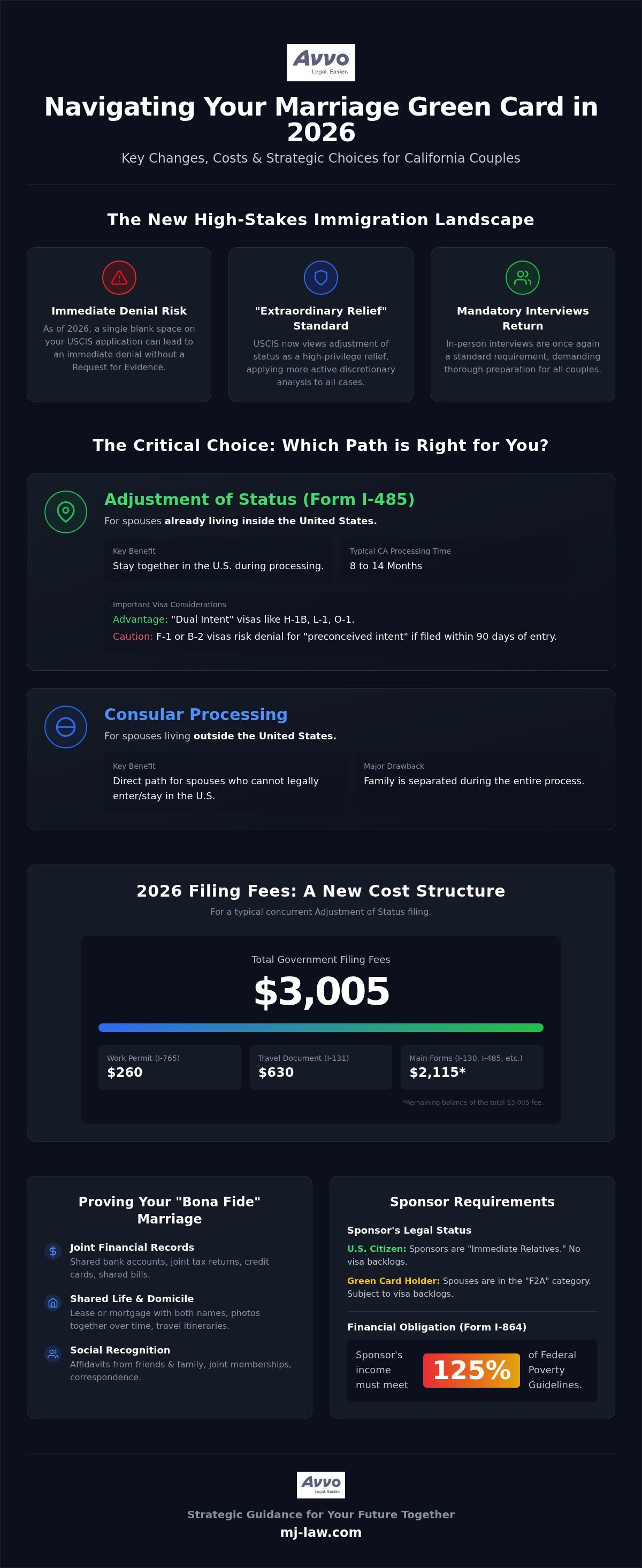
We understand the anxiety that comes with these shifting regulations. This guide offers a clear roadmap to help you navigate the 2026 legal landscape, from managing the new $3,005 total filing fees for adjustment of status to preparing for the return of mandatory in-person interviews. You’ll learn exactly how to secure work authorization and achieve the peace of mind that comes with a successful approval. We’ll explore the latest USCIS scrutiny policies, local San Jose processing trends, and the specific evidence required to satisfy the most rigorous vetting standards.
Key Takeaways
- Understand the strict 2026 standards for “bona fide” marriages and how to establish the legal intent required for a successful petition.
- Identify whether Adjustment of Status or Consular Processing is the most efficient path based on your current location and legal status.
- Learn to compile a robust evidence packet using joint financial records and professional affidavits that meet the heightened scrutiny of USCIS officers.
- Partnering with an experienced marriage green card attorney California ensures your concurrent filing is error-free and your interview preparation is thorough.
- Discover how local San Jose expertise can help navigate the specific procedural nuances and processing times of the California Service Center.
Understanding Eligibility: Who Qualifies for a Marriage Green Card?
Establishing eligibility is the first step in a successful immigration journey. The process involves two primary roles: the petitioner and the beneficiary. The petitioner must be either a U.S. citizen or a Lawful Permanent Resident (Green Card holder) who sponsors their spouse, the beneficiary, for permanent residency. While the legal right to petition is established by statute, the specific requirements for approval have become increasingly rigorous under 2026 USCIS standards. Working with a marriage green card attorney California specialist helps ensure your eligibility is established clearly from the initial filing.
U.S. Citizen vs. Lawful Permanent Resident Sponsors
The sponsor’s legal status dictates the timeline and complexity of the case. Spouses of U.S. citizens are classified as "Immediate Relatives," a category that doesn’t have annual visa caps or waiting lists for priority dates. In contrast, spouses of Green Card holders fall under the F2A preference category. As of 2026, the visa bulletin continues to show significant backlogs for F2A applicants, meaning these couples often face a waiting period before a visa number becomes available for adjustment of status. Beyond status, the petitioner must prove financial stability. Under the I-864 Affidavit of Support requirements, the sponsor’s income must typically meet 125% of the Federal Poverty Guidelines to ensure the beneficiary won’t become a public charge.
The Legal Standard for a Valid Marriage
To qualify, your marriage must be legally valid in the place where it was celebrated. California recognizes marriages performed in other states or countries, including same-sex unions, provided they were lawful at the time of the ceremony. However, a marriage certificate alone isn’t enough to satisfy federal authorities. USCIS focuses heavily on Proving Your Relationship is Genuine by looking for evidence of a shared life. A 2026 bona fide marriage is one entered into in good faith for the purpose of building a life together, rather than solely for obtaining immigration benefits, as evidenced by shared financial, social, and domestic responsibilities.
Couples often overlook "grounds of inadmissibility," which are legal hurdles that can disqualify a beneficiary regardless of the marriage’s validity. These can include previous immigration violations, certain criminal records, or medical issues. Under a USCIS Policy Memorandum effective May 21, 2026, officers are directed to apply a more active discretionary analysis to these cases, framing adjustment of status as "extraordinary relief." This means even minor discrepancies in your history can lead to a denial. A marriage green card attorney California expert can help you screen for these issues early, providing a steady hand to navigate potential complications before they become insurmountable obstacles.
Adjustment of Status vs. Consular Processing in 2026
Choosing between Adjustment of Status and Consular Processing is the most critical strategic decision you’ll make. Location is the primary factor, but your current visa type and long-term travel needs also play vital roles. For spouses already living in California, Adjustment of Status (Form I-485) is usually the most attractive option because it allows the family to stay together during the 8 to 14 month processing window. However, this path requires strict adherence to the Official Eligibility Requirements to avoid denials based on technicalities or missing documentation.
Transitioning from H-1B, L-1, or O-1 Status
Silicon Valley’s workforce often holds H-1B, L-1, or O-1 visas, which are categorized as "dual intent." This is a significant advantage. It means you can apply for a green card without jeopardizing your current work status or facing scrutiny over your original intent to enter the U.S. In contrast, those on F-1 student or B-2 tourist visas must be extremely cautious. Filing for adjustment within 90 days of entry can lead to a presumption of "preconceived immigrant intent," which is a common ground for denial. Managing these nuances is where a marriage green card attorney California couples trust becomes an essential partner in your journey.
While your I-485 is pending, you can secure work authorization and travel documents. Under the 2026 fee structure, the I-765 work permit costs $260 and the I-131 travel document costs $630 when filed alongside the green card application. These documents provide stability, allowing you to maintain your career and visit family abroad while waiting for your mandatory in-person interview. Without these approved forms, leaving the U.S. can result in the automatic abandonment of your green card application.
The Consular Processing Roadmap
If the beneficiary spouse is currently outside the United States, you must proceed through Consular Processing. This path starts with the I-130 petition and then moves to the National Visa Center (NVC). In 2026, the NVC has implemented more sophisticated digital vetting, requiring precise document uploads to avoid delays. Once the NVC clears your file, the beneficiary attends a medical exam and an interview at a U.S. Embassy or Consulate in their home country. While long-distance separation is difficult, this route often avoids the "intent" issues that complicate adjustment cases. To maintain a strong case during the separation, couples should continue documenting their relationship through shared travel records and frequent communication logs. Consulting an experienced marriage green card attorney California can help you decide which path fits your family’s unique timeline and goals.
The California Evidence Checklist: Proving Your Relationship
Proving that your marriage is genuine is the most critical hurdle in the immigration process. In 2026, USCIS has implemented heightened scrutiny, using sophisticated database cross-referencing to identify discrepancies. This means a simple marriage certificate isn’t enough. You must demonstrate a shared life through a curated collection of documents that satisfy the official eligibility requirements for a marriage green card. A marriage green card attorney California expert can help you distinguish between high-value evidence and filler that might confuse an adjudicator.
Financial Co-mingling in Silicon Valley
California’s status as a community property state offers unique ways to prove financial unity. Beyond standard joint bank accounts, Silicon Valley couples should leverage their professional benefits. Adding your spouse as a beneficiary to your 401(k), RSU vesting schedules, or tech company life insurance plans provides compelling evidence of a long-term commitment. Joint tax returns filed in California are also essential. If you’ve secured a lease or purchased a home in the San Francisco Bay Area, these residency records serve as primary proof of your shared domestic life; for those navigating the mortgage process during this transition, you can discover LoansByJB (The Nuhome Team) for specialized assistance. We often advise clients to show active use of joint accounts, as stagnant accounts can sometimes raise red flags during the review process.
Proving Life Together
Documenting your shared journey through 2025 and 2026 involves more than just a few wedding photos. USCIS looks for a consistent narrative of your relationship. This includes travel logs from shared trips, receipts from family celebrations, and birth certificates for any children born of the marriage. Digital footprints, such as social media history and communication logs, are now standard parts of the vetting process. USCIS detects "fraudulent" patterns in documentation by identifying documents that appear staged or lack the natural "messiness" of a real life together, such as insurance policies opened only days before an interview. Affidavits from friends, family, and even Silicon Valley colleagues can provide additional context, but they must be specific and personal to be effective.
At MJ Law, we specialize in helping couples navigate these complexities with a "quality over quantity" approach. We’ve seen how overwhelming it is to gather decades of personal history. Our role is to act as your steady hand, identifying the strongest pieces of evidence that tell your unique story while minimizing the risk of a Request for Evidence (RFE). Partnering with a marriage green card attorney California professional ensures your evidence packet is organized, persuasive, and built to withstand the highest levels of government scrutiny.
Navigating the 2026 Filing Process and Interview
The filing process is a methodical journey that begins with the concurrent filing of the I-130 and I-485 packets. In 2026, USCIS enforcement of the "No Blank Space" policy means a single clerical omission can trigger an immediate denial without a Request for Evidence (RFE). This strict environment makes precision your most valuable asset. Partnering with a marriage green card attorney California expert ensures your initial submission is legally sound and exhaustive. Once your packet is accepted, you’ll receive a notice for your biometrics appointment at a local Application Support Center to provide fingerprints and digital photographs for background checks.
Responding to an RFE requires a high level of strategic detail. Adjudicators now have expanded discretion to deny applications if the initial response is deemed insufficient. Precision in these moments prevents your case from stalling or, worse, resulting in a Notice to Appear in immigration court. A steady hand during this phase is essential to maintain the momentum of your application and protect your legal status.
Digital Filing and 2026 USCIS Updates
The 2026 shift to fully digital evidence uploads has modernized the application experience, but it has also introduced new layers of scrutiny. The modernized USCIS portal allows you to track your case status in real time, yet it also enables officers to use AI-assisted tools to flag discrepancies in financial records or travel logs. You must ensure that every digital document is high-quality and consistent with your physical records. This technology-driven landscape rewards applicants who are organized and proactive in their documentation.
Acing the San Jose Field Office Interview
The mandatory in-person interview is the final, most significant hurdle in the process. For residents of the Silicon Valley area, this usually takes place at the San Jose Field Office. You should dress professionally and arrive with a complete set of original documents, including updated proof of cohabitation. Local officers focus on verifying the validity of your marriage through specific questions about your shared life, household routines, and future goals. Preparation is the key to lowering your anxiety and ensuring a smooth interaction with the adjudicating officer.
While the interview focuses on your relationship, the pressure of proving truthfulness is a common hurdle in legal contexts; understanding how experts like Morgan Polygraph address misconceptions about credibility assessment can provide a unique perspective for those preparing for high-stakes questioning.
To ensure you’re fully prepared, MJ Law provides comprehensive mock interviews that simulate the local field office environment. We offer bilingual support in English and Spanish to ensure both spouses feel confident and accurately represented during the high-stakes conversation. If you’re ready to secure your future and achieve peace of mind, contact MJ Law to schedule your strategy session and begin your journey with a trusted expert guide.
Why Experience Matters: Partnering with MJ Law in San Jose
Choosing a marriage green card attorney California couples can rely on is about more than finding someone to fill out forms. It’s about finding a partner who understands the high stakes of your family’s future. Since 1985, MJ Law has specialized in navigating the evolving landscape of U.S. immigration from our home base in San Jose. Our firm, led by Gabriel Jack and Michael Muston, has spent over 30 years building a legacy of successful outcomes and deep community integration. This experience allows us to act as a steady hand, lowering your anxiety while managing the complex administrative hurdles of the 2026 legal environment.
Our veteran practitioners possess a deep, intuitive understanding of the local immigration landscape. We are familiar with the specific procedural rhythms of the San Jose and San Francisco Field Offices, which is an invaluable advantage during the mandatory in-person interview. We don’t just prepare your paperwork; we prepare you. By providing a personalized, solution-oriented approach, we ensure that the positive outcomes of a successful partnership remain the focus of your journey.
The MJ Law Advantage for Silicon Valley Families
Our firm is uniquely positioned to assist the diverse families of the San Francisco Bay Area. We possess a deep understanding of the professional visa transitions common in Silicon Valley, such as moving from H-1B, L-1, or O-1 status to a family-based green card. We recognize that these cases often involve sophisticated financial backgrounds and specific "dual intent" considerations. To ensure every couple receives clear and empathetic guidance, we provide bilingual representation in both English and Spanish. This inclusive approach reflects our global perspective and our commitment to the specific needs of the modern, high-tech regional economy we call home.
Ready to Start Your Journey?
Taking the first step toward permanent residency should feel like a relief, not a burden. We offer comprehensive support that extends beyond the initial green card approval to include the removal of conditions (I-751) two years later. When you schedule a confidential consultation at our San Jose or San Francisco locations, we recommend bringing your current passport, marriage certificate, and any previous immigration correspondence. This allows us to perform a thorough discretionary analysis of your case from the very first meeting. Our goal is to provide a predictable, methodical roadmap that builds your confidence through a transparent and well-ordered presentation of information.
Schedule your marriage green card consultation with MJ Law today.
Secure Your Future Together in California
Building a life with your spouse in the United States is a significant milestone that requires a clear, strategic legal roadmap. Success in 2026 depends on your ability to meet heightened evidentiary standards and navigate the nuances of either adjustment of status or consular processing. By focusing on quality documentation and thorough interview preparation, you can avoid common pitfalls. You don’t have to face this complex system alone. Partnering with a dedicated marriage green card attorney California expert ensures that your application is handled with the precision and authority your future deserves.
Our team brings over 30 years of immigration law experience to every case we manage. With convenient office locations in San Jose and San Francisco, our bilingual English/Spanish legal team provides the stable support necessary to navigate complex administrative hurdles. We are committed to acting as your trusted guide, bridging the gap between your family and the requirements of USCIS. Contact MJ Law for a Professional Marriage Green Card Consultation to begin your journey. We look forward to helping you achieve the peace of mind that comes with a successful green card approval and a stable life together.
Frequently Asked Questions
How long does the marriage green card process take in California in 2026?
Average processing times in 2026 range between 8 and 18 months for most California applicants. Specifically, the I-485 adjustment of status takes approximately 8 to 14 months, while the I-130 petition for immediate relatives averages 10 to 15 months. These timelines vary based on the specific field office and case complexity. Working with a marriage green card attorney California couples trust can help minimize delays caused by administrative errors or missing documentation.
Can I work in the U.S. while my marriage green card application is pending?
Yes, you can apply for an Employment Authorization Document (EAD) by filing Form I-765 alongside your green card application. In 2026, the fee for this work permit is $260 when filed with an I-485 adjustment packet. Once approved, you’re legally permitted to work for any U.S. employer while your permanent residency case is pending. This provides essential financial stability and professional continuity for families during the government’s review period.
What happens if our marriage green card application is denied?
A denial can have serious consequences, including the potential issuance of a Notice to Appear (NTA) for removal proceedings. In 2026, USCIS policies allow officers to deny petitions for minor errors without first issuing a Request for Evidence. If your case is denied, you may have the option to file a motion to reopen or appeal the decision. It’s critical to seek a marriage green card attorney California expert immediately to evaluate your remaining legal options.
Do I need to be a U.S. citizen to sponsor my spouse for a green card?
You don’t need to be a U.S. citizen; Lawful Permanent Residents can also sponsor their spouses under the F2A preference category. However, spouses of citizens are "immediate relatives" and aren’t subject to annual visa caps or priority date waitlists. Spouses of permanent residents may face longer wait times due to current visa bulletin backlogs. Both paths require meeting specific income and relationship requirements to ensure the beneficiary doesn’t become a public charge.
What is the "90-day rule" and how does it affect my application?
The 90 day rule is a rebuttable presumption which is to say that if you happen to get married within the 90 days of your arrival to the United States, it does not necessarily mean that you can be assumed to have permanent intent when you arrived and still eligible for permanent resident status based on an Adjustment of Status filing.
Will we have to attend the green card interview together in San Jose?
Yes, both spouses must attend the mandatory in-person interview at the San Jose Field Office or the office assigned to your jurisdiction. As of 2026, USCIS has eliminated interview waiver provisions for all marriage-based cases. This meeting is designed for the officer to verify the legitimacy of your marriage through direct questioning about your shared life. Preparation is essential to ensure you can confidently discuss your household routines and shared financial responsibilities.
What is a conditional green card and how do I remove the conditions?
If you’ve been married for less than two years when your green card is approved, you’ll receive a conditional residency valid for two years. To remain a permanent resident, you must file Form I-751 within the 90-day window before your card expires. In 2026, the filing fee for this petition is $750 for mail filing or $700 for online filing. This process removes the "conditional" status and grants a permanent 10-year green card.
How much are the USCIS filing fees for a marriage green card in 2026?
Total government fees for a typical adjustment of status package in 2026 are approximately $3,005. This includes the I-130 petition ($675), the I-485 application ($1,440), and the work and travel permit fees. If the spouse is abroad, consular processing fees range from $1,305 to $1,540. You should also budget between $200 and $500 for the mandatory medical examination, which is paid directly to a USCIS-authorized civil surgeon.