
A senior-sounding title alone doesn’t make an L-1A petition persuasive. The case needs to connect the employee’s actual duties to the company’s organizational structure and U.S. business needs, while clearly documenting the relationship between the foreign and U.S. entities. An L-1A intracompany transfer attorney can help employers and transferees bring those pieces together.
If you’re unsure whether the role qualifies as managerial or executive, or which records the employer should provide, you’re not alone. Preparing a petition involves more than collecting forms: the evidence and explanation need to present a consistent account of the employee’s responsibilities, the companies’ relationship, and the planned U.S. operation. Careful preparation can help identify gaps before filing, though no attorney can guarantee an outcome.
This article explains how legal counsel supports L-1A case preparation, which company and employee records to organize, and what to bring to an initial consultation. MJ Law is an immigration law firm in San Jose that assists businesses and professionals with L-1 work visas. You’ll also learn how to clarify the employer’s role in the filing and identify a practical next step with counsel.
Key Takeaways
- An L-1A intracompany transfer attorney can assess how the company structure, the employee’s duties, and the transfer plan fit together in the petition.
- Build the case around relevant evidence that supports specific claims, rather than submitting a large, unorganized file.
- HR and company leaders contribute essential operational knowledge; legal counsel helps assess how to present the facts clearly.
- Before a consultation, gather available records about the companies, the employee’s work history, and the proposed U.S. role. Not every document applies to every case.
- MJ Law serves businesses and professionals in San Jose and San Francisco in L-1 matters.
Why an L-1A Intracompany Transfer Attorney Can Matter to Your Case
A clear petition does more than describe a senior employee moving to the United States. It must explain how the U.S. petitioner and foreign organization are connected, what the employee has done abroad, and what role the employee will perform in the United States. These elements need to support one coherent account of the proposed transfer. An L-1A intracompany transfer attorney can analyze the facts and help the employer present them consistently, but legal representation cannot guarantee approval.
The work involves both company eligibility and the employee’s qualifications for the proposed position. A useful starting point for understanding the category is this L-1 Visa Overview. For a specific petition, general descriptions aren’t a substitute for applying current requirements to the company’s structure, records, and transfer plans.
What an L-1A attorney evaluates before filing
Counsel can review records showing the relationship between the U.S. petitioner and the foreign organization, then compare them with the employee’s work history and proposed U.S. duties. The review may uncover gaps, such as an organizational chart that conflicts with a role description, or company records that don’t clearly explain how the entities operate together. Identifying these issues early gives the employer time to clarify the facts and locate supporting records.
When a transfer raises additional planning questions
A transfer connected to a new U.S. office calls for focused planning because the petition must explain the proposed operation alongside the employee’s role. Company structures may also change through growth, reorganizations, or shifts in reporting lines. If older records describe a different structure from current materials, counsel can help assess what needs explanation. The executive or managerial label alone isn’t enough; the employee’s actual responsibilities must be evaluated under the applicable legal definitions.
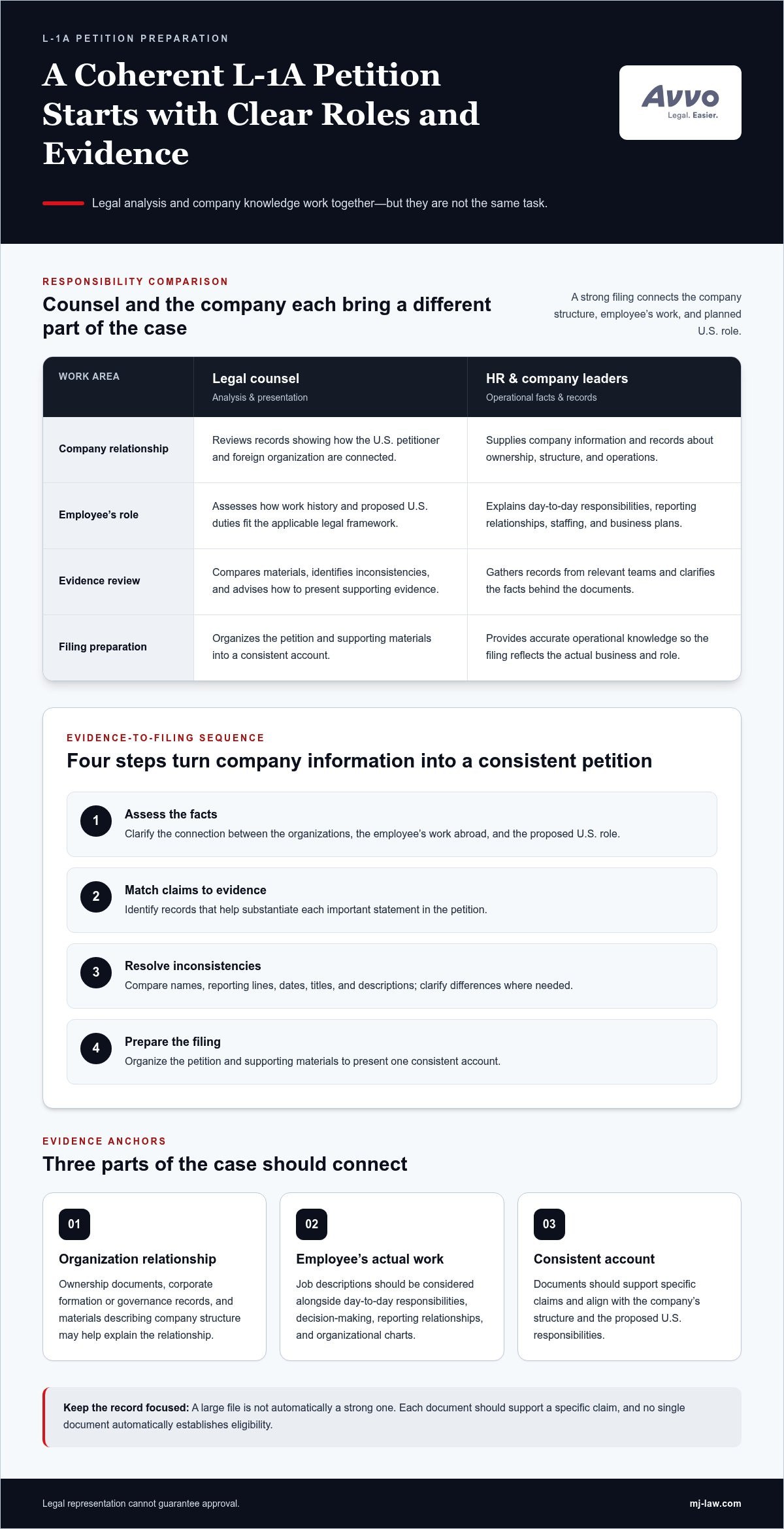
Legal analysis and internal coordination are related, but they aren’t the same task. HR and company leaders supply essential facts about reporting relationships, staffing, business plans, and the employee’s day-to-day responsibilities. They also gather records from the relevant teams. Counsel assesses how those facts fit the legal framework, identifies inconsistencies across materials, and advises on how to present the evidence. A large file isn’t automatically a strong one; each document should support a specific claim in the petition.
This article focuses on selecting legal support and preparing for that collaborative process. It can help employers and transferees understand what counsel may assess, but it isn’t a substitute for case-specific legal advice. Relevant facts differ between companies, and preparation depends on the circumstances of the petition. An early review can clarify what needs attention before filing, without making the outcome certain.
How an L-1A Attorney Builds a Coherent Petition from Company Evidence
A petition is more persuasive when its documents work together to explain the company relationship and the employee’s proposed role. An L-1A intracompany transfer attorney can help turn company records and employment details into a clear, evidence-based filing. The goal isn’t to collect as much paperwork as possible. Each item should support a specific fact the petition asserts.
A persuasive petition aligns corporate records, employment history, and job duties. The right evidence depends on the companies’ structure and the facts of the case. A sequence-based review can keep the record focused:
- Assess the facts. Clarify how the U.S. petitioner and foreign organization are connected, what the employee has done abroad, and what the U.S. role will involve.
- Identify supporting evidence. Match each important statement to records that help substantiate it.
- Resolve inconsistencies. Compare documents for differences in names, reporting lines, dates, titles, or descriptions, and determine whether those differences need clarification.
- Prepare the filing. Organize the petition and supporting materials to present a consistent account.
Connecting the U.S. and foreign organizations
Records that may help explain the relationship between organizations include ownership documents, corporate formation or governance records, and materials describing how the entities are structured. Which records matter depends on the companies’ circumstances. No single document automatically establishes eligibility; the evidence and descriptions should make the relationship understandable and consistent. If an organizational chart and corporate records appear to show different structures, the discrepancy may need a clear explanation supported by the facts.
Explaining the employee’s qualifying role
Job titles alone don’t show what an employee actually does. Counsel can compare written job descriptions with information about day-to-day responsibilities, decision-making, and reporting relationships. Organizational charts can show who reports to the employee and where the role sits within the business. The petition should distinguish executive or managerial responsibilities from routine operational work, using details that reflect the actual position rather than relying on broad labels.
Organizing the filing and supporting record
As evidence comes together, counsel can identify missing information and flag conflicting details for the employer to clarify. USCIS guidance identifies Form I-129 as the employer petition for an L-1 worker. The filing should connect the form’s statements to the supporting record, rather than leave reviewers to infer how separate documents fit together. For broader background, readers can also consult the L-1A visa requirements and transfer guidance in this article.
Employers can help by assigning clear points of contact for corporate, HR, and business records, then responding to requests for clarification with accurate information. To discuss how the company’s evidence fits together, you can schedule an immigration consultation.
L-1A Attorney or In-House Preparation: How to Compare Your Options
Company teams know how the business operates, while immigration counsel focuses on how the facts fit the legal requirements. These roles complement each other. Complete corporate records can help document an organization’s structure, but they don’t automatically establish whether the employee’s duties or proposed role meet the relevant criteria. The right division of work depends on the company’s structure and the complexity of the case.
| Preparation area | Company leaders and HR | Legal counsel |
|---|---|---|
| Legal analysis | Explain the business and the employee’s actual responsibilities. | Assess the facts against applicable immigration requirements. |
| Document coordination | Locate company, employment, and organizational records; respond to requests. | Identify relevant evidence, gaps, and inconsistencies, then organize the filing. |
| Internal business knowledge | Clarify reporting relationships, operations, and the purpose of the transfer. | Use those details to shape a legally focused presentation. |
What company leaders and HR contribute
Employers provide accurate role descriptions, reporting structures, and company records. Business leaders can explain how the employee’s work supports operations and where decisions are made. HR can coordinate materials across teams and help ensure responses are complete and consistent. Prompt follow-up matters: delays or conflicting descriptions can make the facts harder to understand and the record more difficult to prepare.
What legal counsel contributes
An L-1A intracompany transfer attorney can review the company relationship, employment history, and role evidence together, rather than treating each document in isolation. Counsel can identify legal questions, flag discrepancies for clarification, and organize the filing around the case’s specific facts. This analysis can strengthen preparation, but counsel cannot control USCIS decisions or remove every risk.
When company circumstances call for closer coordination
Closer coordination may be useful when the U.S. office is new, ownership is complex, or the organization has changed. A role description that emphasizes leadership while everyday duties appear primarily operational also deserves careful review. The employer should reconcile the written description with the actual work, not reshape the facts to fit a preferred label.
Think of preparation as a shared process: the company supplies reliable operational detail, and counsel evaluates how to present it. A complete set of records is a starting point, not a substitute for analyzing what those records establish. Different visa categories also have distinct rules. An H-1B job-change situation, for example, should be considered under its own framework rather than assumed to follow the L-1 intracompany transfer process.
What to Prepare Before Meeting an L-1A Intracompany Transfer Attorney
You don’t need to build a finished petition before speaking with counsel. A concise overview and the records already available can help an L-1A intracompany transfer attorney understand the company, employee, and proposed transfer. Organizing information early can help identify missing facts before filing preparation. Not every item below will apply to every case, so focus on what you have and flag anything uncertain rather than filling gaps with assumptions.
Company and transfer information to organize
Start with a short description of each organization and how the U.S. and foreign entities are related. Add a plain-language summary of why the transfer is planned and what the U.S. operation is expected to involve. Existing records can show how the business is structured and where the proposed role fits.
- A brief history of the U.S. and foreign entities, including relevant ownership or structural changes.
- Available corporate records and organizational charts that show the relationship and reporting structure.
- A summary of the U.S. business purpose, office plans, and proposed position.
Employee history and proposed duties to outline
Prepare a factual timeline of the employee’s work for the foreign organization, with dates and a short description of responsibilities. Then outline the proposed U.S. duties in everyday language. Be specific about decision-making authority, reporting relationships, and the work the employee will oversee or perform. The aim is to describe the actual role, not just its title.
- Work history and role descriptions for the employee’s foreign position.
- A draft outline of U.S. responsibilities, decision-making, and reporting lines.
- Existing immigration records relevant to the transfer, such as prior filings or status documents.
Questions that make the consultation more productive
Use the meeting to understand how the case will be assessed and how the employer can support preparation. Ask about the company relationship and role evidence, as well as who will coordinate records and communicate with stakeholders. If there have been prior immigration filings, company changes, or inconsistencies between records, raise them early. That context helps counsel assess the facts accurately.
- Which facts and records will be central to evaluating the corporate relationship and proposed role?
- Who should coordinate document collection and respond to questions from counsel?
- How will case-specific preparation proceed, and how will the employer receive filing updates?
MJ Law serves businesses and professionals in San Jose and San Francisco. To discuss your company’s transfer plans and the records you’ve gathered, schedule an L-1A consultation.
Work with an L-1A Intracompany Transfer Attorney in San Jose
For Silicon Valley companies planning an intracompany transfer, the business context matters. A proposed role may sit within a growing organization, involve teams across borders, or depend on a new U.S. operation. MJ Law is a San Jose immigration law firm serving individuals, families, and businesses with immigration matters, including L-1 work visas. The firm assists businesses and professionals in San Jose and San Francisco.
Consultations are available in English and Spanish. Employers and transferees can explain the situation in the language that feels most comfortable and raise questions about the transfer’s facts. A consultation is an opportunity to discuss the case, not a promise of eligibility, approval, or a particular processing timeline.
A structured conversation about your company’s transfer
A productive discussion can begin with three connected topics: how the companies are structured, what the employee’s current and proposed roles involve, and when the business hopes to make the transfer. These details help frame the questions counsel may need to explore. If the company is establishing a U.S. office or has recently changed its ownership or reporting structure, include that context rather than treating it as background.
Bring the concise notes and existing records outlined in the previous section. A short timeline, available organizational charts, relevant company documents, and prior immigration records can help focus the discussion. You don’t need to resolve every discrepancy before the meeting. Clearly mark information that is incomplete or inconsistent so it can be addressed directly.
It may also help to include the people who can explain different parts of the transfer. For example, an HR contact may know the employee’s work history, while a business leader can describe the proposed position and its place in the U.S. operation. Coordinated input gives the discussion a practical starting point without requiring the company to reach legal conclusions on its own.
Plan your next step with MJ Law
Use the consultation to raise case-specific legal questions, understand what additional facts may be relevant, and discuss how the employer and transferee can contribute to preparation. You can also review the L-1A transfer case overview alongside your notes to organize questions about the classification and transfer process. The firm’s role is to assess the circumstances and provide legal guidance, not to promise a result.
Whether you’re an employer planning a transfer or an employee preparing to discuss a proposed role, a focused conversation can help clarify what to examine next. MJ Law works with businesses and professionals on immigration matters, with consultations available in English and Spanish. Schedule an L-1A consultation to discuss your company’s transfer plans and questions.
Take the Next Step with a Clear Plan
A transfer plan is easier to assess when the employer and employee agree on the facts that need explaining. Before moving ahead, identify open questions about the company structure, the employee’s responsibilities, or the timing of the proposed move. Bringing those questions to an L-1A intracompany transfer attorney can help turn uncertainty into a practical plan for case-specific review.
MJ Law works with employers and transferees on L-1 matters, with consultations available in English and Spanish. Use a conversation to discuss your circumstances and identify what information may be useful to organize next. No consultation can guarantee a petition outcome, but legal guidance can help you make informed decisions about preparation.
Schedule an L-1A consultation to discuss your transfer plans with MJ Law.
Frequently Asked Questions
Can a company file an L-1A petition without an attorney?
Yes, an employer may prepare an L-1A petition internally, but it remains responsible for accurate information and supporting evidence. Internal preparation may work for a company with a clear structure and well-documented transfer facts. If records use different titles or show changing reporting lines, legal review can help identify questions that need attention. The employer should assess its resources and the case’s complexity before deciding how to prepare.
What does an L-1A intracompany transfer attorney do?
An L-1A intracompany transfer attorney reviews the relationship between the U.S. petitioner and foreign organization, the employee’s work history, and the proposed U.S. position. Counsel can assess which facts need support, prepare the employer’s petition, and explain filing responsibilities. MJ Law serves businesses and professionals in San Jose and San Francisco in L-1 matters. An attorney can provide case-specific guidance, but can’t control government processing or guarantee approval.
How long can an employee stay in the United States on L-1A status?
L-1A status can allow a maximum stay of seven years, subject to applicable rules and the employee’s circumstances. The initial period and extension considerations may differ for a new U.S. office compared with an established operation. Employers should consider the employee’s prior time in L-1 status and planned role when assessing timing. Review current USCIS guidance and get legal advice before making travel or employment decisions.
Can an L-1A employee bring a spouse and children to the United States?
Certain qualifying spouses and unmarried children under 21 may be eligible for L-2 dependent classification. Each family member’s application depends on the principal employee’s case and applicable requirements. An L-2 spouse may have work authorization incident to status, subject to the rules and documentation that apply. Families should account for individual travel plans and records, and discuss how dependent applications fit with the employee’s transfer.
How much does hiring an L-1A intracompany transfer attorney cost?
Legal fees vary with the work required, company structure, and case complexity, so there isn’t one amount that applies to every L-1A matter. Government filing fees are separate from legal fees and may change. In a consultation, employers can discuss the proposed scope of legal work, what it covers, and which current filing requirements may apply. Avoid budgeting from old fee information without checking its relevance to the petition.
What documents should I bring to an L-1A attorney consultation?
Bring a short company overview, the employee’s work timeline, and a plain-language description of the proposed U.S. duties. Available organizational charts, corporate records, office plans, and earlier immigration filings can provide useful context. You can organize electronic copies by company and topic, then make a brief list of missing records or conflicting details. Not every document applies to every case, so bring what’s available rather than delaying to create a complete file.