
An L-1 transfer turns on more than moving an employee between offices. An L-1 visa transfer lawyer in Silicon Valley can help assess whether the companies have a qualifying relationship, whether the role fits the appropriate category, and how to present the supporting evidence. Legal help may be especially useful when those details are complex or the petition needs careful coordination.
Costs depend on the case and the legal work involved, including petition preparation and filing requirements. There is no single fee for every transfer, so clarify what the legal work covers and which separate expenses may arise.
This article explains when legal representation may be useful, what costs an L-1 petition may involve, and how the employee’s role, the companies’ relationship, and the evidence shape the case. It also outlines the records that can support an employer’s petition, helping you see where legal guidance fits into the transfer process.
Key Takeaways
- Legal help can clarify how the employee’s proposed duties, work history, and supporting records fit the L-1 category.
- A transfer depends on more than the employee’s qualifications: the relationship between the U.S. and foreign businesses also matters.
- Employer support may draw on company records and evidence explaining the employee’s position and planned work in the United States.
- According to U.S. Citizenship and Immigration Services, L-1A status in the United States has a maximum stay of 7 years.
- Legal costs vary with the work involved in assessing the case, preparing the petition, and organizing its supporting evidence.
Petition documentation and employer support letters
An L-1 petition needs evidence about both the U.S. employer and the employee’s qualifications. The records should support the role, company relationship, and transfer described in the petition.
Foreign Company Supporting Documents
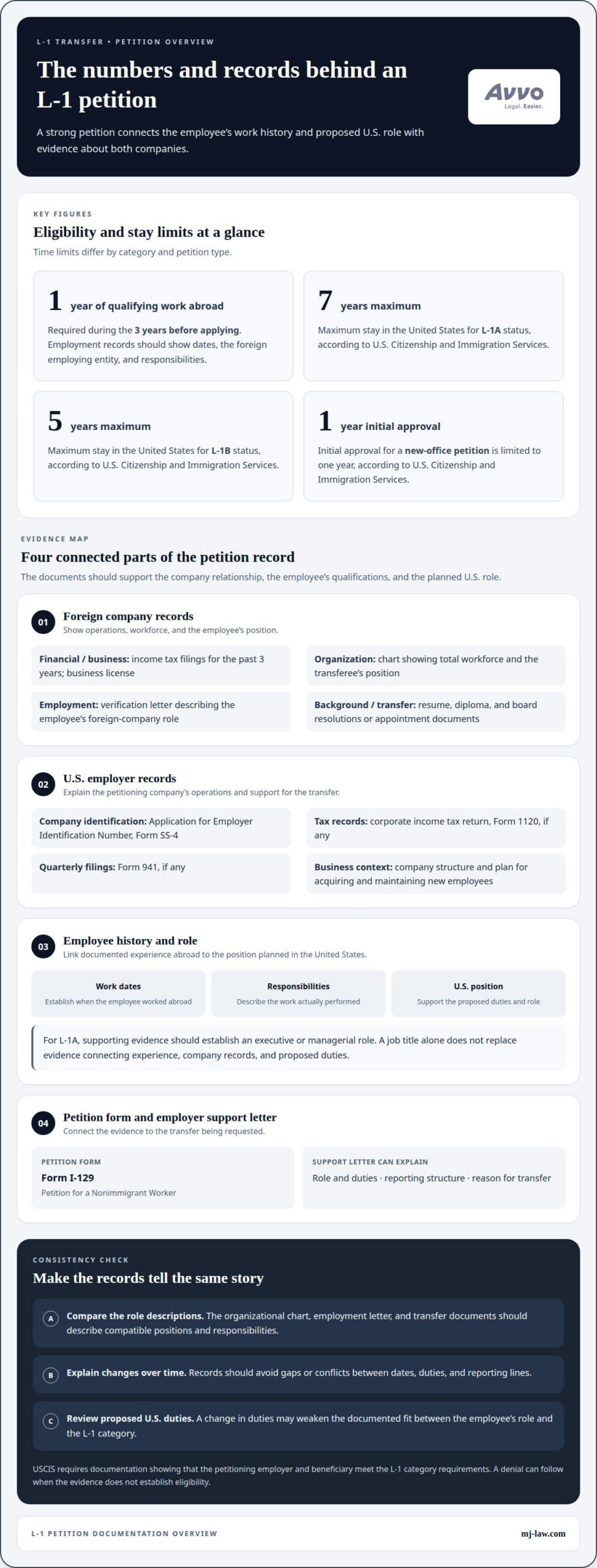
Foreign company records can describe its operations, workforce, and the employee’s position. These documents help show the employee’s work history and the company’s role in the transfer. Supporting records may include income tax filings for the past three years, a business license, and an organizational chart showing the total workforce and the transferee’s position.
An employment verification letter can describe the employee’s role with the foreign company. A resume and diploma add detail about work experience and education, while board resolutions or appointment documents can document the transfer to the United States. Together, these records should tell a consistent story: the chart, letter, and transfer documents should describe compatible positions and responsibilities.
U.S. employer documents help explain the petitioning company’s operations and its support for the transfer. Depending on the company, records may include an Application for Employer Identification Number, Form SS-4, a corporate income tax return, Form 1120, if any, and quarterly tax filings, Form 941, if any. A company structure and plan for acquiring and maintaining new employees can also provide context.
Employer support letters should connect the company’s records to the employee’s proposed U.S. position. A letter can explain the role, duties, reporting structure, and reason for the transfer. Details should align with the organizational chart and petition evidence. USCIS requires documentation showing that the petitioning employer and beneficiary meet the L-1 category’s requirements.
A denial can follow when the petition evidence does not establish the employer’s or employee’s eligibility. A change in job duties may weaken the documented fit between the employee’s role and the L-1 category, so the proposed duties deserve careful review.
L-1A and Petition Documentation
L-1A supporting documentation should establish the employee’s executive or managerial role and the position planned in the United States. Form I-129, the Petition for a Nonimmigrant Worker, is part of the L-1 petition documentation. The supporting evidence should connect the employee’s experience, company records, and proposed duties rather than relying on a job title alone.
According to U.S. Citizenship and Immigration Services, L-1A status in the United States has a maximum stay of 7 years, while L-1B status in the United States has a maximum stay of 5 years. For a new-office petition, initial approval is limited to one year, according to U.S. Citizenship and Immigration Services. Those time limits make accurate records about the petition category and U.S. role especially important.
Do I Need a Lawyer for an Intracompany Transfer?
Legal help can be useful when employment history, job duties, or company records need careful alignment. The central question is whether the employee and employer can support the L-1 classification with consistent evidence.
Transferee Qualifications and Foreign Employment
The employee’s qualifications include prior work abroad and the ability to perform the proposed U.S. role. The petition needs to connect documented experience to the position in the United States.
The qualifying employment test centers on at least 1 year of work abroad during the 3 years before applying. Employment records should establish when the employee worked, which foreign entity employed them, and what responsibilities they held. For example, an employment letter and organizational chart can help explain the employee’s position and reporting structure.
A lawyer can review whether the records tell a consistent story before the employer files. The review should distinguish qualifying employment abroad from a senior-sounding job title unsupported by evidence of the actual work. If responsibilities changed over time, the records should explain those changes and avoid gaps between dates, duties, and reporting lines.
This review is especially useful when the employee’s prior role or proposed U.S. duties are difficult to summarize. The employer provides company and employment records; counsel assesses how they support the petition’s description.
Choosing Silicon Valley Immigration Counsel
Choose immigration counsel with experience assessing L-1 petitions, foreign employment records, and the employer’s organizational evidence. That focus matters because the petition depends on how the employee’s qualifications and company structure fit together, not simply on a prepared form.
Ask counsel to explain the evidence needed, identify potential gaps, and describe how changes in duties could affect the case. Firms handling employment-based immigration may offer consultations, but the relevant discussion should address the employee’s history and the specific U.S. role. A consultation is also a chance to understand the proposed scope of legal work.
Which Silicon Valley law firms handle transfers and offer consultations? Look for immigration practices that handle L-1 matters and can discuss the employer’s and employee’s records directly. For a focused discussion of an employment-based immigration matter, schedule an immigration appointment.
A spouse and children under 21 may obtain L-2 visas, which have the same terms as the principal L-1 holder’s visa. An L-2 derivative who needs work authorization must apply after arriving in the United States; Form I-539 may be filed to change or extend L-2 status.
Transfer Timing and Premium Processing
An L-1 transfer timeline includes preparation of the petition and the agency’s review. It matters because employer records, foreign employment evidence, and the proposed role must be assembled into a consistent filing.
How long does a transfer take, including premium processing? There is no single timeline for every petition. Preparation time depends on how quickly the employer and employee provide complete records. Premium processing affects the agency response stage, not the time required to prepare the evidence.
Counsel can map the work involved by identifying missing employment records, resolving inconsistencies, and organizing supporting documents. A transfer with clear records may take different preparation from one involving changing duties or incomplete organizational evidence. This distinction helps employers plan the filing process without mistaking an agency response timeframe for the full case timeline.
Executive, managerial, and specialized-knowledge roles
An L-1 beneficiary must qualify for an executive, managerial, or specialized-knowledge capacity. The petition’s role description should explain the work itself, not rely on a title alone. For example, “director” does not tell the full story unless the evidence describes the employee’s responsibilities, decision-making, and place within the organization. A lawyer can assess whether the proposed duties and employment records support the selected category.
Executive and managerial roles need a clear account of the employee’s function within the organization. The employer’s chart can show reporting relationships and the position’s place in the company. A detailed description should connect responsibilities to that structure. For example, if the employee directs a business function, the petition can explain what the function covers and how the employee’s work relates to it.
A managerial role description should make the employee’s work clear. An organizational chart may show titles and reporting lines, but not what the employee does. The petition should describe duties in practical terms and align them with the employer’s account of the U.S. position. If the foreign and U.S. roles differ, the evidence should explain the transition rather than treating the titles as interchangeable.
A specialized-knowledge role needs a focused explanation of the knowledge the employee brings to the U.S. position. The petition should connect that knowledge to the employee’s work and explain its relevance to the company’s operations. A resume may establish experience, while role descriptions show how that experience relates to the transfer. Broad phrases such as “technical expert” provide less context than concrete examples of the work and knowledge involved.
For each category, the employer’s and employee’s records should support the same account. Counsel can review the job description, employment verification, resume, and organizational chart together, then flag gaps or conflicting descriptions. A mismatch between the stated role and supporting evidence can make the claimed capacity harder to assess.
- Executive: Explain the employee’s organizational function and responsibilities.
- Managerial: Connect duties to the company structure and reporting relationships.
- Specialized knowledge: Describe the knowledge and its relevance to the U.S. role.
Changes in duties need careful attention during preparation. If the employee’s responsibilities have evolved, the records should make that progression clear. For example, a prior role focused on technical work may differ from a proposed position with broader organizational responsibilities. A precise explanation helps distinguish experience already gained from duties planned in the United States.
Qualifying multinational company relationships
An L-1 petition must connect the U.S. employer to a related business abroad. The company must operate in the United States and at least one other country, with a qualifying relationship such as a branch, subsidiary, or affiliate. The corporate relationship matters because the employee’s transfer must link the two businesses, not merely describe a move between unrelated employers.
The relationship receives review under 8 CFR § 214.2(l). A petition therefore needs to identify which relationship applies and present a consistent account of the companies involved. For example, if the U.S. petitioner and foreign business are described as affiliates, the evidence should explain that connection clearly. Calling them related without showing how they relate leaves the central corporate link unexplained.
Each corporate structure needs a clear explanation. A branch, subsidiary, or affiliate describes a different relationship between businesses, so the petition should use the correct term throughout. Company records, business descriptions, and organizational information can help show which entities operate in each country and how they are connected. Counsel can assess whether the employer’s account matches the supporting documents.
A useful review traces the company relationship from the foreign operation to the U.S. petitioner. The petition should identify each entity’s role and explain how the qualifying relationship supports the transfer. If the foreign company’s organizational chart identifies one entity but the petition names another, the mismatch may obscure that relationship. Clear entity names and consistent descriptions help the evidence tell a coherent story.
The foreign company’s records also provide context. An organizational chart can show its employees and the transferee’s position, while a business license can identify the foreign operation. These records do not replace an explanation of the corporate connection, but they can help establish which business is involved and where the employee worked.
For the U.S. employer, company structure and operational plans can help explain its role. The petition should distinguish the petitioner from related entities and show how the U.S. business fits within the multinational organization. If several corporate entities appear in the records, explaining each entity’s role can prevent confusion about names or functions.
- Identify the entities: Name the U.S. petitioner and foreign business consistently.
- Describe the connection: State whether the relationship is a branch, subsidiary, or affiliate.
- Align the records: Keep company descriptions and organizational information consistent.
A lawyer’s review can flag gaps between the corporate description and the records before filing. The key question is whether the evidence supports the specific qualifying relationship claimed. A well-organized explanation makes the connection easier to follow, while inconsistent entity names or unclear roles can make the basis for the transfer harder to establish.
Can an L-1 visa holder change employers or transfer to a new U.S. company?
An L-1 holder can’t assume the existing approval automatically covers a different U.S. employer. The proposed employer must be able to support an L-1 petition, including evidence of a qualifying relationship with the foreign company and a role that fits the category. The key question is whether the new arrangement still meets those requirements.
If the new U.S. company is a branch, subsidiary, or affiliate of the foreign business, that relationship may provide a basis for review. The petition must identify the entities and explain how they are connected. For example, a transfer to another U.S. affiliate still requires evidence connecting that affiliate to the foreign operation. Shared branding or a business partnership alone doesn’t establish the qualifying relationship described for L-1 petitions.
A move to an unrelated U.S. company presents a different issue. The L-1 category depends on a qualifying multinational company relationship, so an unrelated employer cannot rely solely on the employee’s existing L-1 approval. The employee’s skills or prior approval don’t replace the need to establish the relationship required for the proposed petition.
The new employer’s petition also needs to describe the proposed position accurately. If the employee moves from a specialized-knowledge role to managerial duties, for example, the petition must support the relevant capacity through the evidence. A different title alone doesn’t establish that the new work fits an L-1 category. The employee’s experience, the employer’s organizational structure, and the duties should tell a consistent story.
Coordinate the transition with petition preparation. The proposed employer and employee should organize records about the foreign company, the U.S. entity, and the new role. Counsel can assess whether the corporate relationship qualifies, identify evidence gaps, and consider whether the proposed duties align with the petition category. This review helps distinguish a transfer within a qualifying multinational structure from a move that calls for a different immigration path.
Before accepting a new position, clarify which entity will file the petition and how it relates to the foreign company. For example, a group may have several U.S. subsidiaries, but the petition should identify the actual employing and petitioning entities. A change in payroll entity or reporting structure can affect how the arrangement is described, so the petition should reflect the actual employment plan.
Approval of an L-1 petition doesn’t guarantee visa issuance. The employee’s next steps depend on the petition and their circumstances, including whether they are inside or outside the United States. An immigration lawyer can evaluate the proposed employer, corporate relationship, role, and timing together. To discuss a potential employer change, schedule an L-1 transfer consultation.
MJ Law
MJ Law helps employees and employers assess L-1 transfer questions through its employment-based immigration practice. Legal guidance can be useful when the proposed U.S. role, foreign employment history, or relationship between companies needs careful review. The firm can help organize the petition strategy around the employee’s qualifications and the employer’s supporting evidence, so the filing presents a clear account of the transfer.
If a change in duties or a new U.S. employer raises questions about eligibility, an immigration lawyer can review how those facts fit together before the petition is prepared. To discuss your L-1 transfer circumstances, contact MJ Law.
Prepare for a Clear Next Step
Before moving forward, bring the proposed role and employer change into one conversation. An L-1 visa transfer lawyer in Silicon Valley can help evaluate the legal work involved and explain how the circumstances shape the next step. That discussion can also clarify the scope of representation and the costs associated with the case, without relying on a generic estimate.
MJ Law’s immigration practice includes Employment-Based Visas, Business and Investor Visas, and Family Immigration Services. This broader perspective can help when a transfer raises related questions for an employee or family. The aim is to understand the situation and identify a practical path forward, rather than assume every transfer follows the same course.
When you’re ready to discuss your circumstances, contact MJ Law about your L-1 transfer. A focused conversation can help you approach the next decision with greater clarity.
Frequently Asked Questions
Who Qualifies for an L-1 Visa?
An employee may qualify if they have worked abroad for a qualifying related business and will fill an executive, managerial, or specialized-knowledge role in the United States. The foreign employment requirement is at least one year during the three years before applying. The U.S. petitioner must also show a qualifying relationship with the foreign business. An L-1 visa transfer lawyer in Silicon Valley can assess how the employee’s records support these criteria.
What is an L-1 visa transfer and who qualifies?
An L-1 transfer allows a qualifying multinational business to petition for an employee to work at its U.S. operation. The employee’s prior foreign work and proposed U.S. role must fit the relevant L-1 category. A move to a different U.S. company isn’t automatically covered by an existing approval. The new petitioning entity must support the required relationship with the foreign business and document the proposed employment arrangement.
What are the L-1A and L-1B eligibility requirements for a transfer to the United States?
L-1A applies to employees transferring in an executive or managerial capacity; L-1B applies to employees transferring in a specialized-knowledge capacity. Both categories require qualifying employment abroad and a qualifying relationship between the U.S. petitioner and foreign business. According to U.S. Citizenship and Immigration Services, maximum stay in the United States is 7 years for L-1A and 5 years for L-1B. The petition evidence must support the selected category.
How can an immigration lawyer manage the steps for an L-1 employer transfer, and what documents should the employer and transferee provide?
An L-1 visa transfer lawyer in Silicon Valley can coordinate the employer’s evidence with the transferee’s employment history, then prepare and file Form I-129. The employer may provide company records such as Form SS-4 and, if any, Forms 1120 or 941. The transferee’s records may include a resume, diploma, and foreign employment verification. Counsel can identify inconsistencies, such as conflicting role descriptions, before filing. In San Jose and San Francisco, local counsel can coordinate with the employer and employee.
What are the USCIS filing fees and typical lawyer fees for an L-1 transfer?
Plan for separate USCIS filing charges and attorney fees; the total depends on the petition and legal work involved. Applicable filing charges depend on the filing, while attorney fees reflect factors such as case complexity and the scope of preparation, filing, and representation. Attorney fees are provided after a quote request. A useful fee discussion clarifies what work is covered and which costs are separate, without assuming every transfer requires the same level of support.
Can my spouse and children remain in L-2 status during an L-1 transfer?
A spouse and children under 21 may obtain L-2 visas, which have the same terms as the principal L-1 holder’s visa. Form I-539 may be filed to change or extend L-2 status.