
A sound immigration strategy starts with the facts, not a form. An immigration legal consultation in San Francisco can help clarify how your history, goals, and available documents shape possible visa pathways or green card options. A case evaluation also helps identify questions and potential issues to address before deciding on next steps.
It’s understandable to want clear direction when an immigration decision may affect your family, work, or future in the United States. A careful consultation can make your options easier to understand without treating every case as the same.
This article explains what a case evaluation may cover, how professionals assess visa and green card pathways, and what information can help make the discussion productive. It also outlines what to expect from a confidential consultation and how a focused review can inform your legal strategy.
Key Takeaways
- A case evaluation connects your immigration history, goals, and records to a practical legal strategy.
- Adjustment of status and consular processing follow different routes, so where you apply is an important part of planning.
- Visa options for workers, businesses, and investors depend on the purpose of the stay and the applicant’s circumstances.
- A review of family-based pathways can clarify which green card options may fit your situation.
- A confidential consultation gives you space to discuss sensitive details and understand possible next steps.
Immigration case evaluations and legal strategy
A case evaluation connects your immigration history and goals to possible legal pathways. For people in San Francisco, an attorney can review records, identify key issues, and explain which questions need careful attention.
Case Evaluation and Tailored Strategies
An evaluation should account for your current status, prior applications, family relationships, work history, and future plans. These details help attorneys assess options and identify records or timing concerns that could affect an immigration case. For example, a naturalization review considers residence history: U.S. Citizenship and Immigration Services says applicants must have resided continuously in the United States for the past 5 years and in the district where they apply for at least 3 months.
An attorney can discuss which pathway may fit your goals, what evidence may support it, and what risks or procedural questions deserve attention. A strategy should reflect your facts, rather than assume that a relative’s or coworker’s experience applies to you.
Scheduling an Immigration Case Consultation
To arrange a consultation, provide a concise account of your immigration history and the issue you want to discuss. Relevant details may include prior applications or decisions, upcoming deadlines, family or employment circumstances, and any past contact with immigration authorities. This information helps the attorney focus the meeting on the questions that matter to your case.
For an immigration consultation appointment, identify your main concern and preferred language when scheduling. If you’re considering nonprofit or pro bono help, San Francisco nonprofit legal-service organizations and community legal clinics may offer consultations subject to their intake criteria and resources.
Assessing an Immigration Lawyer’s Credentials and Reputation
To confirm a lawyer’s California license, look up their name in the State Bar of California’s attorney directory and review the listed license status and public disciplinary information. Then consider whether their experience relates to your immigration issue, such as family petitions, work visas, or naturalization.
Choose an immigration lawyer serving San Francisco who explains the review process, listens closely, and answers questions clearly. A notario or other nonlawyer may lack the legal training needed to assess immigration options. Relying on unqualified advice can lead to inaccurate forms or missed issues. A professional title alone doesn’t establish attorney credentials.
Preparing for an Immigration Consultation
Bring relevant identity and immigration records, prior applications or notices, and documents tied to your circumstances, such as family or employment records. These materials help the attorney understand your history and identify information that may need follow-up. If you can’t gather every record before meeting, explain what is missing and why.
Ask about the strengths and concerns in your case, possible pathways, supporting evidence, and next procedural steps. MJ Law offers consultations in English and Spanish. Spanish consultations are available: “Se Habla Español – Consultas de Inmigración Disponibles.” A focused discussion helps you understand the legal questions and make informed decisions about what to do next.
Adjustment of status and consular processing
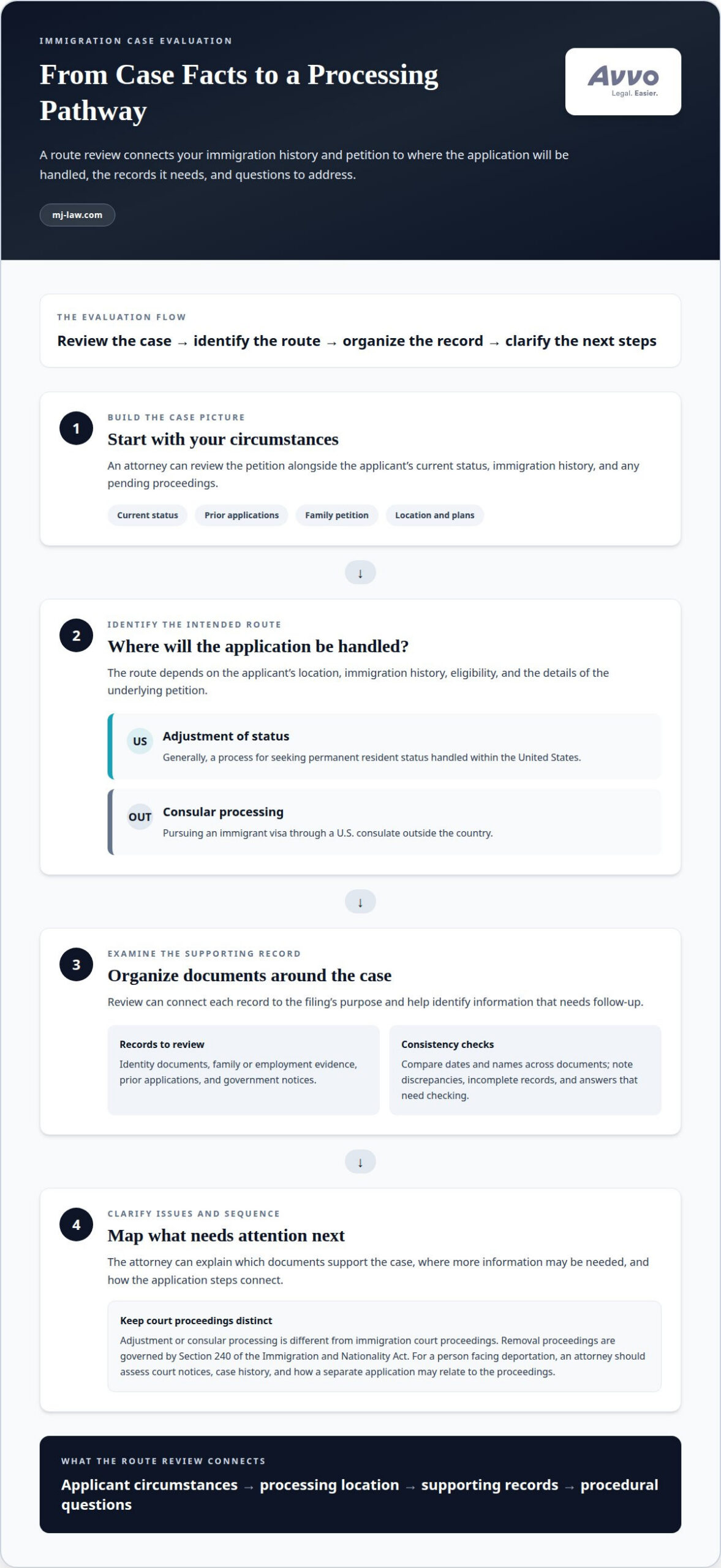
Choosing between adjustment of status and consular processing begins with where the application will be handled and the applicant’s circumstances. An immigration attorney can review the person’s history, family petition, and any pending proceedings before outlining next steps.
Comparing the Two Processing Routes
Adjustment of status generally refers to seeking permanent resident status through a process handled within the United States. Consular processing involves pursuing an immigrant visa through a U.S. consulate outside the country. The appropriate route depends on the applicant’s location, immigration history, eligibility, and the details of the underlying petition.
During an evaluation, the attorney can map the sequence of decisions: review the petition, identify the intended route, examine supporting records, and address issues that could affect the application. For example, a family-based case may involve reviewing relationship evidence alongside the applicant’s prior immigration records. Differences in location or history can change which questions deserve attention.
The consultation should also clarify how the route relates to the applicant’s current status and plans. An attorney can explain which documents support the case, where additional information may be needed, and how the application steps connect. This helps the applicant understand the process without treating another person’s experience as a guaranteed model.
Documents and Application Processing
Document review involves more than collecting forms. The attorney can organize identity records, family or employment evidence, prior applications, and government notices into a consistent case record. If a date or name differs across documents, identifying the discrepancy early helps determine what explanation or additional record may be relevant.
Application preparation can include checking that answers are consistent, confirming that supporting evidence addresses the filing’s purpose, and identifying incomplete records. The attorney can explain what needs to be assembled and how each item supports the case. Clear organization also makes it easier to respond to questions during processing.
San Francisco Immigration Court Procedures
Adjustment or consular processing is distinct from immigration court proceedings. Removal proceedings are governed by Section 240 of the Immigration and Nationality Act. A person facing deportation should have an immigration attorney assess court notices, case history, and how any separate application may relate to the proceedings.
For an immigration court matter involving someone in San Francisco, the attorney can review the notice, identify the issues presented, and explain procedural next steps based on the case documents. Court proceedings and an application for immigration services may involve different records and decisions. The strategy should account for both, rather than treating a pending application as the entire case.
If you’re weighing a family-based route or responding to a court notice, a focused immigration case consultation can help organize the questions and records that matter to your next decision.
If permanent residence is part of a longer-term plan, an attorney can also distinguish it from later naturalization requirements. U.S. Citizenship and Immigration Services says applicants for U.S. naturalization must be over 18 years old when they file, and must have been physically present in the United States for 30 months during the 5 years before filing.
Business and temporary worker visas
Business and temporary worker cases start with the purpose of the proposed stay in the United States. A consultation can distinguish an employment-based path from an investor or business-related option, then organize questions around the applicant’s role, employer, or investment plans.
Match the Visa Pathway to the Work or Business Goal
H-1B and L-1 visas are examples of work visa categories that may arise in an employment-based case. The relevant facts differ, so an attorney reviews the position, the employer’s needs, the applicant’s background, and the intended work arrangement. A transfer between related business operations, for example, raises different questions from a specialized professional role.
Investor matters require a separate focus. An EB-5 consultation can examine the investment plan, the applicant’s objectives, and records that describe the proposed business activity. The attorney can explain how those facts shape the legal analysis and what information is needed to assess a possible path. A business visa strategy should fit the actual transaction, not just a preferred category name.
Coordinate the Employer and Applicant’s Records
In an employment-based case, the applicant and employer often hold different pieces of the story. A thorough review can organize role descriptions, business records, employment history, and supporting documents into a consistent account. If the proposed position changes during planning, the attorney can identify which parts of the case need reconsideration.
For San Francisco and Bay Area companies, the discussion can address how the planned work connects to the organization’s operations. Individuals should be prepared to explain their experience and intended duties, while the employer can describe the position and business context. These details help identify gaps before documents are assembled for an application.
Plan Around Timing and Case History
A consultation should establish the intended start date, current immigration status, and any prior filings or decisions. These facts help frame the order of work and reveal whether the proposed visa path needs coordination with another pending matter. If an individual has received an immigration court notice, include that history in the evaluation, because court proceedings may affect the broader case strategy.
The attorney can then outline the next tasks: clarify the visa category, identify records held by the employer or applicant, resolve inconsistencies, and prepare a filing plan. For example, an L-1 discussion may need both the employee’s work history and the company’s organizational context. A focused plan helps each participant understand their role.
Use the Consultation to Resolve Key Questions
Before deciding on a route, ask how the facts support the proposed category, what documents remain necessary, and which issues could change the analysis. A dedicated review helps connect the employer’s objectives with the individual’s plans, without assuming that an H-1B, L-1, or EB-5 pathway fits every business situation.
Green cards and lawful permanent residency
A green card grants lawful permanent resident status, while the appropriate pathway depends on the applicant’s circumstances. During an evaluation, an attorney can connect the goal of permanent residency with relevant family, employment, or investment history. For someone seeking a green card through marriage, the review can focus on the relationship, supporting records, prior immigration history, and any inconsistencies that need explanation.
Marriage-based applications call for a clear account of the relationship and the couple’s shared life. An attorney can review available documents, identify gaps, and organize evidence that supports the application. For example, records showing shared commitments may help explain the relationship’s development. The legal strategy should also account for prior filings or government notices, since those records can shape what needs further review.
Timing deserves careful discussion, but one person’s experience doesn’t establish a reliable expectation for another case. A client reported receiving approval for a marriage-based green card application about 2.5 months after filing. That individual result is an example, not a standard timeline. Case preparation, the records submitted, and subsequent review all form part of the process an attorney can discuss.
Some applicants pursue permanent residency through family connections, while others have employment or investment objectives. The consultation should identify which facts support the proposed route and whether another pathway better matches the applicant’s goals. An attorney can also explain how a green card plan relates to longer-term plans, including citizenship, without treating permanent residency and naturalization as the same decision.
Applicants should also discuss any prior immigration court matter, government notice, or concern about removal. Green-card planning and deportation defense are distinct legal issues; a consultation can identify how an existing proceeding affects the questions being reviewed. Accurate representation of the applicant’s history matters, including earlier applications and decisions. Leaving out a difficult fact can prevent the attorney from evaluating the whole situation.
For a useful review, the attorney can organize the discussion around these steps:
- Identify the intended green-card pathway and the facts supporting it.
- Review relationship, employment, or investment records relevant to that route.
- Note inconsistencies, prior filings, and notices that may require explanation.
- Discuss how permanent residency fits the applicant’s broader personal mission and future plans.
These steps turn a broad goal into a focused legal strategy. The attorney can explain which questions remain, how each record relates to the application, and what decisions the applicant may need to consider next. Clear representation starts with a complete account of the case, not assumptions based on another applicant’s outcome.
Confidential immigration consultations
A private consultation gives you space to discuss sensitive immigration facts with a lawyer. The conversation may involve family relationships, employment, prior applications, or an asylum concern. Share the central issue early so the attorney can focus the meeting on relevant history and possible legal services.
Discuss Sensitive Facts Clearly
Immigration matters can involve details that feel difficult to explain, including a past filing or a change in family circumstances. Describe what happened in a clear sequence, and identify records or dates that may help explain it. For example, if an earlier application contained an error, raise that issue directly. An accurate account helps the attorney assess the case carefully.
Understand How the Consultation Works
At the beginning of the meeting, clarify its purpose and which issues you want addressed. Ask how information shared during the discussion and any records you provide will be handled. A lawyer can explain the scope of the meeting, what the review covers, and whether further legal work involves separate steps.
That conversation matters because confidentiality and legal privilege are not interchangeable terms. Don’t assume every communication has the same protections in every setting. Ask the attorney to explain how those concepts apply to your consultation, especially if another person, employer, or family member will participate.
Prepare for a Focused Discussion
Organize the facts around the question you need answered. For a family-based case, note the relationship and any prior applications. For an asylum concern, explain the events prompting the request and identify relevant records. You don’t need to resolve the legal issues before the meeting. A clear timeline helps the attorney identify what needs closer review.
Bring copies of notices, prior filings, and decisions related to the issue. If records are incomplete, explain which documents are missing and where the information may appear. Keep original documents secure unless the attorney requests them. This helps distinguish verified records from recollections and gives the discussion a practical starting point.
Set Expectations for Next Steps
Before the meeting ends, ask what the attorney has identified, which questions remain, and what decisions may come next. Clarify whether the consultation addresses a particular application or a broader immigration strategy. Clear expectations help you understand the discussion without assuming an initial review resolves every part of a case.
A focused consultation can help you organize sensitive facts and understand the legal questions ahead. Schedule an immigration consultation to discuss your concerns with an attorney.
MJ Law: Family Immigration Services
MJ Law provides Family Immigration Services for people evaluating family-based immigration options, including marriage-based green cards. A consultation can clarify how your relationship, immigration history, and available records shape next steps. MJ Law also assists with Business and Investor Visas, Employment-Based Visas, and Entertainment and Artist Visas, helping individuals and families discuss a strategy aligned with their immigration goals.
Consider speaking with an immigration attorney when you need to assess a possible pathway, understand application requirements, or address questions raised by your case history. A focused discussion can help identify the issues to review and the records relevant to your next decision.
Contact MJ Law to discuss your immigration case.
Choose a Clear Next Step
Your next step is to turn your immigration goal into a focused discussion about the facts, records, and decisions that shape your case. An immigration legal consultation in San Francisco can help identify which questions to address first and what information will make the conversation useful. Bring your priorities forward, including family plans, employment goals, or concerns about an existing application.
MJ Law offers Family Immigration Services, Business and Investor Visas, and Employment-Based Visas. These services provide a starting point for discussing the immigration matter most relevant to your circumstances. A consultation can clarify the issue you want reviewed and the next steps to consider, without assuming that another person’s experience predicts yours.
Contact MJ Law to discuss your case. A careful first conversation can help you move forward with greater clarity and purpose.
Frequently Asked Questions
Where can I get an immigration law consultation in San Francisco?
For an immigration legal consultation in San Francisco, contact MJ Law, an immigration firm based in San Jose serving the San Francisco area. When arranging a consultation, share the main issue you need help with, such as a family petition or a pending immigration application. That context helps focus the discussion on your concerns and the records relevant to your situation.
What immigration issues can a San Francisco attorney advise on?
An immigration attorney serving San Francisco can advise on family immigration, marriage-based green cards, employment visas, investor visas, artist visas, and naturalization. MJ Law handles these immigration matters, including questions about an application or choosing a pathway aligned with your plans. For example, an artist preparing to work in the United States may need guidance distinct from that of a family seeking to reunite through immigration.
Do San Francisco immigration attorneys offer free or low-cost consultations?
San Francisco nonprofit legal-service organizations and community legal clinics may offer consultations, including through pro bono help, subject to their intake criteria and resources.