
Filing yourself can avoid attorney fees, but it does not eliminate USCIS filing fees or other case expenses. A hiring immigration lawyer vs DIY filing cost comparison should account for legal fees, government charges, and any supporting documents or services your application requires.
It is reasonable to focus on the upfront cost: legal fees can feel avoidable when you can complete forms yourself. But the initial bill is only part of the decision. The application type, work involved, and any complications all affect the total cost of each option.
This article explains how attorney fees, consultations, USCIS filing fees, and related expenses fit into an immigration budget. It also explains how flat-fee, hourly, and hybrid billing differ, and why a straightforward filing may call for a different cost decision than a case with complex facts. Use these points to compare expenses and decide what support fits your situation.
Key Takeaways
- DIY filing can avoid attorney fees, but it doesn’t eliminate USCIS filing fees or other application expenses.
- Compare written legal quotes by looking at the work included, how complications are billed, and whether the fee is flat, hourly, or hybrid.
- A consultation can help clarify the tasks and costs involved before you decide how much legal support you need.
- Case complexity, documentation needs, and unexpected requests can affect the total cost of either approach.
- For family, employment, business, investor, or artist visa matters, understand how the relevant legal support fits your application and budget.
What Factors Affect Immigration Attorney Costs?
The total depends on the case type, USCIS filing fees, and the attorney’s scope of work. DIY filing avoids attorney fees, but you handle the forms, supporting evidence, and follow-up yourself.
Evaluating Attorneys and Written Quotes
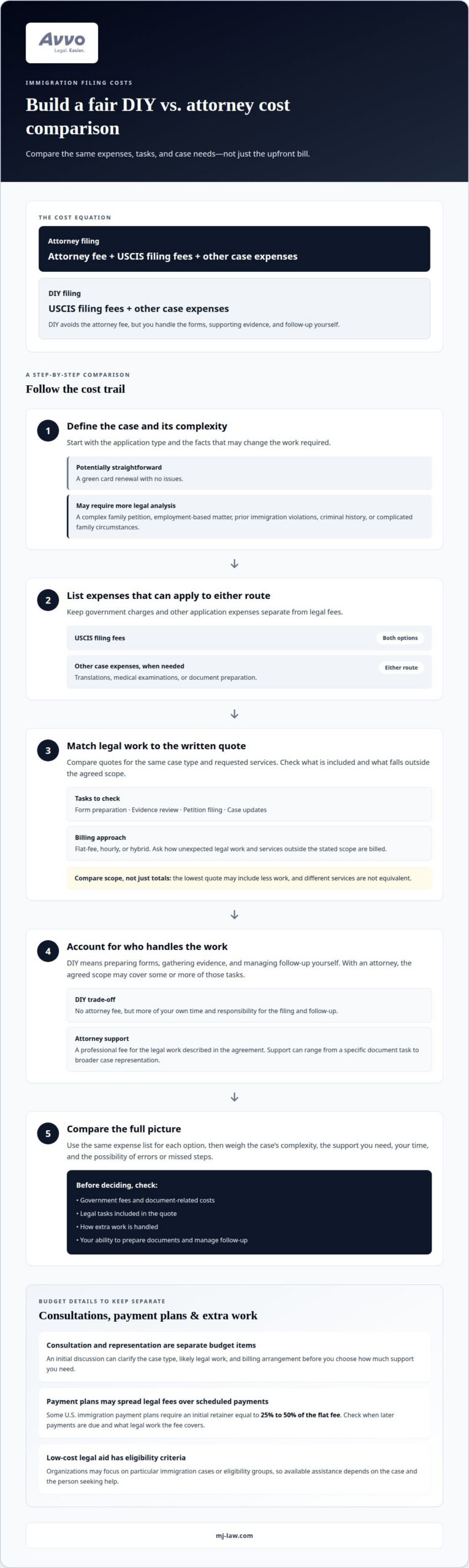
A written quote explains the work an attorney will perform and how the fee is calculated. To compare quotes, match the case type and requested services, then check what each estimate covers: form preparation, evidence review, petition filing, and case updates.
Check exclusions, too. A flat fee may cover the agreed filing but not unexpected legal work or services outside that scope. Get the estimate in writing and compare the same tasks across quotes. That makes price differences easier to understand without treating different services as equivalent.
Experience, location, and case complexity can affect attorney fees. The lowest quote may cover less work, so compare the stated scope before weighing the total. In San Jose and the wider Silicon Valley area, ask what local representation includes and how the quoted work relates to your case.
Fee Tiers and Included Representation
Attorney fees vary with the level of representation, from help with a specific form to support throughout a broader case. A limited service may focus on preparing or reviewing documents, while fuller representation can include organizing the filing and handling legal work as the case progresses.
For an employment-based green card, the work may involve employer obligations and strict legal standards. Those requirements can make the case more involved than a basic form filing. The quote should distinguish attorney work from government filing fees and explain how additional legal work is handled.
Cases involving prior immigration violations, criminal history, or complicated family circumstances may call for legal guidance. These facts can affect both the work required and the fee. A quote limited to form preparation may not cover the legal analysis such circumstances require.
Comparing DIY and Attorney Costs
The total cost of hiring an immigration lawyer is the attorney’s fee plus USCIS filing fees and other case expenses. Filing without an attorney removes the attorney fee, but not government charges or costs such as translations, medical examinations, or document preparation when needed.
DIY can be workable for a straightforward filing, such as a green card renewal with no issues. The trade-off is that you prepare the forms, gather evidence, and handle follow-up yourself. An attorney charges a professional fee but may take on agreed parts of that work.
Compare the options by listing the same expenses for each: government fees, document-related costs, and legal services included in the quote. Then consider the case type. A complex family petition or employment-based matter may involve more legal analysis than a simple renewal, changing the value of attorney support.
For a fair hiring immigration lawyer vs DIY filing cost comparison, match each option to the tasks and risks in your case. A lower upfront total does not account for the time you spend preparing the filing. The decision depends on the case’s complexity and the support you need.
How much does an immigration lawyer consultation cost?
Consultation charges and ongoing representation are separate parts of an immigration budget. Use an initial discussion to understand the case type, likely legal work, and billing arrangement before choosing between DIY filing and attorney support.
Weighing Legal Help Costs and Benefits
A cost-benefit decision compares the attorney’s work with the tasks and risks you would handle yourself. This matters because immigration cases can differ greatly in their evidence, forms, and follow-up needs.
Start by identifying the application and your main concerns. A straightforward renewal may involve fewer tasks than an asylum case involving detailed personal history and supporting evidence. Consider whether you can organize documents, complete forms, and manage communications confidently. The more legal analysis or case-specific preparation involved, the more useful representation may be.
Also consider the time you will spend and the consequences of errors or missed steps. These are not fixed dollar amounts, but they belong in the decision alongside attorney fees and government charges. A consultation can help clarify which work requires legal judgment and which tasks you can manage.
Payment Plans and Low-Cost Legal Aid
Payment plans divide legal fees into scheduled payments, while low-cost legal aid may support people who meet eligibility criteria. Both options can matter when paying a full legal fee upfront would strain a household budget.
Some U.S. immigration payment plans require an initial retainer equal to 25% to 50% of the flat fee. The agreement should explain when later payments are due and which legal work the fee covers. Low-cost legal aid organizations may focus on particular immigration cases or eligibility groups, so the assistance available depends on the case and the person seeking help.
That work is separate from other employment-based case expenses. Ask how a proposed payment arrangement treats each stage and whether additional work changes the amount owed.
Budgeting and Managing Legal Fees
Budgeting for immigration representation means separating attorney charges from filing fees and other case expenses. This helps prevent a quote for legal work from being mistaken for the full application cost.
Before committing, list the expected tasks, payment dates, and possible extra work in one budget. Prepare relevant records before a consultation so the discussion can focus on your case. If a payment plan is offered, compare its schedule with your available funds and the stages of the matter.
A written fee estimate makes changes in scope easier to track. If your case involves asylum, employment documentation, or a family-based petition, identify those details early because they shape the work required. A consultation can clarify whether limited guidance or ongoing representation better fits your needs.
Use a consultation to discuss your immigration case and the legal support it may require.
Separate USCIS filing fees and other expenses
USCIS filing fees are separate from attorney charges, and applicants filing without an attorney still pay applicable government fees. Fee waivers or reduced fees apply only to eligible applicants and qualifying forms; they do not automatically cover every filing or related expense.
Government Filing Fee Expenses
Government filing fees pay for processing a specific application, not for an attorney’s work. Separating them in your budget matters because these charges remain whether you file independently or hire legal representation.
Filing fees can vary by application and may change over time. Concurrent Form I-485 and I-130 filings have listed fees totaling $2,115. Government filing fees can vary by application, and some applications may have no filing fee. USCIS adjusts fees periodically, so the applicable amount depends on the form and fee schedule in effect when you file.
Some forms and applicants qualify for a fee waiver or reduced fee under USCIS eligibility criteria. Qualification depends on the form and the applicant’s circumstances; an attorney’s fee, medical examination, or translation cost is not automatically covered.
Flat Fees for Immigration Forms
A flat fee is a set attorney charge for an agreed service, such as preparing and filing a specific immigration form. It can make the professional-service portion of a budget easier to identify, but it does not replace the USCIS filing fee.
The amount depends on the form and the work included. A quote should distinguish form preparation and filing from additional legal work, such as responding to a request for evidence or handling unexpected developments.
Other expenses may fall outside both the flat fee and the USCIS charge.
DIY Application Filing Fees
DIY filing means you prepare and submit the application yourself, but you still pay the applicable USCIS filing fee. Removing attorney charges does not remove government fees or necessary supporting expenses.
For example, a person filing Form I-130 without an attorney still faces the listed $675 government fee. An applicant filing Form N-400 still faces its listed $760 fee. If a medical examination or translated document is required for the case, those costs remain separate from the filing fee.
Employment petitions can involve expenses beyond the USCIS charge, while family filings may require supporting records and translations. A deportation matter, criminal history, or prior immigration violations can add legal complexity, even though they do not change the basic distinction between government fees and attorney charges.
For a practical budget, group costs into three categories: USCIS fees, attorney services, and other case expenses. This makes it easier to compare DIY filing with legal help without treating one category as the full cost.
Factors that affect immigration lawyer costs
An immigration case’s cost depends on its facts, evidence, and required legal work. Translation needs, background records, criminal history, and the possibility of additional proceedings can change the overall budget.
Document preparation adds expenses beyond attorney and government charges. For example, a birth certificate in another language may need translation and certification before it supports an application, and applicants often rely on document assistance services like Dokumen24 to help manage and prepare official civil records. The number and type of records affect the work involved.
These records matter when an immigration case requires detailed information about a person’s history. You should include them as a separate budget item rather than treating them as part of an attorney’s fee or a USCIS charge.
Case complexity is another major cost factor. An application with clear facts and organized documents requires less legal analysis than one involving conflicting records, prior immigration violations, or criminal history. Asylum cases, for example, involve detailed personal accounts and extensive supporting evidence, which directly influences professional legal fees for U.S. immigration proceedings.
Employment-based matters can also require additional analysis and documentation. A petition involving complex employer obligations or strict legal standards may need more specialized work than a simple form filing. Immigration appeals generally cost more because they involve extended litigation and formal appellate filings. The type of proceeding and the record under review affect both the required legal work and the total expense when evaluating hiring an immigration lawyer vs DIY filing cost comparison.
A DIY denial can affect the timeline as well as the overall budget. A denied DIY immigration case can add 12 to 24 months to the case timeline. The resulting delay may mean additional document preparation or corrective legal work through firms like MJ Law, depending on the reason for denial and what follows. The outcome and next steps depend on the specific decision and case history.
To understand which factors apply to your situation, separate costs into three groups: legal services, government charges, and supporting documents. Then list known needs, such as certified translations, police clearances, or a criminal-record issue. This shows whether a quote covers the work your case may require or leaves important tasks outside its scope.
Flat-fee, hourly, and hybrid billing
Immigration attorneys may bill by the hour, charge a flat fee, or combine both approaches. The billing method affects how legal work is priced, especially if a case changes after filing.
Hourly Lawyer Fees
Hourly billing means you pay for the time an attorney spends on your case. U.S. The total depends on the time required, so the hourly rate alone doesn’t show the final cost.
This structure can suit work that is difficult to define in advance, such as reviewing a complicated record or responding to an unexpected issue. Ask how the attorney tracks time and bills for calls, document review, and case correspondence. These tasks can affect the final charge alongside formal filings.
Deportation defense illustrates how legal work can extend beyond preparing forms. The proceedings and work involved shape the total, so compare the expected services and billing method, not just the initial rate.
Flat-Fee Arrangements
A flat fee sets one agreed charge for a defined scope of immigration legal work. It can make the covered services easier to budget, provided the agreement explains what the fee includes and excludes.
For example, a flat fee may cover preparing and filing an application but exclude additional work after submission. A request for evidence or another unexpected development can require work beyond the original scope. Ask how those tasks are billed and whether the attorney will discuss added work before proceeding.
USCIS filing fees remain separate from attorney billing, whether the legal fee is flat or hourly. Keep government charges distinct when comparing proposals. The written agreement should identify the legal services covered, additional charges, and how work outside the agreed scope is handled.
A hybrid arrangement combines a flat fee for defined preparation and filing with hourly charges for unexpected legal work. This separates routine tasks from work that cannot be predicted at the outset. For instance, the agreement might define filing support while treating a later complication as additional work.
Before choosing, compare the same task list across billing proposals: preparation, filing, record review, and post-submission work. A lower initial flat fee may cover fewer services, while an hourly arrangement can change with the time spent. Understanding these distinctions helps you assess the full fee structure alongside filing fees.
Discuss legal representation and billing options in relation to your immigration matter.
MJ Law: Family Immigration Services
MJ Law provides Family Immigration Services for people weighing legal support for a family-based matter. This can be relevant when a marriage-based green card or family petition raises questions about eligibility, supporting documents, or the scope of legal work.
For other immigration needs, MJ Law also handles Business and Investor Visas, Employment-Based Visas, and Entertainment and Artist Visas. The right level of support depends on the application and the issues it raises. A discussion can connect your case type with the legal services involved, helping you understand what representation would cover alongside government and document expenses.
If you’d like to discuss your immigration matter, contact MJ Law.
Choose the level of support that fits your next step
Use your cost comparison to decide what you want to handle yourself and where legal guidance would help. The right choice is not only about the initial expense; it is also about the time, preparation, and responsibility involved in moving your immigration matter forward. A hiring immigration lawyer vs DIY filing cost comparison can frame that decision around your application and the work you want covered.
For family immigration, business and investor visas, or employment-based visas, MJ Law can provide support in those areas. A conversation can help clarify the legal work involved and how it fits your plans. Bring questions about your case type, documents, and preferred level of representation.
Contact MJ Law about your options and take a considered next step toward preparing your filing.
Frequently Asked Questions
Can I file my own immigration forms without a lawyer?
Yes, you can prepare and submit many immigration forms yourself. A straightforward green card renewal with no issues is one example that may suit DIY preparation. You will need to identify the correct form, provide the required information, and organize supporting documents. If your history includes prior violations, criminal issues, or complicated family circumstances, the filing may require legal analysis beyond completing forms.
How much does an immigration attorney cost in 2026?
Attorney fees depend on the case type, billing method, and work required. In 2026, U.S. These are general market ranges, not a quote for a specific case. A written estimate can clarify whether document review, filing, and additional legal work are included.
Quick Reference: What Is Immigration Lawyer vs DIY?
DIY means you prepare and submit the immigration filing yourself; hiring a lawyer means paying for agreed legal support. Both paths can involve USCIS fees and document expenses. The practical difference is who handles the forms, evidence, and legal questions. Someone with a simple renewal may manage the paperwork independently, while complicated records can call for more analysis.
When should I definitely hire an immigration lawyer instead of filing myself?
Consider legal representation when your case includes prior immigration violations, criminal history, complicated family circumstances, or a detailed legal issue. Employment petitions such as H-1B, EB-2 NIW, and PERM can also involve employer obligations and strict legal standards. These factors make the work more involved than entering information on a form. An attorney can assess the case facts and explain the work required.
What are current USCIS filing fees for common immigration applications?
Listed fees include $760 for Form N-400, $675 for Form I-130, and $795 for Form I-601A. Concurrent Form I-485 and I-130 filings total $2,115 in listed USCIS fees, while an affirmative asylum application has a listed fee of $0. These amounts are separate from attorney charges and related expenses. USCIS adjusts fees periodically, so the applicable amount depends on the filing and current schedule.
How much do U.S. immigration lawyers charge for common cases?
General market ranges vary by application and legal work. These figures describe broad market estimates, not an individual attorney’s quote or a guaranteed total.
Which immigration cases are straightforward enough to file without a lawyer?
A Form I-90 green card renewal with no issues is an example of a case that may be suitable for DIY filing. The key is whether the application has a clear history, uncomplicated supporting records, and no related immigration concerns. Even a familiar form can become less straightforward if the information is inconsistent or the case involves prior violations. Assess the specific facts, not just the form name.
When is an immigration lawyer strongly recommended or legally necessary?
Legal help is worth considering when a case involves removal proceedings, criminal history, prior immigration violations, or complex evidence. These facts can affect the legal issues and strategy, not just the paperwork. Whether representation is legally necessary depends on the specific proceeding and circumstances; a general cost guide cannot determine that for every person. An attorney can review the situation and explain the role counsel may play.