
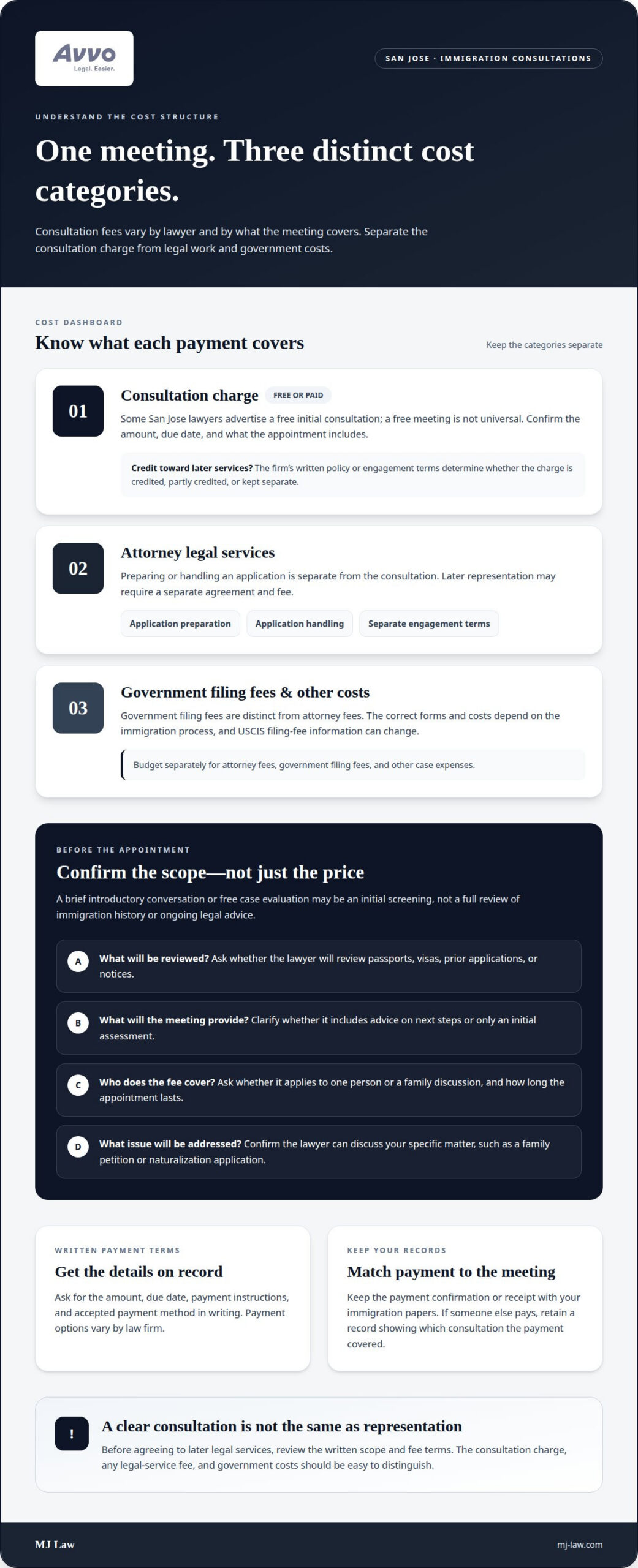
Some San Jose immigration lawyers advertise a free initial consultation, but free meetings aren’t universal. Immigration consultation fees in San Jose depend on the lawyer’s terms and what the meeting covers. There is no single fee for every lawyer or case.
It’s reasonable to want a clear picture of costs before discussing personal immigration matters. A consultation charge is separate from fees for legal work and government filing fees. Knowing what each covers helps you plan.
This article explains what an immigration consultation may include, what to clarify about payment, and how consultation fees differ from other costs. It also outlines factors that can affect legal fees and what to prepare for a productive initial meeting.
Key Takeaways
- Some San Jose immigration lawyers advertise free initial consultations, but a free meeting isn’t universal. Find out what the consultation includes and whether a fee applies.
- Clarify how to pay and what the consultation charge covers so you can distinguish it from fees for legal work.
- Ask for a clear explanation of what affects the legal fee for your case, including its type and complexity.
- Separate attorney fees from government filing fees and other case expenses when planning your budget.
- USCIS publishes filing fees and related information, which can change; the correct forms and costs depend on the immigration process.
Immigration lawyer consultation fees and free initial consultations
Some San Jose immigration lawyer listings advertise a free consultation, but that doesn’t mean every lawyer offers one. The scope can differ, too: a brief introductory conversation and a detailed legal consultation are not necessarily the same service. Before booking, clarify whether the meeting is free or paid and what the lawyer will cover.
A free case evaluation may be an initial screening, not a full review of your immigration history. A short discussion, for example, might identify whether your question concerns a family petition, a green card, or another application. The lawyer may then explain what information is needed for a more detailed assessment. Treat “free evaluation” as a description of the first contact, not a promise of ongoing legal advice at no charge.
Are nonprofit immigration legal services in San Jose free or low-cost? Some nonprofit programs offer free or reduced-cost help, but eligibility and capacity to accept new clients vary. Available assistance and costs depend on the program and the applicant’s circumstances.
What is included in an immigration lawyer consultation in San Jose? The lawyer discusses your goals, reviews relevant facts and documents, and explains possible options and next steps. A family-based green card consultation, for example, may cover the relationship, current immigration status, and application process.
Before arranging a meeting, clarify these points to understand the fee:
- Whether the appointment is free or paid, and whether the charge applies to one person or a family discussion.
- Whether the lawyer will review passports, visas, prior applications, or notices during the consultation.
- Whether the meeting includes advice about next steps or only an initial assessment of the issue.
These details distinguish a consultation from later representation. A lawyer might identify questions about a petition, explain what further document review involves, and outline the next stage. Any consultation charge is separate from fees for preparing or handling an application.
When comparing immigration consultation fees in San Jose, focus on what the appointment provides, not just whether the advertised price is zero. The State Bar of California offers an attorney search through apps.calbar.ca.gov, where you can review an attorney’s status and public disciplinary information. That search helps you check professional status; the consultation addresses your immigration matter.
Consultation fee and payment methods
A consultation charge and its payment process should be clear before the appointment begins. The law firm sets the fee and the payment options it accepts. Ask for the amount, due date, and payment instructions in writing. That gives you a record to compare with the invoice and helps avoid confusion about what the charge covers.
Do immigration attorneys in San Jose apply the consultation fee toward future legal services? The firm’s written policy or engagement terms determine whether the fee is credited, partly credited, or kept separate. Review this alongside the scope of any later services before agreeing to representation.
Payment methods vary by law firm, so don’t assume every office accepts the same options. Written payment instructions should identify the accepted method and explain how the firm records the transaction. Keep the confirmation or receipt with your immigration papers. If someone else pays, such as a family member supporting a citizenship application, retain a record showing which consultation the payment covered.
Before paying, separate three items in the written terms:
- The consultation charge and when payment is due.
- The work included in the meeting, such as discussing a petition or reviewing application documents.
- Any later legal services, which may require a separate agreement and fee.
This distinction matters for employers and individuals alike. An employer discussing a work visa may need an initial consultation, followed by separate legal services for a specific application. A founder considering an investor visa may also need to understand what falls within the meeting and what requires a later engagement. A payment record should identify the consultation, not just show that a transaction occurred.
If the payment terms are unclear, pause before authorizing payment and request a written explanation of the fee, timing, and credit policy. This helps resolve ambiguity without assuming the consultation covers later legal work. Clear written terms also distinguish a one-time meeting from continuing representation.
For a citizenship question, a focused appointment can help organize the issues for discussion and identify relevant next steps. You can schedule an immigration consultation to discuss the matter with a lawyer. Bring the payment confirmation and relevant immigration records so the appointment can address the right case details.
Consultation pricing and fee transparency
A clear consultation fee should be explained alongside the meeting’s scope, payment timing, and any conditions. A discussion about naturalization, for example, may differ from a detailed review of an application and immigration history. Ask about the fee and service description before booking, then compare the invoice with those terms. In California, a written explanation helps you understand what you’re paying for.
What questions should I ask before booking an immigration consultation? Ask whether the fee covers document review, legal advice, and discussion of next steps, and whether later representation is separate. Also ask how long the appointment lasts and whether the lawyer will address your specific matter, such as a family petition or naturalization application.
Those answers show whether a consultation fits your issue. A Bay Area appointment focused on one filing question may differ in scope from a review involving prior applications, a change in immigration status, or several family members. The fee should be explained in relation to the planned work, not presented without context.
Before paying, request written terms that clarify:
- The consultation’s scope, including whether the lawyer reviews documents or discusses them only.
- The amount due, accepted payment methods, and when payment is required.
- Cancellation or rescheduling terms, and whether any payment is refundable or credited toward later services.
- Whether the quoted charge covers one individual or more than one person.
What should I verify before paying an immigration consultant in California? Confirm whether the person is an attorney or an immigration consultant, and get a written description of the service and charge. An immigration consultant isn’t a lawyer and can’t provide legal advice or represent someone in the same way as a lawyer.
That distinction matters when your issue requires legal analysis. Someone seeking a naturalization assessment, for example, may need advice about eligibility or the effect of earlier immigration filings. A consultant can’t substitute for a lawyer’s legal advice on those questions. Clarify the person’s role before paying, and ensure the written terms describe the service being purchased.
For a San Jose lawyer, fee transparency also means identifying what falls outside the consultation. Preparing an application, communicating about a case, or handling later filings may involve separate legal services. The consultation should make these boundaries clear, so you can decide whether to proceed without assuming the initial payment covers work beyond the meeting.
When comparing immigration consultation fees in San Jose, focus on the service, not just the advertised amount. A founder discussing a business immigration matter, for instance, should know whether the meeting addresses an initial question or includes broader document review. Clear scope and written payment terms make the difference easier to assess.
Cost estimates based on immigration case type
A useful legal fee estimate describes the work involved, not just the immigration category. Two family petitions may require different levels of attorney review if their histories differ. The same is true of a marriage-based green card, an employment application, or another immigration matter. Attorneys assess records, procedural history, and the services needed before defining representation. A case label alone cannot establish the full scope.
For a family petition, an estimate may depend on the amount of document review and application preparation required. A straightforward filing may differ in scope from one involving prior applications or records that need careful analysis. For a marriage-based green card, the lawyer may need to understand the couple’s history and review relevant documents. The estimate should identify the included tasks.
Employment-based matters vary, too. An employer and worker may need to establish who supplies information and which application tasks the attorney handles. The visa type and records involved shape the work. “Employment-based” is a broad category, so an estimate should connect the legal services to the specific case rather than treat every application alike.
Ask attorneys to describe the proposed representation in practical terms. A written estimate can distinguish initial legal analysis, form preparation, review of supporting records, and responses to later case developments. It should also identify tasks outside the quoted scope. That detail helps you understand what the estimate covers before agreeing to legal services.
Useful factors to discuss include:
- The application or petition involved, such as a family petition or employment-based filing.
- Whether the lawyer will review prior filings, notices, or other immigration records.
- How many applicants or family members the representation covers.
- Which preparation, review, and follow-up tasks are included in the proposed work.
- Whether a change in circumstances could require work beyond the original scope.
These points make estimates easier to compare without assuming a lower quote covers as much. One estimate, for instance, might include preparation and review, while another covers a narrower task. Ask each attorney to define services and exclusions in writing. This helps clarify what legal representation involves for your specific matter.
For San Jose applicants, the best estimate connects the case facts to a defined scope of work. A family pursuing a marriage-based green card and an employer seeking an employment-based visa have different records and objectives. The attorney’s review of those details helps shape the estimate. Discuss the case type, history, and requested representation together, so the written scope reflects the work involved.
Government filing fees and other costs
USCIS filing fees are separate from attorney charges and consultation fees. USCIS publishes official forms, filing fees, and processing information, and those materials can change. A focused budget should separate government charges from legal services and refer to the applicable USCIS fee information for the filing. A fee for one application does not automatically apply to another.
For example, filing costs can differ between applications, so check the applicable fee information before budgeting. The listed fee for Form I-485 is $1,225 in 2026, including biometrics. These forms serve different purposes, so the amounts aren’t interchangeable. A family seeking permanent residency through a marriage-based green card may have more than one filing to consider, depending on the process involved.
Form I-130 is a family petition, while Form I-485 is an application to adjust status. The filing fee is paid to the government for the relevant application, not to the attorney for legal representation. If a case involves both forms, account for each government filing separately. The applicable process and forms determine which filing charges belong in the budget.
Other case expenses may arise, depending on the documents and steps involved. An application, for example, may require supporting records, and obtaining or preparing them can involve separate costs. Keep these potential expenses distinct from attorney fees and USCIS filing charges. Ask for a breakdown identifying each category and why it applies.
A clear budget separates the main cost categories:
- USCIS filing fees for each form required in the case.
- Attorney fees for consultation, application preparation, or representation.
- Other expenses tied to supporting records or case-specific steps.
Before filing, the attorney can identify the forms involved and explain which government fees apply to the planned process. For a permanent residency matter, this helps distinguish the petition from an adjustment-of-status application. It also prevents a common budgeting error: treating legal fees and government charges as one payment.
Because USCIS materials can change, use the current published fee information for the specific form rather than relying only on an older estimate. The figures above are listed for 2026; a later fee schedule may differ. If you’re preparing a marriage-based green card filing, schedule a consultation about your filing costs and the legal work involved.
MJ Law: Family Immigration Services
MJ Law helps individuals and families with Family Immigration Services, including marriage-based green card cases. If you have questions about a family petition, an application, or next steps after a consultation, legal guidance can help clarify the work involved. MJ Law also handles Business and Investor Visas, Employment-Based Visas, and Entertainment and Artist Visas.
Consider reaching out when you’re ready to discuss your immigration matter and understand the legal support it may require. Contact MJ Law to discuss your case.
Move forward with a clear consultation plan
A consultation can be a useful starting point for discussing your goals and the legal work your matter may involve. Understanding immigration consultation fees in San Jose helps set expectations. The next step is to connect the fee and meeting scope to your specific needs.
MJ Law offers Family Immigration Services, Business and Investor Visas, and Employment-Based Visas. If your matter involves one of these areas, a focused conversation can help you discuss your situation and understand what support may be appropriate.
Before moving forward, consider what you want the consultation to clarify, such as your options, the work involved, or the next stage of your case. A direct discussion can help you decide whether to proceed with legal representation.
Contact MJ Law about consultation fees to discuss your immigration matter. Taking that next step can help you move ahead with greater clarity.
Frequently Asked Questions
Can I get a free consultation with an immigration lawyer in San Jose?
Yes, some San Jose immigration lawyer listings advertise free consultations, but the offer isn’t universal. A free first conversation may be an introduction rather than a detailed legal review. A lawyer might discuss your main concern and explain what records would help assess it. Before booking, clarify the meeting’s scope and whether it includes advice about your specific situation.
How much does an immigration lawyer cost in California?
There isn’t one cost for every immigration matter in California. The price depends on the case and is provided after a quote request. Work can vary with the application, relevant records, prior filings, and level of representation requested. Preparing a new petition, for example, may involve different tasks from reviewing a complicated immigration history. A written scope helps explain the estimate.
Is it worth hiring an immigration lawyer?
Hiring a lawyer can be useful when a decision depends on interpreting immigration rules, assessing past filings, or preparing a complex application. Someone with a prior status issue, for instance, may need individualized legal analysis before proceeding. A lawyer can explain options and the work involved, but can’t guarantee an outcome. Consider whether you need legal advice or representation, rather than help with clerical tasks alone.
What do immigration lawyers charge for an initial consultation in San Jose, California?
An initial consultation may be free or paid, depending on the lawyer and the meeting’s scope. Some San Jose listings advertise free consultations, while other appointments may involve a charge. The amount depends on the firm’s terms, so no single figure represents every consultation. A meeting that includes detailed review of prior documents may cover different work from an introductory discussion.
Do San Jose immigration attorneys offer free consultations?
Some San Jose immigration attorneys advertise free consultations, but not all do. Also, “free consultation” can mean an initial screening rather than a full review of eligibility or documents. An attorney may first identify the type of petition involved, then explain what further review would entail. Clarifying the meeting’s purpose helps you understand what the free appointment does and doesn’t cover.
Are immigration consultation fees flat-rate or billed hourly in San Jose?
The billing structure depends on the attorney’s stated terms. A consultation may have a set charge, or the firm may describe charges based on time. Don’t assume it uses the same billing method as later representation. Clarify what the quoted charge covers, when it is due, and whether later work falls under a separate agreement.
How do consultation fees vary by immigration case type in San Jose?
The meeting’s scope can vary by case type and the questions requiring legal analysis. A family petition may involve relationship evidence, while an employment-based matter may concern the employer’s role and visa category. Prior applications or notices may add documents for review. Describe the issue accurately when arranging the meeting so the attorney can address the relevant questions.
How can I compare immigration lawyer consultation fees in San Jose?
Compare the work included, not only whether the appointment is free or paid. For each consultation, note whether the lawyer will review documents, discuss options, and identify possible next steps. Also distinguish an attorney’s legal advice from a nonlawyer consultant’s assistance. A brief screening and a case-specific document review aren’t equivalent services, even if both are called consultations.