
You may still seek an I-751 waiver while living in the United States if your marriage has ended or you qualify under another waiver ground. If you received your green card through marriage and were married for less than two years when it was approved, U.S. Citizenship and Immigration Services (USCIS) says you must apply to remove the conditions; the joint petition is generally due within the 90 days before your conditional status expires. An I-751 waiver attorney in San Francisco can help you assess your options and prepare evidence for your circumstances.
It’s understandable to worry that separation, divorce, or abuse could put your ability to stay in the country at risk. The key issue is not simply whether the marriage lasted, but whether you can support the applicable waiver ground and show that the marriage began in good faith. This article explains who may qualify to file without a spouse, what documents can help establish a bona fide marriage, and how legal representation can support preparation and next steps. You’ll also learn how to approach the process carefully if your conditional green card has expired or your case involves sensitive personal circumstances.
Key Takeaways
- Identify which waiver ground may fit your circumstances, such as divorce, abuse, or extreme hardship.
- Build a clear account of why the marriage began in good faith, supported by records from your shared life.
- Organize key documents, including green card copies and any required English translations, before preparing your petition.
- Consider legal guidance when evidence is complex, your case involves abuse, or you have received a request for evidence.
- Learn how an I-751 waiver differs from other immigration options that may apply in cases involving abuse.
Who may need an immigration attorney for Removal of Conditions?
Legal help can be useful if you cannot file jointly, are facing a deadline, or need to document a waiver ground. Start by identifying the filing route that applies to your situation, then organize evidence to support each requirement.
Conditional Residence Through Marriage
Marriage-based conditional permanent residence applies when the couple was married for less than two years when the green card was approved, according to U.S. Citizenship and Immigration Services. The resident receives conditional status, not an unrestricted permanent resident card, and must later request removal of those conditions. Review the approval date and card expiration date first, since they establish the filing window.
U.S. Citizenship and Immigration Services requires a U.S. immigrant spouse to file Form I-751 within the 90 days before the two-year conditional resident status expires. A joint petition generally requires the spouse’s participation and evidence that the marriage was genuine. If the relationship has ended or a spouse will not cooperate, consider whether an individual waiver applies instead.
I-751 Waiver Grounds
An I-751 waiver may be available after divorce or annulment, after the petitioning spouse’s death, following battery or extreme cruelty, or when removal would cause extreme hardship. Divorce does not by itself establish eligibility: the conditional resident must also show the marriage began in good faith. An abuse-based waiver likewise requires evidence of a genuine marriage and qualifying abuse.
Extreme hardship is a separate waiver ground and does not require divorce or abuse. The applicant must show both that the marriage began in good faith and that being forced to leave the United States would cause extreme hardship. Organize the facts around this ground rather than submitting unrelated records. A resident whose card has expired may still file an individual waiver if the requirements are met.
Denied Waivers and Appeals
A denied I-751 can put conditional resident status at risk. USCIS may terminate that status when the conditions are not removed, and a denial may lead to removal proceedings. Review the decision’s stated reasons, deadlines, and any request for further evidence so the response addresses the actual concerns rather than repeating the original submission.
A denial may be challenged through the applicable review process, including immigration court proceedings if the case is placed before a judge. The available route depends on the decision and the case’s procedural stage, so distinguish an appeal from presenting the waiver case in court. Keep the denial notice, earlier filings, and supporting evidence together for review.
What is the current USCIS filing fee for Form I-751? The fee is the amount USCIS lists for Form I-751 when it is filed. Use the current filing instructions to determine the required payment; do not rely on an older fee figure.
Good-faith marriage evidence
For an I-751 waiver, evidence should explain both the history of the marriage and the waiver ground. Build a timeline from courtship through separation, then match each major period with records or specific examples. A shared lease, joint bank account, photographs, or correspondence can help show how the couple organized daily life. The goal is a consistent account, not a stack of documents without context.
Records of shared finances and assets can support your account. Gather available bank statements, tax records, insurance documents, leases, mortgage papers, utility bills, and records of jointly owned property. Check that names, dates, and addresses are consistent. If you did not share a particular account or asset, explain the circumstances rather than leaving an apparent gap.
For a joint filing, arrange evidence by category and date so the relationship is easy to follow. A practical sequence is to gather housing and financial records, add photographs or travel records showing shared activities, and then include statements from people who knew you as a couple. A friend’s statement is more useful when it describes personal observations, such as attending a family gathering, than when it offers only a general opinion about the marriage.
A hardship-based waiver may involve evidence about the circumstances the conditional resident would face if required to leave the United States. Organize records around the specific circumstances described in the petition. Identify the hardship concern, gather documents relevant to it, and explain how they relate to your situation. Keep marriage evidence distinct from hardship evidence, even if a record helps explain both.
For an abuse-based waiver, preserve records that help establish the marriage and describe the abuse, such as messages, photographs, medical records, or statements from people with direct knowledge. Police reports and protective orders are not required to qualify. If a document is unavailable, explain why and include other relevant evidence, without suggesting that every case has the same records.
Before filing, create an index that names each document and the point it supports. Check translations, dates, and consistency across the petition and attachments. An immigration lawyer can help identify gaps, organize evidence around the selected waiver ground, and prepare explanations for conflicting details. To discuss how to structure your records, arrange an immigration consultation.
Immigration waiver legal representation in San Francisco
For a San Francisco Bay Area case, legal representation can help align the waiver ground, personal history, and supporting records. A useful first step is to create a timeline of the marriage, separation, divorce, and immigration filings. That timeline can reveal which facts need explanation and help keep statements consistent across the petition and evidence.
Divorce does not automatically prevent a conditional resident from pursuing an I-751 waiver. A divorced immigrant spouse may file alone, and USCIS may approve the waiver if the marriage began in good faith. Organize the divorce record alongside evidence from the relationship, then explain how the marriage unfolded. If the spouse died, the death of the petitioning spouse is another listed waiver ground.
Children’s cases require attention to who experienced the abuse and who committed it. For a child seeking an I-751 waiver based on battery or extreme cruelty, the abuse must have been committed by the child’s U.S. citizen or lawful permanent resident parent. Keep the child’s immigration history, relevant family records, and evidence of abuse organized separately from a parent’s documents.
Immigration misrepresentation raises a different question from whether a marriage was genuine. An I-751 waiver concerns removal of conditions; an I-601 waiver addresses inadmissibility grounds that include immigration misrepresentation. Don’t treat the forms as interchangeable. A lawyer can review the exact issue raised in a notice or prior filing and distinguish a marriage-evidence concern from an inadmissibility question.
To compare I-751 waiver lawyers, look for experience with the specific ground involved, clear explanations of the filing process, and reviews that describe communication and case preparation. During a consultation, assess whether the lawyer identifies evidence gaps, explains how the facts fit the waiver requirements, and outlines the work involved without promising an outcome.
Representation in the San Francisco area can also help you prepare for USCIS questions or a request for further evidence. Gather your conditional green card, prior immigration filings, divorce or court records, and a dated summary of important events. Flag inconsistencies, missing records, or address changes before filing so the petition can address them directly.
For a case involving divorce, abuse, a child applicant, or a possible misrepresentation issue, an immigration attorney can help organize the facts and identify the relevant filing path. A focused consultation can begin with your current status, notices received, and available records. Schedule an immigration consultation to discuss how those details shape your case.
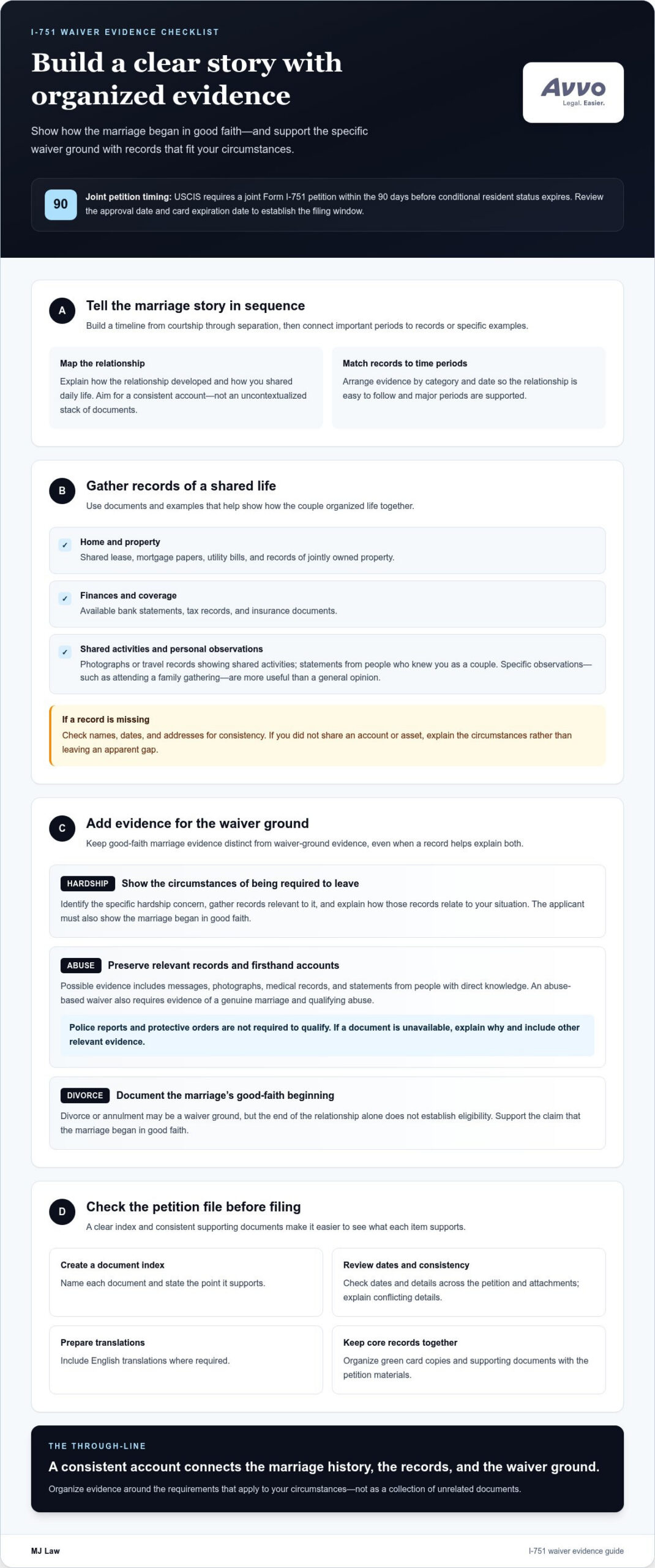
Documents supporting an I-751 petition
A well-organized Form I-751 petition connects each document to the filing ground and the history it supports. Start with a checklist, then separate marriage records, waiver evidence, identity documents, and explanations. This structure helps USCIS follow the record and spot how the documents relate to the request to remove conditions. Include a copy of both sides of the conditional green card.
For a joint petition, spouses can group records that show shared finances and daily life. Examples include joint bank statements, tax records, insurance documents, leases, utility bills, and jointly held assets. Select records from different points in the marriage, then check names, addresses, and dates for consistency. Add a short index explaining what each item demonstrates instead of submitting an unexplained stack.
For an individual waiver, include documents supporting the specific circumstances. A divorce or annulment record can establish that the marriage legally ended, while a spouse’s death certificate can document that event. An abuse-based filing may include relevant messages, photographs, medical records, or statements from people with direct knowledge. Police reports and protective orders are not required to qualify for an abuse waiver.
Pay attention to translations and name records before filing. Include a full English translation of each document written in another language. If you legally changed your name, include the court order documenting the change. If you have a criminal or drug history, provide documents explaining what happened. Keep copies of everything you submit and arrange attachments in the same order as the petition’s index.
Timing depends on the filing route. U.S. Citizenship and Immigration Services says a U.S. immigrant spouse must file Form I-751 within the 90 days before the two-year conditional resident status expires. A joint petition generally needs both spouses’ participation; an eligible waiver applicant files individually. If a conditional green card has expired, an individual waiver based on divorce, abuse, or extreme hardship may still be filed if its requirements are met.
U.S. Citizenship and Immigration Services identifies an I-360 petition for battered spouses under the Violence Against Women Act as a possible option in certain circumstances. The I-360 and I-751 are separate filings, so identify which process addresses the person’s circumstances before assembling forms and evidence. An immigration lawyer can help distinguish the options and organize the supporting record.
I-751 processing time depends on USCIS review and any added steps, such as a request for evidence or interview. While a petition is pending, determine which current documents establish status and support work or travel plans; don’t assume the filing receipt alone answers both questions. Approval of Form I-751 extends the immigrant spouse’s status to a 10-year green card. For help organizing the petition materials, schedule an immigration consultation.
Good-faith marriage requirements
A key part of an I-751 waiver may be explaining that the marriage was genuine, rather than entered into to obtain immigration status. A later separation or divorce doesn’t, by itself, show the original intent was fraudulent. Build a chronological account that explains how the relationship began, what changed, and why the marriage ended, if it did.
Start with the marriage date and the couple’s history of conditional residence. Then identify significant events, such as moving in together, combining responsibilities, or separating. Explain changes in the relationship in context. For example, separate addresses near the end of a marriage may need an explanation that reflects the couple’s circumstances at the time.
Consistency matters across the petition, personal statements, and supporting records. Compare dates, addresses, and descriptions before filing. If a document lists a different address, explain the difference rather than leaving USCIS to interpret it without context. A concise explanation can clarify whether the discrepancy reflects a temporary move, an administrative update, or a change in the relationship.
The evidence needed depends on the waiver ground. An applicant relying on divorce must show the marriage began in good faith, even if the relationship later ended. For an abuse-based waiver, the conditional resident must establish both a good-faith marriage and battery or extreme cruelty by a U.S. citizen or lawful permanent resident spouse. Present the marriage history and abuse evidence as connected but distinct parts of the case.
An extreme hardship waiver also requires proof that the marriage began in good faith, along with evidence that removal from the United States would cause extreme hardship to the conditional resident. Divorce and abuse are not prerequisites for this ground. Separate the account of the marriage from the explanation of hardship, and show how each set of evidence supports a different requirement.
Do not confuse a difficult marriage with a marriage entered into for immigration fraud. The focus is the couple’s intent when they married, not whether the relationship remained successful. A clear timeline can help distinguish the two by showing how the relationship developed and explaining major changes without overstating what any one record proves.
Before filing, review the account from the perspective of someone unfamiliar with the relationship. Can they understand how it began and changed? Identify gaps, unclear dates, or conflicting statements, then prepare concise explanations. This helps keep the petition coherent and connects each piece of evidence to the relevant waiver requirement.
If you need help assessing how your marriage history supports an I-751 waiver, schedule an immigration consultation.
MJ Law: Family Immigration Services
MJ Law provides Family Immigration Services for people addressing marriage-based immigration matters, including removing conditions on residence. If your marriage has ended, your spouse cannot participate in a joint filing, or you need to organize evidence for a waiver, legal guidance can help you understand the filing path and present a clear account of your circumstances.
Bring your conditional green card, USCIS notices, prior petitions, and key relationship records to a discussion about your case. These documents help clarify your current status, the waiver ground you may rely on, and any issues that need attention before filing. Contact MJ Law to discuss your I-751 waiver circumstances and possible next steps.
Take the Next Step With a Clear Plan
Your next move can be a focused review of your immigration history, current notices, and questions about the filing path. Organize those materials before speaking with an I-751 waiver attorney in San Francisco, so the discussion can address your specific concerns and the evidence you have available. If family circumstances or other immigration matters affect your plans, make those connections clear from the outset.
MJ Law’s Family Immigration Services can help with family-based immigration questions. The firm also handles Business and Investor Visas and Employment-Based Visas for clients with separate immigration needs. The first step is a conversation about the facts that shape your I-751 situation, not a promise of a particular result.
Contact MJ Law about your I-751 waiver to discuss your circumstances and possible next steps. A well-prepared conversation can help you move forward with greater clarity.
Frequently Asked Questions
What if I’m Still In the U.S.?
You can pursue an I-751 waiver while living in the United States; remaining here does not itself rule out filing. If your marriage ended, your spouse died, you experienced qualifying abuse, or leaving would cause extreme hardship, the relevant waiver ground determines what you must establish. Keep your current green card, USCIS notices, and address history together so your filing reflects your present circumstances.
Who Qualifies for an Abuse-Based Waiver?
A conditional resident may qualify for an abuse-based waiver after battery or extreme cruelty by a U.S. citizen or lawful permanent resident spouse, if the marriage began in good faith. A child’s case requires abuse by the child’s U.S. citizen or lawful permanent resident parent. Police reports and protective orders are not required to qualify. Other records or a clear personal account can help explain what happened and support the petition.
Who Qualifies for an Extreme Hardship Waiver?
A conditional resident may seek this waiver by showing that the marriage began in good faith and that removal from the United States would cause extreme hardship. Divorce or abuse is not required for this ground. Focus on the specific hardship circumstances, such as the consequences of returning to your home country, and gather records that directly support them. Keep this evidence distinct from documents about the marriage.
What is an I-751 waiver and who qualifies?
An I-751 waiver lets an eligible conditional resident ask USCIS to remove residence conditions without the spouse’s joint petition. Grounds include divorce or annulment after a good-faith marriage, the petitioning spouse’s death, battery or extreme cruelty, and extreme hardship from removal. Each route has distinct requirements. Identify the ground that matches your situation, then organize your explanation and supporting records around that basis.
What evidence is needed for an I-751 waiver application?
Evidence should support both the waiver ground and the history of the marriage. A divorce decree, for example, documents the marriage’s legal end, while dated messages or statements from people with direct knowledge may provide context. For hardship, focus on records tied to the claimed consequences of leaving. Review every form and attachment for consistent names, dates, and addresses, and include full English translations of foreign-language documents.
How do I find an experienced I-751 waiver attorney in San Francisco?
Look for an attorney who can explain the waiver ground relevant to your circumstances and how they would organize the evidence. Ask how the attorney handles USCIS requests for more information, interviews, or removal proceedings, and what the consultation covers. An I-751 waiver attorney in San Francisco should be able to discuss your specific timeline and records clearly. For Bay Area residents, assess whether the communication process suits your needs.
What are the steps and deadlines for filing an I-751 waiver?
First, identify the waiver ground and gather records that support it. Then complete Form I-751, organize the evidence, and submit the petition according to the filing instructions. A joint petition is generally filed within the 90 days before conditional status expires. An individual waiver based on divorce, abuse, or extreme hardship may be filed after expiration, even years later, if the requirements are met. Keep copies of the complete submission.