Leaving the country to secure a green card shouldn’t mean risking a ten-year exile from the life you’ve built. If you’re living without legal status, the thought of departing for a consular interview can feel paralyzing. You worry about leaving your spouse to carry Silicon Valley’s staggering living costs alone, missing your children’s milestones, and getting trapped abroad. That anxiety is entirely justified, but partnering with an experienced I-601A waiver lawyer San Jose families rely on fundamentally changes your legal standing.
The provisional unlawful presence waiver allows eligible applicants to secure approval before leaving the United States, giving your household vital certainty before any travel occurs. In this guide, you’ll learn how to navigate the I-601A provisional waiver process with local insight to secure your permanent residency without tearing your family apart. We’ll break down how to document extreme hardship under heightened USCIS scrutiny, unpack current adjudication trends, and outline the strategic steps to safeguard your future together.
Key Takeaways
- Understand how the provisional unlawful presence waiver allows you to await adjudication inside the United States, minimizing separation from your loved ones.
- Discover how to establish extreme hardship to a qualifying spouse or parent by documenting financial, psychological, and medical realities beyond normal distress.
- Learn why working with an experienced I-601A waiver lawyer San Jose families trust helps translate the Bay Area’s unique cost of living and community ties into compelling legal evidence.
- Master the multi-stage roadmap from initial petition approval to consular interview preparation so your family avoids procedural bottlenecks.
- Identify hidden grounds of inadmissibility and documentation gaps that could jeopardize your provisional approval before leaving for your appointment.
What is the I-601A Provisional Unlawful Presence Waiver?
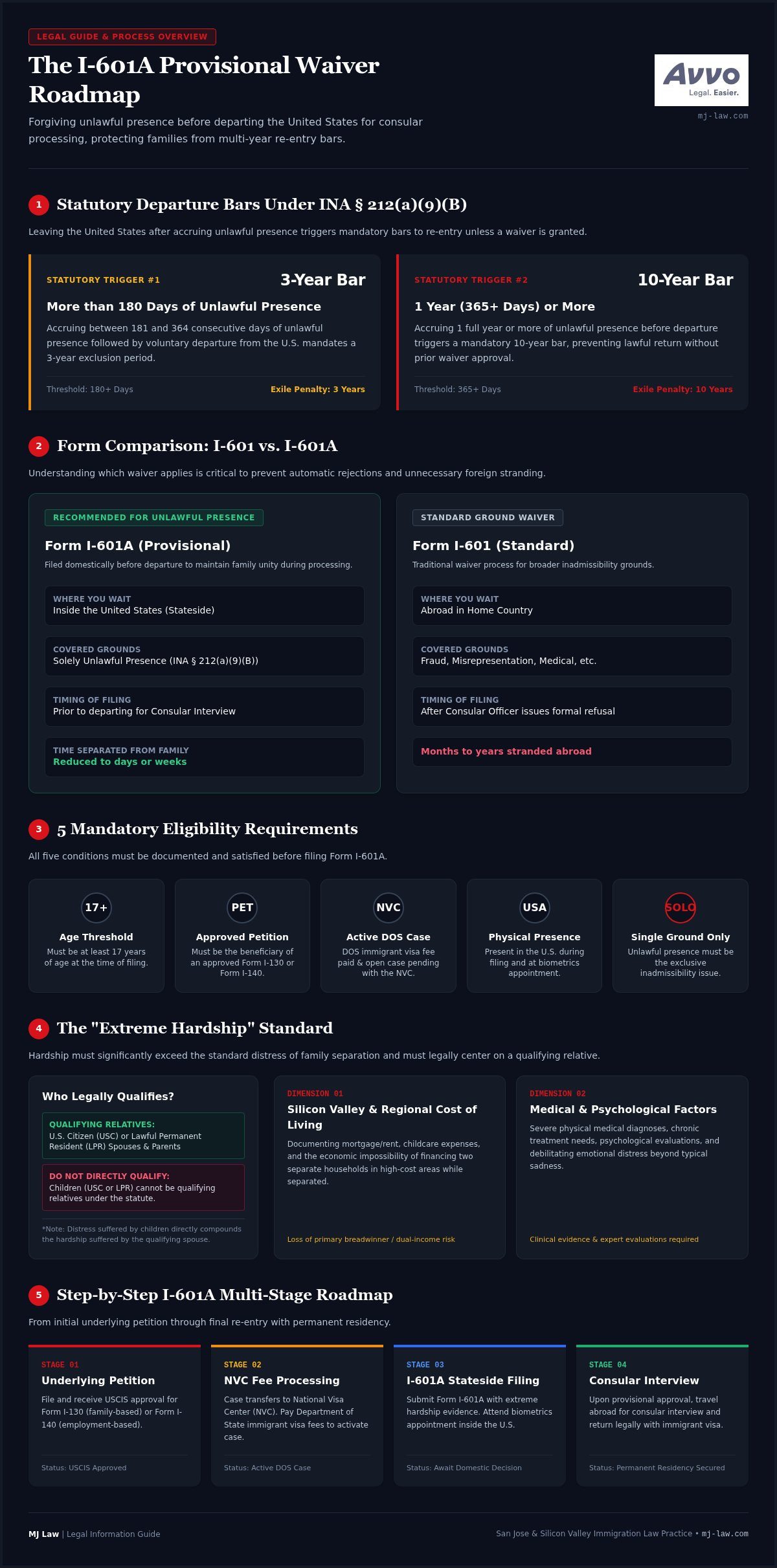
For undocumented immigrants living in Northern California, obtaining permanent legal status often feels like an impossible dilemma. Under federal immigration statutes, individuals who accrue more than 180 days of unlawful presence face a mandatory three-year bar from returning if they depart the country. Those who accrue one year or more trigger a devastating ten-year bar. Because individuals who entered without inspection or overstayed certain visas cannot adjust their status domestically, they must attend a consular interview abroad. Leaving without prior authorization triggers these statutory bars immediately.
The provisional unlawful presence waiver functions as a legal bridge across this divide. Established under the broader statutory framework of a Waiver of Grounds of Inadmissibility, Form I-601A allows eligible applicants to apply for forgiveness while remaining securely in the United States with their families. Consulting an experienced I-601A waiver lawyer San Jose residents trust ensures you do not depart before USCIS provisionally forgives this ground of inadmissibility, reducing your time apart to days or weeks instead of years.
I-601 vs. I-601A: Which One Do You Need?
Filing the incorrect form can derail your immigration journey and result in automatic rejections. Form I-601A exclusively addresses unlawful presence and requires you to remain stateside during adjudication. In contrast, the standard Form I-601 covers broader grounds of inadmissibility, including prior immigration fraud, misrepresentation, or specific medical grounds, and is usually submitted abroad after a consular officer formally issues a refusal. An I-601A waiver lawyer San Jose applicants partner with can conduct a comprehensive record review to confirm you don’t have overlapping grounds that would invalidate a provisional filing.
Eligibility Requirements for San Jose Applicants
Before submitting Form I-601A, an applicant must establish statutory eligibility through clear documentation. You must meet each of the following criteria:
- Age threshold: You must be at least 17 years of age at the time of filing.
- Approved underlying immigrant petition: You must be the beneficiary of an approved Form I-130 (family-based petition) or Form I-140 (employment-based petition).
- Active consular case: You must have paid the Department of State immigrant visa processing fee and have an open case pending with the National Visa Center.
- Physical presence: You must reside inside the United States when submitting the application and during your biometrics appointment.
- Single ground of inadmissibility: Your only ground of inadmissibility must be unlawful presence under INA section 212(a)(9)(B).
The “Extreme Hardship” Standard: The Core of Your Case
Extreme hardship is a legally defined situation that significantly exceeds the common consequences of deportation, such as routine emotional sadness or standard financial strain. Under federal guidelines governing the Provisional Unlawful Presence Waiver, USCIS does not grant approvals based on ordinary family separation. Instead, you must demonstrate that your qualifying relative would suffer exceptional devastation if you were barred from returning.
Identifying who legally counts as a qualifying relative is vital. For Form I-601A, qualifying relatives are strictly limited to U.S. citizen or lawful permanent resident (LPR) spouses and parents. U.S. citizen children do not qualify under the statute. However, any emotional, developmental, or financial distress your children experience directly compounds the hardship suffered by your qualifying spouse. A knowledgeable I-601A waiver lawyer San Jose families depend on weaves these interconnected pressures into a cohesive narrative rather than submitting a sterile checklist.
Economic Hardship in Silicon Valley
Establishing economic hardship requires translating local financial realities into federal evidence. San Jose consistently ranks among the most expensive metropolitan areas in the nation. If deportation removes a primary breadwinner or vital contributing earner, the remaining spouse often faces immediate eviction or financial insolvency. Paying Silicon Valley rent while simultaneously financing an overseas household in a developing economy is mathematically impossible for most families. Documenting mortgage obligations, childcare expenses, and regional living costs demonstrates that relocation or separation would destroy the family’s financial stability.
Medical and Emotional Factors
Severe medical diagnoses and psychological burdens carry substantial weight with adjudicators. Hardship arguments frequently center on complex medical needs, such as:
- Specialized healthcare: Chronic conditions like cardiovascular disease or autoimmune disorders that depend entirely on Northern California medical networks.
- Psychological strain: Clinical depression or severe anxiety documented by licensed professionals, showing that separation would incapacitate the qualifying relative.
- Caregiving responsibilities: Ongoing support provided to aging resident parents who cannot relocate abroad.
Every case requires proving two distinct scenarios: why your relative cannot survive alone in the Bay Area without you, and why they cannot reasonably relocate abroad with you. If you need personalized guidance on gathering this documentation, you can schedule a consultation with our legal team to review your family’s unique circumstances.
The Step-by-Step I-601A Process in 2026
Securing legal status through the provisional waiver requires strict adherence to a four-stage chronological pipeline. Missing a filing deadline or submitting documents out of sequence can stall an application for years. The standard roadmap involves:
- Underlying petition: Your qualifying family member files Form I-130 with USCIS to establish the qualifying familial relationship.
- Department of State fee intake: Once approved, USCIS transfers the file to the National Visa Center (NVC), where you must pay the immigrant visa processing fee to generate a receipt number.
- Waiver submission: Armed with fee confirmation, you file Form I-601A directly with USCIS while remaining in the United States.
- Provisional adjudication: You wait for USCIS approval before booking travel or scheduling an exit interview.
Processing times in 2026 average between 26.5 and 32.5 months at the Potomac and HART Service Centers. Because there is no premium processing available for this petition, partnering with an experienced I-601A waiver lawyer San Jose applicants rely on ensures your initial filing contains zero procedural errors that could trigger lengthy Requests for Evidence.
Navigating the National Visa Center (NVC)
The NVC acts as the administrative checkpoint between domestic USCIS processing and foreign consular posts. After paying the required fees, you must formally notify the NVC that you are seeking a Provisional Unlawful Presence Waiver stateside. This crucial notification halts premature consular scheduling while your waiver is pending. During this prolonged waiting period, your legal team maintains contact with the NVC, updates changing civil records, and keeps your immigrant visa file active so it isn’t terminated for inactivity.
The Consular Interview and Final Approval
Once USCIS grants provisional approval, the NVC completes documentary qualification and forwards the file to the U.S. Consulate in your country of origin. You then schedule your overseas medical exam and biometrics before attending the formal visa interview. Because an I-601A waiver lawyer San Jose families trust has already resolved the unlawful presence bar prior to departure, the risk of becoming stranded abroad drops drastically. Consular officers verify that no unexpected disqualifications have arisen, approve the immigrant visa, and clear you to return home to Northern California as a lawful permanent resident within a matter of days or weeks.
Why You Need a Local San Jose I-601A Waiver Lawyer
Federal statutes govern immigration law, but your case unfolds within a distinctly local environment. Successfully navigating procedural expectations across Northern California requires an advocate familiar with the jurisdiction of the San Jose and San Francisco USCIS offices. For Spanish-speaking households throughout Santa Clara County, bilingual consultations eliminate communication gaps, ensuring personal hardships are captured with absolute precision. Partnering with a dedicated I-601A waiver lawyer San Jose families rely on through MJ Law’s Family Immigration Services provides the steady guidance needed to navigate complex family reunification procedures.
Evidence Collection in the Silicon Valley Area
Building a compelling waiver application requires extensive documentation rooted in your daily life. Living in Silicon Valley presents distinct evidential opportunities that out-of-area firms often overlook. Our firm works directly alongside you to assemble comprehensive records from regional institutions, including:
- Educational documentation: Individualized Education Programs (IEPs) and progress reports from local Santa Clara County school districts showing why your children depend on their current environment.
- Medical narratives: Comprehensive records from Bay Area hospital networks documenting specialized treatments that cannot be replicated abroad.
- Community and professional ties: Verified payroll records, employer declarations, and community letters establishing deep civic roots.
Meeting your attorneys in person establishes a collaborative partnership. Rooted in the community since 1985, Gabriel Jack and Michael Muston personally guide clients through the evidence-gathering phase, ensuring no critical hardship detail is omitted.
Managing Processing Times and Delays
With adjudication timelines often stretching across multiple years, active case monitoring is critical. A qualified I-601A waiver lawyer San Jose residents work with tracks processing trends across service centers, submitting formal service inquiries whenever a petition falls outside normal processing times. MJ Law maintains a methodical communication rhythm throughout the multi-year wait, keeping your household informed so you don’t face unexpected surprises. To take the next step in protecting your family from separation, schedule an appointment with our San Jose team today.
Common Pitfalls and How to Avoid Waiver Denial
A provisional approval provides crucial security, but it does not guarantee an approved visa. Form I-601A forgives only one legal ground: unlawful presence. If a consular officer uncovers other grounds of inadmissibility during your interview abroad, such as prior fraud, undisclosed criminal citations, or prior removal orders, the provisional waiver is automatically revoked. At that point, you become stranded outside the country, forced to file Form I-601 and wait through an overseas adjudication that can separate your household for years.
Complete transparency with your legal team is the single best defense against an unexpected denial. Sharing every past law enforcement contact, border interaction, and immigration filing allows your counsel to anticipate potential disqualifiers before you submit paperwork. Working with an experienced I-601A waiver lawyer San Jose families trust ensures that hidden legal hurdles are identified and addressed while you remain safely in the United States.
Handling Requests for Evidence (RFE)
Adjudicators issue a Request for Evidence when they decide the initial submission fails to demonstrate the required level of extreme hardship. Receiving an RFE isn’t a final refusal, but failing to answer within the strict deadline results in an automatic denial with no option for administrative appeal. If USCIS demands more hardship substantiation, consulting a skilled Marriage Green Card RFE Lawyer San Jose applicants turn to helps pinpoint the exact evidentiary gaps. MJ Law prepares targeted rebuttal packages, providing additional expert financial documentation or clinical evaluations to satisfy adjudicator inquiries.
Final Checklist Before You Leave the US
Never depart the United States until your legal team completes a comprehensive pre-departure audit. Essential steps include:
- Approval confirmation: Ensure the original Form I-797 approval notice for your I-601A is safely secured in your travel packet.
- Record verification: Confirm that no new citations, arrests, or travel violations have occurred since the initial filing date.
- Application consistency: Verify that information on your DS-260 matches the facts documented in your waiver package.
Scheduling a pre-travel consultation with MJ Law provides a final, methodical review of your dossier, giving your family confidence as you complete your path to permanent residence.
Protect Your Family’s Future in the Bay Area
Navigating the provisional waiver process requires more than filling out federal forms; it demands a strategic legal roadmap designed to keep your household intact. By securing provisional approval before departing for your consular interview, you shield your loved ones from years of separation. Proving extreme hardship through Silicon Valley’s unique economic pressures, healthcare requirements, and family ties turns a difficult standard into a compelling argument for relief.
You don’t have to face this complex process alone. With over 30 years of local San Jose experience and bilingual English and Spanish representation, MJ Law delivers the steady guidance your family deserves. Decades of successful family reunification cases prove that thorough preparation and honest communication make all the difference. When you partner with a trusted I-601A waiver lawyer San Jose families rely on, you gain clarity, confidence, and peace of mind at every stage. Take the first step toward lasting security and schedule a confidential consultation with MJ Law by appointment today.
Frequently Asked Questions
Can I apply for an I-601A waiver if I have a criminal record?
Generally, having a criminal record complicates eligibility because Form I-601A only waives unlawful presence. If a past conviction triggers a separate ground of inadmissibility, USCIS will deny the provisional waiver. Certain minor infractions might not disqualify you, but your entire history requires strict analysis. You should have an immigration attorney review your certified court dispositions before submitting paperwork to determine if you remain eligible for provisional relief.
How long does it take to get an I-601A waiver approved in 2026?
Current processing times for Form I-601A average between 26.5 and 32.5 months across the Potomac and HART Service Centers. USCIS adjudicates these petitions without a premium processing option, meaning every applicant experiences this prolonged timeline. Preparing an exhaustive hardship package at the initial filing stage prevents additional delays caused by Requests for Evidence, keeping your case moving forward as quickly as federal processing allows.
What happens if my I-601A waiver is denied?
If USCIS denies your Form I-601A, you cannot file an administrative appeal, but you remain safely inside the United States. A denial means you should not travel abroad for consular processing, as departing triggers the ten-year bar. In most cases, you can compile additional evidence and submit a brand new application. Working with an experienced I-601A waiver lawyer San Jose families depend on helps resolve evidentiary weaknesses before refiling.
Do I have to leave the United States to apply for the I-601A?
No, you do not leave the United States to apply for this waiver. Remaining physically present in the country during the entire filing and adjudication process is a mandatory legal requirement. You only travel abroad to attend your immigrant visa interview after USCIS provisionally approves your waiver. This structure protects you from facing prolonged separation while waiting for a decision on your unlawful presence.
Can my children be the “qualifying relatives” for my hardship waiver?
No, children do not qualify as qualifying relatives under the provisional waiver statute. Federal law strictly limits qualifying relatives to U.S. citizen or lawful permanent resident spouses and parents. However, hardship to your children remains critical evidence. Adjudicators evaluate how your children’s medical, developmental, or financial distress directly causes extreme suffering for your qualifying spouse or parent, making their well-being an essential component of your case.
Is it safe to apply for a waiver if I am currently undocumented?
Applying for a provisional waiver is a standard legal process created specifically for undocumented individuals seeking permanent legal status. USCIS generally does not issue notices to appear or initiate removal proceedings based solely on a denied I-601A, provided there are no active deportation orders or serious disqualifications. Consulting an immigration firm by appointment allows you to safely evaluate potential risks before contacting immigration authorities.
How much does an I-601A waiver lawyer in San Jose cost?
Legal representation costs vary depending on the complexity of your background, the volume of evidence required, and whether prior immigration violations exist. Most firms structure fees based on the preparation of the underlying petition, hardship legal brief, and consular coordination. When hiring an I-601A waiver lawyer San Jose residents should look for transparent service agreements and confirmed experience handling complex waivers rather than focusing solely on cost.
Can I work while my I-601A waiver is pending?
Filing Form I-601A does not grant work authorization or confer temporary legal immigration status while it is pending. The waiver merely pauses consular proceedings while USCIS decides whether to forgive your unlawful presence. Unless you already maintain independent work permission through another program, such as Deferred Action for Childhood Arrivals (DACA) or Temporary Protected Status (TPS), submitting the waiver application alone will not provide employment authorization.