A family petition can open the door to a green card, but it doesn’t by itself grant permanent residence. Eligible people physically present in the United States may use Form I-485 to apply for adjustment of status when an immigrant visa is available in their category. An I-485 adjustment of status attorney in San Francisco can help clarify how the petition and application fit together.
The process can feel difficult to map out, especially when a family relationship, visa availability, supporting documents, and an interview all affect the next steps. This guide explains how adjustment of status works, what to expect during I-485 processing, and which records may be needed for an application and interview.
You’ll also learn how Form I-130 family petitions connect to Form I-485, when eligible immediate relatives may file both forms together, and why family-preference categories can involve a different wait. With a clearer picture of the process, you can better understand the issues to address as you prepare for a family-based green card application.
Key Takeaways
- Adjustment of status lets eligible people in the United States apply for permanent residence without returning abroad for immigrant visa processing.
- Processing time depends on factors such as the visa category and visa availability, so understand what may affect your case’s timeline.
- Prepare for possible biometrics and an interview by understanding the records that can support your I-485 application.
- A family petition establishes the qualifying relationship, while visa-category rules determine how it connects to the green card application.
- If USCIS denies an appealable adjustment-of-status decision, the appeal generally must be filed within 30 days of service, according to U.S. Citizenship and Immigration Services.
What is Adjustment of Status (I-485)?
Adjustment of status is the process eligible people already in the United States use to apply for lawful permanent residence without returning abroad for immigrant visa processing. Form I-485 is the application, but being physically present in the country alone does not establish eligibility. The applicant must qualify under an immigration category, meet its requirements, and have an immigrant visa available when required.
Family and employment petitions can provide the basis for a green card application. For example, a qualifying relative may file Form I-130, while an employer may file Form I-140 for an employment-based case. The petition establishes the relevant family relationship or employment basis; it does not by itself grant permanent residence. Visa availability and the applicant’s circumstances determine whether and when adjustment can proceed.
Eligibility also includes humanitarian and special immigrant categories. Refugees generally must have lived in the United States for one year after admission as refugees before applying for permanent residence. People granted asylum must also wait at least one year before applying through Form I-485. U.S. Citizenship and Immigration Services states that U visa holders must have held U nonimmigrant status for at least three years and cooperated with law enforcement to qualify for adjustment.
Some applicants may qualify under Section 245(i) of the Immigration and Nationality Act. Others may have an underlying petition through Form I-360, used for certain special immigrant categories. The relevant category matters: a rule that applies to a family petition may not apply to an employment or humanitarian case. Applicants outside the United States generally pursue consular processing rather than adjustment of status.
Adjustment of status is distinct from naturalization. Lawful permanent residents are generally eligible to apply for U.S. citizenship after five years of permanent residence; that timeline concerns naturalization, not the I-485 application. Citizenship involves a separate application and eligibility requirements.
To compare I-485 immigration attorneys in San Francisco, assess their experience with your petition category, how they explain eligibility and risks, and who will manage case preparation. Ask for a clear description of the work and communication process before deciding.
For free or low-cost immigration legal help in San Francisco, look for local nonprofit legal-aid organizations and community immigration clinics. Ask whether they assist with adjustment of status and whether you meet their eligibility criteria.
If USCIS issues an adjustment-of-status decision that can be appealed, the appeal generally must be filed within 30 days of service of the decision, according to U.S. Citizenship and Immigration Services. Because the deadline runs from service, the date and instructions on the decision are important to the next step.
Processing times
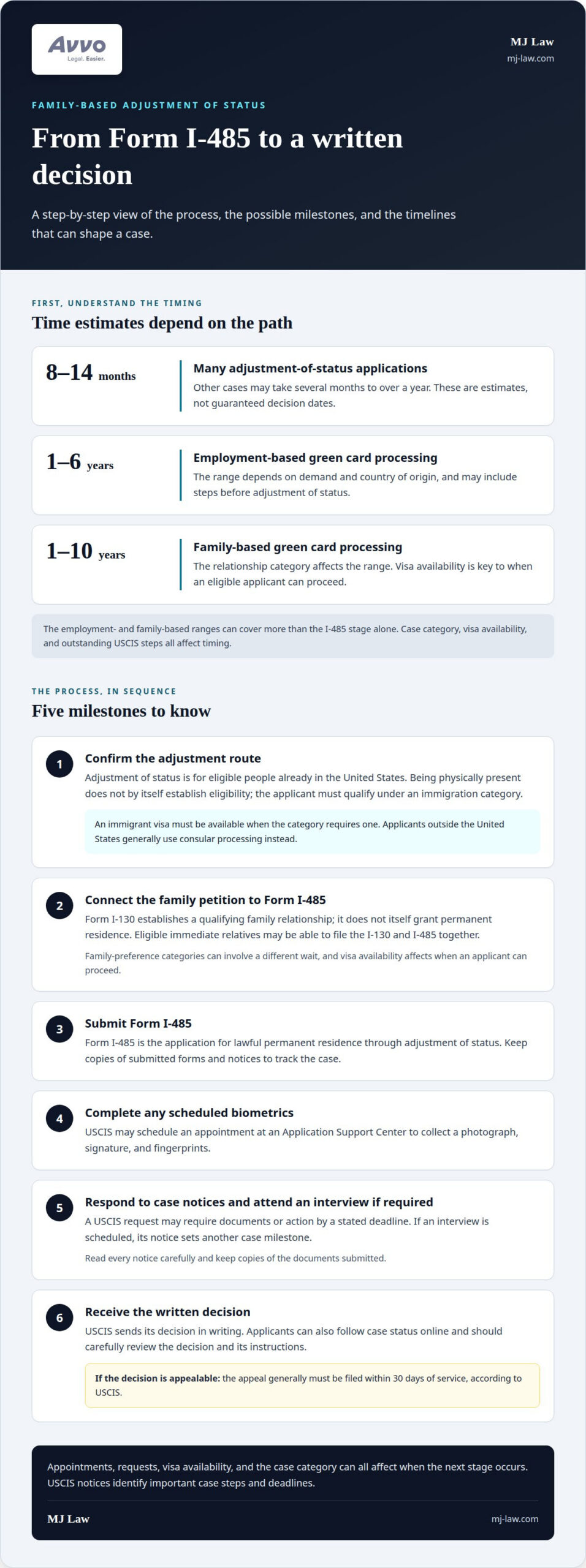
Many adjustment-of-status applications in the United States are estimated to take 8 to 14 months. Other cases may take several months to over a year. These ranges describe different case circumstances, not a guaranteed decision date. The process includes submitting the application, attending biometrics when scheduled, responding to any USCIS request, and completing an interview if required. Each step affects when a case can move forward.
The immigration category can make a substantial difference. Employment-based green card processing typically ranges from 1 to 6 years, depending on demand and the applicant’s country of origin. That broader timeline may include steps before an applicant can complete adjustment of status. Family-based green card processing can range from 1 to 10 years, depending on the relationship category. Visa availability is a key factor in when an eligible applicant can proceed.
Applicants outside the United States generally use consular processing instead of adjustment of status. In this route, the immigrant visa application proceeds through a U.S. consulate abroad, rather than through Form I-485 inside the country. The steps and timing depend on the visa category and the consular stage. Someone already in the United States may pursue adjustment only if they meet the applicable eligibility rules. The two processes lead through different application pathways.
After submitting an I-485 application, applicants may receive a biometrics appointment notice. USCIS collects a photograph, signature, and fingerprints at an Application Support Center. An interview notice, if issued, sets another case milestone. USCIS sends its decision in writing. Applicants can follow case status online and should read notices carefully, since they may require documents or action by a stated deadline. Keeping copies of submitted forms and notices helps track each step.
San Francisco naturalization processing is a separate timeline from adjustment of status. Naturalization applicants typically wait 8 to 14 months for application processing. At the San Francisco USCIS field office, applicants are scheduled for biometrics before their naturalization interview. Ceremonies frequently take place at City Hall or the field office. These steps apply to citizenship applications, not a pending I-485, so the two timelines should not be confused.
For an individual case, the category, visa availability, and outstanding USCIS steps help explain the timeline. Organizing notices and tracking each required appointment gives applicants a clear view of progress. If you want to discuss how the stages apply to your situation, schedule an immigration case discussion.
Adjustment of status and Form I-485
Form I-485 is the application for eligible people in the United States seeking permanent residence. Its filing date depends on the applicant’s immigration category and immigrant visa availability.
Visa Availability and I-485 Filing
Before filing, identify the petition category and whether a visa number is available. Some immediate relatives of U.S. citizens may submit Form I-130 and Form I-485 together. For many other applicants, filing depends on visa availability in their category. The applicable category and priority date help determine which path applies; a petition alone does not establish that filing is permitted.
Form I-485 Application Preparation
Preparation means completing the application consistently and assembling supporting documents for the applicant’s specific basis. The packet may include an underlying petition or approval notice, identity records, and other evidence relevant to the category. Form I-864, an Affidavit of Support, is required for some applications. A careful review can identify missing answers, conflicting dates, or records that need explanation before submission.
Applicants may also consider related forms based on their needs. A person with a pending Form I-485 may apply for employment authorization using Form I-765, but work authorization is not automatic. The applicant must receive an Employment Authorization Document before beginning employment. Form I-131 relates to advance parole for travel; travel while an application is pending requires careful attention to the applicant’s status and applicable travel rules.
After filing, USCIS may schedule biometrics at an Application Support Center. The appointment includes a photograph, signature, and fingerprints. Keep copies of your filed forms, supporting documents, receipts, and appointment notices together. If USCIS requests additional evidence, its notice explains what is needed and gives a response deadline. Keeping a clear record helps you connect later requests to your original application.
Family-based applications require coordination between the relationship petition and the residence application. For example, some immediate relatives of U.S. citizens can file Forms I-130 and I-485 concurrently, while other categories depend on visa availability. Form I-797 may serve as an approval notice for an underlying petition. The relevant filing sequence depends on category and visa status, not simply on having a qualifying relative.
Form N-400 is a separate application for naturalization, not a replacement for Form I-485. Lawful permanent residents generally become eligible to apply for citizenship after five years of permanent residence. N-400 preparation focuses on the applicant’s residence history, eligibility, and supporting answers, while I-485 preparation concerns obtaining permanent residence. For help understanding how these application steps fit together, arrange an immigration case discussion.
Adjustment of status interviews and required documents
For Form I-485, USCIS may schedule biometrics and an interview before deciding the green card application. The appointment notice determines whether an interview is required and where the applicant must appear.
Interview Documents and Preparation
Organize the records connected to the application so you can respond clearly to questions about the case. Supporting documents may include the I-94 Arrival/Departure Record as proof of lawful U.S. entry, 2×2-inch photos, and Form I-693, the medical examination report. Bring the interview notice and documents relevant to the application’s eligibility basis.
For a marriage-based case, the interview may cover your relationship and information in the application. If you have a criminal history, bring certified court dispositions or related records to your San Francisco USCIS interview. An attorney can help organize your documents and prepare you to explain your answers consistently with your filing.
Biometrics and Interview Steps
The steps are: submit Form I-485 with its supporting documents, attend a biometrics appointment if USCIS schedules one, then attend an interview if USCIS issues an interview notice. Biometrics collection includes a photograph, signature, and fingerprints at an Application Support Center. Applicants must attend an adjustment-of-status interview when they receive a notice.
Not every I-485 case requires an interview. If USCIS schedules one, read the notice for the appointment details and bring the requested records. USCIS sends adjustment-of-status decisions in writing, so retain the decision notice with the case documents.
International travel requires particular care while an I-485 application is pending. Travel abroad without valid advance parole or a valid H-1B or L visa may cause USCIS to treat the application as abandoned. Applicants seeking advance parole should file Form I-131 and wait for written approval before traveling internationally. A pending application alone does not provide permission to travel or return.
After receiving a green card, a different travel rule applies. A permanent resident outside the United States for less than one year can use the green card for re-entry. Someone planning to remain abroad longer than one year needs to obtain a re-entry permit before departure. These rules concern travel after permanent residence, not travel during I-485 processing.
San Francisco USCIS field office appointments can also involve naturalization, which is separate from an adjustment interview. Naturalization applicants attend biometrics before their interview, and ceremonies frequently take place at City Hall or the USCIS field office. An I-485 applicant should follow the specific notice for their own case rather than assume a naturalization appointment process applies.
Family-based green card petitions
A family relationship can provide a path to permanent residence, but the sponsor’s status and the relationship category matter. U.S. citizens and lawful permanent residents can petition for different relatives, and those categories affect visa availability and the steps toward a green card. Start by identifying the sponsor’s immigration status and the applicant’s relationship to them.
A family-based sponsor files Form I-130 with U.S. Citizenship and Immigration Services to establish the relationship between sponsor and applicant. The petition addresses the family connection; the applicant must still qualify for the next stage of the immigration process. Approval of an immediate-relative petition may take several months, while family-based green card processing can range from 1 to 10 years, depending on the relationship category.
Immediate relatives of U.S. citizens include spouses, parents, and unmarried children under 21. There’s no annual numerical cap on immediate relatives a U.S. citizen can sponsor. A U.S. citizen must be at least 21 years old to petition for a parent. For a stepchild to qualify as an immediate relative, the marriage creating the relationship must occur before the child’s 18th birthday.
Other family relationships fall under preference categories. A lawful permanent resident may sponsor an unmarried child under 21, but family-preference relatives may wait years or decades for a green card. This difference matters when planning the order of steps: filing a petition establishes the case’s family basis, while visa availability determines when an applicant in a capped category can move forward.
Marriage-based cases also require attention after permanent residence begins. A conditional permanent resident who receives status through marriage gets a 2-year green card. To remove the conditions on residence, the person must file Form I-751 before that conditional card expires. This later filing is separate from the original family petition and adjustment application, so the expiration date belongs on the family’s immigration timeline.
For a family preparing to apply, useful planning starts with the sponsor’s citizenship or permanent-resident status, the exact relationship, and the relevant visa category. Those details shape whether the case is an immediate-relative or preference petition and how the applicant proceeds. A family immigration case discussion can help clarify which steps apply to your relationship and timeline. Schedule a family immigration discussion.
MJ Law
MJ Law helps individuals and families understand how an I-485 application fits their immigration path. For family-based cases, the work can include assessing how a petition and adjustment application relate, identifying issues that may affect filing, and guiding applicants through the process and supporting documents. This can be useful when a family relationship is the basis for permanent residence or when the next step after a petition is unclear.
Through its Family Immigration Services, MJ Law assists with marriage-based green card matters. The firm explains the process and helps clients prepare for the steps ahead, including application review and interview preparation. Contact MJ Law to discuss your adjustment-of-status or family immigration matter in San Francisco or San Jose.
Take the Next Step With a Clear Plan
The next step is to connect the facts of your situation to the right immigration pathway. Before making decisions, organize your petition history, current immigration status, and any notices or deadlines that shape your case. A focused review can help identify the key questions and clarify what preparation comes next.
An I-485 adjustment of status attorney in San Francisco can help assess how your circumstances fit the application process. MJ Law assists individuals and families through Family Immigration Services, and also handles Business and Investor Visas and Employment-Based Visas. The right starting point depends on the basis for seeking permanent residence and the details of your immigration history.
Bring your questions about eligibility, filing sequence, or case documents to a conversation with the firm. Contact MJ Law about your I-485 to discuss a practical next step. With a clearer plan, you can move forward with greater confidence.
Frequently Asked Questions
Can I file the I-485 at the same time as my immigrant petition?
Some applicants can file Form I-485 together with the immigrant petition, but concurrent filing depends on the category. For example, certain immediate relatives of U.S. citizens may submit Forms I-130 and I-485 at the same time. Other applicants need an approved petition and an available immigrant visa before filing. The petitioner’s status and the applicant’s relationship determine which sequence applies.
Can I work with a pending I-485?
A pending I-485 alone does not authorize employment. Applicants can apply for employment authorization using Form I-765, then wait until USCIS issues an Employment Authorization Document before starting work. For example, filing Form I-765 with or after an adjustment application does not itself provide permission to work. Keep the EAD and its validity information available when completing employment paperwork.
What happens if my I-485 is denied?
A denial notice explains the decision and any appeal rights, but not every denial can be appealed. For an appealable adjustment decision, the appeal generally must be filed within 30 days of service, according to U.S. Citizenship and Immigration Services. Depending on the circumstances, an applicant may also be able to file a motion to reopen or reconsider. The notice and its stated options guide the next step.
What does an I-485 adjustment of status attorney in San Francisco help with?
An attorney can assess how the applicant’s immigration history and petition category relate to the I-485, then help organize the application and supporting evidence. MJ Law provides immigration legal services, including Family Immigration Services, and assists with green card applications. For someone in San Francisco with a family-based case, legal support can help address petition sequencing, document preparation, and questions raised during the process.
How much do San Francisco immigration attorneys charge for I-485 adjustment of status cases?
Legal fees depend on the case and are provided after a quote request. Factors include the immigration category, the work involved in preparing the application, the number of related forms, and whether the case requires additional responses or interview preparation. Government filing fees are separate from attorney fees. A written explanation of the work covered helps clarify what a proposed legal fee includes.
Who is eligible to file Form I-485 and what are the main requirements?
Form I-485 is for people physically present in the United States who qualify through an immigration category and meet its requirements. The basis may involve a family or employment petition, asylum, refugee status, or another eligible category. Applicants also need an immigrant visa number when their category requires one. For example, a qualifying relationship alone does not make every family-preference visa immediately available.
What documents are needed for an I-485 adjustment of status application?
Common supporting records include proof of lawful entry, such as Form I-94, the medical examination report on Form I-693, and the required photographs. The application category can call for additional evidence, such as a family petition approval notice or Form I-864, an Affidavit of Support. For a marriage-based case, relationship evidence can also support the petition. Organize documents by form and purpose.
What risks or common reasons for I-485 denial should applicants know about?
Problems can arise if you do not meet eligibility rules, a required visa is unavailable, or information in your application conflicts with supporting records. Missing evidence or an incomplete response to a USCIS request can also leave important questions unanswered. International travel without the required authorization can lead USCIS to treat a pending application as abandoned. Review notices promptly and keep details consistent across forms and evidence.