
Could an approved employment petition still leave you waiting for a green card? Yes. Form I-140 is an important step in many employment-based cases, but approval alone does not grant permanent residence. For professionals and employers in San Jose and San Francisco, an I-140 immigrant petition lawyer can help clarify who should file, which category may fit, and how the petition connects to the rest of the case.
It’s understandable to feel uncertain when PERM labor certification, employer sponsorship, and self-petition options all come into play. The right approach depends on the worker’s qualifications, the position, and the petition category. Supporting evidence and employer information also need to align with the case strategy. A priority date may affect when the applicant can move to the final green card stage.
This guide explains how Form I-140 fits into an employment-based green card case, what can shape the choice of pathway, and what documentation may need careful preparation. You’ll also learn why approval is not the same as receiving a green card and when experienced counsel can help identify practical next steps. MJ Law has served San Jose since 1985, guiding individuals and businesses through employment-based immigration matters.
Key Takeaways
- Form I-140 supports an employment-based green card case, but approval alone does not grant permanent residence.
- Compare EB-1, EB-2, EB-2 NIW, and EB-3 based on the petition basis, who may file, and whether PERM applies.
- Prepare evidence for the selected category, including relevant job details, employer records, and the worker’s qualifications.
- An I-140 immigrant petition lawyer can help assess pathway fit, organize evidence, and address issues in a prior petition, but cannot guarantee approval.
- Before filing, organize the case details and check the current USCIS form edition and filing instructions.
Role of I-140 Petition in Employment Green Card Cases
Form I-140, the Immigrant Petition for Alien Workers, is filed with U.S. Citizenship and Immigration Services (USCIS) to establish a basis for an employment-based immigrant case. USCIS reviews whether the position or other qualifying basis fits the requested category and whether the worker meets that category’s requirements. In an employer-sponsored case, the petition generally concerns a specific permanent job offer as well as the worker’s qualifications. In an eligible self-petition, it focuses on the individual’s qualifying basis instead.
The distinction matters because the I-140 is one stage, not the entire green card process. Form I-140 Immigrant Petition for Alien Worker provides a general overview of the form and its relationship to immigrant visa cases. For an individual case, the petition’s role depends on its category and the applicant’s eligibility to proceed to the next stage.
An approved I-140 is not lawful permanent-resident status; it is an approved petition that may support a later step toward a green card. Approval does not, by itself, authorize permanent residence or guarantee that the applicant will receive a green card. A separate immigrant-visa or adjustment-of-status step is required when the applicant is eligible.
Who files Form I-140: an employer or the worker?
In employer-sponsored categories, the employer commonly files the I-140 for the employee. The employer is the petitioner, and the worker is the beneficiary, the person for whom the immigration benefit is sought. The petition generally connects the employer’s job offer and relevant business information with evidence that the employee meets the category’s requirements.
Some qualifying EB-1A and EB-2 National Interest Waiver (NIW) cases may allow the worker to self-petition. The person files on their own behalf, and the evidence must support the applicable category and basis. The labels “petitioner” and “beneficiary” depend on the route, not simply on who hopes to obtain a green card. A San Jose or San Francisco I-140 immigrant petition lawyer can help assess how those roles apply to the case.
Where the I-140 fits after PERM or before the next stage
For many employer-sponsored cases, the process begins before the I-140. PERM labor certification, handled by the U.S. Department of Labor, is required in many employment-based cases, including many EB-2 and EB-3 petitions. It concerns the job opportunity and the labor market. PERM is not required for every route: EB-1 cases and EB-2 NIW cases are notable examples that do not require it.
When PERM applies, the employer generally obtains the labor certification before filing the I-140. After the petition stage, the next step may be adjustment of status in the United States or an immigrant-visa application through consular processing. Which option is available depends on the applicant’s circumstances and whether an immigrant visa is available under current rules. Visa availability can change, so an approved petition may not mean the applicant can immediately file the next application. Understanding the sequence helps workers and employers plan without mistaking petition approval for the finish line.
Which I-140 Pathway May Fit: EB-1, EB-2, EB-3, or NIW?
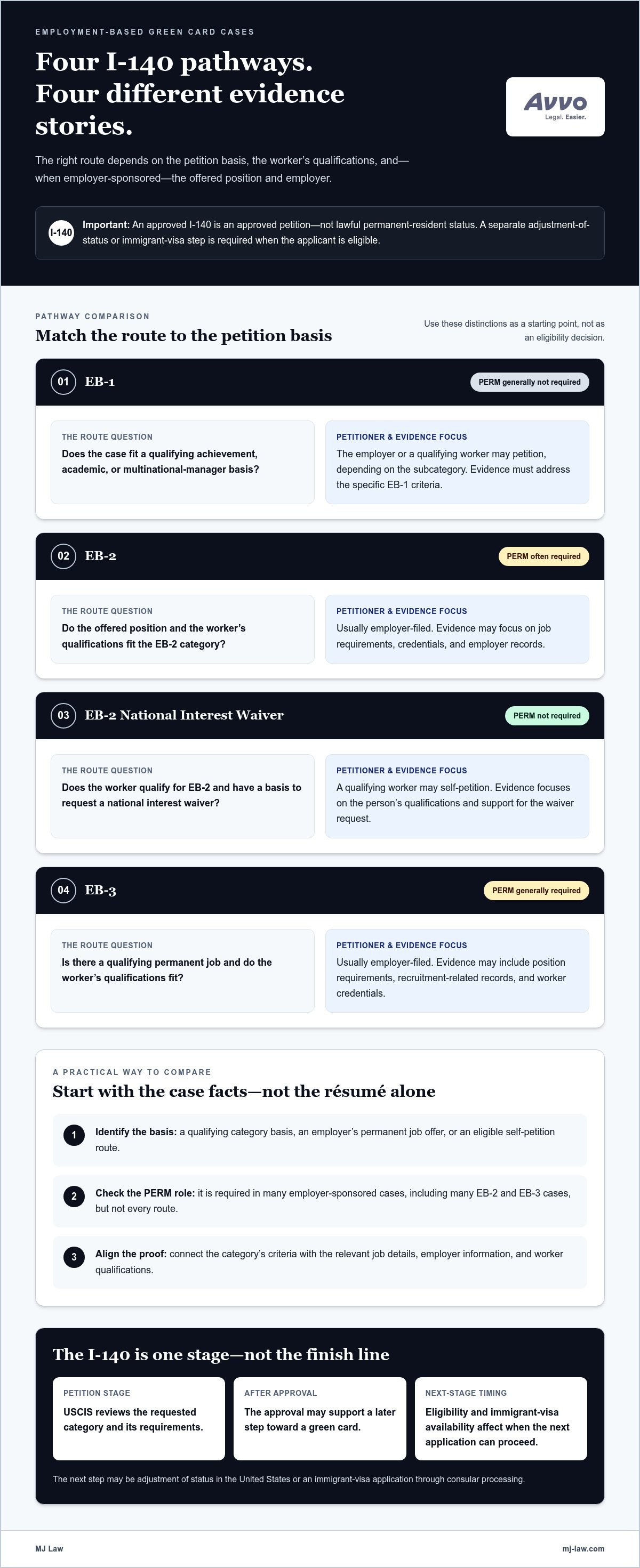
These categories aren’t interchangeable. The right one depends on the basis for the petition, the worker’s background, and, for employer-sponsored cases, the offered position and employer. A strong résumé alone doesn’t determine category fit; the evidence must address the legal criteria for the specific route. Use the comparison below as a starting point, not as an eligibility decision.
| Pathway | Typical petitioner | General basis | PERM relevance | Evidence focus |
|---|---|---|---|---|
| EB-1 | Employer or qualifying worker, depending on subcategory | Qualifying achievement, academic, or multinational-manager basis | Generally not required | Evidence tied to the specific EB-1 criteria |
| EB-2 | Usually employer | Position and worker qualifications under the EB-2 category | Often required | Job requirements, credentials, and employer records |
| EB-2 NIW | Qualifying worker may self-petition | EB-2 eligibility plus a basis for requesting a national interest waiver | Not required | Qualifications and evidence supporting the waiver request |
| EB-3 | Usually employer | Qualifying permanent job and worker qualifications | Generally required | Position requirements, recruitment-related records, and worker credentials |
PERM is generally associated with many employer-sponsored EB-2 and EB-3 cases, but its role depends on the category and case facts. For employer-sponsored cases, start by examining the job and the worker’s qualifications for it. For a self-petition, focus instead on whether the individual’s record supports the specific route. Neither approach is inherently better for every applicant.
How employer-sponsored EB-2 and EB-3 petitions differ
For EB-2 and EB-3, the offered position, its requirements, and the beneficiary’s qualifications must align with the requested category. The employer may also need to document its ability to pay the offered wage, with USCIS evaluating relevant financial evidence under current standards. PERM commonly precedes the I-140 in these routes, though requirements vary. An I-140 immigrant petition lawyer can help connect the job description, recruitment and employer records, and worker credentials into a consistent case.
When EB-1 or an EB-2 National Interest Waiver may be considered
EB-1 includes distinct routes with their own criteria, including EB-1A extraordinary ability. A worker considering that route should assess evidence against its specific standards; the EB-1A extraordinary-ability guide can provide further context. EB-2 NIW is also distinct: a qualifying worker may self-petition, but must support both the underlying EB-2 basis and the waiver request. Neither category is a shortcut based simply on seniority or a compelling job title.
Temporary work status and an immigrant petition serve different purposes. For instance, L-1A is a temporary status category, while an I-140 is part of an employment-based immigrant process; one does not automatically establish eligibility for the other. If you’re weighing employer sponsorship against a qualifying self-petition, a focused employment-based immigration consultation can help clarify which evidence and criteria deserve attention.
What Evidence and Employer Details Can Shape an I-140 Petition?
Organize evidence around the selected category instead of gathering a one-size-fits-all packet. First list the claims the petition needs to establish, then connect each claim to supporting records. In an employer-sponsored case, that may require coordinating information from the employer and the worker. In a self-petition, the focus shifts to the individual’s qualifications and the specific legal basis asserted.
Evidence is persuasive when it matches both the requested category and the facts documented in the record. For example, a job description that sets out one level of responsibility should not conflict with letters describing materially different duties. Consistent information helps USCIS understand how the evidence supports the petition’s claims.
Employer records, job details, and ability to pay
For an employer-sponsored petition, review the offered position and the employer’s records together. Relevant facts may include the job title, duties, work location, offered wage, and stated requirements, along with the employer’s identity and business operations. These details should align across the petition, supporting letters, and any PERM materials when labor certification applies.
The employer’s ability to pay the offered wage can also matter. USCIS evaluates this issue under its current rules and may consider evidence covering the relevant period. Depending on the circumstances and applicable instructions, examples can include tax, annual report, or audited financial records, or other evidence USCIS recognizes. These examples aren’t a universal checklist. An I-140 immigrant petition lawyer can help identify which records fit the employer’s situation and whether they address the petition’s claims.
Beneficiary qualifications and category-specific evidence
The worker’s evidence should demonstrate the qualifications relevant to the position and requested category. Depending on the case, that may include degree records, transcripts, detailed employment letters describing duties and experience, professional licenses, or other credentials. If the position requires a particular qualification, the supporting documents should make clear how the beneficiary meets it. Keep translations and identity details consistent with the filing requirements.
For self-petitions, there may be no employer job offer to document, but the evidence still needs a clear structure. In an EB-2 NIW case, organize materials around the underlying EB-2 basis and the facts supporting the waiver request. For EB-1A, connect each item of evidence to the specific extraordinary-ability criteria being claimed rather than relying on a general collection of awards, publications, or letters. The EB-1A extraordinary-ability guide can help readers understand that route’s evidence focus.
- Compare job requirements with the beneficiary’s documented education and experience.
- Check that employer records, job details, and petition statements tell a consistent story.
- Group self-petition evidence by the particular criteria or basis it supports.
- Review the current USCIS instructions for the chosen category before finalizing supporting materials.
For Silicon Valley employers and professionals, careful coordination is especially useful when job duties, company records, or a worker’s career history need explanation. MJ Law serves individuals and businesses in the San Jose and San Francisco area. Se Habla Español – Consultas de Inmigración Disponibles.
How to Prepare for an I-140 Filing Without Confusing It With the Green Card Stage
A careful I-140 preparation process separates two tasks: building a case that supports the petition and following USCIS’s current filing instructions. Completing the form is only one part. The petition’s approval does not itself provide a green card, work authorization, or permission to travel. Those questions depend on the person’s current status and separate applications or processes.
Use this sequence to organize the case before submission:
- Identify the petition basis. Confirm which employment-based category and legal basis the case relies on. The facts and evidence should support that specific route.
- Confirm the roles. Establish who is the petitioner and who is the beneficiary. In employer-sponsored cases, coordinate with the employer on the job offer and company information; a qualifying self-petition has a different structure.
- Map the evidence. Connect each important claim to supporting records. For example, identify which documents establish the offered position and which show the beneficiary’s relevant qualifications.
- Review the complete record. Compare names, dates, job duties, wage details, and supporting documents for consistency. Resolve discrepancies or identify questions that need legal analysis rather than relying on assumptions.
- Check filing mechanics separately. Before submitting, use the current USCIS form edition and instructions to verify the filing address and available submission options. These details can change, so don’t rely on an old checklist or a previously filed case.
A focused pre-filing review
Review the proposed category against the actual record, not just the petition’s wording. If the job description calls for particular experience, for instance, the beneficiary’s records should clearly document relevant experience. A difference in a name, employment date, or position detail may need explanation. An I-140 immigrant petition lawyer can help assess category fit, spot gaps, and identify issues that require a case-specific legal review without predicting the outcome.
Keep copies of the submitted petition and supporting materials. They can help the petitioner and beneficiary understand what USCIS reviewed and respond accurately if the agency later sends a notice or requests additional evidence.
After filing: receipt, requests, and separate immigration steps
After submission, USCIS may issue a receipt notice and later make a decision, send a request for evidence, or take another procedural step. A request for evidence calls for a response to the issues USCIS identifies. It doesn’t, by itself, determine the final result. Optional premium processing may be available for certain petitions, but eligibility, timing, and rules vary and should be checked against current USCIS guidance.
Keep the next stage distinct. A priority date helps determine when an immigrant visa may be available; applicants should consult the current Department of State Visa Bulletin and applicable USCIS guidance. Adjustment of status or consular processing occurs separately when the person qualifies and a visa is available. Work authorization and travel permission also require separate analysis, so don’t assume an I-140 filing or approval grants either one.
For a case-specific review of your petition basis, evidence, and filing plan, schedule an immigration consultation.
When an I-140 Immigrant Petition Lawyer Can Help in San Jose
An I-140 petition can involve more than completing a form. The petitioner and beneficiary may need to coordinate information, identify the appropriate category, and present evidence that supports the case as a whole. For professionals and employers in San Jose, San Francisco, and Silicon Valley, legal guidance can help bring those pieces together, especially when the facts don’t fit a straightforward employer-sponsored path.
Hiring a lawyer doesn’t guarantee approval. USCIS decides each petition under the applicable criteria. Counsel’s role is to analyze the case, help prepare a coherent filing, and identify questions that may need attention before submission. That support can be useful when the category is uncertain, employer documentation needs careful review, or a previous petition raised concerns.
What legal guidance can cover in an I-140 matter
An I-140 immigrant petition lawyer can assess how the proposed category fits the worker’s qualifications and, where applicable, the employer’s job offer. Counsel can help organize evidence around the petition’s claims, review form details for consistency with supporting records, and flag issues that call for case-specific legal analysis. In employer-sponsored cases, this may involve coordinating job and company information with the beneficiary’s education, experience, and other relevant records.
Legal review may be especially helpful if the worker’s role or experience is difficult to describe clearly, if employer financial records raise questions, or if a prior petition included a request for evidence, denial, or inconsistent information. These circumstances don’t determine the outcome of a new filing, but they can make it important to understand what the record shows and how the case should address it. A careful review focuses on the facts and applicable criteria, not on promises.
Employers and professionals should also consider how the I-140 fits into their broader employment-based immigration plans. A petition is one stage in a larger process, and its preparation may need to account for the beneficiary’s circumstances and the employer’s role. Discussing those details early can help clarify which questions need resolution before filing.
Discuss your employment-based immigration questions with MJ Law
MJ Law is a San Jose immigration law firm serving individuals and businesses. The firm has served San Jose since 1985 and has more than 400 five-star Google reviews with a 4.8 rating. These reflect the firm’s history and client feedback, not a prediction or guarantee of any petition’s outcome.
For a consultation, consider bringing a copy of any prior I-140 filing or USCIS notice, a summary of the proposed position or self-petition basis, and the records you already have about qualifications and employer details. That information can help focus the discussion on category fit, evidence planning, and questions specific to your circumstances. Se Habla Español – Consultas de Inmigración Disponibles.
Schedule a consultation with MJ Law to discuss your employment-based immigration questions in San Jose or San Francisco.
Take the Next Step With a Clear Case Plan
Turn what you know about your employment and immigration history into a practical plan. Before taking action, identify the questions that could affect your petition strategy, such as how your experience aligns with the proposed category or what information the employer needs to provide. Addressing those questions early can help you approach the process with greater clarity.
An I-140 immigrant petition lawyer can review the facts with you, explain potential pathways, and help identify areas that may need further attention. Legal guidance can support informed decisions, but no lawyer can promise a particular USCIS decision.
If you’re ready to discuss your circumstances and possible next steps, schedule a consultation about your I-140 petition. MJ Law assists individuals and businesses with employment-based immigration matters in San Jose and San Francisco.
Frequently Asked Questions
Can I file an I-140 petition without an employer?
Yes, certain workers may self-petition under qualifying EB-1A or EB-2 National Interest Waiver pathways. Many other employment-based petitions rely on an employer petitioner, and some involve a job offer or labor certification. Having an employer willing to sponsor you doesn’t by itself establish that a particular category fits. Before preparing forms, compare your intended basis with current USCIS instructions and the evidence available to support it.
Can I change employers after my I-140 is approved?
Possibly, but an approved petition doesn’t make every job change permissible or automatically preserve every part of a case. The effect can depend on the petition category, whether a related adjustment application has been filed and how long it has been pending, and applicable portability rules. Before accepting a new position, review the petition and any related USCIS notices with an immigration attorney. This can help identify case-specific issues to address before changing employers.
Does a pending I-140 give me permission to work in the United States?
No. A pending I-140 isn’t a work permit and doesn’t independently grant immigration status. Your authorization to work must come from a separate basis, such as qualifying work-authorized nonimmigrant status or an approved employment authorization document. Check the expiration date and conditions on your current documents, and don’t treat an I-140 receipt notice as proof that you may work. If your authorization is changing, get advice based on your full immigration history.
What happens if an employer withdraws an I-140 petition?
The consequences depend on when the employer withdraws the petition, whether USCIS has approved it, and what related applications are pending. The withdrawal may affect the petition or later immigration steps, but the impact isn’t identical in every case. Keep the employer’s withdrawal notice, USCIS correspondence, and copies of the petition together. An I-140 immigrant petition lawyer can review those records and explain which issues need attention under the rules that apply to your circumstances.
Can I request premium processing for Form I-140?
Premium processing may be available for some I-140 classifications, subject to current USCIS requirements. It concerns the agency’s processing timeframe, not the strength of the evidence or the likelihood of approval. Before making plans around it, review USCIS’s current premium-processing instructions for the category, form, and applicable timeframe. An older estimate or past filing experience may not reflect current rules, so use official guidance when deciding whether the option fits your case.
Does an I-140 petition affect my H-1B status?
An I-140 and H-1B status are separate, though both may be relevant to employment-based immigration planning. Filing or approval of the I-140 doesn’t automatically extend H-1B status or authorize continued work. For example, an upcoming H-1B expiration raises separate questions about extension eligibility and maintaining status. Review your approval notices, status dates, and employment circumstances with counsel before relying on an I-140 to support an H-1B decision.