
What if your experience isn’t the deciding factor in an EB-3 case? The offered job matters just as much. If you’re considering an EB-3 skilled worker green card attorney San Jose applicants can turn to for guidance, it helps to understand how the position’s requirements, your qualifications, and your employer’s role fit together. The skilled worker category generally covers jobs requiring at least two years of training or work experience.
You may be trying to determine whether the job qualifies, which steps belong to you or your employer, and how PERM processing or visa availability could affect your plans. This article explains the EB-3 skilled worker requirements and the three main stages: PERM labor certification, the employer’s Form I-140 petition, and your green card application when a visa number is available. It also explains how an immigration attorney can assess your circumstances and help plan the case. For workers and employers in San Jose, San Francisco, and Silicon Valley, understanding these steps can help you prepare before making plans around the process.
Key Takeaways
- Compare the permanent position’s stated requirements with your education, training, and work experience.
- Understand which steps the employer generally manages and which records you’ll need to provide as the worker.
- Learn how PERM recruitment, the I-140 petition, and visa availability can shape the path to a green card.
- Organize your qualifications and employment details so you can discuss the case more effectively.
- An EB-3 skilled worker green card attorney San Jose workers consults can help assess the job, your qualifications, and the potential process stages.
What an EB-3 Skilled Worker Green Card Means in San Jose
Employer sponsorship, job requirements, and work history all matter in an EB-3 case. The EB-3 skilled worker category is an employment-based immigrant classification that can lead to permanent residence. It is not a temporary work visa. A case generally centers on a qualifying permanent job offer and whether the worker meets the requirements set for that position.
Years of experience alone don’t establish eligibility. The position’s minimum requirements must match the worker’s documented background, and the details of the job and sponsorship matter. Specialized roles are common in the San Jose and Silicon Valley hiring environment, but the same federal immigration standards apply there as elsewhere in the United States. An EB-3 skilled worker green card attorney San Jose workers consult can help assess how the job offer and qualifications relate to the category.
How the EB-3 skilled-worker category differs from other EB-3 categories
EB-3 includes skilled workers, professionals, and other workers. Skilled-worker jobs require at least two years of training or work experience. Professional positions generally require at least a U.S. bachelor’s degree or foreign equivalent, while other-worker positions require less than two years of training or experience. The EB-3 visa overview describes these subcategories, but classification depends on the specific job’s requirements, not just its title.
For a skilled-worker case, the employer’s stated minimum qualifications are central. The worker must be able to show they meet those requirements by the relevant stage of the process. A technical-sounding job title doesn’t automatically make a role a skilled-worker position. Its duties and minimum training or experience requirements need to support that classification.
Why the employer and job offer matter
Because EB-3 is employer-sponsored, the worker’s qualifications are only part of the case. It generally relies on a genuine, permanent, full-time job opportunity. Where labor certification is required, the employer generally manages recruitment and the related filing, then submits Form I-140, the immigrant petition, to U.S. Citizenship and Immigration Services. The worker provides information and evidence about their background, but the employer’s responsibilities remain with the employer.
For example, a Silicon Valley company might seek a worker for a continuing role requiring two or more years of relevant experience. The employer defines the position and its requirements; the worker’s records should show how their experience matches them. This is an illustration, not a separate Silicon Valley rule. Assess eligibility by considering the offered job, the employer’s role, and the worker’s evidence together.
EB-3 Skilled Worker Eligibility: Match the Job Requirements to Your Background
Start by comparing the employer’s requirements for the offered position with evidence of your qualifications. A strong work history is relevant, but it doesn’t answer every question. The position must meet the skilled-worker criteria, and you must be able to document that you meet its stated minimum requirements.
What counts as skilled work for EB-3 purposes?
For EB-3 skilled-worker classification, the job generally must require at least two years of training or work experience. The position’s actual minimum requirements matter more than its title. A technical, trade, or specialist-sounding job isn’t automatically a skilled-worker role if its requirements don’t meet the threshold. USCIS explains the category and its criteria in its USCIS EB-3 visa requirements.
Use this checklist to organize your eligibility review:
- Job offer: Identify the offered role and confirm it is intended as permanent, full-time employment.
- Minimum requirements: Gather the job description and details of the training, experience, education, or other qualifications the employer requires.
- Your qualifications: Compare your background with each requirement, rather than relying only on your résumé or job title.
- Supporting records: Note which documents verify your qualifications and flag gaps or inconsistencies for discussion.
For example, if a position requires two years of relevant experience, your evidence should show not only how long you worked, but also what you did and how those duties relate to the job. Another position may specify particular training or education. The assessment depends on that employer’s requirements. A familiar occupation in Silicon Valley doesn’t qualify automatically because similar roles are common in the region.
Which records can help document your qualifications?
Collect records that correspond directly to the job criteria. The goal is to show clearly how your background satisfies the employer’s stated requirements, not to assemble a large file of unrelated documents.
- Letters from current or former employers describing your role, duties, and dates of employment.
- Training certificates, course records, or other documentation of relevant instruction.
- Education documents, such as diplomas and transcripts, when they relate to the position’s requirements.
- Professional licenses or credentials, if the job calls for them.
Keep your records consistent. If a résumé, employer letter, and application describe the same role differently, flag the discrepancy instead of trying to resolve it by guesswork. Documents in another language may require translation, and foreign education may raise credential-comparison questions. What is needed depends on the case and applicable filing requirements.
The employer’s recruitment materials and labor-certification documentation are separate from your personal records. The employer generally handles those steps, while you provide evidence of your qualifications. An EB-3 skilled worker green card attorney San Jose workers consult can help compare both sides of the case. You can schedule a case discussion to review your circumstances and the employer-sponsored process.
PERM, Form I-140, and Visa Availability: Understand the Main EB-3 Stages
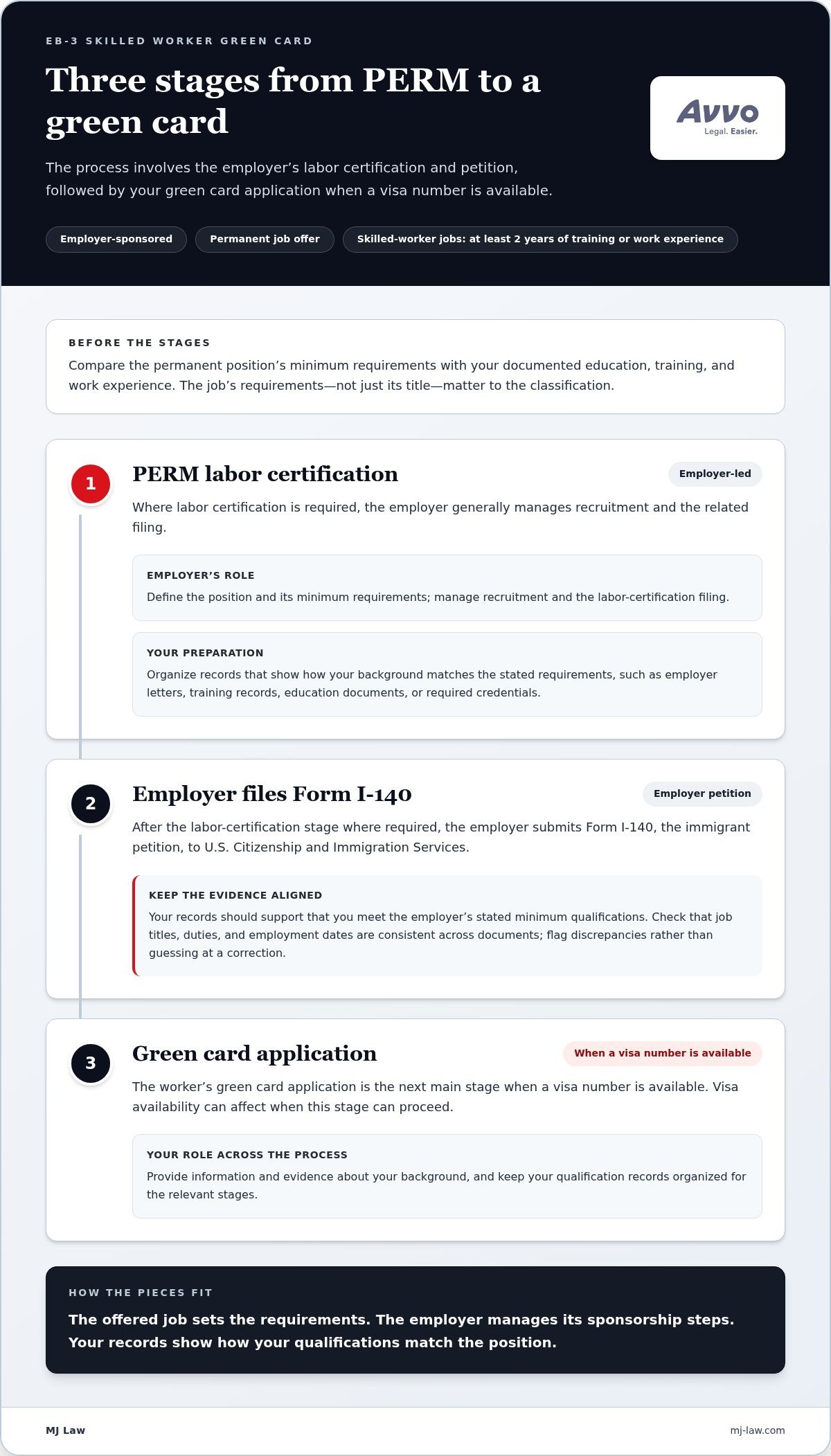
The EB-3 process has distinct steps, and completing one doesn’t automatically complete the next. The employer generally leads the labor-certification and petition stages. The worker provides personal and qualification records, then applies for permanent residence when eligible. The process broadly follows this sequence:
- PERM labor certification, where required: The employer obtains a prevailing wage determination, conducts required recruitment, and files a labor-certification application with the Department of Labor.
- Form I-140 petition: The employer generally files an Immigrant Petition for Alien Worker with U.S. Citizenship and Immigration Services (USCIS).
- Immigrant-visa or adjustment stage: Once a visa number is available and the person is eligible, they may pursue adjustment of status in the United States or consular processing abroad.
What happens during PERM labor certification?
PERM is a Department of Labor process concerning the job opportunity and the U.S. labor market, not approval of the worker’s green card application. The employer defines the role and its requirements, requests a prevailing wage determination, completes required recruitment, and submits the labor-certification application. The worker may need to provide information, but the employer is responsible for recruitment and supporting employer documentation.
These steps can take substantial time. As of September 30, 2026, the Department of Labor was processing prevailing-wage requests filed in June 2026. In late September and early October, analyst review was focused on PERM applications filed in December 2025. Processing estimates change, and audits or case-specific issues can add time. These snapshots aren’t a forecast for an individual case.
How the I-140 and Visa Bulletin affect the next step
After labor certification, the employer generally submits Form I-140 and must provide required petition evidence, including evidence of its ability to pay the offered wage. The petition stage is separate from the final green card application. A priority date, usually tied to the PERM filing date in a PERM-based case, establishes a place in the visa queue. The worker must wait until the applicable Visa Bulletin category allows the next filing or final action.
For October 2026, USCIS is using the Dates for Filing chart for employment-based adjustment applications. EB-3 cutoffs are August 1, 2024, for most countries and Mexico; April 1, 2024, for China; January 15, 2015, for India; and January 1, 2024, for the Philippines. To file under that chart, the priority date must be earlier than the listed cutoff. Filing eligibility isn’t the same as visa availability for final approval, and the applicable chart and dates can change monthly.
Adjustment of status and consular processing depend on eligibility and individual circumstances. Overall timing varies with Department of Labor and USCIS processing, the case facts, and visa availability. An EB-3 skilled worker green card attorney San Jose workers and employers consult can explain the stages and responsibilities without treating an estimate as a promised timeline.
Prepare for an EB-3 Skilled Worker Case: Records and Questions to Organize
A focused case discussion starts with a clear picture of your background and the employer’s proposed position. You don’t need every possible document in advance, and the evidence needed varies by case. Organizing key records and noting open questions can help show how your qualifications match the job and what needs further review.
Worker documents to gather before a case review
Collect records that explain your education, training, and work history. A concise timeline can be as useful as a stack of documents: list employers, job titles, dates, and your main duties.
- Your current résumé and any earlier versions that reflect prior roles.
- Employment letters or records that describe duties and dates of employment.
- Training certificates, course records, diplomas, and transcripts relevant to the offered position.
- Professional licenses or credentials, if they relate to the job requirements.
Check that dates and job titles are consistent across your résumé and supporting records. If an employer used different titles for similar duties, note the context. Flag missing or inconsistent documents rather than changing or recreating records. If documents are in another language, note that too. Translation needs depend on the case and applicable filing requirements.
Employer details that shape the case assessment
The employer holds important information about the position and labor-certification process that the worker may not have. You can prepare by identifying what information exists and who within the organization can address it.
- The job description, including the role’s core duties and work location.
- The minimum qualifications set for the position, such as required experience, training, or education.
- The appropriate employer contact and the person coordinating recruitment or immigration records.
- Available records about recruitment and the position’s wage information.
Employer cooperation affects how clearly the position is documented and how the case is prepared and sequenced. Review the job description and minimum qualifications alongside the worker’s records, rather than treating them as separate paperwork. Keep a short list of open questions, such as whether the duties of a past role match the offered position’s requirements or whether a document needs clarification.
An EB-3 skilled worker green card attorney San Jose workers and employers consult can help organize these details into a case-specific assessment. Once you’ve gathered what’s available, discuss your EB-3 circumstances and the records or employer information that may need attention.
Work with an EB-3 Skilled Worker Green Card Attorney in San Jose
An EB-3 case involves more than matching a résumé to a job title. The position’s minimum requirements, your supporting records, the employer’s responsibilities, and the available immigration steps all need to be considered together. An attorney can help workers and employers understand how these parts connect, identify questions early, and consider how the facts may affect case planning.
MJ Law is an immigration law firm in San Jose with more than three decades of experience assisting individuals, families, and businesses with immigration matters. The firm’s employment-based immigration practice serves the Silicon Valley community, including workers and employers assessing a proposed role alongside their current work or immigration circumstances. Consultations are available in English and Spanish for clients in San Jose and San Francisco.
What to discuss during an EB-3 legal consultation
A useful case review starts with the proposed permanent position and the employer’s sponsorship plans. Counsel can compare the role’s requirements with your education, training, and work history, then consider the employer’s responsibilities and possible process stages. Bring the records you have and identify what remains unclear.
- What are the position’s duties and minimum qualifications?
- Which records show how your background meets those requirements?
- Who within the employer’s organization is coordinating recruitment and petition information?
- What questions remain about your immigration goals or potential next steps?
This review can distinguish worker-held evidence from employer-held job and recruitment records. If information is missing, the discussion can clarify which party may be best placed to provide it. Advice depends on the individual facts and the immigration rules that apply at the time, so a general description of EB-3 eligibility isn’t a substitute for case-specific guidance.
When to seek case-specific guidance
Consider getting advice before assuming that a position qualifies or estimating how long the process may take. Processing and visa availability can change, and another person’s timeline may not reflect your circumstances. An early review can surface questions before you or the employer make plans based on an unexamined assumption.
Reassess the plan if the job’s duties or requirements change, the employer changes, or your immigration circumstances shift. These developments may affect how the case should be evaluated or what information needs updating. An attorney can explain the implications and help each party understand its role. A consultation does not promise that a filing will proceed or that a particular outcome will follow.
If you’re looking for an EB-3 skilled worker green card attorney San Jose workers and employers can consult about the job offer and sponsorship process, MJ Law can discuss your circumstances. Schedule an EB-3 immigration consultation to review your situation and questions.
Take a Clear Next Step Toward Your EB-3 Plan
A sound immigration plan is based on your circumstances, not assumptions drawn from someone else’s experience. Before making major career or personal plans around a possible green card, understand what your situation supports and what questions remain. A focused legal discussion can help you and your employer identify practical next steps.
An EB-3 skilled worker green card attorney San Jose workers can consult can offer a case-specific perspective on the process and the details that deserve attention. Bring your questions, relevant records, and any concerns about the proposed role or your plans. You don’t need to have every answer before starting the conversation.
Schedule an EB-3 immigration consultation with MJ Law to discuss your circumstances and possible next steps in San Jose, San Francisco, or Silicon Valley.
Frequently Asked Questions
What qualifies as a skilled worker for an EB-3 green card?
An EB-3 skilled worker is someone seeking a job that requires at least two years of training or work experience and who meets the employer’s stated requirements. The assessment focuses on the actual duties and minimum qualifications, not simply the occupation’s title. Two roles with the same title may have different requirements. Your records should show how your relevant training or experience matches the specific position.
Does an EB-3 skilled worker need an employer sponsor?
Yes, the standard EB-3 skilled-worker route is employer-sponsored. A U.S. employer offers the qualifying position and generally files the immigrant petition, while the worker provides information and evidence about their qualifications. A job offer alone doesn’t complete the process. The employer must participate in the required steps, and the case must meet applicable immigration requirements. An attorney can clarify each party’s role before the process advances.
Is PERM required for an EB-3 skilled worker green card?
PERM labor certification is generally part of an EB-3 skilled-worker case, but exceptions may apply to certain occupations designated under Schedule A. When labor certification is required, the employer usually handles that process. Whether an exception applies depends on the job and current rules, so don’t assume a position qualifies based only on its title. Reviewing the position and employer’s circumstances can help identify the applicable route.
How long does an EB-3 skilled worker green card take?
There isn’t one reliable timeline for every EB-3 skilled-worker case. The overall wait can depend on labor-certification and petition processing, your circumstances, and whether a visa number is available for your priority date. Visa Bulletin dates can move, so an earlier estimate may not reflect current conditions. Before making plans around a projected completion date, review current processing information and visa availability for your specific case.
Can I apply for EB-3 as a skilled worker without a bachelor’s degree?
Yes, a bachelor’s degree isn’t generally required for the EB-3 skilled-worker subcategory. The key questions are whether the offered position requires at least two years of training or work experience and whether you meet its stated minimum qualifications. A degree may matter if the employer requires one for that job, but it isn’t a universal skilled-worker threshold. The position’s requirements and your supporting records guide the assessment.
Can my spouse and children receive green cards through my EB-3 case?
Your spouse and qualifying children may be eligible to immigrate as derivative beneficiaries through your employment-based case. Generally, qualifying children must be unmarried and under 21, though rules that preserve a child’s eligibility can be complex and depend on the case. Family members usually need to complete their own required immigrant-visa or adjustment steps. Discuss family circumstances early, especially if a child may approach an age-related eligibility threshold.
What should I bring to an EB-3 attorney consultation in San Jose?
Bring a current résumé, relevant employment and education records, and any documents describing the offered position. Prepare a brief timeline of your U.S. immigration history, including prior applications or status changes, and note important dates or pending matters. An EB-3 skilled worker green card attorney San Jose workers consult can use these details to frame a focused discussion. MJ Law offers immigration consultations in San Jose and serves clients in San Francisco as well.