
A strong research record alone isn’t enough for EB-1B eligibility. An applicant needs a permanent U.S. job offer for a tenure-track or comparable research position and must meet at least two qualifying criteria, according to U.S. Citizenship and Immigration Services. An EB-1B outstanding researcher lawyer in San Jose can help assess how the applicant’s record and proposed role fit those requirements.
It’s understandable to focus on publications, citations, and awards, but a petition also depends on how the evidence is organized and connected to the eligibility criteria. The employer’s role and the applicant’s experience matter, too.
This article explains who may qualify, which evidence and supporting documents can strengthen a petition, and how attorney fees may depend on the case’s complexity and scope. It also outlines when legal guidance may be useful, so you can better understand the process and the decisions involved before moving forward.
Key Takeaways
- Assess whether the offered U.S. role and the researcher’s record align with EB-1B eligibility before assembling a petition.
- Organize evidence around the qualifying criteria, connecting achievements to their significance in the academic field.
- Gather employment, experience, and research records early so the petition presents a clear, consistent account.
- Understand that legal fees depend on case complexity and scope, while government filing costs are separate.
- Consider legal help when you need support evaluating evidence, preparing the petition, or coordinating the employer’s role.
Who Qualifies for an EB-1B Green Card?
EB-1B eligibility depends on both the researcher’s record and the sponsoring employer’s position. Changing employers while a petition or green card application is pending can disrupt the required sponsorship and ongoing job offer, putting the case at risk.
Outstanding Professor and Researcher Eligibility
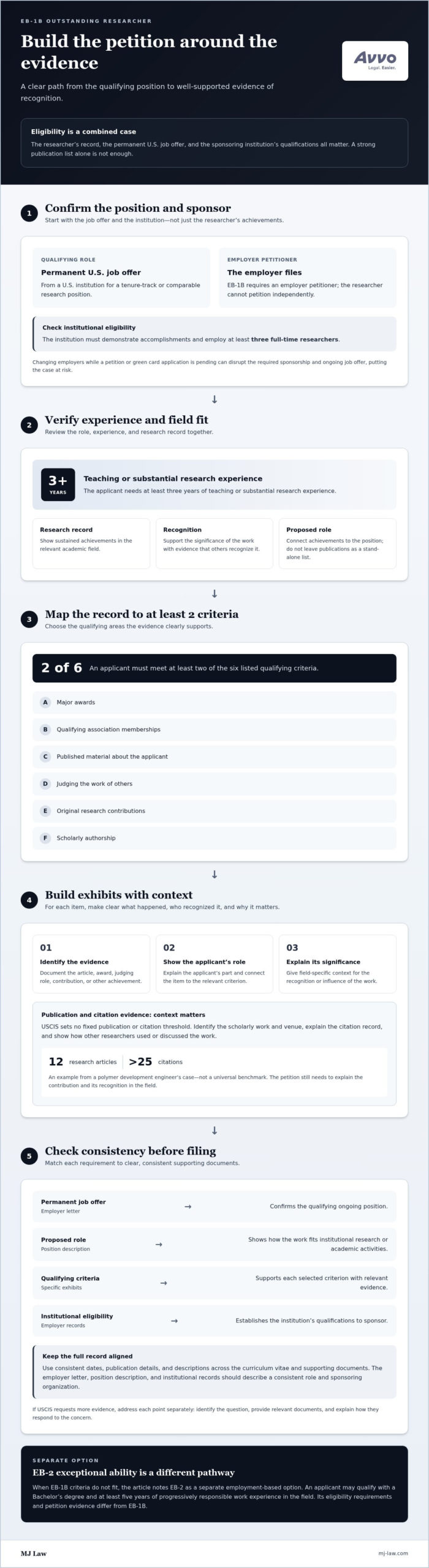
The EB-1 category includes EB-1B for outstanding professors and researchers. An applicant must have a permanent job offer from a U.S. institution for a tenure-track or comparable research position. The record should show sustained achievements in the relevant academic field, supported by scholarly work and evidence that others recognize its significance.
Experience also matters: an applicant needs at least three years of teaching or substantial research experience. Review the position, employment offer, experience, and research record together. A strong publication history, for example, should connect to the proposed role rather than stand alone as a list of papers.
International Recognition Criteria
International recognition is assessed through evidence tied to the applicant’s academic field, not simply through a claim of distinction. For EB-1B, an applicant must meet at least 2 of the six listed qualifying criteria, according to U.S. Citizenship and Immigration Services. These include major awards, qualifying association memberships, published material about the applicant, judging others’ work, original research contributions, and scholarly authorship.
Organize each exhibit around the criterion it supports. For an award, explain the achievement being recognized. For a judging role, show that the applicant evaluated work in the same or an allied field. USCIS sets no fixed publication or citation threshold, so the evidence needs context and must demonstrate its relevance.
Employer Sponsorship and Job Offers
EB-1B requires an employer petitioner, not an independent petition by the researcher. The employer must offer ongoing employment in the qualifying research or teaching role. The job offer and the institution’s evidence should describe a consistent position, showing how the work fits the institution’s research or academic activities.
The employer must demonstrate institutional accomplishments and employ at least three full-time researchers, according to U.S. Citizenship and Immigration Services. The institution’s qualifications are therefore part of the petition. Before filing, make sure the employer letter, position description, and supporting records consistently describe the role and sponsoring organization.
EB-2 exceptional ability is a separate employment-based option to consider when the EB-1B criteria do not fit. An EB-2 applicant may qualify with a Bachelor’s degree and at least five years of progressively responsible work experience in the field. That comparison does not replace an EB-1B assessment: the categories have different eligibility requirements and petition evidence.
For a practical eligibility review, match each requirement to a document: use the employer’s letter for the permanent job offer, the position description for the proposed role, and specific exhibits for each qualifying criterion. Then assess whether the institution’s records establish its eligibility to sponsor. This review can reveal gaps before the petition is assembled and help identify the evidence that best demonstrates the researcher’s recognition.
Evidence for outstanding researcher petitions
An EB-1B petition should connect documented achievements to the applicant’s academic field and eligibility criteria. Organize each exhibit to show what happened, who recognized it, and why it matters.
Academic and Research Career Evidence
Build a record from the researcher’s academic and professional work, including scholarly articles, research contributions, awards, and judging activity. For each item, explain the applicant’s role and its relevance to the field.
A research article, for example, is more persuasive when accompanied by evidence of its influence or use by other researchers. Keep dates, publication details, and descriptions consistent across the curriculum vitae and supporting documents.
Outstanding Achievement Criteria
Evidence should address at least two qualifying areas, such as major awards, selective memberships, published material about the applicant, judging others’ work, original contributions, or scholarly authorship. Choose criteria the record clearly supports instead of listing every possible category without explaining its relevance.
For an award, include details about the achievement and the basis for recognition. For a judging role, document the invitation and the work reviewed. This context helps show how each example demonstrates distinction in the relevant academic field.
Publication and citation evidence can support authorship and original contributions, but USCIS sets no fixed publication or citation threshold for EB-1B eligibility. A strong presentation therefore explains the context behind the numbers. Identify the article, its scholarly venue, citation record, and how other researchers used or discussed the work.
For example, a polymer development engineer’s case included 12 research articles cited over 25 times. Those figures are not a universal benchmark. The petition should explain what the work contributed and why the evidence reflects recognition in that applicant’s field.
USCIS may issue a request for evidence when the record needs clarification or additional support. Treat each point in the notice as a separate task: identify the question, provide relevant documents, and explain how they address the concern. For a question about citations, for instance, connect the citation records to the specific research contribution at issue.
Label exhibits clearly and briefly explain their relevance. Group documents by criterion, provide context for each item, and cross-reference supporting records. This structure helps distinguish the applicant’s achievements from general descriptions of a laboratory or research team.
If you’re organizing a record for an EB-1B petition, a case discussion about research evidence can help you consider how the documents fit together.
Required experience and supporting documents
EB-1B evidence must connect the researcher’s experience to the offered position and the employer’s sponsorship. Build the file around verifiable records, with dates and duties that tell a consistent story.
Experience and Employment Records
An EB-1B applicant needs at least three years of teaching or conducting substantial research, according to U.S. Citizenship and Immigration Services. Useful records can include employment letters, appointment documents, and descriptions of research duties. Each should identify the institution, role, and dates so the experience timeline is easy to follow.
Work completed during an advanced degree program counts only if the applicant had full responsibility for classes taught or the research was recognized as outstanding. Part-time experience may count when it cumulatively equals three years of full-time experience. Explain the schedule and responsibilities rather than relying on a job title alone.
Employer Sponsorship Documents
A private employer’s role requires careful documentation. For EB-1B, the sponsoring institution must show institutional accomplishments and employ at least three full-time researchers, according to U.S. Citizenship and Immigration Services. Employer records should therefore describe the institution’s research work and researcher staffing, alongside the applicant’s specific position.
The U.S. job offer must establish ongoing employment in a tenure-track or comparable research position. Gather the offer letter and detailed position description, then compare them with the employer’s petition and the applicant’s experience records. Consistent titles, duties, and employment terms help present a coherent account of the role.
Recruitment and Labor Certification
EB-1B petitions do not require PERM labor certification. That means the employer does not follow the PERM recruitment process for this petition. It still must document the qualifying job offer and its institutional eligibility; omitting recruitment steps does not remove those sponsorship requirements.
For a practical file review, sort employer records into three groups: the job offer, the institution’s accomplishments, and its research staffing. Then compare the researcher’s experience letters with the proposed position. This can reveal gaps, such as a letter describing teaching without clarifying the applicant’s responsibility for the classes.
How EB-2 Age Rules Differ
Age is a separate consideration in the EB-2 context. Age may be one consideration in an EB-2 assessment, alongside the category’s other eligibility requirements. That threshold should not be confused with EB-1B’s experience and employer requirements, which focus on the research or teaching record and the sponsoring position.
An attorney reviewing employment-based options can compare the records against the relevant category. For an EB-1B file, prioritize the experience timeline, employer documentation, and job-offer terms. For an EB-2 assessment, keep the age requirement and that category’s separate eligibility basis in view.
Reasonable Attorney Fees for an EB-1B Petition?
Separate government filing charges from attorney fees when planning an EB-1B petition. They cover different parts of the process, and the route to permanent residence affects which government forms and charges apply.
For an EB-1B petition, the sponsoring U.S. employer files Form I-140, according to U.S. Citizenship and Immigration Services. The petition presents the employer’s job offer and the researcher’s eligibility evidence, including documented achievements and contributions. Keep the employer’s filing role distinct from the applicant’s later green card application.
The listed Form I-140 filing fee is $700. Premium processing is an optional filing choice with a listed fee of $2,500. These are government charges, not legal-service prices. Premium processing concerns the petition’s processing, while the I-140 filing itself remains the employer’s petition.
An applicant adjusting status may file Form I-485; a person processing abroad follows a consular route. The route is therefore a central factor in estimating government charges.
For adjustment of status, the listed Form I-485 fee is $1,225 for the principal applicant and $1,225 for each dependent spouse or child over age 14. The listed fee is $750 for a dependent child under age 14. These amounts can help families plan separately for each applicant rather than treating household filing costs as one charge.
- Form I-140: listed filing fee of $700.
- Premium processing: listed fee of $2,500, when selected.
- Form I-485: listed fees vary by applicant category and age.
Legal fees depend on the case and are provided after a quote request. Factors include the volume of evidence, petition complexity, employer coordination, and the scope of representation. A file involving extensive research materials or a complicated employment history may require different preparation from a more straightforward case. Ask for a clear explanation of the legal work covered, separate from USCIS filing charges.
Before filing, make a budget with distinct lines for the I-140, optional premium processing, any later green card application, and legal representation. Include dependents in the I-485 estimate when adjustment applies. This separation helps prevent government charges, attorney fees, and family filing costs from being mistaken for one combined price.
Should You Hire an Immigration Lawyer to Prepare Your EB-1B Case?
Ask a San Jose EB-1B lawyer how they would assess your academic record, which evidence supports each criterion, and what the employer must provide. Also clarify who prepares each filing, how requests for evidence are handled, and how legal work and government charges are separated.
An immigration lawyer can help organize an original research record into a petition that connects achievements to eligibility. This may involve reviewing scholarly articles, awards, judging activity, employment documents, and the sponsoring employer’s position description. A citation list alone, for example, does not explain an original contribution; the petition should connect the citations to the research and its significance in the academic field.
Legal guidance may be particularly useful when evidence spans several institutions, research focus has changed, or employment history is complicated. A lawyer can identify documents that support each criterion, flag inconsistencies between the curriculum vitae and employer records, and prepare a response if USCIS requests additional evidence. The applicant and employer remain responsible for providing accurate information.
The immigration process continues after Form I-140 approval. An eligible applicant in the United States may pursue adjustment of status by filing Form I-485 when the next filing step is available. An applicant processing abroad follows the immigrant visa route through a U.S. consulate. The path depends on where the applicant is and the applicable filing conditions.
Family planning may also affect the application. An EB-1B principal applicant’s unmarried children under age 21 may be eligible to apply for admission in E-15 immigrant status if the I-140 petition is approved. After receiving their green cards, eligible dependents can work and attend school in the United States. Include spouse and child details in case planning so each family member’s documents and timing are considered.
For a consultation, bring the job offer, résumé, publication list, citation records, awards, and a timeline of research and teaching positions. Ask how the lawyer would present your strongest evidence, what employer documents remain necessary, and how the team will coordinate the petition and any later application. An EB-1B outstanding researcher lawyer in San Jose should be able to explain the case strategy in clear terms, including the risks in the record and the work needed to address them.
Before deciding, discuss who communicates with the employer, how evidence will be organized, and what happens if USCIS asks follow-up questions. Clear answers help you understand the process and your role in assembling complete records. To discuss your immigration matter, schedule a consultation.
MJ Law: Family Immigration Services
MJ Law can help you consider employment-based immigration options when an EB-1B petition is part of your plans. Its Employment-Based Visas offering addresses work-related immigration matters, while Family Immigration Services can support separate family-based needs. These are distinct pathways, so identifying the purpose of each application helps keep your next steps clear.
If your plans involve a spouse or children, consider how their immigration needs relate to your employment-based process. If family immigration is your priority, MJ Law provides Family Immigration Services, including marriage-based green card assistance. The right starting point depends on your immigration goal and the documents involved.
Contact MJ Law to discuss your immigration needs and possible next steps.
Move Forward With a Clear Plan
Your next step is to turn the research and employment record into a practical plan with the sponsoring employer. Decide who will gather each document, who will address gaps, and how the petition’s progress will be communicated. An EB-1B outstanding researcher lawyer in San Jose can help you evaluate that plan and understand how the evidence fits your immigration goals.
MJ Law provides Employment-Based Visas, along with Business and Investor Visas and Family Immigration Services. This range may help if your plans also involve a spouse, children, or a separate business-related matter. The appropriate service depends on the immigration goal you want to address.
Bring your employment documents and research record to a conversation about possible next steps. Contact MJ Law about your EB-1B case to discuss your situation and how to proceed. A thoughtful plan can make the process easier to manage, one decision at a time.
Frequently Asked Questions
Can I File an EB-1B Petition Independently?
No. An EB-1B petition requires a qualifying U.S. employer to serve as petitioner and file Form I-140, according to U.S. Citizenship and Immigration Services. The researcher can help assemble and explain personal evidence, but cannot replace the employer as petitioner. This differs from EB-1A, which allows an eligible applicant to self-petition. Start by confirming that the institution is prepared to sponsor the offered position.
Can My Spouse and Children Join Me if My Eb-1B Visa is Approved?
Eligible family members may be able to immigrate with the principal applicant. An EB-1B principal applicant’s unmarried children under age 21 may qualify to apply for admission in E-15 immigrant status if the I-140 petition is approved. After receiving green cards, eligible dependents can work and attend school in the United States. Include each family member’s details in the planning process so their applications can be coordinated.
How Does an EB-1B Visa Differ From an EB-1A Visa?
EB-1B requires employer sponsorship for a qualifying research or teaching position, while EB-1A allows eligible applicants to self-petition without a U.S. job offer. The evidence structures differ, too: EB-1B uses six criteria, while EB-1A has ten criteria and a separate option based on a one-time major internationally recognized award. Compare the job arrangement and the evidence available before choosing a category.
How Does the United States Citizenship and Immigration Service Define Outstanding Achievement?
For EB-1B, the relevant standard is supported through evidence in qualifying areas, rather than a single publication or citation cutoff. Examples include major awards, selective association membership, published material about the researcher, judging others’ work, original contributions, and scholarly authorship. U.S. Citizenship and Immigration Services does not set a fixed publication or citation threshold. Explain each achievement’s significance in its academic field.
Is EB-1B Easier Than EB-1A?
Neither category is automatically easier; each fits a different profile. EB-1B requires employer sponsorship and a qualifying academic or research position, while EB-1A does not require a U.S. job offer and permits self-petitioning. Their evidence tests also differ. A researcher with a committed institutional sponsor may assess EB-1B, while a person seeking independence from a specific employer may examine EB-1A eligibility.
Is PERM Labor Certification Necessary for EB-1B?
No. EB-1B petitions do not require PERM labor certification. The employer still has a substantive role: it must sponsor the petition, offer qualifying ongoing employment, and provide evidence about its institution and research staffing. For example, an employer should prepare records that describe the offered position and its research environment, rather than treating the absence of PERM as meaning that employer documentation is unnecessary.
What are the EB-1B outstanding researcher eligibility requirements?
An applicant needs a permanent U.S. job offer for a tenure-track or comparable research position, at least three years of teaching or substantial research experience, and evidence meeting at least two of six qualifying criteria. The sponsoring institution must also meet employer requirements. The researcher’s academic record should align with the work described in the offer, while the employer documents its institutional qualifications.
How is EB-1B different from EB-1A and EB-2 NIW?
EB-1B is employer-sponsored and tied to qualifying research or academic employment. EB-1A allows self-petitioning and does not require a particular job offer. EB-2 NIW belongs to the EB-2 category, so its eligibility framework is distinct from both EB-1 options. Don’t assume that evidence supporting one category automatically satisfies another; compare the relevant criteria, petition structure, and employment plans separately.