
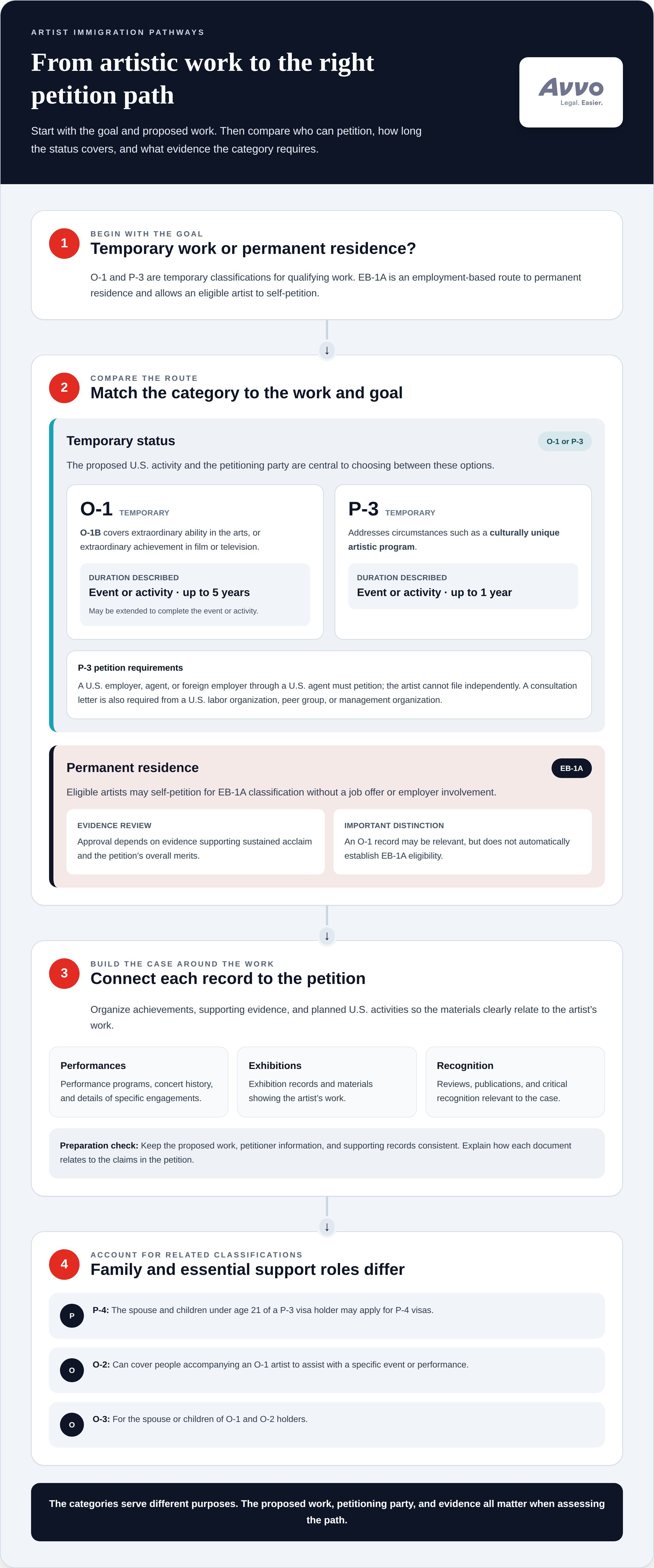
An O-1 visa doesn’t prevent you from pursuing an EB-1A green card. An artist can self-petition for EB-1A classification without a job offer or employer involvement, and an artist green card petition lawyer in San Francisco can help assess how your achievements support the case. The two paths serve different purposes: O-1 is temporary, while EB-1A offers a route to permanent residence.
It’s reasonable to wonder whether your current visa, career record, or plans for future work in the United States affect your options. This guide explains how O-1 status relates to an EB-1A petition, what self-petitioning means, and what evidence and filing steps the process involves.
You’ll also learn how USCIS evaluates EB-1A petitions and what to expect after filing, so you can consider your next step with a clearer understanding of the process.
Key Takeaways
- An O-1 visa doesn’t prevent you from pursuing an EB-1A petition; the two classifications serve different purposes.
- EB-1A allows eligible artists to self-petition, but approval depends on how the evidence supports sustained acclaim and the petition’s overall merits.
- Understand what distinguishes O-1 and P-3 options before deciding which immigration path fits your artistic work and plans.
- Careful petition preparation helps organize your achievements, supporting evidence, and Form I-140 filing.
- Learn when legal support for entertainment and artist visas may help you plan your petition and next steps.
Can an Immigration Attorney Help You Get an O or P Visa?
Yes. An immigration attorney can prepare O-1 or P-3 petitions by matching an artist’s work, planned activities, and supporting evidence to the relevant category. The right option depends on the work and immigration goal, including whether the artist seeks temporary status or permanent residence.
Representation for Creative Professionals
Musicians, dancers, painters, photographers, and authors build different records of professional achievement. An artist green card petition lawyer in San Francisco can help organize materials such as performance programs, exhibition records, reviews, publications, and details of planned U.S. work. For a musician, that may mean presenting concert history alongside specific engagements; a painter’s evidence may center on exhibitions and critical recognition. The key is to connect each document clearly to the artist’s work.
Comparing EB-1A and O-1 Options
O-1 status is temporary and tied to qualifying work, while EB-1A is an employment-based route to permanent residence that permits self-petitioning. For artists, O-1B covers extraordinary ability in the arts or extraordinary achievement in film or television. EB-1A has a separate evidence review, so an O-1 record may be relevant without automatically establishing EB-1A eligibility. Other categories, including P-3, address different circumstances, such as culturally unique artistic programs.
An O visa generally covers the duration of an event or activity, up to five years, and may be extended to complete it. P-3 status covers the event or activity for up to one year. A P-3 petition requires a U.S. employer, agent, or foreign employer through a U.S. agent; the artist cannot file independently. It also requires a consultation letter from a U.S. labor organization, peer group, or management organization. These requirements make the proposed work and petitioner central to choosing the category.
Family members’ options also differ. According to U.S. Citizenship and Immigration Services, the spouse and children under age 21 of a P-3 visa holder may apply for P-4 visas. O-2 classification can cover people accompanying an O-1 artist to assist with a specific event or performance; O-3 classification is for the spouse or children of O-1 and O-2 holders. An attorney can assess these related needs while organizing the principal petition.
When choosing an artist green card petition lawyer in San Francisco, look for experience assessing creative evidence and explaining how O-1, P-3, and EB-1A requirements differ. Ask how the attorney will connect your documented work to the requested classification and proposed U.S. activities.
Artists in San Francisco can draw on local venues, festivals, galleries, presenters, and cultural organizations for records of performances, exhibitions, and collaborations. These materials may help document an artist’s work, while immigration petitions are filed with the relevant federal agency.
What Are the Common Challenges in the O-1 Visa Application Process?
An O-1 petition must identify a qualifying U.S. petitioner or agent and connect the proposed work to the artist’s record. Preparation can become difficult when a musician’s performance history, a photographer’s publications, or a dancer’s engagements appear across scattered documents. A clear strategy organizes the evidence around the work and the petition’s claims.
Common mistakes include presenting materials without explaining their relevance, using inconsistent dates or titles, and leaving gaps between an artist’s achievements and planned U.S. activity. An attorney can review the proposed itinerary, petitioner information, and supporting records together to identify mismatches before filing, such as performances described in the petition but missing from the schedule.
The petitioner or agent is central to the application. A strong portfolio alone does not resolve questions about who is filing or what work the petition covers. For a touring musician, the planned engagements and the petitioner’s role need to align with the petition. An O visa holder generally may work only in connection with the event or activity covered by the visa.
Consular processing adds another stage for artists applying for an O visa abroad. The visa application includes Form DS-160, and a consular interview may ask about the proposed work and petition details. The artist should be prepared to explain the same engagements and role described in the filing. Inconsistent answers can create avoidable confusion.
After a denial, the decision notice identifies the concerns that need attention. Review those reasons and determine the applicable response path rather than simply resubmitting the same materials. A concern about the proposed activity, for example, calls for a different response than one about the petitioner’s role. Any appeal or further filing must address the specific record.
Asylum-based green card applications involve a separate immigration pathway from O-1 artist petitions. They shouldn’t be treated as an extension of an artist visa strategy. Someone with questions about both routes needs an assessment that distinguishes the basis and purpose of each application, rather than combining unrelated evidence into one presentation.
A pending green card petition does not replace the conditions of an artist’s current status. For an O visa holder, work generally remains tied to the approved event or activity. Travel depends on the person’s status and any separate pending application, not the petition alone.
Before filing, an attorney can check that the petitioner, proposed work, supporting records, and consular application tell a consistent story. Artists planning to file or respond to a denial can arrange a review of their O-1 strategy and questions about related immigration applications.
What Makes the EB-1A Green Card Different?
For artists, the central distinction is the immigration outcome: O-1B is temporary, while EB-1A provides a path to permanent residence in the United States. Both concern extraordinary ability, but each has its own classification and evidence review. An O-1 approval can be relevant background, yet it doesn’t by itself establish eligibility for an EB-1A green card.
O-1B applies to individuals with extraordinary ability in the arts, or extraordinary achievement in motion picture or television industries. The O-1 record may include evidence tied to an artist’s professional work, such as a photographer’s recognition or a musician’s significant performances. The evidence needs to support the specific O-1 case and planned activity. A sponsor or qualifying petitioner is part of the O-1 process, unlike EB-1A, which allows an eligible artist to petition independently.
EB-1A is part of the first-preference employment category and does not require PERM labor certification. According to U.S. Citizenship and Immigration Services, an applicant must show a major internationally recognized award or satisfy at least three of ten criteria. Those criteria are only one stage of review: USCIS evaluates the regulatory criteria and then makes a final merits determination. Meeting the threshold does not replace the broader review of whether the documentation shows sustained acclaim.
That distinction matters when presenting an artist’s record. A painter might document exhibitions, critical attention, and recognition, while an author could organize publications and evidence of professional impact. The petition must connect each item to the claimed extraordinary ability. Impressive materials are less useful when their relationship to the artist’s field is unclear.
An EB-1A applicant must intend to continue working in the area of extraordinary ability in the United States, and the work must prospectively benefit the country. The petition strategy therefore needs to address both past recognition and future plans. For example, an artist’s proposed U.S. projects should fit the same area in which the record demonstrates acclaim.
Artists also ask about EB-2 NIW eligibility. That is a separate route from EB-1A: an applicant must qualify for the EB-2 category and establish a basis for waiving the usual job-offer requirement in the national interest. Artistic distinction alone doesn’t make the two categories interchangeable, so the evidence and case theory must be assessed separately.
For an artist weighing O-1B against EB-1A, the useful next step is to compare the purpose of each classification, the evidence available, and the intended U.S. work. The key question is not simply whether an artist has received recognition, but whether the record and future plans support the specific category being pursued.
EB-1A self-petitioning and employer sponsorship
EB-1A lets an eligible artist petition without an employer sponsor or job offer. Understanding that distinction helps clarify who controls the filing and what the petition must establish.
EB-1A Self-Petitioning
Self-petitioning means the artist is the petitioner, rather than an employer filing on the artist’s behalf. It does not mean the artist must prepare the case alone. The petition still needs evidence of eligibility and a clear account of the artist’s accomplishments, intended work, and plans to continue in the area of extraordinary ability.
Employer-Sponsored Petitions
An employer may support an artist’s work, but EB-1A does not require that employer to sponsor the petition. This differs from EB-1B, a category for outstanding researchers or professors that requires an employer sponsor. The distinction matters when an artist’s U.S. projects involve galleries, presenters, or other organizations.
With EB-1A, the artist’s record and future work remain central, whether an employer is involved in the career. A petition needs to show sustained national or international acclaim, plus an intention to continue working in the area of extraordinary ability in the United States. The proposed work must prospectively benefit the country. For example, an artist’s planned exhibitions or performances should relate to the field demonstrated by the evidence.
An employer’s participation can still provide useful context. A gallery might document an exhibition, or a presenter could describe an upcoming performance. Those contributions may help explain the artist’s work, but they do not turn EB-1A into an employer-sponsored category. The petition must connect supporting materials to the artist’s own eligibility and explain how the evidence fits together.
Self-petitioning also affects who takes responsibility for presenting the case. The artist’s name appears as the petitioner on Form I-140, and the supporting record should reflect the artist’s career rather than an employer’s independent qualifications. A law firm can organize the documentation, identify gaps in the narrative, and ensure that employer materials support rather than distract from the artist’s case.
Approval of Form I-140 does not itself grant permanent residence. After approval, an eligible applicant may pursue adjustment of status in the United States or consular processing abroad. These are separate steps from the immigrant petition. The appropriate route depends on where the applicant is and the applicable process, so petition approval should not be treated as the final stage.
For an artist deciding whether to file independently, focus on who qualifies as the petitioner, what evidence establishes eligibility, and how the intended work supports the petition. Employer relationships may inform the record, but EB-1A does not depend on an employer sponsoring the artist.
Petition preparation and Form I-140 filing
Preparation turns an artist’s career record into an organized petition, then filing begins USCIS review. Each step should support the same EB-1A case theory.
Petition Preparation
Preparation starts with organizing evidence around the artist’s field, achievements, and future U.S. work. A legal team can review materials for relevance, consistency, and context, then arrange them so the petition’s claims are supported by the record. For a Bay Area photographer, for example, exhibition documentation and published work should clearly relate to the extraordinary ability being claimed.
A useful review also identifies gaps before filing. If a program lists an artist under a different professional name, the petition can explain the connection. The goal is a coherent presentation, not simply a large collection of documents. Carefully supported evidence gives USCIS a clearer basis for evaluation.
Form I-140 Filing
According to U.S. Citizenship and Immigration Services, the EB-1A immigrant petition is filed with USCIS using Form I-140. The petition package presents the artist’s eligibility and supporting documentation for review. Before filing, the legal team can check that the form and supporting materials identify the same petitioner, field, and requested classification.
Filing begins the immigrant-petition stage, but it does not itself grant permanent residence. For qualifying EB-1A I-140 petitions, premium processing is available for an additional USCIS fee. According to U.S. Citizenship and Immigration Services, premium processing typically results in a decision within 15 business days.
After filing, USCIS reviews the petition and issues a decision. If the petition is approved, that approval is only one part of the process. An applicant may then pursue adjustment of status in the United States or consular processing abroad, depending on the applicable route and visa-number availability. The filing strategy should account for this later step, rather than treating I-140 approval as the green card itself.
Good preparation keeps evidence focused. A concert review, exhibition record, or award should serve a clear purpose in the petition, rather than appear without explanation. A legal team can connect each item to the relevant claims and set aside material that does not meaningfully support them. This helps prevent unrelated details from obscuring the strongest evidence.
For artists planning an EB-1A filing, a focused review can clarify how the evidence, form, and next immigration step fit together. Schedule a petition preparation discussion to consider your filing strategy.
MJ Law: Entertainment and Artist Visas
MJ Law assists artists with immigration matters through its Entertainment and Artist Visas practice. If you’re weighing an O-1 petition against a self-petitioned EB-1A case, legal guidance can help connect your artistic record, planned U.S. work, and immigration goals. This support is especially relevant when your evidence spans performances, exhibitions, publications, or other creative work and needs a clear presentation.
Turn to MJ Law when you’re preparing an artist visa petition or considering how an employment-based option may fit your plans. The next step is a focused discussion of your situation and the questions you need answered. Contact MJ Law to discuss your immigration matter.
Take the Next Step Toward Your Green Card Plan
Your next step is to assess how your artistic record, future U.S. work, and immigration goals fit together. A focused review can clarify which evidence supports your petition and what decisions may shape the filing. MJ Law assists artists in San Francisco and the Bay Area with employment-based immigration matters and entertainment and artist visas. Contact MJ Law to discuss your circumstances and possible case strategy.
MJ Law handles employment-based immigration matters and entertainment and artist visas. Its broader practice also includes Family Immigration Services and Business and Investor Visas, which may be relevant when family or professional plans involve additional immigration needs.
Bring your questions about eligibility, evidence, or the next filing stage to a conversation with the firm. Contact MJ Law about your petition and take a considered step toward your immigration goals.
Frequently Asked Questions
Can I file an EB-1A petition while on an O-1 visa?
Yes. Holding O-1 status doesn’t prevent you from filing an EB-1A petition. The petitions serve different immigration purposes, so the evidence and plans presented for one don’t automatically establish eligibility for the other. For example, a touring musician can pursue an EB-1A case while holding O-1 status, but must still show that the EB-1A requirements fit their record and intended U.S. work.
Does location affect my EB-1A eligibility?
Your address in San Francisco doesn’t determine whether you qualify for EB-1A. The petition is assessed on its eligibility criteria and supporting documentation, rather than the city where an artist lives or works. Location can matter for practical planning, such as organizing evidence from Bay Area exhibitions or coordinating future projects, but it doesn’t replace the need to establish the requirements for the classification.
How can a lawyer help demonstrate an artist’s “extraordinary ability”?
A lawyer can explain how an artist’s documentation relates to the claims in the petition. If a festival program credits an ensemble but does not name a musician, for example, the filing may need additional context establishing the artist’s role. Legal review can also identify inconsistencies in names, dates, or descriptions across records and organize the evidence into a coherent account of the artist’s work.
How long does an EB-1A petition take to process?
Timing depends on the filing route and whether premium processing is used. For qualifying EB-1A I-140 petitions, premium processing typically results in a decision within 15 business days, according to U.S. Citizenship and Immigration Services. That period concerns the petition decision, not the entire green card process. After I-140 approval, applicants may still need to complete adjustment of status or consular processing.
What types of artist green cards can foreign artists apply for in the U.S.?
Employment-based options an artist may explore include EB-1A and, where its distinct requirements fit, EB-2 NIW. Family-based immigration may also be relevant when an artist qualifies through a family relationship. O-1 and P-3 classifications are temporary visa options, not green cards. An artist’s field, record, U.S. work plans, and qualifying relationships help determine which category may be appropriate to assess.
What are the eligibility requirements for an EB-1A green card for artists?
An artist must demonstrate sustained national or international acclaim and meet the EB-1A evidentiary standard. According to U.S. Citizenship and Immigration Services, eligibility can rest on a major internationally recognized award or evidence satisfying at least three of ten criteria. The petition must also address the artist’s intention to continue working in their area of extraordinary ability and the prospective benefit of that work to the United States.
How does an artist compare EB-1A, EB-2 NIW, and employer-sponsored green card options?
Start by comparing who may file and what the category is designed to establish. EB-1A permits an eligible artist to self-petition. EB-2 NIW is a separate route with its own eligibility analysis. EB-1B requires an employer sponsor and applies to outstanding researchers or professors, so it generally isn’t the direct fit for an artist whose work falls outside those fields.
What evidence can artists provide to support a green card petition?
Useful evidence depends on the artist’s discipline and the claims being made. A painter might provide exhibition records and reviews; an author could organize published work and documentation identifying their contribution. Include context that establishes the source, date, and artist’s role for each item. A program naming a production but not the artist, for instance, may need supporting records to clarify their participation.