
What if the strength of an E-2 case depends not only on how much you invest, but also on how clearly your business plans and evidence fit the visa requirements? If you’re unsure whether your nationality qualifies or whether your investment is sufficiently documented, an E-2 treaty investor visa attorney can assess the facts with you before you commit to a filing strategy.
Those concerns are understandable. Treaty eligibility, the source and commitment of investment funds, business operations, and supporting records all need to tell a consistent story. Gaps or conflicting details can make the case harder to present clearly. Legal guidance can help identify questions early, organize relevant evidence, and shape a petition around the realities of your business.
This article explains how an attorney can help you evaluate eligibility, prepare documentation, and understand the application process. You’ll also learn which case details deserve careful review and what to bring to an initial consultation. MJ Law has assisted individuals, families, and businesses with immigration matters for more than three decades, offering guidance as investors consider their next steps.
Key Takeaways
- An E-2 treaty investor visa attorney can assess how your nationality, investment, business activity, and role fit together before you choose a filing strategy.
- Eligibility depends on the details of your case, so compare your circumstances with current official guidance.
- Business records and personal documentation can support key parts of your case. The evidence should reflect your specific facts.
- Preparing an application involves organized steps, from reviewing your circumstances to planning evidence and determining the appropriate filing route.
- MJ Law’s investor visa practice and long-standing immigration experience support case-specific reviews for investors in the San Jose and San Francisco area.
When should you speak with an E-2 treaty investor visa attorney?
Before committing funds, signing a lease, or setting a relocation date, assess whether your nationality and business plans may fit the E-2 framework. General information can explain common requirements, but it can’t show how they apply to your ownership structure, investment history, enterprise, and role. An E-2 treaty investor visa attorney can review those facts together and identify questions to address before you choose a filing strategy.
An early review isn’t a promise of approval. It can help surface missing information, potential weaknesses, and documentation needs while there may still be time to address them. Government decision-makers review the evidence and make the final determination.
What an E-2 immigration attorney does
Counsel can examine your treaty nationality alongside who owns and controls the business, how investment funds have been committed, what the enterprise will do, and what responsibilities you’ll take on. These factors interact, so a clear explanation needs to connect the legal criteria to the actual business structure and your circumstances. A general E-2 visa overview can provide background, but it can’t replace an individualized legal assessment.
An attorney can identify issues to investigate and develop an evidence plan tailored to your case. That may mean clarifying ownership records or explaining how financial and operational documents support the facts presented. Legal counsel focuses on immigration analysis and petition preparation. Business planning, tax treatment, and investment decisions may require separate professional advice.
When legal review may be especially useful
Consider getting guidance early if your business has multiple investors, a layered ownership structure, or operations that are still taking shape. For example, planned ownership percentages, investment transfers, and your intended duties may need to be explained consistently. An early review can reveal what needs clarification before those details appear across business records and immigration documents.
Your prior immigration history also matters to case planning. Share details about past visa applications, status changes, refusals, or other relevant events with counsel, even if you’re unsure whether they affect the E-2 case. Complete information helps an attorney assess which questions may arise and how the record should be addressed.
Timing deserves attention, too. If a business launch, lease, hiring plan, or family relocation depends on immigration timing, seek legal review before building a schedule around an assumed decision date. The appropriate route and timing depend on your circumstances and the procedures in effect. Counsel can help identify steps and dependencies, but can’t control government processing or guarantee an outcome.
For an initial discussion, gather a concise outline of your nationality, ownership and investment plans, business stage, intended role, and relevant immigration history. You don’t need to resolve every question in advance. A clear starting picture helps counsel focus on the facts that may shape your next steps.
How an attorney evaluates E-2 treaty investor visa eligibility
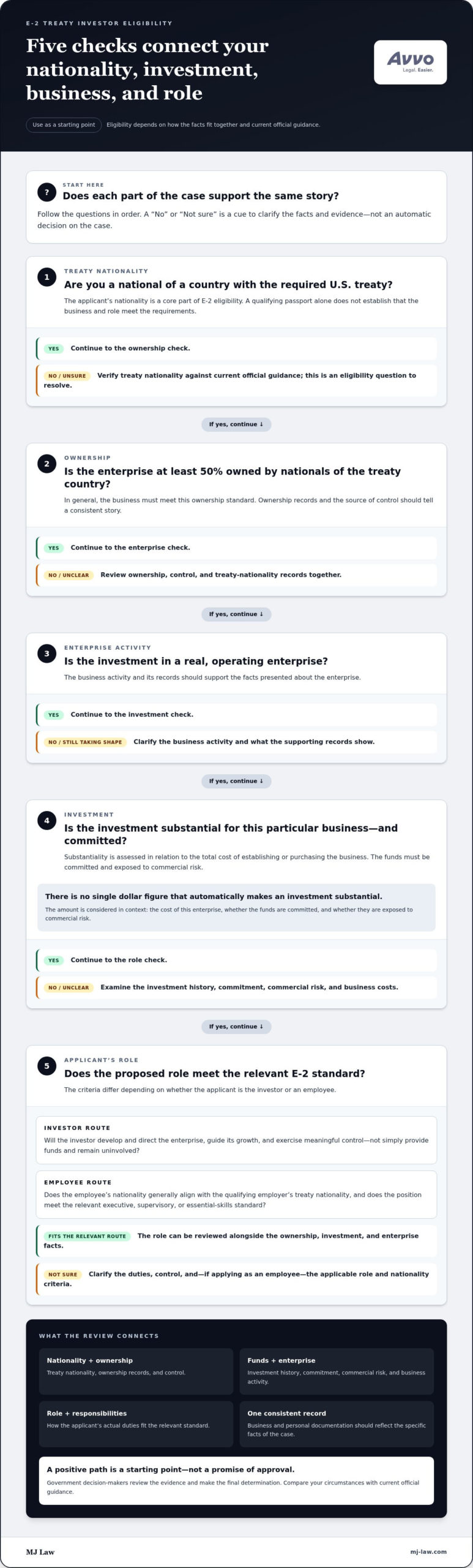
E-2 is a treaty-based nonimmigrant classification, so eligibility depends on the investor’s nationality as well as the business and investment. These factors must work together: a qualifying passport alone doesn’t establish that the enterprise or the investor’s role meets the requirements. An E-2 treaty investor visa attorney reviews how ownership, funds, business activity, and the applicant’s responsibilities fit the current rules, using official guidance such as USCIS’s E-2 Treaty Investor Visa requirements.
Core eligibility depends on treaty-country nationality, qualifying ownership, a substantial investment in a real and operating enterprise, and an investor or employee role that meets the applicable standard. This is a starting point, not a substitute for reviewing the facts and current agency guidance.
Treaty nationality, ownership, and the investor’s role
First, counsel checks whether the applicant is a national of a country that maintains the required treaty with the United States. The enterprise’s ownership matters as well. In general, the business must have at least 50% ownership by nationals of the treaty country. The investor’s nationality, the company’s ownership records, and the source of control should tell a consistent story.
The investor must be coming to develop and direct the enterprise, meaning they’ll guide its growth and exercise meaningful control rather than simply provide funds and remain uninvolved. E-2 employees are assessed under distinct criteria: their nationality generally must align with the treaty nationality of the qualifying employer, and their position must meet the relevant executive, supervisory, or essential-skills standard. The details depend on the role and ownership structure.
Investment, enterprise activity, and business viability
There’s no single dollar figure that automatically makes an investment substantial. The assessment considers the investment in relation to the total cost of establishing or purchasing the particular business, as well as whether the funds are committed and exposed to commercial risk. For instance, the same amount may represent a substantial share of the cost of one small enterprise but only a limited portion of a more capital-intensive operation. Counsel examines the business’s actual needs and the records showing how funds have been committed.
The enterprise must be real and active, not a passive holding whose value comes only from owning assets. Its operating plans, services or products, customers, and financial projections help show what the business does and how it will function. A business plan can also help explain whether the enterprise is marginal, meaning it has no present or future capacity beyond providing a minimal living for the investor and family. Job creation can support a broader picture of economic activity, but the analysis isn’t simply a fixed job-count test.
Treaty lists and agency procedures can change, so assess eligibility against the rules that apply to your circumstances. A focused review connects the legal criteria to your operating business and identifies unanswered questions. MJ Law provides immigration consultations to discuss your situation.
How an E-2 attorney turns business facts into case evidence
A well-organized file does more than collect paperwork. It shows how the investor’s business activity and records relate to the requirements being assessed. An E-2 treaty investor visa attorney can identify which facts need support, select relevant documents, and explain how they fit together. The evidence depends on the enterprise, how the investment was made, and whether the application will be submitted through a consulate or to USCIS.
A large collection of documents may still leave important questions unanswered. A bank statement, for example, may show a transfer but not explain where the funds came from, who invested them, or how they were committed to the business. Counsel can connect records to the facts they’re intended to establish, presenting a coherent account rather than an unexplained stack of attachments.
Business and investment records that may support the case
Examples include formation and ownership records, purchase or transfer documents, bank and transaction records, lease agreements, licenses, contracts, and operating plans. These are examples, not a universal checklist. A document is useful when it supports a relevant fact and fits the applicant’s actual investment path and business model.
| Issue to explain | Illustrative supporting records |
|---|---|
| Ownership and control | Company formation documents, ownership ledgers, or agreements among owners |
| Investment committed | Transfer records, purchase documents, invoices, or business account statements |
| Operating enterprise | Lease, service or supplier contracts, licenses, and operating plans |
| Investor’s role and business outlook | Organizational chart, role description, business plan, or financial projections |
The records should clarify how capital moved into the enterprise and what the business is doing or preparing to do. A lease may support the account of planned operations, while transaction records may document an investment step. Neither document alone necessarily establishes every relevant point. Its value depends on the surrounding facts.
Addressing inconsistencies and evidence gaps
Counsel can compare financial records, ownership details, business plans, and application forms to identify differences that need explanation. For instance, if a plan describes one ownership share while company records show another, understand and accurately address the discrepancy. A missing record may prompt a search for other reliable evidence or a clear explanation of what the available documents establish.
Evidence should be truthful, consistent, and specific to your circumstances. Don’t alter records to make them appear stronger or rely on a generic business narrative that doesn’t match actual operations. The goal is to make the relationship between each fact and its supporting evidence understandable, while recognizing that the reviewing authority makes the final decision.
What to expect when preparing an E-2 visa application with counsel
Working with counsel usually involves a sequence of connected steps, not simply completing forms. The process starts with understanding your goals and circumstances, then moves through fact review, evidence planning, document preparation, and the appropriate filing or consular process. The route depends on your situation and current procedures, so avoid making business or travel plans based on assumptions about which application path applies.
Preparing for the first attorney consultation
A concise overview helps make the first conversation productive. Bring what you have, not a perfect file. Useful starting points include a business summary, ownership details, records of investment funds and transactions, and a timeline of relevant immigration history. Be ready to describe planned operations, investment steps already taken or under consideration, your intended role, and any important launch or relocation dates.
For investors in San Jose or Silicon Valley, explain the local business context that informs your plans, such as the intended customer base, premises, suppliers, or hiring needs. These details describe your enterprise, not special E-2 rules. MJ Law offers consultations in English and Spanish.
From case strategy to filing and follow-up
After reviewing the facts, counsel can help determine what needs further clarification, organize supporting records, and prepare forms and explanations that present a consistent account. The aim is to make the relationship between your business plans, investment, ownership, and role clear. Preparation may also identify details to resolve before filing rather than leave unexplained in the application.
The general process often follows this order:
- Consultation: Discuss your goals, business plans, and questions.
- Fact review: Examine the available information and identify issues that may affect planning.
- Evidence plan: Determine which records can support the relevant facts and where more information may be needed.
- Preparation: Assemble the forms and supporting materials for the selected route.
- Filing and follow-up: Complete the applicable submission steps and respond to process-related developments.
Whether the case proceeds through a U.S. consulate or involves a filing with USCIS depends on the applicant’s circumstances and current procedure. An interview, additional requests, or other follow-up may apply differently by route. Processing times and requirements can change, so review current USCIS and Department of State information when planning. The official E-2 treaty investor guidance is a useful starting point for general background.
To discuss your business and immigration plans with MJ Law, you can schedule an E-2 consultation. A clear summary of your investment, operations, and intended timing can help focus the conversation.
Work with an E-2 treaty investor visa attorney in San Jose
Investing in a business and preparing an immigration case are connected, but they involve different decisions. A tailored legal review can help show how your nationality, ownership, investment steps, business plans, and supporting records fit together. MJ Law works with investors and business owners through its business and investor visa practice, drawing on immigration experience dating back to 1985. Its San Jose office serves the surrounding region, including the San Francisco area.
Why local investors value clear, case-specific legal guidance
Silicon Valley business plans can involve evolving operations, several founders, technology development, commercial leases, or plans to serve customers across different markets. Those details don’t create special E-2 rules, but they can shape which facts and records explain how an enterprise will operate. Clear, well-organized evidence should reflect the business as it actually exists and the investor’s intended role.
An E-2 treaty investor visa attorney can work with individual investors, founders, and business owners to understand their plans and identify immigration issues for careful review. The aim is a strategy grounded in the applicant’s circumstances, not a template applied to different businesses. A local office makes counsel accessible to investors in the San Jose and San Francisco region, but it doesn’t change federal eligibility standards or control a government decision.
MJ Law has assisted individuals, families, and businesses with immigration matters for more than three decades. That experience supports a careful review of how business facts and immigration evidence relate, while keeping legal guidance distinct from business, tax, and financial advice. Consultations are available in English and Spanish, so investors can discuss their plans in the language that works best for them.
Take the next step with a focused consultation
A useful first conversation can begin with a concise account of your circumstances. Be prepared to discuss:
- Your nationality and any relevant immigration history
- The enterprise’s current or planned operations and ownership structure
- Investment funds, completed transactions, and steps still under consideration
- Your intended role in the business and any important timing considerations
You don’t need to have every document organized before starting a discussion. Sharing what’s known, along with open questions, gives counsel a practical basis to understand your goals and identify issues that may need closer analysis. The conversation can clarify possible next steps, but no attorney can promise a particular government decision.
If you’re considering an E-2 investment in San Jose or the surrounding region, schedule an E-2 visa consultation with MJ Law to discuss your nationality, enterprise plans, investment steps, and timing.
Make your next E-2 decision with clarity
Before making further commitments, define what you need to decide next. You may be weighing when to invest, how to structure the enterprise, or how immigration timing fits with your business plans. Bringing those questions into a focused discussion can help you consider the legal implications before choices become harder to change.
An E-2 treaty investor visa attorney can help examine your circumstances, identify issues that deserve closer attention, and consider practical next steps. The purpose is to build a clear understanding of your options and responsibilities, not to promise a particular outcome. Decisions remain yours, supported by case-specific legal guidance.
MJ Law’s business and investor visa practice offers a setting to discuss your goals and concerns directly. You can share the facts you have, ask questions, and learn what further information may be useful to evaluate your situation. A thoughtful conversation can bring greater direction to your next steps.
Schedule a consultation with MJ Law to discuss your plans and move forward with a clearer understanding of the process.
Frequently Asked Questions
Can an E-2 treaty investor visa attorney tell me whether I qualify?
An attorney can assess how your circumstances align with the applicable E-2 criteria, but can’t guarantee a government decision. A review may consider changes in ownership, the timing of investment transfers, and the responsibilities you’ll take on in the enterprise. Share uncertainties as well as favorable details. A complete, candid discussion helps counsel identify what’s clear, what needs more information, and which issues may require careful legal analysis.
Is there a minimum investment amount for an E-2 visa?
There isn’t one universal dollar threshold that determines eligibility in every case. The investment is considered in relation to the type and overall cost of the particular enterprise, as well as whether funds are committed to it. A figure found online may not reflect your business’s circumstances or current guidance. Before relying on a generic amount, review current official sources and seek an assessment based on the enterprise’s actual costs and investment structure.
Can I apply for an E-2 visa if my business has not opened yet?
A business may be at an early stage, but a plan by itself doesn’t establish that the enterprise is real and developing. The case may need to show concrete steps toward operations, such as completed transactions, preparations for a location, or arrangements to provide services, depending on the business. An attorney can assess whether the records reflect meaningful progress and identify facts that need clarification before you choose how to proceed.
How long does an E-2 visa application take?
There’s no single timeline that applies to every E-2 case. Timing can depend on whether you apply through a consular post or pursue a filing with USCIS, current workload, and the time needed to prepare complete materials. For example, delays in obtaining ownership or transaction records can affect preparation even before submission. Check current official processing information for the relevant route, and avoid making firm travel or launch plans around an estimate alone.
Can my spouse and children come with me on an E-2 visa?
Eligible spouses and unmarried children under 21 may qualify to accompany or join an E-2 principal applicant, subject to current requirements. Consider each family member’s circumstances and documentation, including how their plans relate to the principal applicant’s case. A spouse’s work authorization questions should be reviewed separately under current rules. Share relevant family details early so counsel can explain which steps may apply and what information could be needed.
Do I need an attorney to apply for an E-2 visa?
Applicants generally aren’t required to hire an attorney, but legal representation can help assess issues that may be easy to miss when preparing a complex case independently. For example, business records may describe ownership differently from application materials, or investment evidence may need context. Counsel can help develop a filing strategy and organize supporting information. You remain responsible for providing accurate facts, and representation can’t assure approval.
What should I bring to an E-2 visa attorney consultation?
Bring a short description of the enterprise, its ownership structure, available investment and transaction records, and any relevant immigration history. A simple timeline can clarify what has happened, what you plan to do next, and when. Founders and business owners in San Jose or San Francisco may also outline their expected operations and intended role. Don’t wait for a perfect file. Note unanswered questions so the discussion can focus on them.