
Acquiring another nationality doesn’t automatically require a U.S. citizen to give up U.S. citizenship. Dual citizenship means being recognized as a citizen of two countries at the same time, and U.S. law doesn’t require dual nationals to choose one. Sound dual citizenship legal guidance starts with understanding that each country’s rules still matter.
It’s natural to focus first on how to acquire a second citizenship. Possible routes include birth or a parent’s citizenship, marriage, and naturalization; some countries also offer citizenship through investment. Requirements depend on the country, whose laws determine whether it recognizes dual nationality.
This article explains how U.S. citizens may acquire another nationality and what rights and obligations can follow. It covers each country’s citizenship rules, passport requirements, and responsibilities such as obeying applicable laws and meeting tax obligations. That context can help you identify the questions to consider before making decisions about your citizenship status.
Key Takeaways
- Understand what dual citizenship means and why each country’s laws shape how it is recognized.
- Learn how birth, marriage, or naturalization may create a path to another nationality.
- See why acquiring another citizenship does not, by itself, end U.S. citizenship.
- Prepare for the practical responsibilities that may come with dual nationality, including passport, legal, and tax obligations.
- Explore how immigration counsel can help clarify citizenship pathways and related U.S. immigration matters.
What is dual citizenship?
Dual citizenship means legal recognition as a citizen of two countries at once. It can arise through birth, a parent’s citizenship, or later naturalization. Each country applies its own nationality rules, so recognition may differ. U.S. law doesn’t require dual nationals to choose one citizenship. The Supreme Court’s 1967 Afroyim v. Rusk ruling protected citizenship from being taken for dual citizenship without consent. That decision helps explain why acquiring another nationality alone doesn’t automatically end U.S. citizenship.
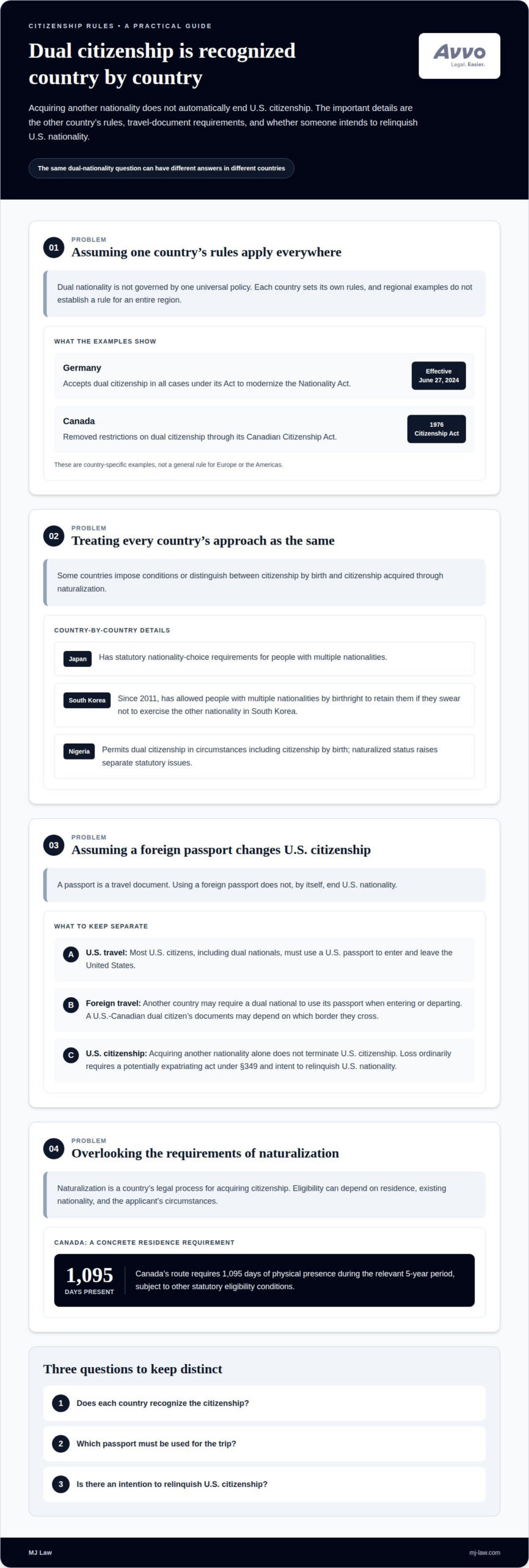
Passport rules affect travel even when both citizenships remain valid. Most U.S. citizens, including dual nationals, must use a U.S. passport to enter and leave the United States. A foreign country may also require a dual national to use its passport when entering or departing. For example, a U.S.-Canadian dual citizen’s travel documents may depend on which border they are crossing. These rules concern travel documentation, not a choice between citizenships.
Using a foreign passport doesn’t, by itself, end a person’s U.S. nationality. The more consequential distinction is between holding another passport and formally renouncing U.S. citizenship with the intention to relinquish it. Renunciation may affect citizenship status. If citizenship is lost, a former citizen’s ability to travel using a U.S. passport can change; appropriate documents depend on their status and destination. Before taking a step intended to give up citizenship, understand how it could affect future travel and legal status.
Tax obligations can also continue alongside dual nationality. U.S. citizens living abroad remain subject to U.S. worldwide-income rules. Qualifying U.S. taxpayers can exclude up to US$130,000 under the foreign earned income exclusion for tax year 2025 using Form 2555, according to the Internal Revenue Service. This exclusion has eligibility requirements; it doesn’t mean every overseas taxpayer qualifies. The Internal Revenue Service gives the approximate 2025 average annual income tax liability threshold for covered expatriate status as $206,000. That threshold concerns expatriation, not ordinary dual citizenship.
Consult an immigration attorney about a foreign citizenship pathway or how another country’s rules affect your U.S. status. Consult a tax attorney if foreign income, U.S. filing responsibilities, or possible expatriation raises questions about tax consequences. Coordinated advice matters because citizenship, travel documents, and tax treatment involve separate legal questions.
For practical dual citizenship legal guidance, separate three issues: whether each country recognizes your citizenship, which passport you must use, and whether you intend to keep U.S. citizenship. A passport answers a travel-document question; it doesn’t settle every nationality or tax issue. Understanding these distinctions can help you evaluate the consequences before applying for another citizenship or taking steps that could change your status.
How an immigration attorney can assist U.S. citizens seeking citizenship in another country
Foreign nationality rules differ by country, so an application can raise separate legal questions. An immigration attorney can help assess the U.S. implications and organize the issues surrounding naturalization.
Dual-Nationality Policies by Region
Regional policy examples show why nationality rules must be assessed country by country. Germany accepts dual citizenship in all cases under its Act to modernize the Nationality Act, effective June 27, 2024. In North America, Canada removed restrictions on dual citizenship through its Canadian Citizenship Act, 1976. These examples don’t establish one rule for Europe or the Americas. They show why the specific country matters to your application.
Countries That Restrict Dual Citizenship
Some countries limit dual nationality or attach conditions to keeping it. Japan has statutory nationality-choice requirements for multiple nationals. South Korea has allowed people with multiple nationalities by birthright to retain them since 2011, if they swear not to exercise the other nationality in South Korea. Nigeria permits dual citizenship in circumstances including citizenship by birth, while naturalized status raises separate statutory issues. These differences can affect eligibility and later status.
Naturalizing in another country with professional legal guidance
Naturalization means acquiring citizenship through a country’s legal process, rather than receiving it automatically at birth. The rules can turn on residence, existing nationality, and the applicant’s circumstances. For example, Canada’s route requires 1,095 days of physical presence during the relevant 5-year period, subject to other statutory eligibility conditions. Legal guidance can help map the foreign requirements and identify where U.S. citizenship questions arise before an application proceeds.
Risk to U.S. Citizenship
Does acquiring another citizenship put U.S. citizenship at risk? No, acquiring another nationality alone doesn’t terminate U.S. citizenship. Under U.S. law, loss ordinarily requires a potentially expatriating act under §349 and intent to relinquish U.S. nationality. This distinction matters: applying for foreign citizenship is different from deliberately giving up U.S. citizenship. An attorney can help clarify how the proposed action and stated intent relate to that legal standard.
For a sound review, an attorney can separate the foreign application criteria from U.S. nationality consequences. That includes identifying the country’s naturalization route, reviewing how its rules treat dual nationals, and clarifying whether the planned steps could affect U.S. status. If you’re also evaluating a U.S. citizenship matter, discuss your immigration questions as part of a focused legal review.
Benefits and obligations of dual citizenship
Holding American citizenship alongside another nationality can connect a person to legal rights in both countries. Those rights depend on each country’s laws and may affect residence, public services, and participation in civic life. A dual national may also face limits that a single-national citizen doesn’t encounter. For example, Australia’s Constitution, Section 44(i), restricts people who hold allegiance to a foreign power from sitting in its Parliament. The practical benefit and the legal constraint can coexist.
How does U.S. dual citizenship affect citizenship and obligations in another country? It doesn’t displace the other country’s laws or obligations. Dual nationals owe allegiance to both countries, and each may enforce its laws, particularly when the person is physically there. A foreign country may require its citizens to use that country’s passport for entry and departure. South African citizens aged at least 18 who also hold another citizenship may commit an offence by entering or leaving South Africa using another country’s passport.
Tax responsibilities can also span borders. What taxes and IRS reporting rules apply to U.S. citizens living abroad with dual citizenship? U.S. citizens remain subject to U.S. worldwide-income rules, and may also have tax obligations in their other country. The Internal Revenue Service gives U.S. citizens living overseas an automatic two-month extension to file, with the deadline extended to June 15. That filing extension doesn’t itself remove tax responsibilities. Qualifying taxpayers may use applicable tax provisions, but eligibility and reporting depend on their circumstances.
Other obligations depend on age, location, and applicable laws. Dual citizens may need to register for Selective Service, if applicable. A person living abroad should distinguish this U.S. responsibility from requirements imposed by the country of residence. The country where a dual national is physically located generally has the stronger claim to that person’s allegiance. This can matter during travel, legal disputes, or contact with government authorities. A U.S. passport doesn’t exempt its holder from local law.
Before relying on a citizenship benefit, identify which country’s law governs the specific activity. Political office illustrates why: Australia applies Section 44(i), while another country may set different eligibility rules. Tax filing presents a separate issue, since U.S. obligations continue even when a person lives abroad. Treat each country’s citizenship, travel, civic, and tax rules as distinct responsibilities. That approach helps American dual nationals understand both the opportunities citizenship may provide and the obligations that accompany it.
Meaning and recognition of dual citizenship
Recognition depends on each country’s nationality laws, not on a shared international rule. The United States may recognize someone as its citizen while another government applies different rules to that person’s other nationality. Recognition by one country doesn’t establish recognition by another. A person can hold documents from two countries yet face different legal treatment in each. The Fourteenth Amendment forms part of the U.S. citizenship framework, but other countries determine their own citizenship policies.
Some governments allow citizens to retain nationality after becoming U.S. citizens; others restrict it. The British Nationality Act 1948 removed restrictions on dual citizenship in the United Kingdom. India took a different approach by introducing Overseas Citizenship of India in 2005. That status doesn’t include the right to vote or run for office. The distinction shows why a status with “citizenship” in its name may not carry the same political rights as citizenship itself.
Legal recognition can also depend on how a person acquired nationality. The Philippines’ Citizenship Retention and Re-acquisition Act of 2003 was approved on August 29, 2003. Under Republic Act No. 9225, children under 18 of qualifying natural-born citizens are deemed Philippine citizens. This example connects a parent’s legal status with a child’s citizenship recognition. The applicable conditions still depend on the law’s specific categories, rather than simply on a family’s use of two passports.
Recognition also differs from eligibility for U.S. citizenship. A person who qualifies must immigrate to the United States and become a permanent resident before becoming eligible for U.S. citizenship. That route concerns acquiring U.S. citizenship, not automatically retaining another country’s nationality. A foreign government may have separate rules for its citizens who naturalize in the United States. Consider both questions separately: whether U.S. requirements are met and whether the other country continues to recognize that nationality.
For a practical review, distinguish citizenship, immigration status, and travel documents. A U.S. permanent resident has a different status from a U.S. citizen, even if they also hold foreign nationality. Likewise, an Overseas Citizen of India isn’t automatically entitled to the same political rights as an Indian citizen. These examples show why a label or passport alone may not explain every right. The relevant government’s nationality law determines how it recognizes a person and what that recognition permits.
Citizenship through birth, marriage, or investment
Citizenship can come through family ties, marriage, or investment, but each country sets its own eligibility rules. A person born abroad to at least one U.S. citizen parent may acquire dual citizenship, depending on applicable requirements. Birthplace alone doesn’t determine whether citizenship follows. The rules of both the United States and the other country matter. A family connection may create a pathway, while separate procedures govern recognition and proof.
Marriage may also provide a route to foreign nationality. A U.S. citizen may acquire another country’s citizenship through marriage, but marriage itself doesn’t establish that every applicant qualifies. The other country’s law controls the requirements and process, including whether a new citizen may retain existing nationality. For a couple considering a marriage-based green card in the United States, that immigration process is separate from acquiring citizenship in a foreign country.
Citizenship by investment follows specific national programs, not one universal standard. These are country-program figures, not U.S. immigration fees.
Other options have distinct conditions. Argentina added an investment-based statutory citizenship route in a 2025 reform. These examples show why the route matters: a contribution, property purchase, or statutory investment pathway may have different eligibility criteria. The headline amount alone doesn’t establish that an applicant qualifies or explain every program condition.
Before pursuing any route, separate three questions: what creates eligibility, what evidence the country requires, and whether U.S. citizenship remains intact. The answer can differ between a child claiming citizenship through a parent, a spouse seeking naturalization, and an investor applying under a national program. If a foreign citizenship plan raises questions about your U.S. immigration status, discuss your U.S. immigration matter with counsel.
MJ Law: US Citizenship and Naturalization
MJ Law assists individuals with U.S. citizenship and naturalization matters connected to their immigration plans. If you’re assessing how a foreign nationality could affect your U.S. status, legal guidance can help clarify the U.S. immigration questions involved. The firm also handles family immigration, employment-based visas, and business and investor visas, which may be relevant when a family or work pathway forms part of your broader plans.
Foreign citizenship eligibility depends on the other country’s laws, while U.S. immigration and citizenship questions follow U.S. rules. Consider counsel when you’re evaluating a U.S. citizenship process or need to understand how your U.S. immigration matter fits alongside plans involving another nationality. Contact MJ Law to discuss your immigration matter.
Make your next citizenship decision with clarity
Your next step is to define the decision you’re facing. Are you pursuing another nationality, evaluating a U.S. immigration pathway, or considering how a family or investment plan affects your status? Clear dual citizenship legal guidance can help separate these questions and focus on the rules that apply to your situation.
MJ Law assists with U.S. immigration matters through Family Immigration Services, Business and Investor Visas, and Employment-Based Visas. If your plans involve U.S. citizenship or immigration alongside another country’s nationality rules, counsel can help you understand the U.S. issues and identify a practical direction.
Bring your goals and the citizenship question you need resolved to a conversation with the firm. Contact MJ Law for guidance and take a considered next step toward your plans.
Frequently Asked Questions
Does the United States allow dual citizenship?
Yes. U.S. law permits a person to hold U.S. citizenship alongside another nationality. Acquiring a second citizenship by itself doesn’t end U.S. citizenship; the key issue is whether the person performs a potentially expatriating act with the intention to relinquish U.S. nationality. For someone considering renunciation, the decision has separate legal and tax consequences. Distinguish the citizenship question from the rules governing travel documents and foreign nationality.
Can U.S. citizens hold two passports, and when should they use each one?
Yes, a U.S. citizen may hold passports from both countries of citizenship. Most U.S. citizens, including dual nationals, must use a U.S. passport to enter and leave the United States. The other country may require its passport for entry or departure there. For a trip involving both countries, account for the passport rules at each border rather than treating either passport as universally interchangeable.
How can an immigration attorney help a U.S. citizen acquire dual citizenship through birth, descent, marriage, or naturalization?
An immigration attorney can clarify U.S. citizenship or immigration issues that overlap with a foreign nationality plan. A person born abroad to at least one U.S. citizen parent may acquire U.S. citizenship, depending on applicable requirements. Marriage or ancestry may also be relevant under another country’s rules. Foreign eligibility is determined by that country’s requirements. Legal counsel can help distinguish a U.S. immigration matter from a separate foreign naturalization process.
Can dual citizens be required to serve in another country’s military or pay its taxes?
Potentially, because each country applies its own laws to its citizens. Dual nationals must obey the laws of both countries, and U.S. citizens abroad remain subject to U.S. worldwide-income rules. Tax obligations may also arise in the other country. Military-service requirements depend on that country’s law and the person’s circumstances; citizenship alone doesn’t establish the answer. Identify the applicable country’s rules before making decisions about residence or travel.
What travel, entry, and consular assistance rules apply to U.S. dual citizens abroad?
Use a U.S. passport to enter and leave the United States, and account for the other country’s document rules when traveling there. Either government may enforce its laws against a dual national, particularly during a visit to that country. The country where the person is physically present generally has the stronger claim to allegiance. Dual citizenship doesn’t remove local legal obligations, so understand the destination’s rules before traveling.
How do dual-citizenship laws differ by country, and where can I verify current rules?
Countries set their own nationality policies, so the same event can have different effects across borders. Japan has statutory nationality-choice requirements for multiple nationals, while Germany accepts dual citizenship in all cases under its modernized nationality law. For current eligibility and retention rules, contact the relevant country’s embassy or consulates in the United States. Ask about the specific route, such as descent, marriage, or naturalization, because requirements vary.
What steps can an immigration attorney help with when applying for dual citizenship, and what documents, fees, and processing times should clients expect?
An attorney can clarify the U.S. immigration issues involved, identify questions about foreign eligibility, and organize the legal issues surrounding your planned route. The foreign authority sets its application documents and processing schedule, which depend on the country and pathway. No single document list or timeframe applies to every case. Legal fees depend on the case and are provided after a quote request; scope and complexity affect the cost.