
Taking another country’s citizenship does not automatically mean giving up U.S. citizenship. For dual citizenship legal advice in San Francisco, the key U.S. rule is that a citizen may naturalize abroad and retain U.S. citizenship unless they intend to relinquish it. That intention may be shown through statements and conduct.
It’s understandable to want a clear answer before making decisions about citizenship, travel, or family plans. This article explains how U.S. rules treat dual citizenship, when citizenship through a parent or grandparent may be relevant, and what benefits and complications can come with holding two nationalities. It also outlines practical questions to discuss with an immigration lawyer in San Francisco, including how they assess your circumstances, explain the process, and communicate about your case. The aim is to help you understand the issues and identify a useful next step.
Key Takeaways
- Understand when U.S. citizenship may be retained after naturalizing in another country, and why intent matters.
- Explore whether citizenship through a parent or grandparent could apply before pursuing a different immigration path.
- Consider how dual nationality may affect travel, work, property ownership, tax obligations, and responsibilities under two countries’ laws.
- Review the other country’s citizenship rules, including whether it requires citizens to use its passport when entering or leaving.
- Learn how an immigration lawyer can assess a citizenship application, identify relevant family-based options, and guide complex filings.
U.S. rules on retaining citizenship after foreign naturalization
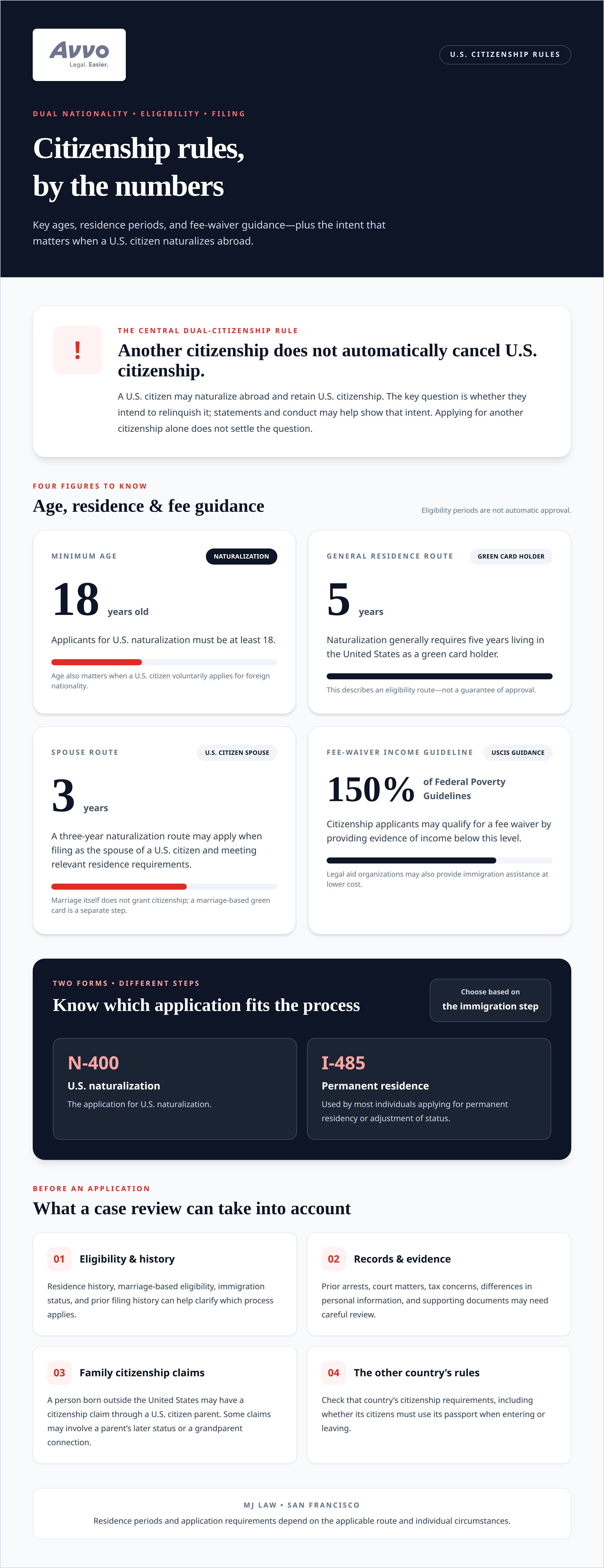
U.S. law allows a person to hold citizenship in two countries at once. A U.S. citizen may naturalize abroad without automatically losing U.S. citizenship. The key issue is whether that person intends to relinquish U.S. nationality. Statements and conduct may show that intention, so applying for another citizenship alone does not settle the question.
Age and intent matter in this analysis. A U.S. citizen who voluntarily applies for foreign nationality after age 18 may relinquish U.S. nationality if they intend to do so. Choosing to give up U.S. citizenship is different from simply seeking another passport. An immigration lawyer can assess the person’s stated intentions and actions in context, rather than treating foreign naturalization as an automatic loss.
For people seeking U.S. citizenship, eligibility follows a separate process. U.S. Citizenship and Immigration Services says applicants must be at least 18 years old. According to U.S. Citizenship and Immigration Services, naturalization generally requires five years living in the United States as a green card holder, or three years when filing as the spouse of a U.S. citizen. These periods describe eligibility routes, not automatic approval.
Forms also depend on the step involved. U.S. Citizenship and Immigration Services identifies Form N-400 as the application for U.S. naturalization. Form I-485 is used by most individuals applying for permanent residency or adjustment of status. An immigration lawyer can distinguish whether a matter concerns permanent residence, naturalization, or the effect of another country’s citizenship process.
Marriage to a U.S. citizen can affect the naturalization timeline, but it does not itself grant citizenship. The three-year route applies when filing as the spouse of a U.S. citizen and meeting the relevant residence requirements. A marriage-based green card is a separate immigration step. An attorney can review your status and filing history to identify which process applies.
For someone in San Francisco seeking citizenship in another country, an immigration lawyer can explain how foreign naturalization may affect U.S. nationality and review the person’s statements and conduct. The foreign country’s application requirements and processing steps shape that application’s timeline, while the U.S. legal review focuses on the potential effect on U.S. citizenship.
Before filing Form N-400, an attorney can assess residence history, marriage-based eligibility, and the applicant’s immigration record. Complications such as an arrest can jeopardize a green card or visa and may create deportation risk for a person who is not a U.S. citizen. Reviewing those facts before an application helps counsel identify issues that may affect the filing strategy.
Immigration lawyer assistance with citizenship applications
An immigration attorney can assess an application, identify record issues, and organize supporting evidence. The right preparation depends on the applicant’s status, residence history, and citizenship goal.
Attorney Costs and Legal Aid
Legal fees depend on the case and are provided after a quote request; the expected work, records, and filings affect the cost. Discuss the scope of representation and how fees are handled at the outset. U.S. Citizenship and Immigration Services says citizenship applicants may qualify for a fee waiver by providing evidence of income below 150% of the Federal Poverty Guidelines. Legal aid organizations may also provide immigration assistance at lower cost.
For an application involving an FBI background check, an attorney can assess how available records relate to the immigration history under review. Prior arrests, court matters, or differences in personal information may raise questions that deserve careful attention. The attorney can identify relevant documents and explain how a record may affect the filing, rather than leaving the applicant to interpret it alone.
Filing without counsel can make it harder to spot missing information, address a complicated record, or respond to a deadline. For example, an applicant with a prior conviction or tax concern may need advice specific to that issue. A citizenship interview that raises questions may also call for a clear, accurate response. If an application is denied, legal counsel can explain available response options, including an appeal where appropriate.
Choosing a Lawyer and Preparing for Consultation
Look for an attorney whose immigration experience includes citizenship applications and the issues relevant to your case. Ask how they assess eligibility, which evidence may be needed, how they communicate about progress, and what work the proposed representation covers. A focused citizenship consultation can help organize those questions around your status and application.
Bring available identity and immigration records, including your green card, prior applications, notices, and travel or residence history. Include marriage documents if you’re applying through a spouse, and court records for any arrest or charge. These materials help the attorney understand the case and identify what further evidence may matter.
Acquired or derivative citizenship through a parent or grandparent
A person born outside the United States may already have a citizenship claim through a U.S. citizen parent. In other cases, a claim may depend on a parent’s later status or a family connection involving a grandparent. These paths differ from applying for naturalization after receiving a green card. The first step is to identify which family relationship and legal pathway may apply.
An immigration lawyer can map the family line, starting with the applicant and working back through each parent and grandparent. The review considers where each person was born, their citizenship, and when relevant events occurred. For example, a claim involving a U.S. citizen parent requires examining that parent’s circumstances in relation to the child’s birth. A grandparent connection calls for a closer review of how citizenship may have passed through the intervening generation.
Records help establish family history. Counsel may review birth certificates, marriage records, adoption documents, passports, and citizenship papers. Different names across records, a parent’s name change, or a missing certificate can complicate the family connection. The attorney identifies which documents support each relationship and whether additional records may help explain inconsistencies. This is a legal assessment, not simply a search for a relative who held a U.S. passport.
Acquired citizenship and derivative citizenship are distinct routes, each with its own facts and applicable requirements. A lawyer examines whether a person’s claim arose through a parent or may involve a grandparent, then determines what evidence supports that route. A foreign-born child adopted by a U.S. citizen may qualify for derivative citizenship if certain requirements are met. The adoption record and the child’s circumstances therefore need individual review.
Family circumstances can change the analysis. A parent’s citizenship status at the relevant time, the child’s birth or adoption history, and the sequence of family events may all matter. Marriage documents may help establish a parent’s identity or family relationship, but marriage alone does not establish a child’s citizenship claim. A California resident seeking an answer should have counsel connect the documents to the legal pathway, rather than assume one family fact settles the issue.
Language and record location can also affect the review. A certificate issued outside the United States may use a different spelling or format from an English-language U.S. record. The attorney can identify the discrepancy and assess its effect on the evidence. If relatives or institutions outside California hold records, organizing the family timeline helps counsel see which documents remain relevant.
After reviewing the family line, counsel can explain whether a claim appears to involve acquired or derivative citizenship, what evidence supports it, and what further steps may apply. That assessment can prevent someone from treating a potentially existing citizenship claim as a standard naturalization case. For a San Francisco family, the result is a clearer distinction between seeking citizenship through a parent or grandparent and pursuing a separate immigration process.
Advantages and disadvantages of dual citizenship
Holding citizenship in two countries can expand a person’s options, but it also connects them to two legal systems. The practical value depends on where they expect to live, work, own property, and travel. A careful assessment weighs those benefits against obligations that may continue in each country. The decision should be informed by both countries’ rules, not passport access alone.
One potential advantage is the ability to live and work in both countries. A dual citizen with family, employment, or property ties across borders may find that status useful when deciding where to build a life. Citizenship can also support property ownership in both countries. The specific rights and requirements depend on the countries involved.
Travel is another practical consideration. U.S. citizens, including dual citizens, must use a U.S. passport to enter and leave the United States. That requirement affects travel planning even when a person also holds another passport. For travel between the United States and another country, that country’s entry and departure rules may add another step. Passport use should follow the rules of each destination.
There are also potential disadvantages. Dual citizenship can expose a person to double taxation, and citizens may be bound by the laws of two nations. These concerns can matter even when someone spends most of their time in one country. Anyone who works in one country, owns property in another, or moves between them should understand how each country treats those connections before making plans.
Tax obligations deserve particular attention because they can depend on a person’s circumstances and the rules of both countries. A citizenship lawyer can identify immigration issues and explain how nationality relates to the person’s plans. Tax questions require advice focused on tax rules. Keeping these issues distinct helps avoid assuming that immigration status alone answers every financial question.
Assess the trade-offs in a structured way. First, identify where you may live, work, and own property. Next, consider travel requirements, including the U.S. passport rule. Then examine possible tax exposure and legal obligations in each country. This sequence helps you compare the practical advantages with the responsibilities attached to each citizenship.
An immigration law firm can connect citizenship rules with your immigration history and future plans. In a consultation, describe the countries involved and the decisions you’re weighing. Ask how the lawyer will assess relevant citizenship rights, travel requirements, and possible immigration consequences. A clear discussion helps define the legal questions, but it does not replace specialized tax advice where taxation is a concern.
The central takeaway is balance: access to two countries can be valuable, while obligations in both require attention. For a person in the United States, the U.S. passport rule is one concrete travel requirement; double taxation and the laws of two countries are potential burdens. Reviewing those factors together helps make dual citizenship a deliberate decision rather than an assumption based on holding two passports.
Travel planning must account for the U.S. passport requirement when entering or leaving the United States, as well as the other country’s entry and departure rules when traveling between countries.
What are the citizenship and dual nationality rules of the other country involved?
The other country’s rules matter because U.S. citizenship is only one part of a dual nationality decision. A lawyer can review how that country treats citizenship acquired through naturalization, ancestry, or another family connection. The analysis starts by identifying the country and the route involved. Rules can differ for a person applying for citizenship and someone who already holds it.
A central question is whether the country permits dual nationality in the situation at hand. The lawyer examines whether obtaining another citizenship could affect the person’s existing nationality, and whether the country requires a formal declaration or another step. The answer depends on that country’s law and the individual’s circumstances. Do not assume that the U.S. position automatically determines how another government treats citizenship.
Travel rules deserve separate attention. The other country may require a dual citizen to use its passport to enter and leave. That requirement can affect travel planning even when the traveler also holds a U.S. passport. The lawyer can identify which passport rules apply to the person’s route and explain how they relate to the U.S. requirement for U.S. citizens entering and leaving the United States.
A country-specific review can also distinguish citizenship from a passport. A passport is a travel document; citizenship concerns nationality and the rights or obligations attached to it. The attorney assesses whether the person’s status is recognized, what evidence supports it, and whether a separate application or registration process is relevant. For example, a citizenship claim through a parent may call for a different review than naturalization.
Useful information for the legal review includes the country involved, how citizenship may have been acquired, and any applications or official decisions already received. The lawyer can then identify relevant rules, interpret documents, and explain how the foreign process interacts with U.S. nationality. If records use different names or spellings, that difference can also affect how the evidence is assessed.
Timing and required steps depend on the foreign country’s process and the person’s route to citizenship. A lawyer can separate issues controlled by U.S. law from those governed by the other country, then explain which questions require country-specific legal analysis. This helps avoid treating a passport requirement as a citizenship decision or assuming that a foreign application automatically changes U.S. status.
Before taking action, have counsel review the foreign country’s dual nationality rules alongside the person’s U.S. citizenship concerns. A focused consultation can clarify which law applies, which documents matter, and what legal question remains unresolved. Schedule a citizenship consultation to discuss how the other country’s rules may affect your situation.
MJ Law: US Citizenship and Naturalization
MJ Law assists individuals with U.S. Citizenship and Naturalization when they need guidance on eligibility, applications, or complex immigration histories. If your question involves citizenship through a family relationship, Family Immigration Services may also be relevant. The right path depends on whether you’re applying to naturalize, assessing a possible claim through a parent, or addressing another immigration matter.
For example, a person unsure whether to file a citizenship application or pursue a family-based route can benefit from a legal review of their circumstances and supporting records. MJ Law can help clarify which immigration process fits the issue and guide the related work. Contact MJ Law to discuss your citizenship questions.
Choose a Clear Next Step for Your Citizenship Plans
The next step is to define the decision you need help making. You may need to understand your citizenship status, assess a family-based path, or plan an immigration application alongside longer-term goals. For dual citizenship legal advice in San Francisco, a focused discussion can connect your question to the legal process that fits your circumstances.
MJ Law assists with U.S. Citizenship and Naturalization and Family Immigration Services. Its Business and Investor Visas and Employment-Based Visas may also relate to broader immigration plans. A useful starting point is the issue you need resolved, along with the records and background that shape it. From there, you can discuss which legal steps apply to your situation.
Discuss your citizenship plans with MJ Law and take a considered next step with a clearer sense of direction.
Frequently Asked Questions
What Questions Should I Ask When Trying To Find an Immigration Lawyer in San Francisco?
Ask about the attorney’s experience with citizenship cases like yours, the steps they expect, and possible complications. Clarify what records they’ll review, how they’ll communicate about deadlines, and what the representation includes. For example, if your case involves a family citizenship claim, ask how the attorney evaluates supporting documents. Discuss fees and the scope of work before deciding how to proceed.
Can U.S. citizens hold dual citizenship under U.S. law?
Yes. U.S. law does not require a person to choose U.S. citizenship over another nationality. Holding two citizenships may create rights and responsibilities in both countries, so the other country’s rules also matter. For example, one country may treat a dual citizen differently when entering or leaving its territory. Consider both legal systems when assessing how dual nationality fits your travel or residence plans.
Can acquiring another citizenship affect U.S. citizenship or require renouncing it?
Acquiring another citizenship does not by itself require a U.S. citizen to renounce U.S. citizenship. The key question is whether the person intended to relinquish U.S. nationality. Statements and conduct may help show that intent. For example, applying for another nationality alone is different from expressing an intention to give up U.S. citizenship. An attorney can assess the context before you make or document decisions about nationality.
What are the tax and reporting obligations for U.S. citizens with dual citizenship?
Dual citizenship can involve potential double taxation, but the applicable tax and reporting obligations depend on the person’s circumstances and the countries involved. Citizenship alone does not answer every filing question. Relevant details may include where you live, work, or hold property. Keep tax questions distinct from immigration eligibility, and seek advice that addresses the tax rules relevant to your situation before making cross-border financial decisions.
What does a dual citizenship consultation cost in San Francisco?
The cost depends on the case and is provided after a quote request. Factors include the questions involved, the records requiring review, and the scope of legal assistance. Ask what the consultation covers, whether further work is separate, and how fees are explained before proceeding. This helps you understand the expected legal work without relying on a general estimate that may not reflect your circumstances.