
The timing of your spouse’s entry to the United States can affect whether they receive conditional or regular permanent resident status. If you are comparing the CR1 route with another option, understanding that distinction is a practical first step. A CR1 spousal visa attorney San Jose couples consult can help you assess the process, organize the case, and identify questions that need individual attention. Inconsistent paperwork, delays, or a request for evidence can complicate family plans, so it helps to prepare carefully.
This guide explains the CR1 process and how it differs from the IR1 classification, which generally applies when a couple has been married for at least two years at the foreign spouse’s entry. It covers the roles of USCIS, the National Visa Center, and a U.S. embassy or consulate, and explains why clear evidence of a genuine marriage matters throughout. MJ Law assists individuals and families with immigration matters and provides family immigration legal representation. The sections below explain what to organize, which circumstances may call for individualized legal review, and what to consider when choosing legal support in San Jose and San Francisco.
Key Takeaways
- Check how long you’ll have been married when your spouse enters the United States, since that timing affects the residency classification.
- Map the case stages and responsibilities so you can track what needs attention as the petition moves forward.
- Consider whether prior immigration history, document gaps, or inconsistent records make individualized legal guidance useful for your case.
- Prepare a concise timeline of your marriage, addresses, key dates, and immigration history before an attorney consultation.
- When comparing a CR1 spousal visa attorney San Jose families may consult, look for relevant family-immigration experience, a clear process, and understandable communication.
What a CR1 Spousal Visa Does, and Who It Is For
A CR1 is an immigrant visa classification for the spouse of a U.S. citizen whose marriage is less than two years old when the foreign spouse is admitted to the United States. Admission grants permanent resident status, subject to conditions tied to the length of the marriage. The CR1 process is distinct from the process for a spouse of a lawful permanent resident, which falls under a family-sponsored preference category rather than CR1.
The visa is one stage in a longer process, not the green card itself. The U.S. citizen first files a family petition. After approval, the case moves through visa application steps and consular processing. The foreign spouse becomes a permanent resident upon admission to the United States. Understanding these stages helps couples distinguish the decision they are making now from what happens later.
How CR1 differs from IR1
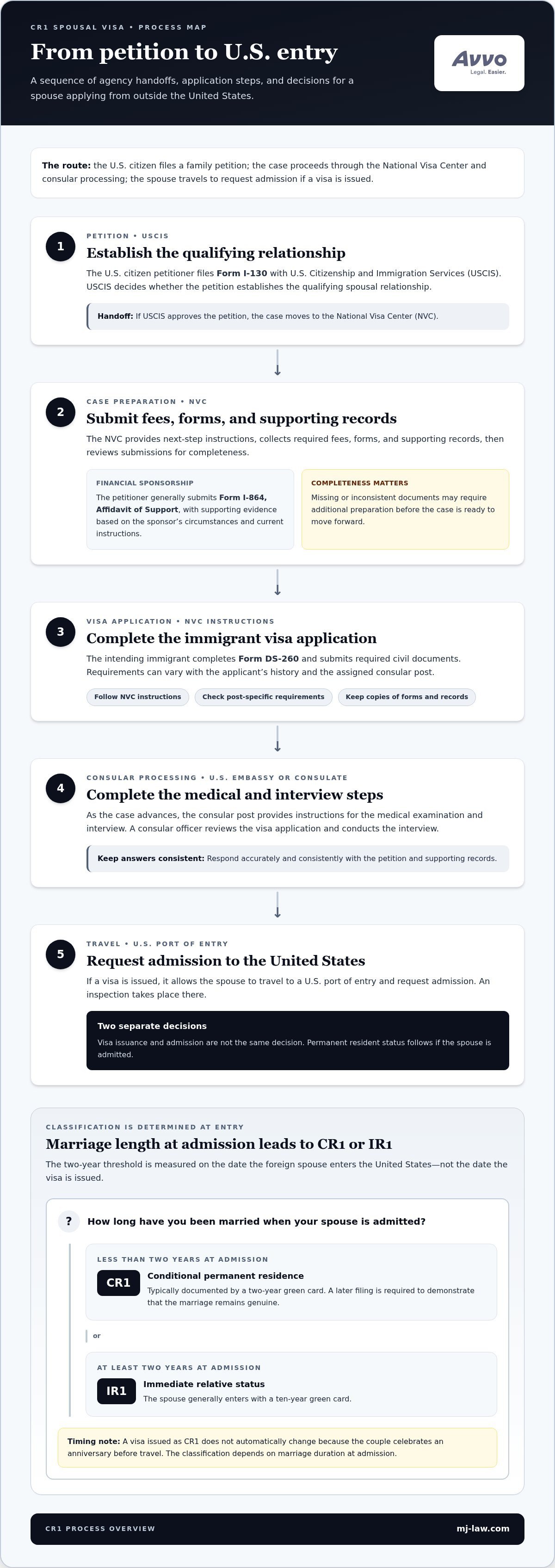
CR1 describes conditional residence; IR1 describes immediate relative status for a spouse whose marriage is at least two years old at admission. The two-year threshold is measured on the date the foreign spouse enters the United States, not simply when the visa is issued. A visa issued as CR1 doesn’t automatically change because the couple celebrates an anniversary before travel. For a general overview of the categories, see CR-1 visa on Wikipedia.
A qualifying CR1 entrant receives conditional permanent residence, typically documented by a two-year green card. The conditions require a later filing to demonstrate that the marriage remains genuine. If the marriage has reached its second anniversary before admission, the spouse generally enters in the IR1 category and receives a ten-year green card instead. Because classification turns on the marriage duration at admission, timing can matter while a case is moving through consular processing.
Is consular processing the route for your spouse?
CR1 is generally a consular immigrant-visa route for a spouse applying from outside the United States. After the petition stage, the case proceeds through the National Visa Center and then to a U.S. embassy or consulate for visa processing. The visa allows the spouse to seek admission. Permanent residence follows if the spouse is admitted.
A spouse already in the United States may have a different option: adjustment of status, an application for permanent residence from within the country. Whether that route is available depends on the person’s immigration history, current circumstances, and applicable rules. Location alone doesn’t determine the right process. Previous entries, visa status, and other case details may affect the analysis, so don’t treat consular processing and adjustment as interchangeable shortcuts.
These distinctions are useful starting points, not a case-specific eligibility decision. A CR1 spousal visa attorney San Jose couples consult can review the relationship timeline, the spouse’s location, and relevant immigration history to help clarify which process may fit. Early review can also help couples understand that petition approval, visa issuance, and admission are separate decisions made at different stages.
How the CR1 Spousal Visa Process Moves from Petition to Entry
The CR1 process involves several handoffs, with a different agency responsible for each stage. The U.S. citizen files Form I-130 with U.S. Citizenship and Immigration Services (USCIS). After approval, the case moves to the National Visa Center (NVC) for fees and documents. The foreign spouse submits Form DS-260 and completes consular steps. If a visa is issued, the spouse travels to the United States and seeks admission.
USCIS decides whether the petition establishes the qualifying family relationship. The Department of State oversees the NVC and consular stages, while a consular officer reviews the visa application and conducts the interview. Visa issuance and admission are separate decisions. A visa allows the spouse to travel to a U.S. port of entry and request admission, where an inspection takes place.
From Form I-130 to National Visa Center processing
The U.S. citizen petitioner files Form I-130 to establish the qualifying spousal relationship. If USCIS approves the petition, it sends the case to the NVC, which provides instructions for the next stage. The NVC collects required fees, forms, and supporting records, then reviews submissions for completeness. Missing or inconsistent documents may require additional preparation before the case is ready to move forward.
Financial sponsorship is part of this stage. The petitioner generally submits Form I-864, Affidavit of Support, to show how the intending immigrant will be financially supported under applicable requirements. The supporting evidence depends on the sponsor’s circumstances and current instructions.
Visa application, medical exam, and consular interview
The intending immigrant completes Form DS-260, the online immigrant visa application, and submits required civil documents. Requirements can vary according to the applicant’s history and the assigned consular post, so a generic checklist may not cover every case. Follow the NVC and post-specific instructions closely, and keep copies of submitted forms and records.
As the case advances to the consular stage, the post provides instructions for the medical examination and interview. The applicant should answer questions accurately and consistently with the petition and supporting records. MJ Law can help organize and review case materials in San Jose, even though the medical examination and interview take place abroad.
After the interview, the consular officer determines whether the visa can be issued or whether further steps are needed. If a visa is issued, the spouse must travel and seek admission before becoming a permanent resident. A CR1 spousal visa attorney San Jose families work with can help coordinate preparation across these stages, explain agency notices, and identify issues that need attention. To discuss case preparation, schedule a consultation about your CR1 case.
CR1 Attorney or Self-Filed Case? Compare the Support Your Case Needs
A self-filed case may feel manageable when the couple’s records are organized, the relationship history is straightforward, and there are no known immigration complications. Forms and supporting documents still need to be accurate and consistent. Attorney-guided preparation adds individualized review and structured support, but it doesn’t change which agency decides the case or guarantee approval or faster processing. The right level of support depends on the couple’s circumstances, comfort with the process, and capacity to manage detailed filings.
This comparison focuses on responsibilities and communication, not outcomes. A couple filing on their own handles the preparation themselves. With legal representation, the attorney and clients coordinate the work according to their agreement.
| Area | Self-filed case | Attorney-guided preparation |
|---|---|---|
| Responsibilities | The couple organizes records, completes forms, and follows agency instructions. | Counsel explains the process and helps prepare the case; clients provide accurate information and records. |
| Review | The couple checks documents and consistency before submission. | An attorney reviews the facts and materials for case-specific issues and gaps. |
| Communication | The couple tracks notices, deadlines, and follow-up steps. | The attorney clarifies responsibilities and helps interpret case-related notices within the scope of representation. |
When individualized legal review may be especially useful
Prior immigration filings, changes in status, earlier visa refusals, or facts that may raise inadmissibility questions can make a case harder to assess without legal context. Records also deserve close comparison. A name spelled differently on a civil document, an address history that doesn’t align, or dates that vary across forms can prompt questions. Don’t assume how a discrepancy affects eligibility; bring the underlying records to counsel for case-specific review.
What meaningful attorney support should clarify
Useful representation should begin with an assessment of the couple’s circumstances, followed by an explanation of the document strategy, petition preparation, and support through later stages. The attorney should clarify what clients must provide, how updates will be handled, and where to direct questions. Look for explanations you can understand and a process that makes responsibilities visible. Representation supports preparation and advocacy, but government agencies retain decision-making authority.
Before choosing, consider whether you can confidently manage each filing and follow-up, or whether professional review would help. A CR1 spousal visa attorney San Jose couples work with can help identify case-specific concerns and organize preparation without promising a particular decision or timeline. MJ Law assists individuals and families with immigration matters. If you want to discuss the level of support that fits your circumstances, schedule a consultation about your case.
Prepare for a CR1 Attorney Consultation in San Jose
A focused consultation starts with a clear account of your circumstances, not a perfectly assembled filing. Before meeting a CR1 spousal visa attorney San Jose couples can organize the details they already know, note unresolved questions, and gather available records. This gives counsel a useful starting point for understanding the relationship history and identifying topics that may need closer review.
Information that helps counsel understand your circumstances
Prepare a brief timeline covering when and where you met, important relationship milestones, your marriage date, and any periods living apart. Note each spouse’s citizenship or immigration status, current location, and contact details. A simple chronology is useful; you don’t need to make legal conclusions about the facts.
- List current and past addresses for both spouses, with approximate dates of residence.
- Write down prior petitions, visa applications, entries to the United States, refusals, or other immigration decisions, including dates and locations if known.
- Gather identity and civil records already available, such as passports, birth certificates, and marriage records. This is a starting point for discussion, not a complete filing checklist.
- Flag changes in names, contact information, or personal history that could explain differences among records.
If a date is uncertain or a document is missing, note that rather than guessing. Separating confirmed facts from unanswered questions gives counsel a more useful starting point. For broader context about how a spousal case fits within family-based immigration, review this family immigration guide for San Jose.
Questions to discuss about the case plan
Bring a short list of questions, especially if you have a deadline, received an agency notice, or feel unsure about a consular step. Ask how responsibilities will be divided, what document review includes, how updates and questions will be handled, and which steps involve USCIS, the National Visa Center, and the consular post. If your spouse will interview abroad, discuss how case preparation can be coordinated while the appointment takes place overseas.
You can also ask how the case team would approach missing or inconsistent information and what you should do if an agency requests additional evidence. Clear, complete responses matter. This marriage green card RFE guide explains why a response should address the request carefully and directly.
MJ Law is an immigration firm in San Jose that assists individuals and families, with consultations available in English and Spanish. The firm serves families in San Jose and San Francisco. To discuss your circumstances and prepare a focused next step, schedule a CR1 consultation.
Choosing a CR1 Spousal Visa Attorney in San Jose: What to Expect
Choosing counsel is not just about finding someone who handles immigration matters. Look for relevant family-immigration experience, a clear explanation of how the case will be prepared, and communication that helps you understand your responsibilities. A good attorney-client relationship should make the process easier to follow, even when agencies or a consular post abroad handle parts of the case.
MJ Law serves families in San Jose and San Francisco and offers consultations in English and Spanish. The firm’s immigration practice dates to 1985, and the MJ Law partnership formed in 2000. That history provides context for its immigration work, while each couple’s case still requires individual attention. A CR1 spousal visa attorney San Jose couples consult should discuss the facts and explain how they shape the work ahead, rather than rely on a one-size-fits-all approach.
A careful, collaborative approach to case preparation
Case preparation should begin with understanding your circumstances, including the relationship timeline, available records, and relevant immigration history. Counsel can then explain which process steps apply and how you can prepare for them. Expect clear answers about who is responsible for gathering documents, reviewing information, and responding to requests for follow-up.
Clear communication matters throughout. You should understand how to share updates, where to direct questions, and what to expect when an agency sends a notice. The attorney can provide guidance and advocacy, but USCIS and the Department of State make their own decisions. No attorney can promise approval or control government processing times.
Take a clear next step with local counsel
Before a consultation, organize the key facts and questions you’ve already identified. A concise marriage timeline, addresses, prior immigration details, and relevant dates can help keep the discussion focused. You don’t need to resolve every uncertainty in advance. Note what you know, what you’re unsure about, and any upcoming deadlines so those issues can be reviewed in context.
A consultation can help clarify which process may fit your circumstances, what information needs further review, and how responsibilities might be coordinated as the case moves forward. It’s also an opportunity to understand the firm’s approach to updates and document preparation, and to see whether the communication style works for you. These are practical considerations for couples comparing legal support, not a prediction about the case outcome.
MJ Law provides family immigration legal representation for couples in San Jose and San Francisco whose spouse’s visa steps may take place abroad. If you’re ready to discuss your situation and possible next steps, Schedule a CR1 spousal visa consultation.
Move Forward With a Clear Case Plan
Your next step doesn’t need to resolve every uncertainty. Start by identifying the decision or concern that matters most right now, such as which process fits your circumstances, what information needs review, or how to prepare for consular processing. Bringing that focus to a discussion with a CR1 spousal visa attorney San Jose couples can consult helps turn a complicated situation into practical questions and a clearer plan.
Legal guidance can help you understand responsibilities and prepare carefully, while government agencies retain authority over processing and decisions. The goal is to move forward with a realistic understanding of your case, not assumptions about a guaranteed result or timeline. If you’re ready to discuss your circumstances, schedule a consultation about your CR1 case.
Take the process one informed step at a time. A focused conversation with MJ Law can help you decide what to address next.
Frequently Asked Questions
What is the difference between a CR1 and an IR1 visa?
The marriage duration on the date the foreign spouse is admitted generally determines whether the spouse receives conditional or immediate relative classification. If admission occurs before the second wedding anniversary, the spouse is generally classified as a conditional resident. At or after the qualifying two-year point, the immigrant visa classification is generally IR1. Because case timing and records matter, discuss how the rule applies to your circumstances with counsel before making travel plans.
Can a CR1 visa applicant be inside the United States?
CR1 is generally the immigrant visa route for a spouse completing consular processing abroad. A spouse already in the United States may have a different option, such as applying to adjust status, but eligibility depends on individual facts and immigration history. Filing a family petition by itself does not grant immigration status or permission to remain. A CR1 spousal visa attorney San Jose couples consult can help assess which route may apply.
How long does the CR1 spousal visa process take?
There isn’t one timeline that applies to every CR1 case. The wait can be affected by agency workload, whether submissions are complete, NVC review, the assigned consular post, and case-specific questions. Published estimates change, so use current USCIS and Department of State information rather than relying on an older estimate found online. An attorney can help identify which stages apply to your case, but can’t control agency processing or promise a completion date.
Does a CR1 applicant need a consular interview?
Immigrant visa applicants generally attend an interview at the U.S. consular post handling the case, subject to current rules and instructions. Follow that post’s directions for scheduling, required documents, and the medical examination. Before the appointment, review the submitted application so the applicant can answer truthfully and consistently. For example, if an address or date has changed since filing, be prepared to explain the difference accurately rather than guess or give conflicting information.
What happens if we have been married for two years before the visa interview?
The relevant measurement is generally the marriage’s duration when the foreign spouse is admitted to the United States, not the petition filing date or interview date alone. If the second anniversary occurs before admission, the classification may differ from a case where admission occurs earlier. Keep the marriage certificate and case notices accessible, and discuss expected timing with counsel. Don’t assume an anniversary automatically changes an already-issued visa without following agency instructions.
Can a spouse work after entering the United States on a CR1 visa?
A spouse admitted as a lawful permanent resident is generally authorized to work in the United States. That is different from having permission to work while a petition is pending. For employment verification, the spouse may need to present acceptable documentation under the employer’s process, so keep immigration records organized and follow current instructions. If a job start date is approaching, clarify what documents are available and whether further steps are needed for the specific situation.
What documents should we bring to a CR1 attorney consultation?
Bring a concise relationship timeline, each spouse’s citizenship or immigration information, and notes about prior filings, decisions, and important dates. You can also organize identity and civil records already on hand, such as passports or marriage records, without treating them as the full application package. Mark uncertain dates and write down questions separately. For couples in San Jose and San Francisco, this preparation can make an initial legal discussion more focused and useful.