
What if you are already a United States citizen and simply lack the official paperwork to prove it? For thousands of individuals living in uncertainty, citizenship isn’t a status they must earn from scratch; it’s a hidden legal right inherited at birth or derived during childhood. Trying to unravel decades-old statutes and locate missing family records can feel daunting. Partnering with an experienced citizenship through parents lawyer helps you cut through the confusion and unearth the definitive proof of who you already are.
We know how exhausting it is to worry about your legal status while trying to interpret complex laws that change depending on the year you were born. You shouldn’t have to carry that anxiety alone. In this 2026 guide, you’ll discover whether you already hold citizenship through your parents and learn the exact legal steps to secure your status. We’ll examine the critical differences between acquisition and derivation, explain how to obtain a Certificate of Citizenship or U.S. passport, and outline the essential evidence required to protect your future.
Key Takeaways
- Understand the vital distinction between acquiring citizenship automatically at birth abroad and deriving it later in childhood when your parents naturalized.
- Discover how holding lawful permanent residency and living in your parent’s legal and physical custody before age 18 can trigger citizenship without a naturalization ceremony.
- Learn why USCIS treats Form N-600 as a strict, one-time opportunity and how to choose the right timing between a U.S. passport and a Certificate of Citizenship.
- Find out how partnering with an experienced citizenship through parents lawyer can resolve complex hurdles like missing foreign records, unwed parent requirements, and shifting historical statutes.
- Identify the exact secondary evidence and government documentation required to prove your parents met their physical presence requirements before your birth.
Understanding U.S. Citizenship Through Parents: Acquisition vs. Derivation
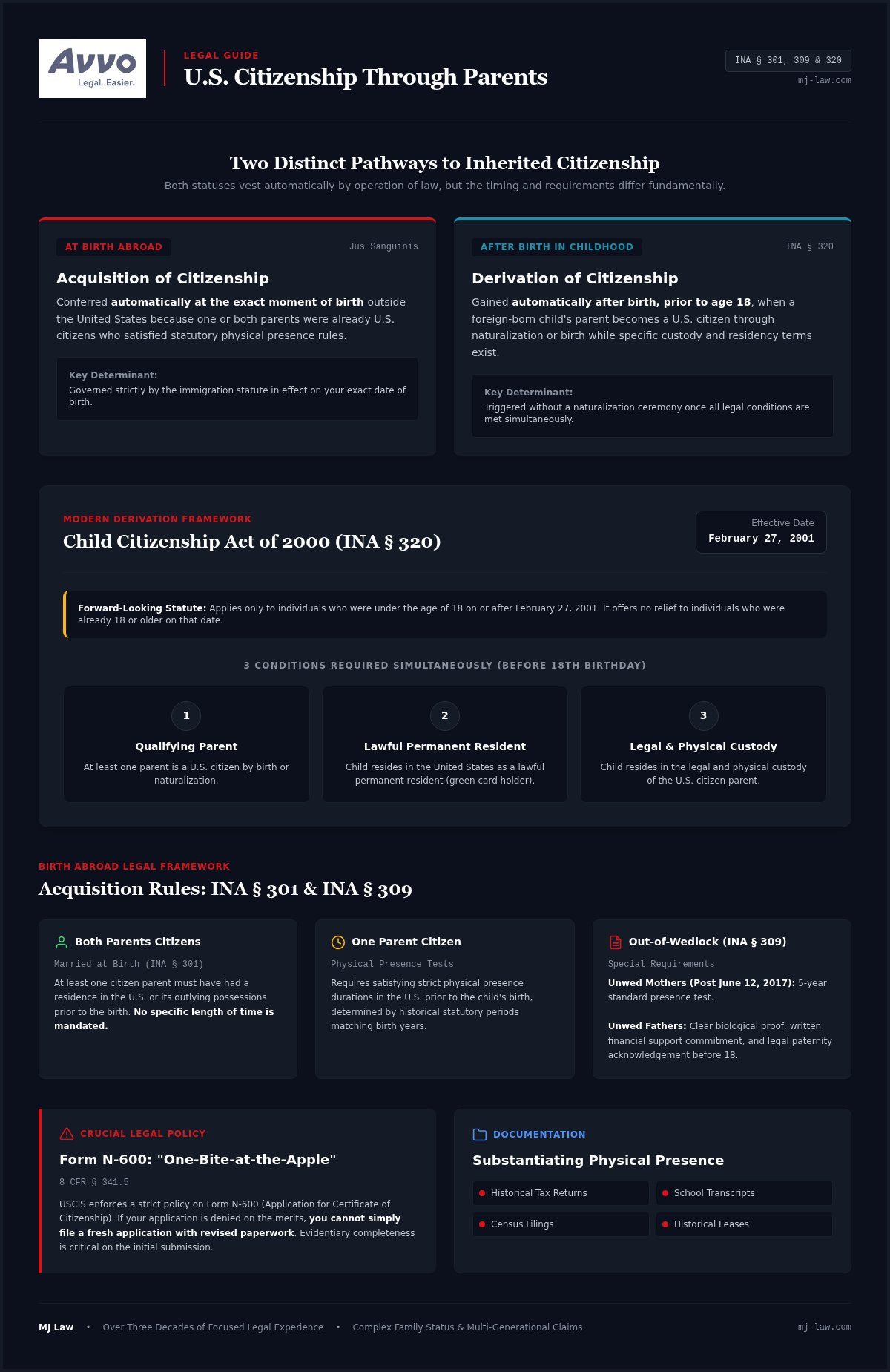
Immigration law recognizes two distinct pathways for obtaining citizenship through family bloodlines. While both grant the exact same legal rights, confusing the two can lead to rejected filings and prolonged uncertainty. A qualified citizenship through parents lawyer begins by identifying which specific framework governs your life history.
- Acquisition of Citizenship: You receive citizenship automatically at the exact moment of your birth outside the U.S. because one or both parents were already American citizens who satisfied statutory physical presence rules.
- Derivation of Citizenship: You were born a foreign national, but you automatically gained citizenship after birth, prior to turning 18, when your parent naturalized as an American citizen.
Both statuses vest by operation of law. You do not wait for an approval notice to technically become a citizen; the status exists retroactively. However, government agencies, employers, and passport acceptance facilities require tangible legal proof before recognizing those rights. Complicating matters, immigration statutes are not static. The law that governs your case is strictly determined by the exact date and year you were born, meaning decades-old historical statutes dictate modern outcomes.
The Importance of the Child Citizenship Act of 2000
Modern derivation rules changed dramatically with the passage of the Child Citizenship Act of 2000 (codified under INA § 320). Effective February 27, 2001, this statute removed cumbersome administrative barriers for qualifying foreign-born children. Under this provision, a child automatically derives citizenship once three conditions exist simultaneously before their 18th birthday: at least one parent is a U.S. citizen by birth or naturalization; the child resides in the U.S. as a Lawful Permanent Resident (green card holder); and the child lives in the legal and physical custody of that citizen parent. This statute is strictly forward-looking; it offers no relief to individuals who were already 18 years of age or older on February 27, 2001.
Why a Citizenship Lawyer is Essential for Proof
Proving citizenship after the fact presents significant evidentiary hurdles. Self-filers frequently stumble over Form N-600 because USCIS maintains an unforgiving “one-bite-at-the-apple” policy under 8 CFR § 341.5. If USCIS denies your application on the merits, you cannot simply submit a fresh application with revised paperwork. Working with a dedicated citizenship through parents lawyer ensures you avoid fatal evidentiary omissions.
Attorneys meticulously reconstruct historical records, tracing census filings, tax returns, school transcripts, and old leases to substantiate parental physical presence. The team at MJ Law draws on more than three decades of focused experience to assist clients through these intricate evidentiary requirements, providing dependable counsel when navigating complex family reunification and multi-generational status claims.
Acquisition of Citizenship: Were You Born a U.S. Citizen Abroad?
Under American law, citizenship can pass through bloodlines rather than geography. This concept, legally known as jus sanguinis, allows children born outside the country to inherit citizenship automatically at the moment of birth. However, establishing this claim requires far more than showing a parent’s birth certificate. Specific statutory conditions must align precisely before birth takes place.
If both parents were American citizens married at the time of your birth, the statutory hurdle under INA § 301 is straightforward: at least one parent must have had a residence in the U.S. or its outlying possessions prior to the birth. No specific length of time is mandated. The challenge deepens when only one parent is a citizen, triggering strict physical presence tests outlined in the USCIS Policy Manual on Children of U.S. Citizens.
Out-of-wedlock births introduce additional legal layers under INA § 309. Following the Supreme Court ruling in Sessions v. Morales-Santana, children born abroad to unwed American mothers on or after June 12, 2017, must meet the standard 5-year physical presence rule. For unwed citizen fathers, the statute demands clear evidence of a biological relationship, a written commitment of financial support, and formal legal paternity acknowledgement before the child turns 18.
Physical Presence Requirements for Parents
For individuals born on or after November 14, 1986, to one citizen parent and one non-citizen parent, the American parent must have accumulated at least five years of physical presence in the United States prior to the child’s birth. Crucially, at least two of those years must have occurred after the parent reached age 14. Periods of honorable service in the U.S. military or qualifying employment with the U.S. government abroad count as direct physical presence, helping bridge difficult evidentiary gaps.
Changing Laws: 1934 to 2026
Congress has overhauled acquisition requirements repeatedly across the decades. Those born before December 24, 1952, or between 1952 and 1986 face vastly different physical presence benchmarks, such as the older requirement mandating ten years of presence with five after age 14. Identifying the precise statute active on your calendar birthday remains the essential starting point for any valid claim. Retention requirements were historical legal conditions that forced foreign-born individuals to reside in the United States for a specified number of years during early adulthood or permanently forfeit their citizenship.
Unraveling these multi-generational evidentiary puzzles requires methodical precision. If you are uncertain which historical statute governs your family background, consulting a seasoned citizenship through parents lawyer provides clarity. You can schedule a consultation with MJ Law to evaluate your historical documentation and verify your standing.
Derivation of Citizenship: When Parents Naturalize After Your Birth
Legal permanent residents frequently transition into U.S. citizens without ever taking an oath, signing paperwork, or attending a ceremony. This quiet legal shift happens through derivation. Because the transition takes place invisibly by law, many people carry green cards well into adulthood, unaware that they became Americans years earlier. Often, individuals discover their true status only when applying for a first-time passport or attempting to renew a permanent resident card, only for officials to inform them that they may already be citizens. A valid green card remains an absolute prerequisite; derivation cannot occur while a child holds unlawful status or temporary visitor credentials.
Divorce complicates derivation significantly. When parents separate before naturalization, USCIS demands clear proof that the naturalized parent possessed actual legal custody. Adjudicators scrutinize divorce decrees, legal separation agreements, and state child-custody laws to verify who held primary decision-making authority over the minor. Joint legal custody can qualify under prevailing agency guidelines, but contested or poorly documented custody arrangements regularly trigger complex evidentiary challenges.
The Three Pillars of Derivation
To establish derivation under modern statutes, an applicant must demonstrate that three distinct elements converged before their 18th birthday:
- Parental Naturalization: At least one parent naturalized as an American citizen (or both, depending on historical birth rules).
- Age Threshold: The child was under age 18 on the date the parent completed naturalization.
- Residency and Custody: The child resided in the United States as a lawful permanent resident under the legal and physical custody of the citizen parent.
Submitting Form N-600, Application for Certificate of Citizenship officially documents that these criteria were satisfied concurrently.
Derivation for Adopted Children
Foreign-born adoptees fall under specific provisions of the Child Citizenship Act, provided the adoption was finalized before the child turned 16 (or 18 if adopted alongside a biological sibling). Children admitted to the country on IR-3 or IH-3 immigrant visas automatically derive citizenship upon lawful entry because the foreign adoption was fully recognized abroad. Those admitted under IR-4 or IH-4 visas must finalize the adoption or complete domestic readoption procedures before citizenship attaches. Stepchildren do not derive citizenship automatically unless formally adopted. Retaining an experienced citizenship through parents lawyer ensures these delicate custody distinctions are handled accurately. For families in San Jose with complex naturalization cases, early legal analysis prevents costly administrative delays.
Proving Your Status: The N-600 Application and U.S. Passport
Confirming your status requires choosing between two primary documents: a U.S. passport issued by the Department of State, or a Certificate of Citizenship issued by USCIS via Form N-600. While both serve as conclusive proof of nationality, their legal weight differs. A passport offers international travel rights and standard identification, yet it remains subject to revocation and eventual expiration. A Certificate of Citizenship, by contrast, is permanent, never expires, and provides definitive verification for federal agencies and security clearances.
Filing Form N-600 carries unique risk because it represents a strict “one-shot” opportunity. Under federal regulations, USCIS does not permit applicants to refile an N-600 after a denial on the merits. If your filing lacks critical documentation, you cannot simply pay another fee and try again. Your only recourse is filing an appeal (Form I-290B) within a tight 30-day deadline or initiating federal litigation. In 2026, standard government filing fees are $1,335 online and $1,385 on paper, with field office processing timelines ranging from 5.5 to well over 15 months. Ensuring complete evidence from day one protects both your investment and legal standing.
Evidence Checklist for Citizenship Claims
Documenting a family claim requires assembling a compelling evidentiary chain. When primary records like foreign birth certificates are lost, destroyed, or incomplete, secondary evidence becomes crucial:
- Primary Documents: Official birth certificates, parents’ Certificates of Naturalization, and certified marriage licenses.
- Secondary Physical Presence Evidence: Historical school transcripts, residential leases, utility bills, Social Security earnings statements, and U.S. Census records.
- Scientific Substantiation: AABB-accredited DNA parentage testing to confirm biological relationships in contested out-of-wedlock claims.
The San Jose USCIS Interview Experience
While many N-600 applications receive administrative approval on the papers, USCIS officers frequently schedule personal interviews when legal custody or residential continuity remains ambiguous. At the San Jose Field Office, adjudicators closely examine contemporaneous proof of where the child slept, attended school, and received medical care prior to age 18. Applicants benefit from reviewing our 2026 legal prep guide for local interviews to anticipate specific custody questioning.
If you face missing family documents or need strategic representation before federal adjudicators, partner with a trusted citizenship through parents lawyer. You can book a consultation with MJ Law to evaluate your evidence and prepare an airtight filing.
Why Consult a Citizenship Lawyer at MJ Law?
Establishing inherited citizenship requires far more than completing standard government forms; it demands a forensic approach to family history and statutory interpretation. MJ Law has served families across Northern California since 1985. Four decades of focused immigration practice provide a distinct advantage when untangling complex claims involving decades-old documents, unwed parents, or records lost in foreign archives. Having a steady, experienced advocate ensures your family narrative translates into convincing legal proof.
Clear communication is foundational to this process. Our firm provides comprehensive bilingual support in English and Spanish, allowing families to share personal histories and review intricate foreign paperwork comfortably in their preferred language. Because USCIS enforces a strict prohibition against refiling Form N-600 after a formal denial, there is no room for procedural missteps. Retaining a seasoned citizenship through parents lawyer shields you from premature filings, building a solid evidentiary brief before USCIS adjudicators ever review your file.
Navigating Silicon Valley’s Unique Immigration Challenges
Silicon Valley is home to dynamic, international households whose careers frequently span multiple countries. Tech-sector professionals often navigate overlapping legal pathways, whether transitioning family members from temporary statuses or managing cross-border executive relocations through L-1A intracompany transfers. Local experience makes a measurable difference. Our attorneys possess deep familiarity with the San Jose USCIS Field Office, its local administrative culture, and the precise custody standards preferred by Northern California adjudicators.
Your Next Steps Toward U.S. Citizenship
Your journey begins with a methodical eligibility assessment. During an initial legal review, our team traces your family timeline against the specific statutes governing your birth year to confirm whether your status was acquired or derived. MJ Law manages the entire procedure from start to finish: locating certified vital statistics, gathering historical physical presence documentation, authoring persuasive legal memoranda, and preparing you for field office interviews. If you need a reliable citizenship through parents lawyer to confirm your legal standing, take the first step. Schedule a consultation with MJ Law today.
Claim Your Inherited American Status With Confidence
Uncovering inherited citizenship can transform your future, turning years of legal uncertainty into permanent security. Whether your rights stem from acquisition at birth abroad or derivation following a parent’s naturalization, establishing official recognition demands precision. Because USCIS strictly limits Form N-600 adjudications to a single opportunity on the merits, assembling comprehensive secondary evidence and verifying historical physical presence rules from the outset is vital.
You don’t have to decipher decades of changing immigration statutes by yourself. Backed by over 30 years of dedicated legal experience, MJ Law guides families through every stage of documentation and San Jose USCIS representation. Offering compassionate bilingual consultations in English and Spanish, an experienced citizenship through parents lawyer from our firm provides the steady advocacy your case deserves. Take the definitive step toward confirming your rightful status: secure your U.S. citizenship legacy and book a consultation with MJ Law today.
Frequently Asked Questions
Can I get citizenship if only one of my parents is a U.S. citizen?
Yes, you can acquire or derive citizenship through a single citizen parent if statutory criteria are met. For acquisition at birth abroad, the citizen parent must satisfy specific physical presence thresholds before your birth date. For derivation after birth under INA § 320, you must hold lawful permanent residency and live in the legal and physical custody of that citizen parent prior to your 18th birthday.
What is the difference between an N-400 and an N-600?
Form N-400 is an application to become a naturalized citizen, whereas Form N-600 requests formal documentation of citizenship you already hold. Green card holders who do not qualify through bloodlines file Form N-400 and attend an oath ceremony. If you already inherited citizenship automatically through your parents, you don’t naturalize; you file Form N-600 to receive a Certificate of Citizenship proving your preexisting status.
How much does a citizenship through parents lawyer cost?
Legal fees depend entirely on the factual complexity of your family history and evidentiary requirements. Straightforward filings with readily available birth and naturalization certificates require fewer legal hours than complex cases involving foreign archival research, DNA analysis, or contested custody decrees. During an initial consultation at our San Jose office, our attorneys evaluate your family records to outline a transparent, predictable fee structure tailored to your situation.
Can I apply for a U.S. passport without a Certificate of Citizenship?
Yes, you can apply directly for a first-time U.S. passport through the Department of State without holding a Certificate of Citizenship. The passport agency independently adjudicates your citizenship claim based on primary evidence like birth records and parental physical presence proofs. While a passport provides full international travel rights, obtaining an N-600 certificate remains beneficial because it provides a permanent, non-expiring federal record of status.
Does my parent need to have lived in the U.S. for a certain amount of time?
Yes, for citizenship acquired at birth abroad, the citizen parent must satisfy statutory physical presence requirements. If you were born on or after November 14, 1986, to one citizen parent and one non-citizen parent, the American parent must prove five years of presence in the U.S., with at least two years after age 14. For post-birth derivation under current law, no parental pre-birth presence test applies.
What happens if my N-600 application is denied?
Under 8 CFR § 341.5, USCIS strictly prohibits applicants from filing a second Form N-600 if the initial petition was denied on the merits. You cannot simply submit a fresh form with corrected evidence. You must file an administrative appeal via Form I-290B within 30 days or pursue a declaratory judgment action in federal district court, making early legal preparation crucial.
Can I derive citizenship if I am already over 18?
You cannot derive citizenship today if you are over 18, but you can prove that you derived it automatically during your childhood. Derivation occurs retroactively the exact day all statutory criteria align before your 18th birthday. If your parent naturalized while you were an unmarried minor green card holder in their custody, you are already a citizen and may file Form N-600 at any age.
Is citizenship through parents automatic for children born out of wedlock?
Automatic citizenship applies to children born out of wedlock, but specific conditions differ depending on which parent holds citizenship. Unwed mothers must satisfy standard physical presence requirements prior to the child’s birth. Paternal claims require additional steps under INA § 309, such as clear biological proof, written support agreements, and legal legitimation before age 18. Consulting a seasoned citizenship through parents lawyer helps resolve these evidentiary hurdles.