
What if your child’s future in the United States depended entirely on a single birthday? For many families in Silicon Valley, the 21st birthday isn’t just a milestone; it’s a looming deadline that creates immense pressure and fear. You want nothing more than to ensure your child can live, study, and build a life here legally, yet the complex web of USCIS regulations often feels like it’s designed to keep families apart. Partnering with an experienced child green card lawyer San Jose can transform this high-stakes race against time into a manageable, structured process.
We understand that the uncertainty of immigration status can be overwhelming for any parent. You’ll learn the exact steps to secure permanent residency, how to navigate local San Jose USCIS requirements, and the legal strategies needed to prevent your child from “aging out” of eligibility. This guide provides a clear roadmap through the confusion of Adjustment of Status and Consular Processing so you can move forward with confidence and genuine peace of mind.
Key Takeaways
- Understand the legal definition of a child as unmarried and under 21, including how eligibility requirements differ for U.S. citizens and permanent residents.
- Learn how the Child Status Protection Act (CSPA) can effectively freeze your child’s age at the time of filing to prevent them from losing residency eligibility.
- Prepare for local procedural nuances by exploring what to expect during interviews at the San Jose USCIS Field Office on Coleman Avenue.
- Discover how a child green card lawyer San Jose uses comprehensive case audits and strategic planning to navigate complex aging out scenarios.
- Identify the most efficient path for your family by comparing the specific requirements for Adjustment of Status and Consular Processing.
Who Qualifies for a Child-Based Green Card?
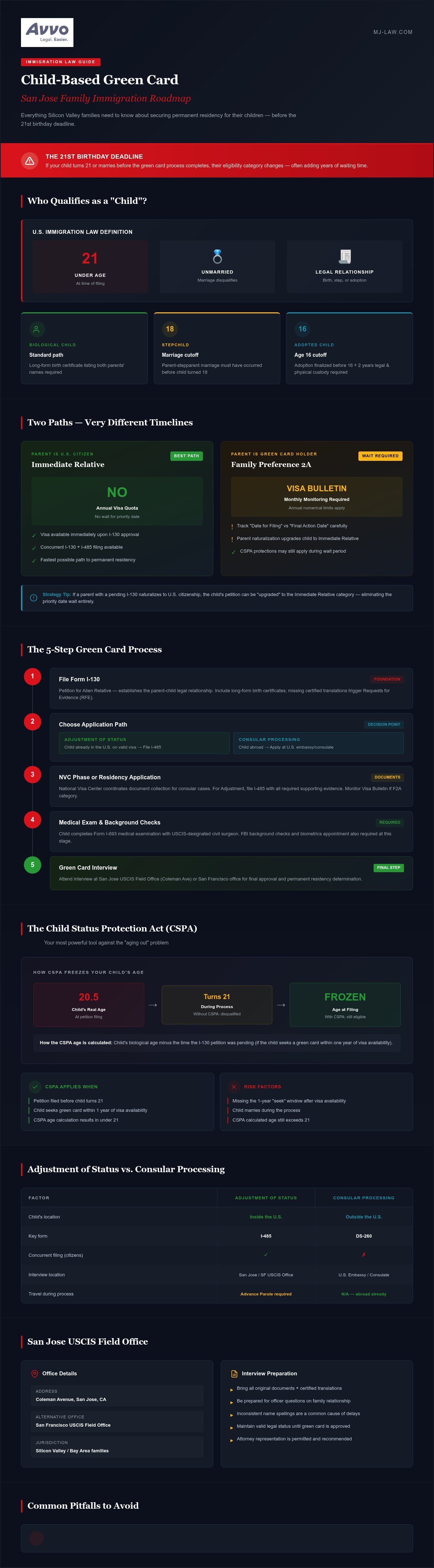
In U.S. immigration law, the term “child” carries a specific legal definition that differs from everyday conversation. To qualify for permanent residency through a parent, an individual must be unmarried and under the age of 21. If they marry or reach that 21st birthday before the process is complete, their eligibility changes instantly, often moving them into a category with significantly longer wait times. Partnering with a child green card lawyer San Jose helps families identify these nuances early to avoid the heartbreak of a denied application due to simple timing errors.
The law also provides pathways for stepchildren and adopted children, though strict timelines apply. For a stepchild to be eligible, the marriage between the biological parent and the stepparent must have occurred before the child turned 18. In the case of adoption, the process generally needs to be finalized before the child reaches 16, and the child must have been in the legal and physical custody of the adopting parent for at least two years. These rules ensure the family bond is legally established before the child approaches adulthood.
Children of U.S. Citizens: Immediate Relatives
Children of U.S. citizens are classified as “Immediate Relatives,” which is the most prioritized category in the immigration system. An Immediate Relative is defined as an unmarried child under the age of 21 who has at least one parent with U.S. citizenship. Unlike other family-based paths, there is no annual limit or visa quota for this group. This means a visa is always available as soon as the initial petition is approved, bypassing the years-long waiting lists that affect other relatives. If a parent is currently a permanent resident but naturalizes while a petition is pending, the child’s case can often be “upgraded” to this category to accelerate the process.
Children of Green Card Holders: Family Preference 2A
When the sponsoring parent is a Lawful Permanent Resident (LPR), the child is placed in the Family Preference 2A (F2A) category. Because these visas are subject to annual numerical limits, families must carefully monitor the Department of State’s monthly Visa Bulletin to see when they can move forward. It’s vital to distinguish between the “Date for Filing,” which signals when you can submit the final application, and the “Final Action Date,” which indicates when a green card can actually be issued. A child green card lawyer San Jose can help you track these shifting dates and prepare for the moment the parent naturalizes, which would move the child into the Immediate Relative category and eliminate the wait for a priority date.
The 5-Step Process to Sponsor Your Child for Permanent Residency
Sponsoring your child for a green card is a structured journey that requires precision at every turn. It isn’t merely a matter of filling out forms; it’s about building a cohesive legal narrative that satisfies USCIS requirements. The process generally follows five distinct steps. First, you file the initial petition to establish the relationship. Second, you determine if the child will apply through Adjustment of Status or Consular Processing. Third, you manage the National Visa Center (NVC) phase or file the residency application. Fourth, the child completes a medical exam and background checks. Finally, you attend the green card interview for final approval. Seeking guidance from a child green card lawyer San Jose ensures you choose the most efficient path for your specific family dynamics.
Filing the I-130 Petition Correctly
The foundation of your case is Form I-130, Petition for Alien Relative. You must provide clear evidence of the parent-child relationship, typically through long-form birth certificates that list both parents’ names. In some complex cases, USCIS may request secondary evidence or DNA testing if primary documents are unavailable or considered unreliable. Common mistakes in local filings often involve inconsistent name spellings or missing certified translations for foreign documents, which lead to frustrating Requests for Evidence (RFEs). Working with a Family Immigration Lawyer San Jose can help you avoid these clerical pitfalls that cause unnecessary delays.
Adjustment of Status for Children Already in the U.S.
If your child is currently in the United States on a valid visa, they may be eligible for “Adjustment of Status” by filing Form I-485. In Silicon Valley, many families of U.S. citizens choose to file the I-130 and I-485 concurrently to speed up the process. It’s vital that the child maintains their current legal status while the green card is pending to avoid complications. If your child needs to visit relatives abroad during this time, applying for “Advance Parole” is essential. Without this travel document, leaving the U.S. could result in the application being considered abandoned. Because every family’s situation involves unique timelines, you might find it helpful to schedule a strategy session to review your child’s specific eligibility before you file.
The medical exam is another critical component. You’ll need to visit a USCIS-designated civil surgeon in the San Jose area to complete Form I-693. This exam ensures the child meets health-related admissibility standards. Once the background checks and biometrics are cleared, the final step is the interview at the San Jose Field Office, where an officer will verify the details of your petition before granting permanent residency.
Protecting Your Child from ‘Aging Out’: The CSPA Explained
The fear of a child “aging out” by turning 21 before their green card is approved is a primary concern for many Silicon Valley families. Historically, if a child reached their 21st birthday while their application was pending, they would lose their eligibility as a minor and move into a category with much longer wait times. The Child Status Protection Act (CSPA) was created to address the inherent unfairness of government processing delays. It provides a legal mechanism to “freeze” a child’s age at a specific point in the process, ensuring that administrative backlogs don’t destroy a family’s chance at staying together.
CSPA doesn’t simply stop the clock for everyone. It uses a specific mathematical formula to determine the child’s legal age for immigration purposes. This “CSPA age” is calculated by taking the child’s actual age on the date a visa becomes available and subtracting the number of days the initial I-130 petition was pending with USCIS. To benefit from this protection, the child must meet the “sought to acquire” requirement, which generally means filing their residency application within one year of a visa becoming available. A child green card lawyer San Jose can help you track these dates with precision to ensure no deadlines are missed.
Calculating the CSPA Age
The level of protection depends heavily on the parent’s status. For children of U.S. citizens, the age is often locked in on the date the I-130 petition is filed, providing the highest level of security. For children of Lawful Permanent Residents, the calculation is more complex because it relies on the Visa Bulletin’s “Final Action Date.” CSPA prevents family separation by allowing children to retain their “child” status even if they physically turn 21 while waiting for a visa to become available. This protection is vital for families in high-demand categories where wait times can fluctuate significantly from month to month.
What to Do if Your Child is Turning 21 Soon
If your child is approaching their 21st birthday and a petition hasn’t been filed, you must act with extreme urgency. In some cases, a parent who is currently a permanent resident may choose to naturalize quickly to “lock in” the child’s age as an immediate relative. If a case is already pending and the child is at risk of aging out despite CSPA protections, we can sometimes request expedited processing from the USCIS San Jose Field Office. Every week matters when a child is near the age limit. If you’re worried about an upcoming birthday, you can schedule a consultation to review your child’s specific timeline and develop an emergency filing strategy.
Navigating the San Jose and San Francisco USCIS Field Offices
The final stage of your child’s journey often leads to the USCIS San Jose Field Office, located on Coleman Avenue. While most families in Santa Clara County will interview here, some may be directed to the San Francisco office depending on current caseload distributions. Each office has its own operational rhythm and processing trends. San Jose generally handles a high volume of family-based cases from the local tech community, making it essential to have a child green card lawyer San Jose who understands the local environment. A local attorney’s familiarity with regional officers and specific document preferences can prevent minor procedural issues from becoming major delays.
Preparing for the Child Green Card Interview
Interview requirements vary based on the child’s age. Minor children are generally required to attend, but the officer’s questions are usually directed at the parents to verify the legitimacy of the relationship. For adult children, the questioning is more direct. Officers often ask about shared history, living arrangements, and family traditions to ensure the parent-child bond is genuine. In cases involving stepchildren, the officer may scrutinize the timing of the marriage and the ongoing relationship between the stepparent and the child. If your case involves a complex family structure, reviewing strategies from a Marriage Green Card RFE Lawyer San Jose can provide valuable insights into how USCIS evaluates blended family dynamics.
Local Logistics for San Jose Families
The San Jose office on Coleman Avenue requires careful planning. Parking is available on-site, but it can fill up quickly during peak morning hours. You should arrive at least 30 minutes before your scheduled appointment to clear security, which involves a process similar to airport screening. Because interviews are scheduled during standard business hours, you’ll likely need to coordinate with your child’s school schedule. It’s often better to plan for a full morning or afternoon away from work and class to account for potential wait times inside the building. If a local officer issues a Request for Evidence (RFE) during the interview, you’ll typically have a specific window to respond directly to the San Jose office. To ensure your interview goes smoothly and your documents are in perfect order, you can book a consultation with our team to prepare your family for the big day.
How a San Jose Child Green Card Lawyer Streamlines Your Case
Every successful immigration case begins with a thorough audit of the family’s history and documentation. A child green card lawyer San Jose doesn’t just fill out forms; they act as a strategic partner who anticipates potential hurdles before they become denials. This audit includes a deep dive into priority dates, CSPA eligibility, and any past entries or exits that might complicate a residency claim. By identifying these issues early, we can develop a strategy that minimizes the risk of a Request for Evidence (RFE) and keeps your child’s case moving forward. For families who are more comfortable discussing these sensitive legal matters in their native language, we offer full bilingual support in both English and Spanish to ensure every detail is perfectly understood.
Why MJ Law is the Right Choice for Your Family
With a 35-year history in the Silicon Valley legal community, MJ Law has established itself as a reliable anchor for families navigating complex federal regulations. Our firm is led by Gabriel Jack and Michael Muston, seasoned experts who provide personalized attention to every case. We don’t believe in a one-size-fits-all approach; instead, we build collaborative relationships with our clients to solve intricate status adjustments. Our long standing presence in the region has given us a deep understanding of local success stories involving complex child status adjustments, particularly those where the clock was ticking toward a 21st birthday. This experience with the local USCIS offices allows us to navigate the system with a level of precision that only comes from decades of practice.
Take Action for Your Child’s Future
Waiting until your child’s 21st birthday is approaching is a risk you don’t need to take. The peace of mind that comes from professional representation allows you to focus on your family’s future while we handle the legal complexities. Securing your child’s residency is one of the most important steps you’ll take to protect their ability to live, study, and work in the United States legally. If you’re ready to begin this process with a steady hand guiding you, schedule your consultation with MJ Law today. Our team is prepared to conduct a comprehensive review of your situation and provide the clear roadmap your family deserves.
Taking the Next Step Toward Your Child’s Permanent Residency
Securing your child’s legal status in the United States requires more than just submitting paperwork; it demands a proactive strategy that accounts for strict age deadlines and local procedural nuances. You’ve learned how the Child Status Protection Act can safeguard your child’s eligibility and why the specific requirements of the San Jose Field Office on Coleman Avenue matter for your timeline. Navigating these federal regulations alone is often stressful, but a dedicated child green card lawyer San Jose can provide the steady guidance needed to protect your family’s future.
At MJ Law, we bring 30+ years of San Jose immigration expertise and the trust of 250+ five-star Google reviews to every case we handle. Our team provides bilingual legal support in English and Spanish to ensure you feel confident at every stage of the process. Don’t let a looming birthday create unnecessary risk for your family. Secure your child’s future—book a consultation with MJ Law today to start building a clear path to residency. We’re here to help you navigate this journey with precision and care.
Frequently Asked Questions
What is the age limit for a child to get a green card through a parent?
To qualify as a “child” under U.S. immigration law, the individual must be unmarried and under the age of 21. If a child marries or reaches their 21st birthday before the process begins, they typically move into a different visa category with much longer waiting periods. It’s vital to file the initial petition as early as possible to ensure your child meets these specific age and marital status requirements.
Can I sponsor my stepchild for a green card in San Jose?
You can sponsor your stepchild for a green card as long as your marriage to their biological parent took place before the child turned 18. Once this legal relationship is established for immigration purposes, the stepchild is treated the same as a biological child. You’ll need to provide both the child’s birth certificate and your marriage certificate to the San Jose USCIS office to prove the relationship qualifies.
How long does the child green card process take at the San Jose USCIS office?
Processing times at the San Jose field office vary based on the current volume of applications and the specific path your family takes. While some immediate relative cases are adjudicated in under a year, others may take longer if there are background check delays or requests for additional evidence. A child green card lawyer San Jose can help you track local trends and provide a realistic timeline based on recent approvals.
What happens if my child turns 21 while the green card application is pending?
If your child turns 21 while the application is in process, the Child Status Protection Act (CSPA) may protect their eligibility. This law uses a formula that subtracts the time the initial petition was pending from the child’s physical age at the time a visa becomes available. However, you must meet specific deadlines, such as the “sought to acquire” requirement, to ensure your child doesn’t lose their status due to government delays.
Can my child stay in the U.S. while the green card is being processed?
Whether your child can stay in the country depends on their current legal status and the filing method. If the child is already in the U.S. on a valid visa and files for Adjustment of Status, they can typically remain here legally while the application is pending. If they are outside the U.S., they must usually wait for their immigrant visa to be issued through Consular Processing before they can enter the country.
Do I need a lawyer for a straightforward child green card case?
While hiring representation isn’t mandatory, a child green card lawyer San Jose provides a layer of security against common filing errors and “aging out” risks. Even cases that seem simple can become complicated if USCIS issues a Request for Evidence or if processing times fluctuate unexpectedly. A professional can conduct a comprehensive case audit to ensure every document is perfect, giving your family peace of mind throughout the entire legal process.
Can I sponsor my married child for a green card?
You can sponsor a married child for a green card, but they’re placed in the Family Third Preference (F3) category rather than the Immediate Relative category. This shift means they’ll be subject to annual visa quotas and significantly longer wait times, which can often span several years. U.S. citizens can sponsor married children of any age, but Lawful Permanent Residents are generally restricted to sponsoring only their unmarried children under current law.
What documents are needed to prove a parent-child relationship for USCIS?
The primary document needed is the child’s long-form birth certificate that clearly lists the parents’ names. For stepchildren, you must also provide the marriage certificate showing the union occurred before the child turned 18. If birth certificates are unavailable, you may need secondary evidence like school records, medical files, or DNA results. You’ll also need to provide proof of the sponsoring parent’s U.S. citizenship or permanent residency status to establish eligibility.