
What if the most important adjustment-of-status decision comes before Form I-485 is filed? For people hoping to get a green card without leaving the United States, eligibility can depend on the basis for applying, immigration history, and other case-specific facts. An adjustment of status lawyer San Jose families consult can review those facts and help plan the filing, rather than treating the application as paperwork alone.
It’s understandable to want clear answers about whether you can apply from inside the country, how a family petition connects to Form I-485, and what a missing document could mean for your case. This guide explains the adjustment-of-status pathway, common eligibility considerations, and circumstances that call for a closer review.
You’ll also learn how family-based petitions fit into the process and what information to gather before discussing your options with counsel. MJ Law assists individuals and families with immigration matters, with consultations in English and Spanish for the San Jose, San Francisco, and Silicon Valley community.
Key Takeaways
- Adjustment of status lets eligible applicants seek permanent residence from within the United States, while consular processing follows a different route.
- A family petition may provide a basis for applying, but it doesn’t automatically establish that every applicant qualifies to adjust status.
- Entry history, prior immigration filings, and other personal circumstances can affect eligibility and the filing strategy.
- Gather immigration documents, prior applications, travel dates, and relevant family records before discussing your situation with counsel.
- An adjustment of status lawyer San Jose applicants work with can review case-specific facts and help organize the filing approach and supporting evidence.
What adjustment of status means for San Jose green card applicants
Adjustment of status is the process of applying for lawful permanent residence from within the United States. Instead of applying for an immigrant visa through a U.S. consulate abroad, an eligible applicant files for permanent residence while in the country. The two routes have different requirements and steps, and adjustment of status isn’t available to everyone seeking a green card.
In plain English, adjustment of status lets an eligible person apply for a green card without completing the immigrant visa process at a U.S. consulate abroad. USCIS describes Form I-485 as the application to register permanent residence or adjust status. For a broader overview of the concept, see What is Adjustment of Status? The key question isn’t just whether someone has a family member who can petition. The applicant must also meet the requirements for their particular route and circumstances.
For residents of San Jose, San Francisco, and Silicon Valley, one point is important: the process is federal, so living locally doesn’t determine eligibility. A careful case review considers the applicant’s history and immigration category. An adjustment of status lawyer San Jose applicants consult can explain how those facts fit together before a filing strategy is chosen.
Who may consider adjustment of status through family immigration?
A qualifying family relationship may allow a U.S. citizen or lawful permanent resident to file an immigrant petition for a relative. Marriage-based cases are a familiar example, but marriage alone doesn’t guarantee that the other spouse can adjust status. The petitioner’s eligibility to file and the applicant’s eligibility to submit Form I-485 are related but distinct questions.
An approved or pending family petition can establish or support an immigrant basis, but it doesn’t by itself satisfy every I-485 requirement. The applicant’s manner of entry, immigration history, and other case-specific factors may affect whether applying from within the country is an option. Family sponsorship is an important starting point, not a complete eligibility assessment.
What does Form I-485 do?
Form I-485 is the applicant’s request to USCIS to become a lawful permanent resident from within the United States. In a family-based case, the petitioner may file Form I-130, Petition for Alien Relative, to establish the qualifying relationship. The forms have different purposes: Form I-130 concerns the family relationship, while Form I-485 is the applicant’s request for permanent residence.
Depending on the category and current rules, the forms may be filed together or at different times. The right sequence depends on the individual case, so a family petition should not be mistaken for the green card application itself. This overview of the family immigration process in San Jose explains where a petition fits; a case-specific review can help determine whether adjustment of status is an appropriate next step.
How the San Jose adjustment-of-status process moves from petition to decision
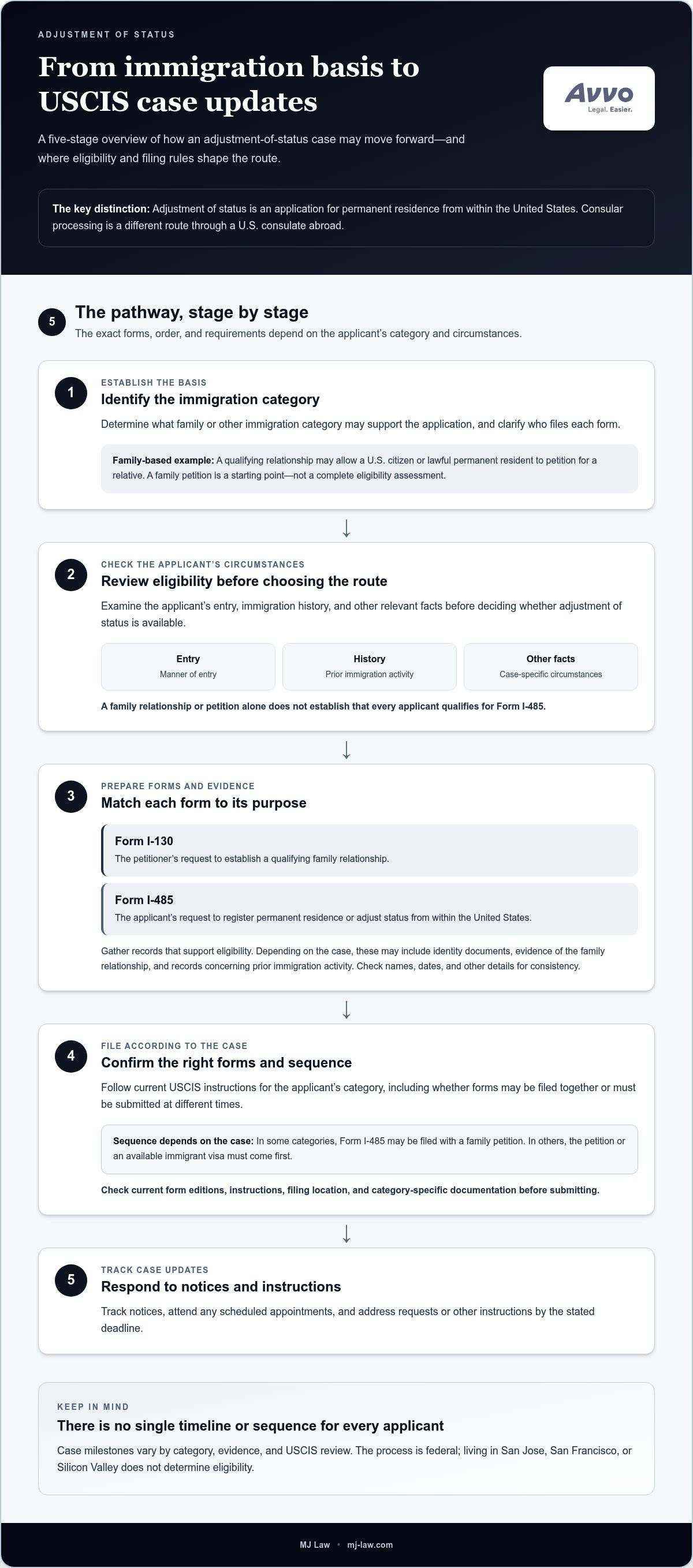
Although each case has its own details, the process generally moves through a series of decisions and filings. A family petition may be part of the pathway, but the applicant’s category and current USCIS rules determine which forms can be filed and when. A careful sequence helps align the application with the applicant’s eligibility and supporting records.
- Assess the basis. Identify the family or other immigration category that may support the application and clarify who files each form.
- Review eligibility. Examine the applicant’s entry, immigration history, and other relevant circumstances before deciding whether adjustment is an available route.
- Prepare forms and evidence. Complete the required forms and gather records that support the eligibility claims. Check names, dates, and other details for consistency across documents.
- File the application. Follow current USCIS instructions for the applicant’s category, including whether forms may be filed concurrently or must be submitted in sequence.
- Respond to case updates. Track notices, attend any scheduled appointments, and address requests or other instructions by the stated deadline.
Case milestones vary by category, evidence, and USCIS review, so no single timeline or sequence applies to every applicant. That is especially important when considering concurrent filing. In some categories, an applicant may file Form I-485 with a family petition; in others, the petition or an available immigrant visa must come first. The correct approach depends on the case and current filing rules, not simply on a general example found online.
Which forms and supporting documents may be involved?
In a family-based case, Form I-130 is generally the petitioner’s request to establish a qualifying family relationship. Form I-485 is the applicant’s request to register permanent residence or adjust status. Supporting records may include identity documents, evidence of the family relationship, and records concerning prior immigration activity. The relevant evidence varies by case, so a sample checklist is a starting point, not a universal filing list.
USCIS updates forms and filing instructions. Before submitting an application, confirm the current form editions, instructions, filing location, and category-specific documentation using Official USCIS Adjustment of Status Information. An adjustment of status lawyer San Jose applicants consult can help organize the record and identify inconsistencies before filing.
What can happen after an application is filed?
After filing, USCIS may send a receipt notice acknowledging that it received the application. The agency may also issue biometrics instructions, request additional evidence, or schedule an interview. These are possible milestones, not steps every case necessarily follows. Read each notice promptly, keep a copy, and follow its instructions and deadlines. A response to a request for evidence should address the specific issue USCIS identifies and include relevant supporting records.
Processing estimates can change and don’t predict when an individual case will be decided. Check USCIS’s current processing-time information for the relevant form and office, then consider it alongside the case’s own status. If you have questions about a filing sequence or USCIS notice, you can discuss your adjustment-of-status case with MJ Law.
Eligibility concerns that can change an adjustment-of-status strategy
A qualifying relative can be an important part of a green card case, but the relationship alone doesn’t mean the applicant can adjust status. The applicant must meet the requirements for the relevant category and address any separate eligibility or admissibility concerns. As the Legal Definition of Adjustment of Status helps explain, adjustment is a process for applying for permanent residence from within the United States. Whether it is available in a particular case depends on the governing rules and facts.
These common factors can shape the review. None should be treated as a standalone yes-or-no test.
| Case factor | Why it matters |
|---|---|
| Qualifying basis | The family relationship or other immigration category must support the requested benefit, and the applicable category determines the requirements. |
| Manner of entry | How the applicant entered the United States may affect the adjustment analysis, subject to applicable rules and exceptions. |
| Immigration history | Prior applications, periods without lawful status, or immigration proceedings may raise issues that require individual review. |
| Possible statutory exceptions | Some exceptions may affect how a rule applies, but their availability depends on the precise facts and legal requirements. |
How entry and immigration history may affect the analysis
Entry history can influence whether a person may apply from inside the country. A prior removal order, unlawful presence, or a past immigration filing may also affect the analysis, but no single detail should be interpreted in isolation. The relevant law, the applicant’s category, the dates involved, and any available exception all matter.
Be candid about prior proceedings and any concern that information in an earlier application may have been inaccurate or incomplete. These facts can be sensitive, but leaving them out may prevent a lawyer from identifying potential issues before filing. An adjustment of status lawyer San Jose applicants work with can review the record and identify questions to address before choosing a strategy.
When a family petition is not the whole eligibility analysis
A family petition addresses the qualifying relationship; the applicant’s adjustment application involves additional requirements. Depending on the case, admissibility issues or other statutory limits may need review. Visa availability also matters in some family-based categories, so applicants should consult the current Department of State Visa Bulletin and applicable USCIS filing guidance rather than assume that every approved petition allows an immediate I-485 filing.
Marriage-based cases may also turn on the quality and consistency of relationship evidence. If USCIS raises questions about that evidence, the issues may require a focused response; the San Jose marriage green card RFE discussion explores that topic further. Exceptions and potential bars are technical and fact-dependent. A short checklist can flag questions, but it can’t determine eligibility. Review current statutes, USCIS policy, and category-specific instructions with counsel before filing.
Preparing for an adjustment-of-status consultation in San Jose
A focused consultation starts with a clear account of your immigration history and family circumstances. You don’t need to resolve every legal question before the meeting. Organized records and a timeline help counsel identify what is known, what needs clarification, and which next steps may make sense. An adjustment of status lawyer San Jose applicants consult can assess the details in context rather than rely on assumptions or a general checklist.
What information helps an attorney understand your case?
Before the meeting, write down key dates as accurately as you can. Include each entry into the United States, changes in immigration status, prior applications, and important notices or proceedings. Mark dates you’re unsure about instead of guessing. That makes it easier to identify gaps and focus the review.
Gather available records that may help explain your situation:
- Current and expired passports, visas, and other immigration documents
- Copies of prior applications, decisions, receipts, and USCIS or court notices
- A travel history with approximate dates and relevant supporting records
- Family documents related to the petition, such as marriage or birth records
Document needs vary by case, so this is a starting point, not a complete filing checklist. Bring sensitive records directly to your consultation rather than sharing them in a public forum. Be candid about prior applications, proceedings, periods without status, or information that may have been inaccurate. Full disclosure gives counsel a more reliable basis for assessing potential concerns.
What should a useful first discussion clarify?
A first discussion can help identify the potential eligibility basis, facts that remain unclear, records that may be needed, and procedural choices that could affect the case. For example, counsel may need to understand whether a prior filing or travel event changes the questions to address before deciding on a filing approach. The discussion helps organize those issues, but it doesn’t guarantee a particular outcome.
MJ Law offers consultations in English and Spanish for individuals and families in the diverse Silicon Valley community, including San Jose and San Francisco. You can ask how the available information fits together, which documents would help with further analysis, and what steps may be appropriate next. The attorney can explain where the facts support a clearer assessment and where additional review is needed.
Once you’ve gathered your timeline and available records, schedule an adjustment-of-status consultation to discuss your circumstances and possible next steps.
How an adjustment-of-status lawyer in San Jose can guide the next steps
Adjustment of status involves more than completing forms. A lawyer can review the applicant’s circumstances, identify facts that may affect eligibility, and develop a filing approach that reflects the case and the applicant’s goals. That review can clarify which questions need answers before filing and how the available documents fit together.
What legal representation can contribute to case preparation
Careful preparation starts with the full record. Counsel can compare information across applications and supporting documents, flag missing details or conflicting dates, and identify issues that may call for further legal analysis. For example, a difference between a travel date in an old filing and a current account may need to be understood and addressed before forms are submitted.
For a family-based case, legal support may include coordinating applicable forms and supporting materials, reviewing the consistency of the record, and helping prepare responses to USCIS correspondence when needed. The appropriate work depends on the case. A marriage-based green card matter may require attention to both the family relationship and the applicant’s separate adjustment requirements; a family petition alone doesn’t resolve every question.
MJ Law assists individuals and families with family immigration and marriage-based green card matters. The firm has assisted individuals, families, and businesses with immigration matters for over three decades. That experience supports a careful review of each person’s circumstances, without promising approval or faster processing. An adjustment of status lawyer San Jose applicants work with should help them understand the issues, organize the case, and make informed decisions about next steps.
Choosing a clear next step for a family-based case
Each case turns on its own facts and the law that applies to the applicant’s category. An initial discussion can help clarify the possible basis for applying, unresolved details, likely evidence needs, and procedural choices that may warrant further review. It can also distinguish what is already documented from what needs to be confirmed or explained.
Bring a concise timeline and the questions you most want answered. Include relevant dates and be open about prior filings or proceedings, even if you’re unsure how they affect the case. Complete information allows counsel to assess the situation more meaningfully. A consultation can identify issues for further analysis, but no review can guarantee a particular result.
MJ Law offers consultations in English and Spanish for the San Jose, San Francisco, and Silicon Valley community. If you’re considering a family-based adjustment case, you can book a consultation with MJ Law to discuss your circumstances and possible next steps.
Take a considered next step toward your green card
You don’t need to have every answer before seeking legal guidance. Bring your questions and the details you do know into a conversation where they can be reviewed in context. A thoughtful discussion can help you understand which issues need attention and what a practical path forward may involve.
Working with an adjustment of status lawyer San Jose applicants trust can make it easier to approach the process with a clear, case-specific plan. The goal is to understand your options and make informed decisions about how to proceed, not to assume the outcome.
If you’re ready to discuss your circumstances, schedule a consultation with MJ Law. A clear first conversation can help you understand what comes next.
Frequently Asked Questions
Can I apply for adjustment of status if I entered the United States without inspection?
Possibly, but entry without inspection can create a significant obstacle to adjustment under the standard pathway. Some applicants may qualify under a specific exception or a different provision, depending on their immigration category and complete history. Prior entries, departures, petitions, and proceedings can all affect the analysis. Don’t rely on a family relationship alone to decide whether you can file. Have an immigration lawyer review the relevant facts and applicable law before submitting Form I-485.
Can I travel outside the United States while my Form I-485 is pending?
Leaving the United States while Form I-485 is pending can lead USCIS to treat the application as abandoned unless you have advance parole or qualify for a recognized exception. Before making travel plans, confirm that the required travel document has been approved and is valid for your trip, and review whether any separate status-related exception applies. Advance parole doesn’t guarantee admission at the border. Get case-specific legal advice before departing, especially if you have a complicated immigration history.
Can I work while my adjustment-of-status application is pending?
A pending I-485 doesn’t, by itself, give every applicant permission to work. You may work if you have a valid Employment Authorization Document (EAD) or another independent basis for employment authorization. Some applicants file Form I-765 while their I-485 is pending, but eligibility and filing requirements depend on the circumstances. Check the validity dates and any conditions on your existing authorization before accepting a job or continuing employment, and don’t assume that a receipt notice is work permission.
Does marrying a U.S. citizen automatically give me a green card?
No. Marriage to a U.S. citizen may provide a basis for an immigrant petition, but it doesn’t itself grant permanent residence or automatically satisfy the requirements for adjustment. The couple may need to document that the marriage is legally valid and genuine, while the applicant must meet separate requirements. For example, a marriage certificate establishes that the marriage took place, but it doesn’t alone show the relationship’s full history or resolve other immigration concerns. Review the facts before filing.
Will I have to attend an interview for adjustment of status in San Jose?
Not necessarily. USCIS may schedule an interview or may decide a case without one, depending on its review and the details of the application. If an interview notice arrives, read it carefully for the location, date, required documents, and instructions for anyone asked to attend. Applicants should answer questions truthfully and consistently with their filings. San Jose-area applicants should use the location and directions on the official notice rather than assume which office will handle the appointment.
What happens if USCIS sends a Request for Evidence on my application?
A Request for Evidence (RFE) means USCIS needs specified information or documents before it can continue reviewing the application. Read the notice closely: it identifies what the agency says is missing and gives a response deadline. Submit a complete, organized response that addresses each request and follows the notice’s delivery instructions. Keep a copy of what you send and proof of delivery. If the request raises a legal or complex factual issue, an adjustment of status lawyer San Jose applicants consult can help assess a response.
How long does adjustment of status take in 2026?
There’s no single timeline for every I-485. As of September 17, 2026, the estimated processing time reported for the San Jose field office was 32.5 to 43 months. Treat this as an estimate, not a prediction for your case: category, visa availability, evidence, interview decisions, and other review can affect timing. USCIS estimates change, so check the agency’s processing-time tool for the relevant form and office and follow updates on your own case.
Can I apply for adjustment of status if I overstayed my visa?
Some people who overstayed may still be eligible, but the answer depends on the immigration category and how they entered the United States. Certain immediate relatives of U.S. citizens may be treated differently under adjustment rules than other family-based applicants. An overstay doesn’t resolve separate concerns, such as entry history, prior orders, or possible misrepresentation. Gather your visa and entry records and have the full timeline reviewed before filing, rather than assuming an overstay either automatically disqualifies you or has no effect.